
Reminiscences From The Sands Of Time
The Memoirs of George Henry Hill, Co. B, 13th M.V.I.
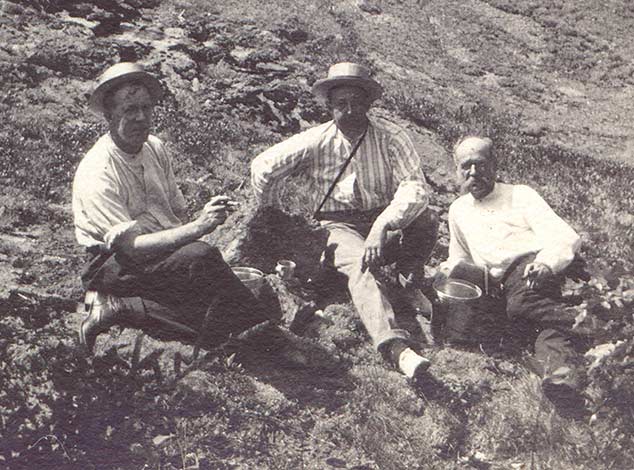
In a happy post-war moment, George Henry Hill, on the right, enjoyes the outdoors with family members
Table of Contents
- Introduction: “Searching For Sergeant Fuller"
- Reminiscences From The Sands Of Time. By George H. Hill
Introduction: “Searching For Sergeant Fuller”By Bradley M. Forbush, May 15, 2026
George Henry Hill’s excellent letters grace this website. His exciting memoir was published in the 13th Regiment Association’s Circular #20, December, 1907. I never had any reason to doubt the accuracy of the details in the story when I first read it over twenty years ago. These were his memories. He lived it. [Corporal George H. Hill, Company B, 13th Mass., pictured.] But last year when I began to research the role the 13th Regiment played in the Battle of the Wilderness certain inconsistencies appeared in the story. And when I tried to identify the soldiers he mentions in his narrative, I ran into some trouble. The most interesting of which proved to be the identity of “Sergeant Fuller” supposedly of the “9th” New York. The first inconsistency I encountered after reading up on the battle, is that George Henry writes he was briefly questioned by General Longstreet shortly after his capture, late in the afternoon of May 5th 1864. General Longstreet did not arrive on the battlefield until the morning of May 6. And, he was seriously wounded and off the field on his way to a hospital in Orange, Virginia by mid-afternoon that day. Also, General Longstreet operated in the southern sector of the battlefield, where as the 13th Massachusetts was fighting in the northern sector of the battle-field, 3 miles distant. If this is just a case of mistaken identity, it is not a crucial detail, other soldiers have made similar mistakes with names in their post-war recollections. He just may have mistaken General Ewell or someone else for General Longstreet. I also wanted to identify the several soldiers George Henry mentions in his memoir before posting it on this website. This helps to bring the story to life and adds a bit of authenticity to the tale. A subscription to the American Civil War Research Database helped to make this task a little easier. I was able to conduct simple name searches and identify several of the boys he mentions. When I did so, I found there were a few additional mistakes with the regiments he designated for these men. So, proceeding, I sought out information on "Billie Crossett," "Henry Klingingsmith," "John Rice," "Jim Trownsell," and "Sergeant Fuller." Hill wrote correctly, that Billie Crossett was a young soldier in the 32nd Massachusetts Infantry. The 32nd fought in the same sector of the battlefield, around Saunders Field, as the 13th MA did, in the early and mid-afternoon of May 5th. In fact the two units were next to each other at one point. Henry "Klingingsmith" and "John Rice" were identified as “Bucktails” from the 11th PA in Hill's memoir. The soldiers of the 13th MA had a long association with the soldiers of the 11th PA; Colonel Richard Coulter’s regiment from Western Pennsylvania. The association began in May, 1862 when the two regiments first came together in George Lucas Hartsuff’s Brigade. They remained in the same Brigade or Division during the rest of their term of service. But the 11th PA weren’t “Bucktails” and Henry Klingensmith, (proper spelling) wasn’t in that unit. Because of his unique name, he was easily identified as a member of Co. G, 40th PA. [The 40th may have worn bucktails, but the true bucktails were the 149th & 150th Pennsylvania Volunteer Regiments.] The rest of Klingensmith’s record matches details in George’s story. He was captured May 5th at the Battle of the Wilderness, and released from Southern prisons, February 27, 1865, the same time as George Henry Hill. After the war Klingensmith belonged to G.A.R. Post #71, Oklahoma City. I could not positively identify John Rice due to
the commonality of his name. The Soldier's Research Database
listed only 1 Pennsylvanian named John C. Rice taken prisoner during
the war, in their records. He was John C. Rice, a buglar in the 5th
Pennsylvania Cavalry, captured at Ream's Station, in August,
1864. I don't know if this is the same soldier in George's story. I found James Trownsell listed as a Corporal in Company F, of the 4th Ohio Infantry. His record states he was born, 1842 in Bristol, England; Son of William Trounsell and Annie Grabb, and married to Miss Mary Woody. Trounsell (listed spelling) was promoted Sergeant October 1, 1862; wounded May 3, 1863 at the Battle of Chancellorsville, and reported missing, May 6, 1864 at the Battle of the Wilderness. The Soldiers Historical Database had no further record after the Wilderness. The source of this information is the Official Roster of the State of Ohio. “Sergeant Fulller” an important character in the story, proved to be an enigma. According to George Henry Hill's memoirs, Sgt. Fuller was captured with George in the woods of the Wilderness on the afternoon of May 5th. They were imprisoned at Andersonville, Georgia, for a while, and then transported by train to Florence Prison in South Carolina. George and Sgt. Fuller made plans to escape from the train en route. George made his escape but Sgt. Fuller did not, and George never saw him again. A record for Everett Fuller found in the Historical Data Systems database pointed me to a likely candidate for George Henry’s friend. The record stated Everett Fuller enlisted as a Corporal, (date unknown) in Company B, 76th New York Infantry. He died of disease, as a Prisoner of War on Sept. 25, 1865 at Florence, South Carolina. The New York Adjutant-General’s Report, 1893-1906 was cited as the source of this information. This record put Everett Fuller in the right place at the right time to be the “Sgt. Fuller” of George Henry Hill’s story. When I found the New York Adjutant-General’s Report, cited as the source for the record above, it stated Fuller was paroled, (no date) and transferred to Co. C, 147th Infantry on January 31, 1865. The full record follows. FULLER, EVERTT. ––Age, 21 years Enlisted, September 21, 1861, at Union Valley, to serve three years; mustered in as private Company B October 4, 1861; wounded in action, August 28, 1862, at Gainesville, Va.; promoted corporal, June 1, 1863; wounded in action, July 1, 1863, at Gettysburg, Pa.; captured in action, May 5, 1864, at the Wilderness, Va.; paroled, no date; transferred to Co. C, One Hundred and Forty-seventh Infantry, on January 31, 1865. I found the 76th New York Infantry Regiment published a regimental history and roster. Following up the N.Y. A.G. Report I found this entry in the roster: FULLER, EVERETT. Wounded at Bull Run and Gettysburg; taken prisoner, and died at Andersonville, November 1864. So far, the two records disagreed, but the reference to Andersonville, fit the George Henry Hill narrative, and the record of death at Florence stated on the Research Database, also matched up. But the actual New York State Adjutant-General's report, did not agree with the information given at the Research Database. There was another soldier in the roster of the 76th NY, Private Jerome W. Frink, whose record caught my eye because alphabetically it was listed near Fuller. Private Frink, was also in Company B, and also captured at the Battle of the Wilderness on May 5, 1864. The description of his service was almost identical to that of Everett Fuller. Frink's record was listed in both the Soldiers Research Database on-line, and the New York State Adjutant-General’s Report. Because Jerome W. Frink was such an unusual name, and because both he and Fuller had similar but incomplete records, I tried to see if I could find anything else out about him on the internet. A human interest article about Private Frink turned up, authored by Vicky House, dated March 6th, 2013, published in The Evening Sun, (Chinengo County’s Hometown Daily Newspaper). It contained this interesting information: “Jerome was wounded July 1, 1863 at Gettysburg and returned to his company only to be wounded and captured May 5, 1864 at the Wilderness, VA. While a prisoner at Andersonville, GA, he was being transported to the stockade in Florence, SC where he died shortly before his discharge date. He was described in his muster roll as having blue eyes, brown hair, light complexion and 5’11: tall. His mother Amelia Frink was able to collect a Mother’s Pension several years after her son’s death. Two soldiers who knew him gave affidavits to support his mother’s claim for a pension. It was then that one soldier stated, “Jerome W. Frink who was a member of Co. B, 76th N.Y. Vol. died and was buried between the railroad and the prison stockade at Florence, S.C, in the month of October 1864 and on or about the 21st of that month.” These details for Frink follow the same narrative of George Henry Hill’s story. From this point in my search I got lucky. There is a well organized website for the 76th New York Volunteers operated by Mr. Mike Brown. For Everett Fuller’s roster entry on this website there was listed this additional information: “Father’s pension application on file in National Archives states he died a prisoner of war at Florence, S.C., September 26, 1864. William Crozier’s affidavit, in the Jerome Frink pension file mentions the death of Everett Fuller at Florence. Regimental History says he died in November at Andersonville.” There was a link to Crozier’s affidavit mentioned in the note above. The Crozier document transcription was provided to the website by Mr. Dick Crozier who was William Crozier’s Great-Great Grandson. Some choice excerpts from this letter follow. “This man Jerome W. Frink was captured at the same time and place I was and went along in same party to Andersonville, Ga., and along about the last of September 1864, was sent along in a party with me to Florence, S.C. “I am certain he was in the same party who went with me to Florence, S.C. I am positive I saw and talked with him at Florence, S.C. I think I saw him between the railroad and the stockade. I think he was not able to walk when I saw him. I think I saw him 2 or 3 times there at different times. “I think when we first arrived at Florence the stockade was not finished and a guard was placed around us. I think it was a week or ten days before I was put in the stockade and kept there. I was run down but I was able to get around. “I saw Lewis H. Fox another member of my company there. He was in bad condition but was able to get around some. He now lives in South Pitcher this county. I do not recall seeing him with Frink at any time there but he was out there with the sick. Everitt Fuller and Amos Minor and Charles Bush of our company was also there. “I do not remember ever having seen Fox inside the stockade but I did see him between the railroad and the stockade in the camp of the sick and disabled. I cannot remember ever seeing Fuller, Minor or Bush inside the stockade. “….I do not know what became of Jerome W. Frink but I heard he had died there. “The last time I saw Everett Fuller alive he gave me his diary to bring home to his Father and that day that Fuller gave me the diary I heard that Frink had died the night before. Fuller died the next day. I saw Fuller after he was dead, but I did not see Frink.” With these details, I now had a soldier who fit the profile of George Henry Hill’s Sergeant Fuller, who Hill encountered wandering in the woods, “hunting for his captain's sword which was lost during the engagement earlier in the day.” I contacted Mike Brown, the 76th NY website owner, in August of 2025, and conversed about George Henry Hill’s memoir and its mention of Everett Fuller. I also mentioned the inconsistencies between the 76th NY Regimental Roster and the New York A.G. report; the former stating Fuller died at Andersonville, the latter had no information beyond his capture May 5. Mike, the webmaster told me the following. “Yes, that’s what the entry on the roster page in my website says. A.P. Smith was the author of the regimental history. He left the regiment (under a cloud, some say) in the aftermath of Nelson Winch Green’s removal as Colonel after an incident when he shot one of the other officers. He became a judge in Cortland, I think, and was active in the regimental reunions after the war, which is probably why he wound up writing the history. It makes an interesting read, but he had little or no contact with the unit while it was in action and I’ve found a number of inaccuracies in it.” PART II: The 76th N.Y. at the Battle of the Wilderness 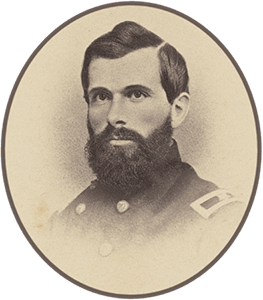
When Everett Fuller first became a candidate for the soldier in George Henry Hill’s story, I checked to see where the regiment was on the battlefield of the Wilderness, May 5th, and what part they played there. Keep in mind, Fuller and Frink, who were both captured, belonged to Company B of the 76th NY. This regiment was in Brigadier-General James Wadsworth’s 4th Division of the 5th Corps; Brigadier-General James C. Rice’s 2nd Brigade. [General Rice, pictured.] They fought over near the Higgerson Farm Field and the woods to the east of it. At the same time I learned this, I was formulating a theory that after the 13th MA crossed the Orange Turnpike, about 4 p.m., May 5th, they moved deep into the woods far to the left of Saunders Field towards ground fought over by Wadsworth’s men earlier in the day. If George Henry Hill’s “Sergeant Fuller” fought here too, it just added more weight to that argument. Private Bourne Spooner’s journal entry for May 5th 1864, actually clinched the proposition for me, when he said there were some dead from a Wisconsin regiment nearby their position in the late afternoon of May 5th. These were more troops from Wadsworth’s Division, Cutler’s Brigade. So what did the 76th NY do? Do their actions support the idea that a scout from the 13th MA might run into a soldier from the 76th NY deep in the woods near the Higgerson Farm in the late afternoon of May 5th? The 76th N.Y. regimental history states, at 7 a.m. the Brigade moved on Parker’s Store road “about 2 mlles then halted, formed in line of battle, and moved through a dense wood …nearly a mile, when it was met by the heavy fire of musketry from an unseen enemy. …A sharp engagement ensued. The Second Brigade …occupied the left flank of the Division.” Picture of the Higgerson Farm 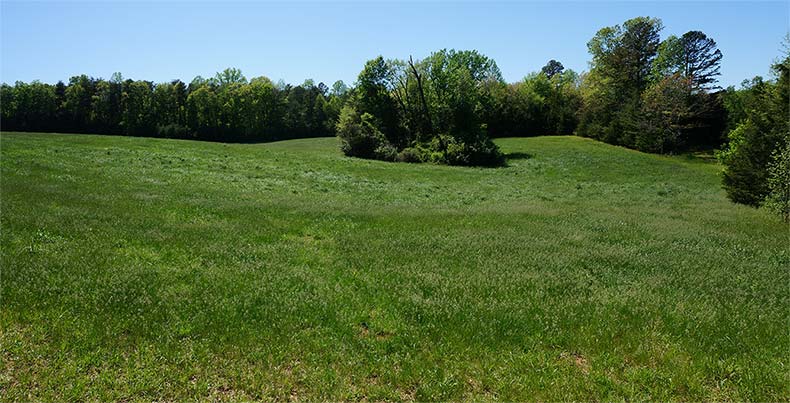 Regimental History cont'd: “Companies B, F, & K, were thrown out as skirmishers to cover the left flank. “They soon reported the enemy to be advancing in a line extending far beyond the left of our forces. Almost simultaneously with this report, the line on the right fell back in disorder, and was followed by this Brigade. The underbrush was very dense, and the men found great difficulty making their way through it. The enemy, still unseen, continued to pour in a very destructive fire. At the end of half a mile the officers succeeded in rallying about 350 men on the crest of a slight eminence, and prepared to hold the position. At this moment, an aid of General Wadsworth arrived, with instructions to move some distance to the rear, where the Division was reforming. Shortly after the skirmishers were sent out they received orders to advance their line two miles, and on arriving at the point indicated, to remain until further orders… “…The skirmishers marched to the required position without meeting any opposition. In a few moments, however, heavy firing was heard on the right, and a skirmish line at least twice as strong as ours appeared in front, and opened a heavy fire. “Our skirmishers, and especially Company B, were in an open field, [Higgerson Farm––B.F.] exposed to the enemy, who were covered by the wood. From this wood the balls came like rain, but not a rebel could be seen. The order was finally given to retreat to another wood about twenty rods to the rear. “The rebels, seeing our skirmishers retire, …rushed out into the open field in pursuit. No sooner, however, had they reached the open space than they received a most destructive fire, which sent them reeling back in disorder to the wood again. They soon rallied and came out again with a rush and a yell of defiance. Again they were received with a galling fire; but though they fell in great numbers, …they kept on until they reached a fence in the middle of the field. A heavy fire was kept up on both sides. Our skirmishers occupied a most dangerous position upon the side of a hill sloping toward the enemy, and though in the wood, there were no trees of very large size, and they were only screened from sight by bushes. Our men were, therefore, ordered back about fifteen rods, to a point more heavily timbered. The enemy advanced to the position thus abandoned. …A portion of the line on the right gave way and before the fact became known to the whole line, the enemy had turned our flank. A portion of Company B was sent out to drive them back, when a severe hand to hand conflict took place, resulting in our favor. When it was ascertained that our skirmish line was broken, a staff officer, who had accompanied the line, started back to learn the state of affairs in the rear. He had not rode over fifty rods, when he found a rebel line in rear of our skirmishers, which fired upon, wounded and captured him…” The rest of this long narrative continues for several pages. After realizing there was an enemy line in both their front and rear, the remnant of the brigade rallied to decide what to do. They assumed the Army was falling back so determined to find a way back to Gold Mills, about two miles distant, where they had camped the previous night. They scouted a trail that seemed clear and came upon a house in a clearing. They persuaded the farmer and his daughter to guide them to the road that would lead them to Gold Mills. When they came to a dirt crossroads, the dubious guide pointed the correct path for them to follow and then returned to his farm house. Regimental History cont'd: “The guide and his daughter had scarcely left, when the detachment came to ground which had that day been burned over, and several dead bodies were strewn about, showing that they were even then upon the battle-field. Advancing a few rods farther the detachment fell into an ambush, and received a volley from a whole rebel brigade. Many fell wounded, among whom was Lieutenant William Cahill, of Company B, wounded in the shoulder, and one arm broken. All the wounded and about half the others were captured on the spot. The remainder broke and ran, but were pursued by a strong force and mostly captured.” Author Gordon C. Rhea in his book The Battle of the Wilderness, succinctly summed up the ordeal of the 76th New York this way: “Rice’s losses were severe. Two of his five regimental commanders lay wounded, along with several lesser-grade officers. The brigade’s skirmish line, consisting of three companies from the 76th New York was cut off from the main body of troops and wandered for hours in trackless forest. Most of the soldiers were either shot or captured, along with their leader.” Everett Fuller must have been one of those poor souls lost in the woods wandering around for hours, when he came upon Sergeant George Henry Hill of the 13th MA. Hill says Fuller said he was looking for his captain’s sword, which was lost earlier in the day. It might be closer to the truth to say that Fuller was shell shocked, from the bad experience he suffered through, and that he was wandering, in a sort of daze through the woods. The evidence seems clear to me, that I had found Hill’s “Sergeant Fuller” from his story. Without further delay, I present George Henry Hill’s exciting memoir. PICTURE CREDITS: All Images are from the LIBRARY OF CONGRESS DIGITAL COLLECTIONS with the following exceptions: Portrait of George Henry Hill, & post war group shot, author's collection via Hill's Descedant, Carol Robbins; Lt.-Col. Charles H. Hovey, & William Blanchard, 13th MA, aauthor's collection; James E. Taylor sketches, "Crowded Car," "Spooning," and "Dead Line" from "Sketches Inside a Confederate Prison, accessed at Historynet.com; "Leaving Andersonville," by James E. Taylor is from Library of Congress; The sepia toned book illustrations were accessed at the internet archive on-line from the book, "Andersonville, a story of rebel military prisons" by John McElroy, 1879; Picture of the raft is by W. H. Shelton, from, "Jeb, a boy's adventures in the army, '61--'65, by Warren Lee Goss, 1889, accessed on-line at the internet archive; Engraving of slaves with Union Soldiers [croppd] is from "Harpers Weekly" accessed digitally from the website, "sonofthesouth.net"; B&W illustration of the Civilian & the Prison Train, [N&CRR] title, "Transporting CIvil War Prisoners," by W. H. Shelton, is from "The Century Collection of Civil War Art" American Heritage, 1974, [I scanned this at twice its thumbnail size]; B&W illustration of aPrisoners at Andersonville Stockade isfrom "Boys of '61" by Charles Carleton Coffin, 1896, accessed digitally at the internet archive; Color tinted illustration of the dead cart is an vignette running along the edges of a large digital graphic map of Andersonville Prison. (I cannot find the link). ALL IMAGES HAVE BEEN EDITED IN PHOTOSHOP. Reminiscences From The Sands Of Time.By George H. Hill The winter of 1863 was passed by the Thirteenth Massachusetts Regiment at Mitchell's Station, Va., where it occupied the position of extreme outpost of the army of the Potomac, in connection with the cavalry, to form a picket guard. The duty was arduous and often exciting. With the vanguard of the army in the memorable campaign which under Grant led up to the glorious victory at Appomattox, we crossed the Rapidan river at Germanna Ford on the fourth day of May, 1864, and became engaged in the Battle of the Wilderness. It is not my purpose to describe the part taken by the Thirteenth Massachusetts Regiment in this battle, or to record acts of heroism of its members, or chronicle its fatalities. Abler hands have written its history and no word of mine can add interest thereto, or give further detail of organized action. Every soldier has an individual history, and thinking possibly a simple story of my experience, after leaving the regiment on that memorable fifth day of May, will be of interest to my comrades, I will, as briefly as possible, tell where I was while the regiment was following Grant to victory. At about 4 o'clock in the afternoon, during a lull in the battle, which had been raging fiercely all day with apparently small results for either side, our regiment was moved by the left flank some half mile and faced to the front. It was apparent that no skirmish or picket line was between us and the rebel force. Colonel Hovey, [Lt.-Col.Charles H. Hovey, pictured below] then in command of the regiment, called for volunteers to go forward and ascertain, if possible, the proximity of the enemy. From a number responding to this call, four were detailed to advance cautiously, each taking distance to cover the regimental front, and report back to him. 
As one of this four I had an independent command (myself) and I know nothing of the action or report of the others constituting the detail and have forgotten their names. After advancing some six or eight hundred yards I heard voices and distinguished that it was rebel skirmishers in search of wounded comrades. Returning I reported to Colonel Hovey, who detailed a company of the regiment to deploy and cover our front [Company D] and ordered me to go forward again and bring definite information as to the position of the rebel line of battle. Retracing my steps I passed the place of my former halt and seeing or hearing nothing continued my advance some eighth of a mile, when to my surprise I saw, coming towards me, a man in the uniform of a Federal soldier, unarmed. This proved to be Sergeant Fuller, of the Ninth New York Regiment, [This is actually Corporal Everett Fuller, Co. B, 76th NY––B.F.] who had been hunting for his captain's sword which was lost during the engagement earlier in the day. Surprised that he had found no rebels in front, I insisted that he should go back with me, and together we cautiously advanced until within hearing distance of the rebel skirmish line. Listening for some time to their conversation, we learned that they were as ignorant of the whereabouts of our line as we of theirs, and that they, like us, were waiting to be attacked, and then, on our hands and knees, we crawled out of harm's way (as we supposed) toward our line. The wilderness ! Who that was ever there needs reminder of the dense foliage and undergrowth through which we struggled-impenetrable at times except by little narrow paths made by feet smaller than those of man. Feeling secure that we had left our enemy behind and would find only friends in front, we boldly followed one of those little paths, until, turning an abrupt angle, we came face to face with four full-fledged “Johnny Rebs,” whose leveled muskets touched our bodies. The far-famed Coon of Davy Crockett never “ down” with better grace than did we as we heard the words “surrender, or we fire.” “Tis easy
in the battle's wrath 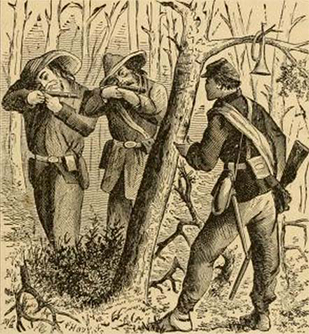
True to the letter; but under these circumstances we were not “heroes” and not “brave enough to bleed,” and so, inwardly cursing our luck and blaming ourselves for over-confidence, we marched back, inside the rebel picket line, which we had such a short time previous left, thinking we were candidates for honorable mention in the Congress of the United States. It was always a matter of dispute between Fuller and myself which was to blame for our capture –– he claiming that but for me he would have safely returned to his regiment, and I, that I would never have gone so far beyond our line but for him. No special attention was paid to us, beyond a few questions by General Longstreet #1 as to what part of our army was in his front, etc., and we were corralled with a large lot of prisoners, previously taken, just back of their field hospital, and were kept awake much of the night by the cries and groans of their wounded, under the agony of surgical operation. Next morning occurred an incident which demonstrates the difference, so marked all through my prison life, between soldiers at the front, whose generosity was so often shown on both sides, and the “hospital beat” and home guard contingent wherever found. While standing near the guard line, talking with a fellow-prisoner, I was accosted by one of the above described hospital attendants thus: “Yank, I reckon I want that hat,” and before I could reply my hat was snatched from my head and from that time until my release, ten months later, I was bareheaded. From the action of our guard it was evident that no victory had been gained for the rebel side, and we were shortly taken to the rear of their line, some ten miles, put on board a train of cars, which evidently had just brought some of their own troops to the front, and taken, through Lynchburg, to Danville, Va. Here we were quartered in a large brick building, evidently a tobacco warehouse, and where we first tasted “home guard” bravery and valor. The sight of a prisoner at a window was sure to bring a shot from one of these brave heroes, and a howl of cheers if any evidence of success attended the exploit. One or two prisoners were hit, none seriously, but we kept away from the windows. During this time we were fairly well fed and, except occasionally, had no cause to complain of harsh treatment. We remained in this place three days, and then by rail, in box freight cars, –– we started south. No stop was made, except to change cars at some station, the name of which I have forgotten (if I ever knew), until we reached Andersonville, Ga. Leaving the cars we were drawn up in line and systematically searched. So faithful was this search that even our mouths were examined, lest some article of jewelry or coin, or greenback, should be secreted beyond their ken. Some, whose shoes were good, were forced to exchange with the guards for theirs, which were nearly worthless, and often even this consideration was denied, and shoes, hats, and coats were taken, leaving the owner nearly naked. At last the large gate was opened and marching past the guard, into a large open space containing sixteen acres, the walls formed by pine logs set end ways into the ground and standing twenty feet high, so close together as to leave no crack between, a sight burst upon my eyes, equaled only by the pictures drawn by old time theologists of the place of torture allotted to the damned. 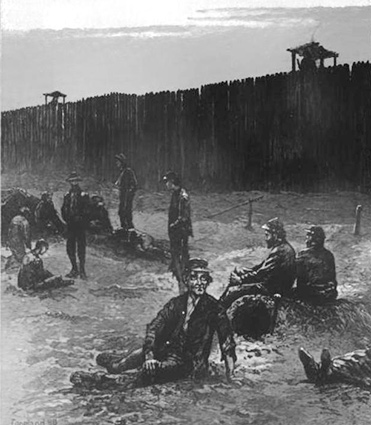
Would to God remembrance of this hell, controlled and rejoiced in by that fiend incarnate, Capt. Henry Wirz, this blot upon humanity, could be erased from our nation's history. To describe the sufferings of its inmates from exposure, starvation and neglect requires greater power than mine. To exaggerate its terrors is an impossibility. No one not actually a prisoner in this “Chamber of Horrors” can form a conception of its reality. The sergeant having charge of squad No. 1 (prisoners were divided into squads of one hundred each), John McElroy, has published in book form a description of life inside the stockade at Andersonville. #2 I pronounce it the most vivid and truthful of any attempt I have ever seen. He knew of what he wrote. Twelve thousand half-clothed skeletons crowded around us, and besieged us with questions of news from home. Except from prisoners entering from time to time, nothing was known inside those walls of union success, while discouraging reports of real or imaginary victories of the rebel army were freely circulated. “Where is Grant ?” “Where is Sherman ?” “Has Charleston been taken ?” “Is there any chance of parole or exchange?” And a thousand other questions, all of which we answered, and all of which we, in turn, asked again and again of each new lot that followed us into this crater of misery and death. Counted off into squads –– for the purpose of drawing rations–– we were directed to assemble each morning at the call of the bugle, and then left to ourselves to find, if possible, an unoccupied spot large enough to lie down upon. Next morning rations were issued for the day –– a piece of corn bread about four inches square, and a small slice of bacon. Twice each week we had in addition half a pint of bean soup, cooked as farmers cook it for their hogs (pods and all). The last part of my stay here, when the number had increased so there were twenty thousand or more, the ration consisted of corn bread alone, and the size was reduced at least one-half. 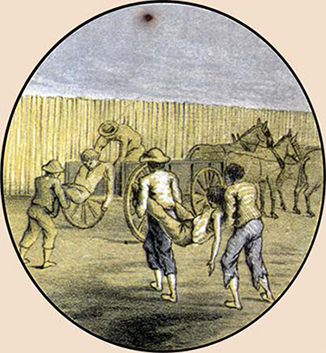
No shelter but the sky –– no bed but the earth –– no cover from the hot sun by day and the heavy dew by night–– exposed alike to rain and sun, there we remained, hoping against hope, revived and encouraged one day by news brought by prisoners of union success, and discouraged the next by the boastful bragging of the rebel guard. Seeing one after another whose acquaintance we had formed sink and die; ourselves reduced to living skeletons; many to idiotic imbeciles; kept alive only by the one hope that the war would end. And let me say here –– among that dying throng not one word of copperhead disloyalty; not one wish for that end to come in any way but with victory and honor to the nation and the flag. Twelve thousand nine hundred men died in Andersonville. Think of it, nearly thirty per cent. of all who entered that prison, gate were buried (most of them in unknown graves) in the cemetery just outside the stockade, while of those that lived at least fifty per cent. were walking skeletons of what we call men. It was here, when it seemed to me we were deserted both by God and by the government we loved so well, and when we had almost abandoned hope, I heard for the first time that song (sung by new prisoners from Sherman's army) to which I never listen, even after so many years, without a thrill of joy left over from that memorable night: “Tramp,
tramp, tramp the boys are marching, 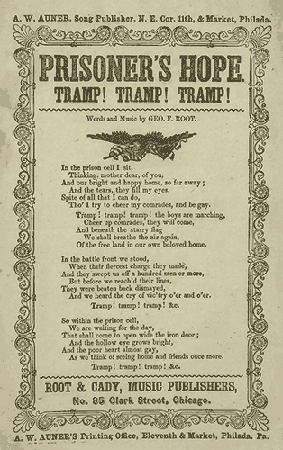 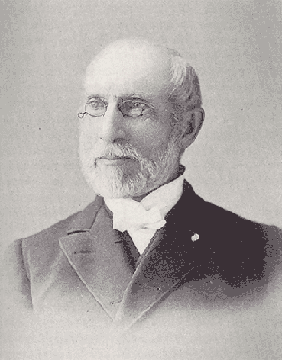 If George F. Root could have seen the joy which came to that throng of helpless, almost hopeless beings, as they crowded around and listened to what seemed to them an inspired message, and could have heard their shouts for repetition, over and over again, he would have felt gratified that at least one of his compositions had received its reward of merit, and that he had made good use of his God-given talent to do good to his fellow-men. [To hear a 2':19" version of the song, click here. ––B.F.] At last Atlanta fell, and victorious Sherman started to rescue the prisoners at Macon and at Andersonville. This necessitated a change of location, and to more safely make this move the report was given out that we were to be sent North for exchange. So many such rumors had come to us which had proved groundless that until the first lot actually left we took but little stock in this one; but when once convinced there came a struggle –– every prisoner anxious to get away, and under such circumstances it is not strange that selfishness predominated to an extent that it became almost a fight for life to get counted into a squad to leave. 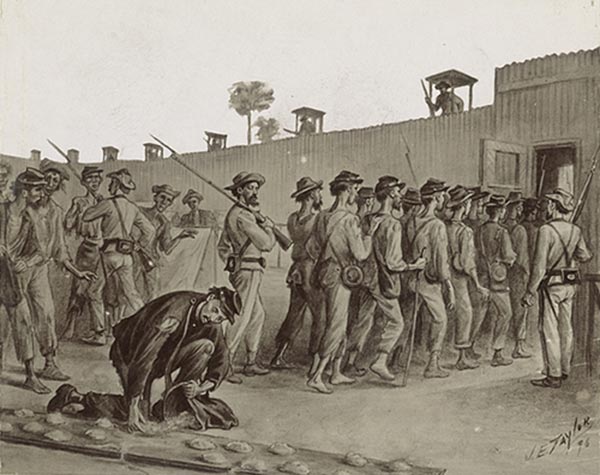 Illustration by James E. Taylor titled, "Leaving Andersonville." Accompanied by Fuller–– between whom and myself had ripened a friendship born from mutual suffering–– I left Andersonville with the fourth lot of five hundred, and after five months in hell was once more out into the world again. Sixty men in each lot, we were put on board a train of freight cars and started, as we believed, for home. At Macon we stopped for wood and water. Rations of corn bread and–– bacon were issued to us, which we were told must last us three days. While stopping here we overheard a conversation between one of our guards and a soldier on the depot platform which dispelled our dream of home we were simply being moved to Florence, N.C., [Florence Prison is in South Carolina––B.F.] where another stockade had been built, and no exchange was contemplated. Turning to Fuller, I declared I would never enter another stockade alive, and together we began to plan our escape from the train, preferring, if necessary, to die by bullet rather than the slower death of starvation or disease which we knew awaited us by further imprisonment. Fortune favored us. At a Junction we changed cars, and noticing one car with rickety flooring, we managed to get in line to count into that particular car. Once inside, we persuaded a young soldier of the 32d Mass., Billie Crossett, to lie down over a large hole, and covering him with our jackets, we insisted he was too weak to stand when our car was inspected by the officer in charge to see if it was properly filled and guarded. 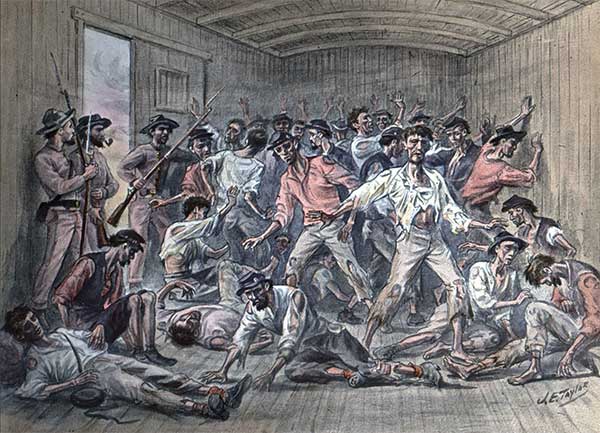 James E. Taylor illustration titled, "Crowded Car." After the train started we began to perfect our plans, taking into our confidence three more of our fellow-prisoners, Jim Trounsell, Henry Klingingsmith, and John Rice, all members of the 11th Penn., the Bucktail Regiment #3 –– We planned to wait until night and then at the first stop after dark to quietly drop down through the hole, lie flat on the road-bed, and take chances of the train passing safely over us. We kept the rest in the car ignorant, even of the hole itself, lest too many would attempt the escape, thereby causing commotion and detection. It seemed as if night would never come, but about sunset we stopped at a small station in South Carolina, called Sumpter, and our car being at the platform, which was crowded with old men, women, and children (at that time every man able to carry a musket was in the rebel army) we overheard the guard on top of the car ask, “How far to Florence?” “Ten miles” was the reply, and our hearts fell, for we knew this was the last stop. It was now or never, and I crawled through the hole, followed by Rice, Crossett, Trounsell and Klingingsmith, and watching our chance when the guard was busy talking to the girls, we slid out between the wheels, under the depot platform, and lay down as close as possible to the building in single file. (For some reason Fuller did not follow, and I never heard of him again.) The train moved on, and there we were. 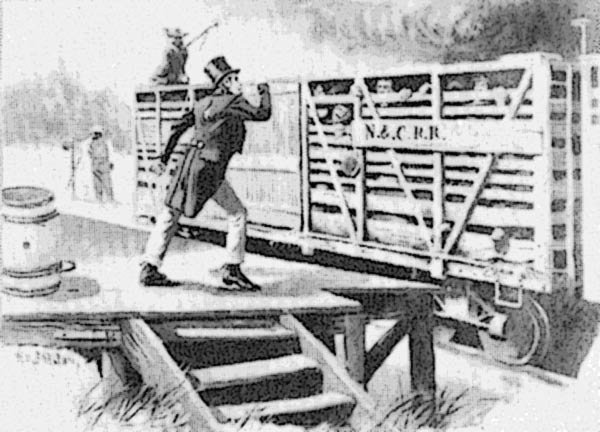
I have stood in the battle front when shot and shell were flying around me and men were falling dead on all sides; have been in that most trying place to a soldier's courage, “the reserve;” have stood on picket, knowing the liability of being pounced upon and shot or strangled, have advanced with the skirmish line in the face of a blazing line of battle and charged in solid column the breastworks of a hidden foe; but never did I experience the feeling of abject helplessness, of mortal terror, of absolute fright, as when that last car passed the platform and left us, subject to discovery by some small boy or girl as they played hide-and-seek around that depot. The fright which the presence of five live yankees would have given that little village meant death to all of us, and we knew it; we dared not speak, we hardly dared to breathe, and when a large sized hog (hogs run wild in that southern village) came rooting at our heads, we dared not drive it off, lest its sudden exit would attract attention to our hiding place. Slowly the twilight gave way to night, the lounging crowd dispersed, and we gained courage to crawl together and plan “what next.” Gradually we worked our way to the end of the building, and then, first Rice, followed in turn by Klingingsmith, Trounsell, and Crossett, passed out into the bright moonlight, across the road, through a gateway, and then by a path over a hill to a clump of trees just outside the settlement, where it was agreed all would wait for me, whom it had been decided was to act as captain of our little squad. The anxiety of superintending the timing of each start, and watching the progress across the village, had so worked upon me that when my time to go arrived I trembled in every nerve and muscle, and as I started across the road my heart stopped beating. It seemed to me that every bush concealed a foe, and every rustling leaf was shouting “halt.” At last I reached the grove, and after a long breath of relief, we all together rushed like frightened sheep across a plain, over a fence, and into a large field of growing corn. Here hunger got the best of our frightened rush, and finding the corn just in the milk, we threw ourselves upon the ground and ate and ate, until the crowing of the cocks and the reddening of the horizon warned us of the coming of the day, and the necessity of finding a safer hiding place. 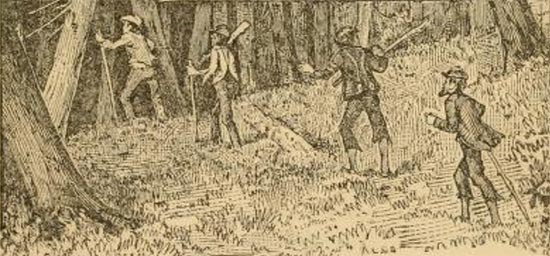
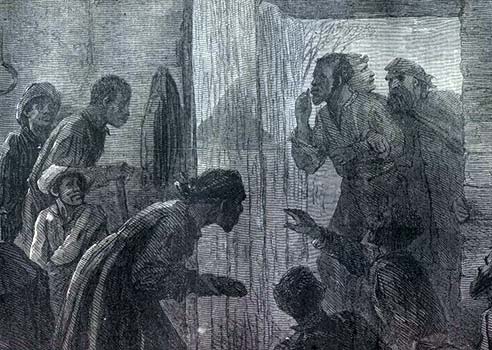
We had now regained our senses and were able intelligently to study our surroundings. A swampy grove, about half a mile away, seemed to offer security and we hurried on and before sunrise were safely sheltered by its dense tanglewood, and all lay down to much needed sleep. Secure in our hiding place, we minded not the dampness or rough underbrush on which we lay, but slept refreshingly until almost night again. We were roused at last by unquenching thirst, and the realization that no food at all was even worse than Andersonville rations–– Digging a hole in the damp ground, we waited until it filled with water from the swampy surface, and, laying on our stomachs, drank our fill, each in turn waiting for a new supply, and ate the tender leaves of growing shrubs around us. We could hear the bells ringing in the village we had left, and concluded it was curfew bed-time, and shortly thereafter we left our friendly cover, and, searching the heavens, found our “pillar of fire,” the north star, whose bright light showed to us the direction we must take to reach the promised land of safety. Before starting out, we had perfected a plan of action which consisted of an Indian file movement across the country, regardless of roads or paths –– North, North, was all we knew. The details of our tramp for the first week of our journey, which began each day at dark and ended at dawn, is uneventful; we avoided all habitations, living on raw corn and sweet potatoes, and hiding during the day in dense woods or dismal swamps. Growing somewhat bolder as we became accustomed to our surroundings, we decided to test the loyalty of the negro, and so drew lots to see what one would risk a visit to some cabin and endeavor to find out where we were and what direction to take to reach our lines, and, not less important, get something to eat. The lot fell to Klingingsmith, and after pledging that in case of betrayal he would insist that he was alone (thus giving us a chance to get away) he left us just as the lights were showing through the windows of what we knew were negro cabins, and with anxious hearts we waited his return. Minutes were hours, for it seemed to us he would never come back, and we had about decided to move off when we heard a low whistle (the signal agreed upon), and he soon appeared, accompanied by four negro slaves, two men and two girls, loaded down with food such as we had not seen since we left our homes, –– ham, cold chicken, cold lamb, hominy, bread, cake, and cheese, and a large pitcher of milk. Great Scott! How we ate, while these angels with black skins rolled their white eyes and showed their whiter teeth, in ecstacy of joy that they could do something for “Lincoln's” soldiers, When we had eaten all we could hold we gathered up the fragments and stored them as best we could among our clothes, hardly daring to believe we would ever get more, shook hands with our faithful servants, and left them waving their hats and aprons in silent encouragement as we disappeared over the hill in the direction pointed out by them as sure to bring us to the “Yankee lines.” After this we never hesitated to make our wants known to man or woman with a black skin, and never was our confidence betrayed. If the negro has no other claim upon the people of this country in his struggle for right and justice, if, in his ignorance, he sometimes falls short of your idea of what he should be, remember his loyalty and faithful service in the war of the rebellion, but most of all, his big-hearted goodness to all union prisoners within his reach. My own experience, in this respect, is precisely that of every soldier who had occasion to ask help of the negro slave, or to put himself into his hands for safety. LET US NOT FORGET IT ! 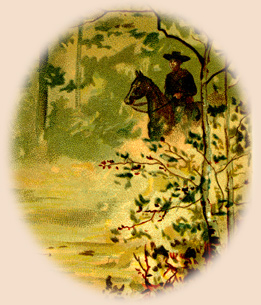
From the information we got from the negroes we now more systematically traveled, using the turnpike roads, which were generally deserted after dark except by an occasional horseman, upon whose approach the one in the lead would quickly dodge out-side the road, which signal was noted by each follower in turn, and so the rider rode peacefully along, little thinking he had passed live yankees on his way. One dark night, Billie Crossett and myself were walking together in the rear (leaving a distance between us and our file leader too long for sight) when directly in our front came quietly walking along a large white horse and on his back a man. Instinctively we threw ourselves out of the road and flat upon our faces, but not before both horse and rider (who proved to be a negro, evidently returning from a visit to a neighboring plantation) had caught a glimpse of us. The horse rose upon his haunches and snorted with fright, and his rider, in the well-known accent of his race, and evidently in equal terror, in a voice low at first but increasing in violence at every word, urged on his trembling steed with, “Go long –– go long–– go long dar–– go long, you damn fool,” and like a streak of lightning away went horse and rider, leaving us nearly as frightened, but unable to repress a laugh as we imagined Sambo relating to his family or friends at home that he had seen a “spook.” It was a lesson to us, however, to be more cautious, and thereafter we kept proper distance while on the road. One day, while waiting in a thick woods for night to come, we were seen by two white boys, who started off on the run. Fortunately, we also saw them, and knew we must move quick and get away from that locality. We struck off towards lower ground and were soon up to our knees in a wooded swamp through which we struggled two miles or more. We were none too quick, for, from the howling of dogs, we knew the dreaded blood-hounds were on our track, and afterwards learned that the boys we saw were sons of a well-known slave hunter who kept a kennel of these savage brutes. These hounds cannot scent through swamps, and we were saved from this danger. But, oh, how we suffered ! No shoes, remember, and at each step roots and stumps raking the skin from off our feet. At last we reached the end of swampy land and came out into solid ground again and lay down completely fagged. 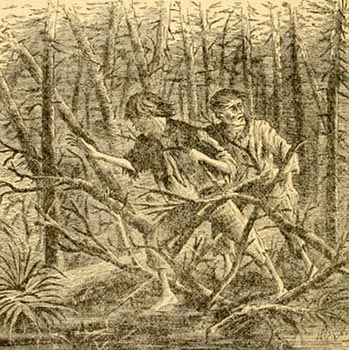
Poor Billie Crossett, the baby of our party, scarcely nineteen years old, was a complete wreck. His feet were raw, he could not stand. We stayed with him one night and two days, hoping he would be able to go on, and then offered to find a safer hiding place and wait again; but heroically he claimed remembrance of the agreement we had made the night of our escape, that “in case either one should become disabled, or a hindrance, the others should leave him and push on to freedom,” and insisted we should do so. We worked him along, as near as we dared, to a large plantation, and left him, with instructions to remain in hiding until the next night, giving us a chance to get a good distance away in case our plan failed, and then to get into communication with our friends, the negroes, whose cabins appeared well separated from the mansion house of the estate. It was like leaving one's heart behind, but we did it, and walked the saddest night's walk I ever knew. We shall meet Billie again before I finish. By the advice of an old darkey who knew the country well we had decided to change our course more to the West, thus reaching, if possible, the territory of Western North Carolina, where we knew roving bands of our troops often penetrated; or, better yet, that hot-bed of union sentiment, East Tennessee. We crossed a railroad which runs between Charlotte and Concord, N.C., camping one day so near the latter place that we plainly heard the rebel bugle call for “reveille” and “retreat,” as we lay concealed, and at last found ourselves stopped by a rushing river, whose swift current made it impossible for us to ford or swim. Again our negro proved his worth. We learned that some two miles below a ferry was run by a black man, and we were assured that he was loyal. We reached this ferry about midnight, too late to cross, and secreted ourselves in a thick woods on the river bank. Next morning-again by lot–– one of our number cautiously approached the grist mill which was operated by the man who owned the ferry, and managed to interview the negro, whose advice was that we wait until night again, when he would put us across and find a trusty guide to pilot us on our way. Delighted at such prospect, I returned to my comrades and found them busy skinning a small pig which they had captured during my absence. Fresh meat was a rarity, and we were hungry, so building a small fire of dry sticks, which we thought would cause but little smoke (by the way, we were furnished with some matches by the negro girls we first met), we were soon eating broiled or toasted pork in fancied security. No festive board, laden with Delmonico's choicest viands, ever gave half the satisfaction that this half-cooked baby pig, eaten without salt or savor, did to those four half-starved mortals in their hiding place near the banks of the Pee Dee river. But it was a costly meat: the smoke of our little fire was observed from the higher ground on the opposite side of the river by a posse of men who were in search of a slave who had run away after a severe flogging. Thinking they had discovered his hiding place, they crossed the river, and, closing quietly around him, as they supposed, were surprised to find, instead, four union soldiers, whose first intimation of their approach was the words, “Surrender, or we fire !” We were captured again, and our dreams of home were shattered. Sitting on the ground with those men –– they were good-natured old men and evidently pitied us –– we tried to convince them that we could do no further damage to their cause and agreed not to take up arms again (knowing our time had expired some months before); but all in vain. The glory of capturing yankee soldiers was too much for them to sacrifice, and we were marched to the ferry and put across by the saddest-faced darkey I ever saw. I think his disappointment was almost as heartfelt as our own. Taken to a plantation we were locked into a kind of a woodshed and left to our meditation. 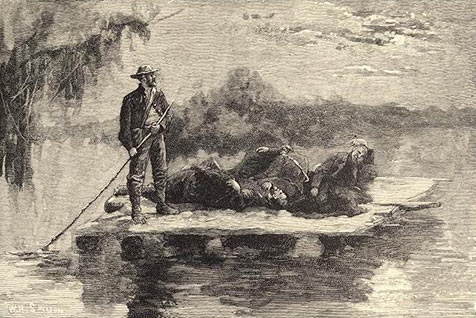
I leave to your imagination the feeling of disappointment which tortured us. It beggars description. We were well fed and, barring the scornful looks of the “women folks,” well treated while here. We were guarded by the men who captured us, each in turn parading in front of the door, until next day when we were taken out and started off, we knew not where. We begged not to be returned to Florence, feeling that any other place was preferable to being again confined with the dregs of Andersonville. The first night, after a journey of about twenty miles, we slept in a jail, in a small village called Albermarle, and such terror did a yankee possess to the women of this quiet place that we were put into a stone cell, entrance to which was so small that we were obliged to crawl through on our hands and knees. We were fairly treated and decently fed, and next morning again on the road. We now learned our destination was Salisbury, N.C., which place we reached at about four o’clock in the afternoon, and were, after eighteen days of liberty, again inside the prison walls. We were the first Federal soldiers to enter Salisbury prison. When we left it, five months later, over twelve thousand had been buried from its confine, and thrice that number had entered through its gateway. 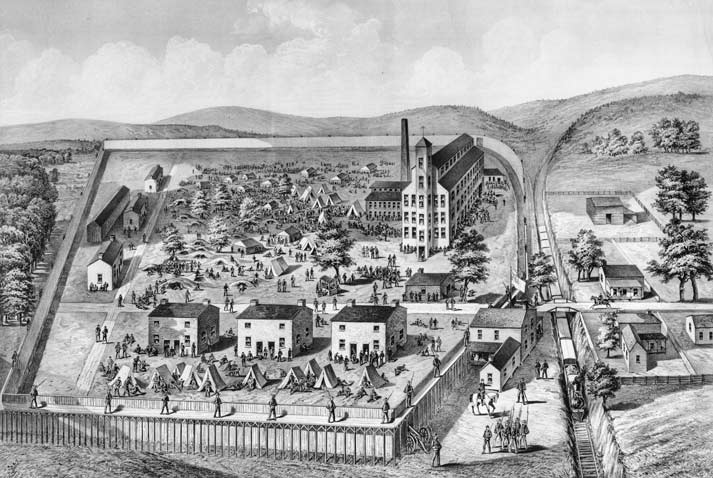 Salisbury prison differed from Andersonville in that it was not remote from a settlement, but on the contrary was directly in the village or town. It had originally been a hospital, and consisted of an enclosure of about one and a half acres, with stone paved yard between the buildings, which formed a square and were six in number –– one large brick building, two stories, used at this time as quarters for deserters and others under sentence from the rebel army, a wooden structure used as a hospital, and four small brick buildings, which may have been used as storehouses. Beyond, or back of these, was an open space, and all of this was surrounded by a high board fence. A platform extended entirely around on the outside of this fence built high enough for the guard to look over and into the yard as they walked to and fro. We were not allowed to enter either of these buildings, but finding a hole leading under-neath the hospital (which set on posts about eighteen inches above the ground) we crawled in and made our home on the dry earth, delighted to find this shelter after our experience at Andersonville. We received rations twice each day, consisting of half a loaf of white bread–– the first we had tasted since our original capture –– and a good-sized piece of bacon, and congratulated ourselves that we were, although prisoners again, better off than we would have been had we gone to Florence. A few days passed, and then prisoners taken from our army–– now in front of Petersburg –– began to arrive in squads of fifty to a hundred or more. Daily the number increased, and although at first the fresh and vigorous condition of the men so recently captured presented a striking contrast to the half-starved associates we had left at Andersonville, the exposure and lack of opportunity for cleanliness soon robbed them of all this, and another crowded den of misery was added to the inhuman record. 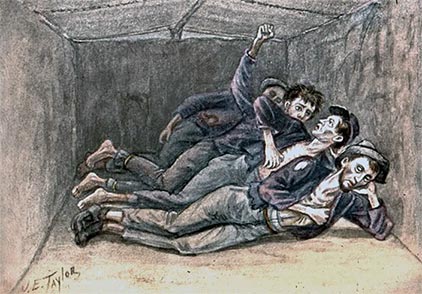
Our retreat under the hospital was quickly filled, and filled so full that we lay at night “spoon fashion,” so close together that it was not possible to turn without first getting general consent of the entire line, as all must turn together, and it was no uncommon thing to hear some one cursing over an apparently obstinate fellow who would not move, and at last hear the exclamation, “This man is dead,” “Well, turn him over,” would be the reply, and so accustomed had we become to death that no further note would be made of it until morning, when he would be dragged out and taken to the dead house (one of the small buildings had been devoted to this purpose), and after being stripped of his clothes left until the old wagon drove in for its daily load. It was cold weather now, rations had been cut down one-half, and but for the extra clothing gotten from the dead we would none of us have lived. No man was buried with clothes on, or with shoes or stockings, in Salisbury. The needs of the living were too great to admit of sentiment, and we were only too glad to “walk in dead men's shoes.” We had water to drink, drawn from two wells, one of which we dug ourselves, but none to waste, so a bath, even of hands or face, was a rarity. One day when we were, as usual, lounging away the time under the house, Klingingsmith, who had gone out by the gate to see what he could hear of news from some prisoners coming in, came rushing out of breath to the entrance and shouted “Hill, Rice, Trounsell, come out here-come out!” Thinking the war was ended, or at least Sheridan had captured Salisbury, we scrambled out and there stood Billie Crossett. Words cannot describe that meeting; we hugged him,
we
kissed him, we
danced around him, we shook him, we hugged him again, while he, poor
baby that he was, cried and laughed with joy at meeting us again. We
gave him all we had to eat and took him into our cave, and that night
the “spoons” were closer than ever, for room had to be made for Billie.
We started tunnel after tunnel, one of which was thirty feet long, three feet below the surface, but the difficulty of disposing of the loose earth taken out brought discovery and defeat. A concerted attempt made one night to break down the fence and overpower the guard resulted in the death of eight, and wounding of twenty of the most daring spirits among us, and the more rigid oversight of the enclosure. Thereafter, any man moving around after dark was shot at without warning, and the most trivial excuse was sufficient to excuse a wound from the rifle of one of the youthful sentinels who now promenaded the platform, twenty feet apart. 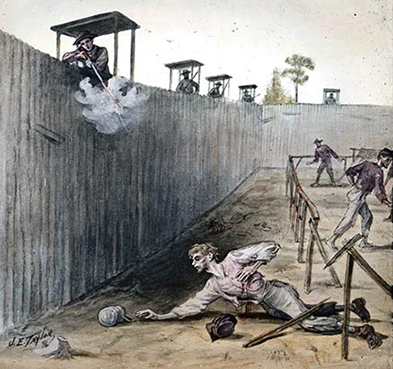
This ended hope of escape, and we settled down to wait for death, or release by victory of our comrades at the front. So passed the winter of 1864. The mortality became fearful. Twice each day the big truck wagon backed up to the dead house and drove away with its load of naked bodies, six or eight deep, with legs and arms hanging over its sides and end, to be buried in a trench outside. No word from home had we received. Tons of letters, I have sinced learned, were sent through our lines, but scarcely a dozen to my knowledge ever reached the prison to cheer those poor fellows starving for news of loved ones so far away. One bright spot there was. Regularly there entered, each day, this pen of misery an old gray-haired, tender-hearted man of God, a catholic priest, whose kind sympathy and hopeful words of encouragement saved many a man from despondency and death. I am not a catholic, but the memory of that holy Father, as he moved in and out among the sick and dying in Salisbury prison, speaking words of hope and comfort, regardless whether to Jew or Gentile, has left an impression on my mind that the lapse of time cannot efface. The triumph of the republican party, and the reelection of Lincoln in November, thus demonstrating the determination of the North to submit to no compromise, was the death-blow of the rebel cause, and the continued victories of our armies, both east and west, news of which came to us through incoming prisoners, encouraged us that the end was near and so we held on to hope that our release was not far distant. About the middle of January rumors of an exchange of prisoners began to circulate around the yard, and on the twenty-fifth of that month the first squad––of which we formed a part––was marched through the gate and put on cars (which were on the track just outside) and started for Wilmington. It was proposed to exchange at Fort Fisher, which place had been captured by General Terry. Our former experience made us suspicious that again this was but a ruse to change our location, and when at Raleigh we were taken from the cars and marched to a grove of trees, and a guard stationed around us, we felt certain that we had been fooled again. Train after train arrived, and each in turn dumped its load of disappointed prisoners and backed away. 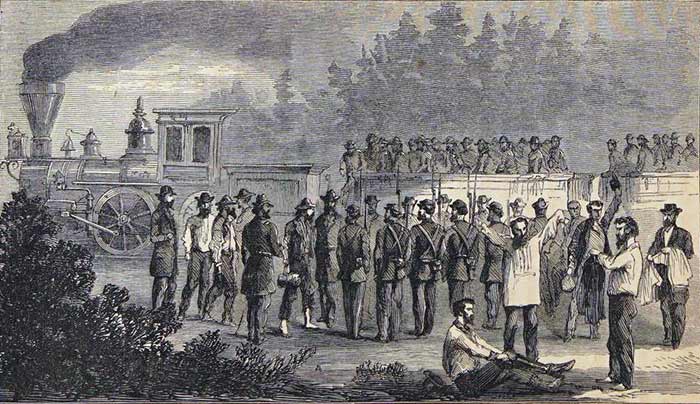 No explanation could we get, but a sort of gloom appeared to settle down upon the rebels guarding us and we knew something was wrong with them, at least. That night watching our opportunity when the guard was down the line, Klingingsmith and I slipped across and deliberately walked into the town. It was about ten o'clock and the streets were nearly deserted. We had read occasionally a copy of the “Raleigh Standard,” which found its way into the prison, and knew that the editor, Mr. Holden, was as near a union man as he dared to show. We were desperate, and determined to find out, if possible, what was to be done with us. Hailing a passing negro we inquired where Holden lived, and soon we stood at the door and boldly rang the bell. The door was opened by a negro girl, and as the light fell upon us she started back, exclaiming : “For de good Lord's sake, what you yankees doing way up yere ?” We asked for Mr. Holden, and she called, “Massa Holden, here be two yankee prisoners done be got away !” and at once a nice-looking, middle-aged man appeared. He asked us in, and when we had explained our motive in coming to him he (without in any way committing himself) informed us that the city of Wilmington had been occupied by federal troops, which necessitated a change of plans as to point of exchange and, on that account, we were stopped at Raleigh to wait for orders, advised us to return to our comrades as the surest way to reach our lines, wished us a safe journey to our homes and friends and then –– evidently to dispel suspicion of his loyalty ––sent us guarded by a negro, to whom he gave a revolver and instruction to shoot us if we attempted to escape, back to camp. We entered where we had left, the sentinel evidently preferring to make no report lest his carelessness in allowing us to get out might get him into trouble. The news we brought (we were careful not to report whom we had talked with) was received with delight by our comrades who, missing us, had concluded we were off again for good. Two days later we again boarded the train and about noon stopped in the open country about three miles away from Wilmington. We were ordered off the train and, as we looked ahead, we saw the engine was just at a fence which crossed the track, and on one side stood a group of rebel soldiers and on the other side an equal number of “officers in blue,” and just beyond on a small knoll we could see a squad of cavalry, one of whom held a staff from which waved an American flag. We moved slowly along, helping those too weak to walk, and as we passed through the line of rebel officers were counted and checked, and then by the Federals, each one receiving from the latter, as he passed, a grip of the hand and a word of encouragement. I can only imagine how others felt. I know how I felt myself. 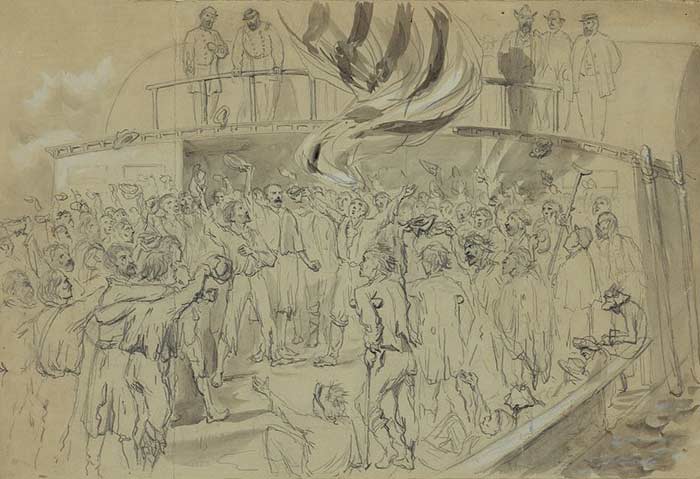 My legs trembled; I could scarcely stand; every drop of blood seemed centered in my heart, and as I passed those rebel officers I could hear the thump, thump, thump, and I held my breath in abject fright lest something in my action should give offence and they should hold me back again. Slowly the prisoners moved along, and at last I was inside the union line. Not daring to look behind, I raised my eyes to the flag and staggered on. Thinking of no one; caring for no one; only wondering if it was true, walking as if in a dream, almost on air, towards the flag; until at last, standing beneath its folds, the blood began to flow again, and again I felt myself a man. Turning now, the pent-up feelings of a soldier's life seemed to come to me as of old, and memories of cruelty and wrong struggled for relief. Sheltered by the emblem of my country's power I almost shrieked in triumph, and then, with failing strength, burst into tears. 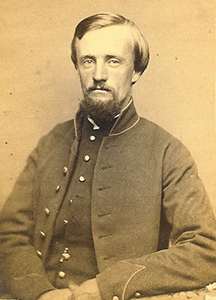
Just then an officer stepped beside me, grasped my hand and threw his arm around my waist, exclaiming, “My God, George Hill, is this possible?” And looking up I saw Bill Blanchard, a private soldier of my own company in the old 13th when I was captured, but now a captain of the 27th U.S. Infantry Colored Troops, and serving as officer of the guard. [William Blanchard, pictured.] Insisting I should go with him, despite my filth and rags, he took me to his tent, furnished me what he called “a lunch,” but what seemed to me a feast; sent to the quartermaster's and “drew” a complete outfit ––hat, shoes, stockings, and underwear–– and took from his own trunk trousers and coat; went with me to a small stream near by and assisted me in ridding myself of the remnants of clothes I wore, and also of the five months' accumulation of confederate soil I carried on my person, and then, arrayed in garments clean, which seemed to me richer than those we read of as being worn by King Solomon, I went with him to the headquarters of his regiment and was royally entertained. Amidst all this a feeling of guilt at apparent desertion of my comrades oppressed me and at last I insisted upon following them to Wilmington. An ambulance was ordered and I rode into the city, found the boys quartered in one of the deserted stores and wondering what had become of “The Captain.” They had all they could eat, but were yet in rags, as no extra clothing was to be found with an advancing army –– my own good fortune being an exception –– but what of that? A happier lot of men you never saw. But little remains to be told. Obtaining a sheet of paper and envelope I wrote to my father, announcing my release, and the arrival of that letter was the first they had heard from me since I was reported “missing in action,” ten months before. It came to them at home like a message from the dead, for they had given up hope that, even if a prisoner, I could have survived the exposure and suffering of which they had heard so much. The joy at home is best imagined; again my powers of description fail. As soon as transports could be provided we were sent north, to parole camp, at Annapolis, and (my regiment having been mustered out six months previous, expiration of term three years) I was, after a week or two doctoring, furnished transportation and ordered to Boston; was honorably discharged from the service of the United States March 26, 1865, and left for my home in Maine. Notes: |
|
© Bradley M. Forbush, 2026. Page Updated June 7, 2026.  |
| |

 We had enough to talk about for the next week, telling him
our
experiences since we left him, nearly two months before, on the edge of
that terrible swamp, and listening to him as he recounted how he waited
a day longer than we asked (so as to be certain sure not to endanger
us) before he made a move; then of his visit to one of the cabins
at
ten o'clock at night, his kind reception by an old negro woman, who
took the shoes and stockings from off her feet and gave them to him to
wear, how she kept him hid for nearly two weeks, bringing others to see
and talk with him, nursing his wounded feet and feeding him with the
fat of the land, until, becoming impatient to follow us –– whom he
imagined safely inside the federal lines –– he insisted upon moving
on;
how then one of them walked with him two nights on the way and left him
then only because a longer absence would excite suspicion and invite
pursuit, how he traveled all alone, with no one to speak to all the
long
nights, and hid all alone all the longer day, until his nerves gave
out, and he felt he must speak to some one or he would be insane;
actually trembling at every rustling leaf, and in imagination feeling
the grasp of his pursuers at every step, he sees a light ahead, and
reaching a house, he staggers to the door and knocks, The door
opens
and there stands an officer in rebel uniform. Who cares, in such
a
state of mind? Not he, and he tells his story. The motley
suit he
wears, furnished by his colored friends, his youthful face, so uncommon
in the Federal ranks –– so common in the rebe army –– discredits his
claim to being an escaped union soldier and he is held as a deserter
from one of the regiments at Raleigh, is taken there and to a dozen
different camps to be identified. At last, convinced that he is
what he claims to be, he is sent, with a lot of newly captured
prisoners, to Salisbury, and while standing in line to be counted,
thinking all the time how hard it was that he could not have kept on
with us to freedom, his hand is grasped by Klingingsmith, and he hears
his name spoken in a voice he knows so well. All this, and more,
he
tells us, and always ends with tears as he repeats how lonesome he had
felt in his travels, and how happy it had made him to be with us
again.
Once more united, we began to plan another escape.
We had enough to talk about for the next week, telling him
our
experiences since we left him, nearly two months before, on the edge of
that terrible swamp, and listening to him as he recounted how he waited
a day longer than we asked (so as to be certain sure not to endanger
us) before he made a move; then of his visit to one of the cabins
at
ten o'clock at night, his kind reception by an old negro woman, who
took the shoes and stockings from off her feet and gave them to him to
wear, how she kept him hid for nearly two weeks, bringing others to see
and talk with him, nursing his wounded feet and feeding him with the
fat of the land, until, becoming impatient to follow us –– whom he
imagined safely inside the federal lines –– he insisted upon moving
on;
how then one of them walked with him two nights on the way and left him
then only because a longer absence would excite suspicion and invite
pursuit, how he traveled all alone, with no one to speak to all the
long
nights, and hid all alone all the longer day, until his nerves gave
out, and he felt he must speak to some one or he would be insane;
actually trembling at every rustling leaf, and in imagination feeling
the grasp of his pursuers at every step, he sees a light ahead, and
reaching a house, he staggers to the door and knocks, The door
opens
and there stands an officer in rebel uniform. Who cares, in such
a
state of mind? Not he, and he tells his story. The motley
suit he
wears, furnished by his colored friends, his youthful face, so uncommon
in the Federal ranks –– so common in the rebe army –– discredits his
claim to being an escaped union soldier and he is held as a deserter
from one of the regiments at Raleigh, is taken there and to a dozen
different camps to be identified. At last, convinced that he is
what he claims to be, he is sent, with a lot of newly captured
prisoners, to Salisbury, and while standing in line to be counted,
thinking all the time how hard it was that he could not have kept on
with us to freedom, his hand is grasped by Klingingsmith, and he hears
his name spoken in a voice he knows so well. All this, and more,
he
tells us, and always ends with tears as he repeats how lonesome he had
felt in his travels, and how happy it had made him to be with us
again.
Once more united, we began to plan another escape.