The Battle of the Wilderness
PART 2; May 6th & 7th, 1864

The first stone in this picture is grave #2532, Lieutenant Josiah Stuart, (also, Joseph Stewart) 13th Massachusetts Volunteers, taken at the Fredericksburg Virginia National Cemetery Luminary Event. He is buried among thousands of comrades. The picture was taken at dusk, Memorial Day 2025. Park Historian Peter Maugle, from his research, identified the grave site for me. For the past several years the park has sponsored this luminary event in conjunction with the Boyscouts.
Table of Contents
- Introduction
- Whats On This Page
- General Henry Baxter's Brigade on May 5th
- Narrative: Alfred S. Roe & Col. Charles Wainwright; May 6th, 1864
- Robinson's Division: Baxter's & Lyle's Brigades on May 6
- Colonel Sumner Carruth's Brigade at the Battle of the Wilderness
- Death of General James S. Wadsworth
- Casualties; 1st & 2nd Brigades, Robinson's Division, 5th A. C.
- May 7, 1864: Moving On
IntroductionThe heavy fighting developed in earnest at the southern sphere of battle along the Orange Plank Road May 6. General Hill’s exhausted Confederates fought valiantly almost to the breaking point on May 5th. It was General A. P. Hill’s best day. When the fighting ended the high command ordered the weary Confederate troops to rest where they lay at night. Their division commanders however, Generals Henry Heth and Cadmius Wilcox, were well aware the troops could not withstand a morning assault without being reformed and their lines strengthened. There was no order or distinctive organization to where they lay. The Generals conveyed their concerns to corps commander A. P. Hill. The lines were mixed up and sprawled “at every angle.” Let them rest as they are was the reply. Generals Hill and Lee were expecting General Longstreet’s corps to arrive in a couple of hours. Not content to let the matter ride, Gen. Wilcox visited Commander Robert E. Lee’s tent. He got the same answer, that Longstreet would be up and Heth and Wilcox’s divisions will be relieved. Let the men rest.#1 But Longstreet had a long road to travel. Between 3 p.m. and sundown on the 5th his command stopped for a well earned rest. They’d marched continuously since 4 pm the previous day, through the night and into late afternoon. A courier traveled there and back to hurry along General Charles Field’s lead division to the battlefield. The reply the courier reported to Robert E. Lee, was the march would resume at 1 am.. Lee had expected Longstreet to be arriving at one o’clock, not starting out from a location 10 miles distant. The courier asked the general if he should return and urge them on sooner? But Lee answered, "it is after 10 o’clock now. By the time you could return to General Field and he could put his division in motion, it would be one o’clock, and at that hour he will move.” #2 Meanwhile, if Gen. Grant’s original orders were obeyed, the Federals would launch an all out assault against Hill at 4.30 a.m. The plan called for 2 divisions of General Burnside's 9th Corps to be in place to plug the gap between Hancock’s 2d Corps and Warren’s 5th Corps when the assault began. Morris Schaff tells the story. Orders to General Burnside: Head Quarters Armies of the
United States, Lieutenant-General Grant desires that you start your two divisions at 2 a.m. to-morrow, punctually, for this place. You will put them in position between the Germanna Plank Road and the road leading from this place to Parker’s Store, so as to close the gap between Warren and Hancock, connecting both. You will move from this position on the enemy beyond at 4.30 a.m., the time at which the Army of the Potomac moves. C.B. Comstock,
“It seems that Burnside came to Grant’s headquarters after the receipt of this order, and then joined Meade. At the close of his interview with Meade and the other corps commanders gathered there, he said, as he rose, ––he had a very grand and oracular air, –– “Well, then, my troops shall break camp by half-past two!” and with shoulders thrown back and measured step disappeared in the darkness. “After he was out of hearing, Duane, Meade's Chief of Engineers, who had been with the Army of the Potomac since its formation, said: “He won't be up ––I know him well!” ––I can see Duane's face, hear his quiet voice, see his hands slowly stroking his full, long, rusty beard, as he says, “He won't be up ––I know him well!” ––And apparently that was the opinion of them all, that he wouldn't be up by 4.30 –-for they knew him well too, and recognized what Lyman says of him, that he “had a genius for slowness.” ” #3 Knowing Burnside’s tendency to be late, Gen. Meade asked Grant to delay the attack until 6 a.m. Grant would only allow a half hour extra time and said 5. At 5 a.m. the attack began. General Hancock’s opening thrusts pushed General Hill’s beleaguered rebels backward. Longstreet had not arrived. (Neither had Burnside). It looked like a Federal victory was within grasp. This was the first of what would be rougly 5 phases of battle during the day. Hancock & Wadsworth’s initial assault and advance which brought success; phase 1. Longstreet’s arrival and counter attack which stymied the Federal advance; phase 2. Then Longstreet’s flank attack about 11 a.m. which collapsed the advanced position of the Union troops. They fell back to the Brock road defense; phase 3. Longstreet’s wounding as he prepared to follow up his success with a second, larger flank attack to be led by General Micah Jenkins. The same friendly fire that wounded Longstreet killed Jenkins. Not knowing Longstreet’s plan’s, and with the afternoon waning, Lee organized a frontal assault. This bloody attack actually breached Federal breastworks along Brock road, which caught fire. But the breach was quickly filled, and the attack fizzled out; phase 4. The battle ended in the Orange Plank Road sector. Many attest that the fighting and sound of musketry surpassed even that of Gettysburg. One example of the severity of the struggle is the Vermont Brigade of General George W. Getty’s 6th Corps. They lost 1,000 men. They were rushed to the Brock Road intersection on May 5th to secure it before the Rebels could get there first. They arrived just in time. General Getty wrote, “In wrestling the possession of the crossing of the Orange Court-House and Brock roads from Hill’s corps, when already occupied by his skirmishers, it is not claiming too much to say, that the Second Division saved the army from disastrous defeat.” #4 The Vermonters advanced west, on the south side of the Orange Plank road until they encountered enemy fire. The Confederates had a stronger position on higher ground behind make-shift breastworks. Visibility was nil. The 3,308 Vermonters got down in the dirt for the little protection they could get, and held the ground until troops from General Hancock’s 2nd Corps arrived to assist. Not only did they take fire from the enemy, but “friendly” artillery fire, firing blindly into the woods from their rear, wounded and killed several of their number. The Vermont Brigade lost one third of their men the first day before retiring to the Brock road defenses. “The action did not end when the troops reached the Brock Road. “Very heavy fighting… without either gaining or losing ground was kept up until after dark,” Getty recalled.” #5 They were ordered in again the morning of May 6th. They had no loss at first, being 2d line of battle, straddling both sides of the Orange Plank Road. When General Wadsworth’s force joined from the north, the brigade was pushed across the road and once again wholly on the south side of it. They suddenly found themselves in the front line again. This time they found a better position, perhaps occupying the works the Confederates held against them the previous day. “It proved to be sufficiently tough resistance that Longstreet embraced the opportunity to launch a flank attack from a railroad cut to break the Union line, rather than continue frontal assaults alone.” #6 The Vermonters took heavy casualties until forced to retire when Longstreet’s flank attack dissolved the troops ¼ mile to their south. One hundred fifty-one of their 947 casualties died from their wounds. Another 96 men were missing, several surely killed. A large stone monument stands silent sentinel to their sacrifice in the lonely woods on the south side of the Plank Road. The Vermont Monument, Wilderness Battlefield  Picture of the Vermont Brigade Monument in the woods on Wilderness National Battle-field. Front face inscription below. The Vermont Brigade In these woods, during
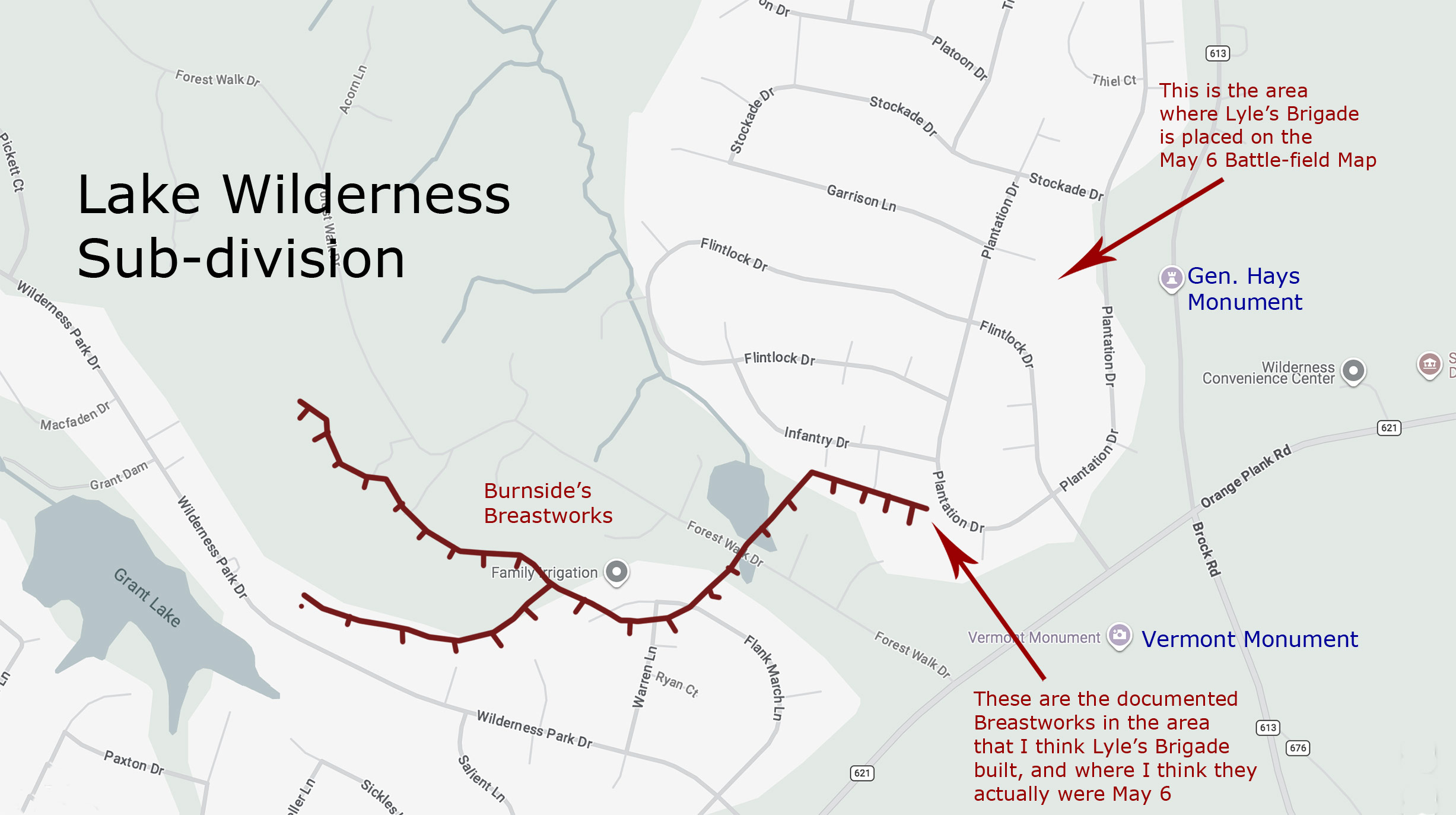
the Battle of the Wilderness Phase 5: The last phase of battle took place 2 miles to the north on the right flank of the Union lines, held by General John Sedgwick’s 6th Army Corps. I quote directly from the National Park Service Trail Map: “Confederate General John B. Gordon spotted an opportunity to assault the Union right flank. Throughout the day he pushed his superiors to act. He finally prevailed, but he rushed against dusk to get the attack in motion. Late on May 6, Gordon’s men stealthily moved north into what is today the Lake of the Woods subdivision. Then, with a rush through the forest, they descended on the Union right flank. “Their line crumbed immediately under our first volley,” wrote a Confederate, “ and I could see them …throwing up their hands and surrendering by scores.” A Union soldier recalled, “It was an awful place, an awful moment… The woods were filled with all kinds of noise.” “…Gathering darkness made it more difficult to keep the attack going. Confederates fired on their own men. Lines became tangled in the woods. As darkness fell, the attack faltered, and Union troops escaped to new lines farther east.” #7 The Rebels captured two brigader-generals during the attack; General Alexander Shaler and Truman Seymour. There was some panic among the 6th Corps officers when the attack began. General Meade remained steady. “Grant carefully attempted to sift fact from rumor. Send reinforcements to the endangered points he directed.” “At the height of the excitement, an officer rushed to Grant and urgently volunteered advice. “General Grant, this is a crisis that cannot be looked upon too seriously,” he warned. “I know Lee’s methods well by past experience; he will throw his own army between us and the Rapidan, and cut us off completely from our communications.” Grant stood, pulled the cigar from his mouth, and spoke his mind. “Oh, I am heartily tired of hearing about what Lee is going to do,” he roared back with unaccustomed heat at the startled officer. “Some of you seem to think he is suddenly going to turn a double somersault, and land in our rear and on both of our flanks at the same time. Go back to your command, and try to think what we are going to do ourselves, instead of what Lee is going to do.” #8 The near collapse of Sedgwick’s corps was the last straw. According to chief of staff Rawlins, Grant met the crisis “outwardly with calmness and self-possession.” When the danger had passed, however, Grant dropped his guard. “He withdrew to his tent, and, throwing himself face downward on his cot, instead of going to sleep, gave vent to his feelings in a way which left no room to doubt that he was deeply moved.” But before dawn broke, the cloud that had settled on him had lifted, and, when... General Wilson, …rode to his headquarters at an early hour, Grant sitting before the door of his tent, said calmly, as Wilson, having dismounted some paces away... started towards him, with anxious face, “It’s all right Wilson; the Army of the Potomac will go forward to-night.” #9 NOTES: Whats On This PageThe inactivity along General G.K. Warren’s 5th Corps front allowed him to send even more re-enforcements to General Hancock’s sector of the battle-field. Colonel Peter Lyle took command of Colonel Leonard’s brigade. The strenuous exertions of May 4th and May 5th took their toll on Leonard’s delicate health. Lyle’s regiment the 90th PA was attached from Baxter’s Brigade. The poor fellows of the 90th suffered terrific loss when they charged across the opening of Saunders Field without support, the previous late-afternoon of May 5th. For some reason, perhaps the jumbled command, (for the rest of their brigade were elsewhere), they went in alone and paid the price for it. Under Lyle's leadership, the brigade went south, took position near the intersection of the Brock road and the Orange Plank road, and started building defensive breastworks. Here Lt. Josiah Stuart of the 13th Regiment was shot in the abdomen by a Rebel sharpshooter. The ball passed over the head of Private Walter C. Thompson before striking into Stuart. Stuart died in hospital at Fredericksburg 4 days later on May 10. The photo of his grave is at the top of this page. The long association between the regiments of Henry Baxter’s Brigade, and the 13th MA inspired me to take a brief look at their actions in the Battle of the Wilderness, for though they also had but a short time left to serve, they participated, as fate would dictate, in harder fighting throughout the Overland Campaign. The first section reviews what Baxter's Brigade did on May 5th, using narratives from two sister regiments, the 12th Massachusetts, and the “Ninth” New York; (83rd N.Y. Vols.). Colonel Richard Coulter, 11th PA, wrote a lengthy, but succinct account of the 2nd Brigades actions during the interval that he assumed command, after General Henry Baxter's wounding on May 6. I have quoted parts of it where appropriate. Next, Alfred S. Roe (39th MA History) and Colonel Charles Wainwright’s combined narratives outline the fighting over the course of May 6 in a very general way, giving a pretty good understanding of what went on from an observer’s point of view. That is especially the case with Colonel Wainwright’s journal entry. He is naturally concerned about the loss of two field pieces from his command on May 5th, and describes his efforts to try to recover the guns which remained in "no mans land" between the opposing forces, unable to be brought in by either side. 
A look at Robinson’s Division on May 6 follows.
Again narratives from the “Ninth”
N.Y. and 12th MA outline Baxter’s fight, accompanied by accounts from
Col. Lyle’s Brigade; including Major Abner Small, (16th Maine) and the
several accounts from the 13th Regiment. (Private Bourne
Spooner’s journal which gave such a detailed account of the 13th
Regiment's
movements on May 5th, remains silent until the 18th of May!).
Once again, there is a disussion about where exactly the regiment
was positioned the afternoon of May 6. I looked for
documentation of historic earthworks in the general area they moved
to. It is important to know because Lt. Joseph Stuart was
mortally wounded there. Because so many of the 13th Mass., commented on seeing old comrades, now in Colonel J. P. Gould’s 59th MA Vols., at the front, I decided to explore in more depth the experiences of Colonel Gould's regiment in the battle. Our old 13th MA correspondent, George Cheney of Roxbury, MA, (formerly in Co. E, 13th MA) shows up again under his pen name ASOF to chronicle the trip to the front for the soldiers in Colonel Gould’s new regiment. He is now a sergeant in Company A, of the 59th. The newly organized Massachusetts Veteran Regiments were a part of Colonel Sumner Carruth’s Brigade, of Burnsides’ 9th Army Corps. A long section, draws upon some excellent source material to outline what these men went through in their first engagement. The primary source is the “War Diary and Letters of Stephen Minot Weld,” Lt-Col. of the 56th MA. The second source is a well researched book of more recent vintage, from which I have amply quoted, titled, “Mother May You Never See The Sights I have Seen,” by author Warren Wilkerson. General James Wadsworth’s death had a big impact on all the former 1st Army Corps comrades, and they eulogized his death in their respective histories. Because Charles Davis, Jr., the 13th MA historian, didn’t really have much to write about in his history for the part played by the regiment during the battle, he devoted a bit of space to eulogize the well liked commander. Davis’s comments are followed by an excerpt of an essay titled, “Through The Wilderness” written by General Alexander Webb, which explains from his perspective how General Wadsworth got himself killed. If the page hasn’t tired out its readers by now, a detailed look at each of the casualties in the 13th Massachusetts Regiment comes next. Though they were light they were significant. I was saddened to learn through the work of Mr. Matthew Sargent of Marlboro, MA, himself a veteran, that the death of 13th MA comrade Theodore H. Goodnow, of Company I, was just one of three brothers, in his family killed in the war. Pictures of the 3 brothers are included. The last section is a short narrative of the beginning of the march south, onward to Spotsylvania, on May 7, where the regiment will play a major roll the next morning, May 8. But until then, we leave them silently passing through dark woods at night, on their way to destiny. A NOTE ABOUT THE MAPS ON THIS PAGE The National Park Service published a beautifully detailed set of six large battle-maps depicting all the estimated troop positions of both armies at crucial times during the two day battle. These maps are numbered 1 through 6 with time references. I have edited close up sections of these maps to illustrate the text in various sections of this page, and numbered my illustrative maps consecutively, as they appear here. My numbers bear no correlation to the Park Service Map numbers. They are not in chronilogical order either. I have referred to the posted maps when necessary, to accompany the various narratives on this page. Readers may find themselves scrolling up or down the page to refer to the correct reference map. This is in part, because the narratives on this page were expanded after the initial design was decided. The scrolling may prove a bit inconvenient, but the maps are an invaluable aid to understanding the text. ––B.F. PICTURE CREDITS: All Images are from the LIBRARY OF CONGRESS DIGITAL COLLECTIONS with the following exceptions: All the photographs were taken by the author, Bradley M. Forbush. The time-stamped detail Maps of the battlefield are from the National Park Service. The color illustration above, the B&W illustration accompanying the commentary after Wainwright's May 6 narrative, and, the color illustration by J.W. Gies, titled, "Flanking the Enemy," are from "Deeds of Valor; how America's heroes won the Medal of Honor," by Walter F. Beyer, & Oscar F. Keydel, 1901-1902; Published by Perrien-Keydel Co., Detroit; The B&W illustration by artist W. C. Jackson, accompanying, Benjamin Cook's 12th MA narrative for May 5 is from, Battle-fields & Victory, by Willis J. Abbot, New York, Dodd, Mead & Co. 1891; The two 'pen & ink' tinted illustrations depicting a charge, and a color bearer, accompanying the section on Carruth's Brigade, are from, "The Boys of '61" by Charles Carleton Coffin, Ests & Lauriat, Boston, 1885; All of the above accessed at the Internet Archive; The pen & ink sketch of a soldier slamming his gun against a tree is by Frederic Ray, from CW TImes Illustrated; Charcoal sketch of soldier struck by a bullet in the same section, is by Winslow Homer, from, "Echos of a Distant Drum" by Julian Grossman, Harry N. Abrams, Inc. New York, n.d.; The B&W Engraved illustrations, "Breastworks of Hancock's Corps," "Capture of a Part of Burning Union Breastworks," "Union Soldiers Building Breastworks," & "Burning Woods" are from Battles & Leaders of the Civil War, Vol. 4, Century Company, 1881.; Portrait of Col. Joseph Moesch, is from “History of the Ninth Regiment N.Y.S.M.––N.G.S.N.Y. (Eighty-third N.Y. Volunteers.) 1845-1888”, by George A. Hussey, Edited by William Todd, 1889. accessed on-line at the Internet Archive.; Portrait of Stephen Minot Weld and two officers of the 57th M.V.I. from his book, 'The War Letters & Diary of Stephen Minot Weld,1861-1865," published privately, accessed on-line at Internet Archive; Portrait of James Wadsworth from, "James S. Wadsworth of Geneseo" by Henry Greenleaf Pearson, NY, Scribners, 1913; Portrait of James Augustus Smith, courtesy of Greg Dowden, Portrait of John Best courtesy of Nancy Martsch, author's collection; Portraits of 13th MA personnel from U.S. Army Heritage Education Center, Carlilsle, PA, MASS MOLLUS Collection; Portraits of the 3 Goodnow Brothers from the Marlborough Massachusetts Historical Society; Portrait of Edward A. Vorra, authors collection, courtesy of Scott Hann. ALL IMAGES HAVE BEEN EDITED IN PHOTOSHOP. General Henry Baxter's Brigade on May 5thThe 13th Mass., was long associated with many of the regiments in General Henry Baxter's 2nd Brigade. The association began in early 1862, and continued when the army re-organized in March, 1864. When the 1st Corps was disbanded, Colonel Leonard's 1st Brigade, and Henry Baxter's 2nd Brigade remained together in tact as part of General John C. Robinson's 2nd Division, which wholly transfered into the 5th Corps, with the same organization. The 12th Mass., the "9th N.Y." and the 11th PA, especially, fought together, or nearly together, at 2nd Bull Run, Antietam, Fredericksburg, Chancellorsville, etc., through the end of their respective terms of enlistment in 1864. The other regiments in these two brigades fought nearby; the 97th N.Y., 90th PA, 88th PA, etc. In May, 1864, the terms of enlistmeent for the 12th MA and "9th N.Y." were about to expire in a couple of months, same as the 13th MA. During the Battle of the Wilderness Baxter's 2nd Brigade followed a different course of action than that of the 1st Brigade, and in this last bloody campaign, as luck would have it, they suffered more severely than the 13th MA. The following brief section outlines Baxter's movements on May 5th. It was cut from the previous page and placed here, where there is more room to include it. George Hussey's (9th New York) narrative gives a good synopsis of the army's activities as the battle unfolded. The first few paragraphs will be sort of a review of the material covered on the previous web-page. On the afternoon of May 5th, Baxter's Brigade was parted out, and marched to the southern portion of the divided battlefield, where it was attached to General Wadsworth's 4th Division of the 5th Corps. They were to plug a gap in the Union lines. The new position in the woods to the north of the Orange Plank Road set them up for the heavy fighting they would participate in the next day. The night of May 5th the 12th MA were put out as skirmishers in front of the brigade line. They lost some men that night and again suffered heavily in the morning attacks that followed, as did the entire 2nd Brigade. General Baxter, their commander, was wounded. History of the 9th New York Militia (83rd N.Y. Vol. Infantry), George A. Hussey The following is from, “History of the Ninth Regiment N.Y.S.M.––N.G.S.N.Y. (Eighty-third N.Y. Volunteers.) 1845-1888”, by George A. Hussey, Edited by William Todd, 1889. Before daylight of the 5th the men were aroused from their bivouac behind their stacks of muskets, and after a hurried breakfast of crackers and coffee, stepped into their places in line of battle. At five o’clock the corps was ordered to move by the let flank towards Parker’s Store. Company H, of the Ninth, were out as flankers for the regiment. At eight o’clock the column was halted, Crawford’s division, in the lead, having encountered the advance of A. P. Hill’s corps near the Chewing [Chewning] Farm, while Griffin and Wadsworth struck Ewell about the same time. [Ewell is on the Orange Turnpike––B.F.] Infantry and artillery were soon engaged, the sound of the heavy guns bringing Generals Grant and Meade galloping to the scene of action. After a hurried view of the situation the troops were formed in line, Crawford’s, Wadsworth’s and Griffin’s divisions forming the first line, with Robinson’s in support. The line was formed across the turnpike, about a mile beyond the [Wilderness] Tavern, with Griffin on the right of the corps. Wright’s division of the Sixth corps was sent to Warren’s right, while Getty’s division of the same corps [Sixth] was ordered into position on Warren’s left and rear, at the intersection of the Plank and Brock Roads, the most important strategic position in the Wilderness.* Badeau tells us that, in an order sent to Meade at half-past eight, Grant said: “If any opportunity presents itself of pitching into a part of Lee’s army, do so, without giving time for dispositions.”** Hancock, then at Todd’s Tavern, on the Brock Road, was ordered to form a junction with the left of Getty’s division. It was near noon before the engagement became general. Griffin’s and Wadsworth’s divisions attacking, and driving the enemy for some distance. [Along the Orange Turnpike. ––B.F.] Owing to the dense woods and underbrush, however, that portion of the Sixth corps on the right of Griffin was not able to advance and cooperate in the attack, and Griffin was finally compelled to fall back. Wadsworth and Crawford were also compelled to retire. The Ninth had been ordered to the support of a battery at the beginning of the battle, but as the Union troops advanced the guns were compelled to suspend firing, for fear of injuring friends as well as foes, and the regiment was then withdrawn to a hollow, where it remained without being exposed to the fire of the enemy. At about half-past four Wadsworth’s division and Baxter’s brigade of Robinson’s, were ordered to support Hancock’s line, which was then hotly engaged with the enemy under A. P. Hill, just west of the Brock Road. The difficulty of marching troops through the Wilderness, except by the roads, was so great, that Wadsworth, who was obliged to make his way through the brush, found darkness closing about him before he reached the position assigned him. But the enemy were pushed back a mile or more before the battle ceased, Baxter’s brigade being in the second line and in rear of the left of Getty. The Ninth suffered no loss, but the Twelfth Massachusetts, occupying a more exposed position, added some fifty-seven to their already large roll of killed and wounded. During the night, the opposing lines were so near each other, that a number of men, searching for water, wandered into each others’ lines and were captured. *NOTES: **Adam Badeau, (1831––1895) was a soldier appointed military secretary to General Grant, achieving the rank of Colonel. He accompanied Grant through the Wilderness to Appomattox. He authored, “A Military History of Ulysses S. Grant,” in 3 volumes, (1867 ––1881). Notes on Badeau are from: “The Biographical Dictionary of America.” I believe the 9th NY were positioned in the Union line where it is here depicted running along side the Orange Turnpike. One of the 39th MA recalls seeing Col. Dick Coulter of the 11th PA in that vicinity on May 5th.  Map #1. Battlefield Positions May 5th about 5 p.m. General Henry Baxter's Brigade of John Robinson's Division was assigned to General Wadsworth's 4th Division in the afternoon and marched to General Hancock's sector of the battle-field along the Orange Plank Road. They will take up a night positon opposite Confederate General Henry Heth's forces as indicated. The 12th MA were sent forward as skirmishers. Here they spent the night. They would engage in the morning attack at 5.30 a.m. The 12th MA lost heavily as did the "9th New York" during the morning battle. Casualites for the brigade are listed below on this page. History of the 12th Massachusetts, Benjamin F. Cook. Benjamin Cook's narrative kind of scrunches the two battle fronts together in a general overview of events. So I inserted some intrusive notes into his text in hopes of clarifying events.––B.F. The following is from, “History of the Twelfth Massachusetts Volunteers, (Webster Regiment)” by Lieutenant––Colonel Benjamin F. Cook, Boston, 1882. May 5. Crawford was instructed to hold on to the plank-road, while Griffin and Wadsworth, supported by Robinson attacked. The enemy were found to be strongly posted. On our right the Sixth Corps gave way, but the rebs kept on the defensive. After losing three thousand men, Warren fell back and formed a new line. [The Sixth Corps wasn't on the field until 3 p.m. after Griffin and Wadsworth had alread attacked and been repulsed. The evening advance of the Sixth Corps also met heavy resistance and fell back to their original line.––B.F.] Wadsworth’s division was sent with our brigade to assail Hill’s flank and rear. [...On the left of the battle-field in the Orange Plank-Road sector––B.F.] After a tiresome march, at about dark, we got into position, and then advanced one mile, firing rapidly. At this juncture some of Company E, which was the right of the line, saw a column of rebs moving to our right to outflank us. Part of the Twelfth changed front to the right, and delivered a destructive fire, which broke the rebel line; but it soon rallied. It was now 8.30 p.m.; and we rested on our arms for the night, so near to the reb skirmishers, that, as Lossing says,”the combatants drew water from the same brook.” Lieut.-Col. Allen, who was serving on Gen. Robinson’s staff, was killed during the day. Total casualties were, ––
Report of Colonel Richard Coulter, 11th PA, Commanding 2nd Brigade Almost after the fact, I remembered Colonel Coulter filed a report on the 2nd Brigade for the days he assumed command. Coulter is a well known figure among the 13th MA veterans, and its nice to have something in his own words. I quote excerpts from it as it applies to each day of the battle, as needed. Report of Col. Richard Coulter, Eleventh Pennsylvania Infantry, commanding Second Brigade, of operations May 3 –– 9. Hdqrs.
Second Brig., Second Div., 5th Army Corps, Sir: I submit the following report of operations of brigade from 3d instant, date of leaving Culpeper, Va., until evening of 9th instant, when brigade was temporarily transferred to Third Division; Midnight 3d instant, brigade (excepting Eighty-eighth Pennsylvania, which had previously been detailed as wagon guard) marched, crossing Rapidan at German Ford, and encamped about 5 miles from ford at 5 p.m. next day. About 11 a.m., 5th instant, enemy were engaged on Fredericksburg and Orange turnpike, near Lacy’s house, by parts of the First and Fourth Divisions. At 1 p.m. brigade ordered to support those engaged who had been compelled to retire to earth-works on road. After assisting to extend and strengthen earth-works were withdrawn, and subsequently, 6 p.m., with Fourth Division, were moved to the left to support of General Hancock’s right. After entering wood, brigade advanced on right of Fourth Division in two lines, right wing of Eleventh Pennsylvania (which was on right of brigade) being marched by flank to protect our right. Soon engaged enemy’s skirmishers, and a brisk fire was maintained until 8 p.m., when, becoming too dark, pickets were advanced and position occupied until next morning, General Rice’s brigade, Fourth Division, having in the mean time taken position on right of this brigade. To be continued... Narrative: Alfred S. Roe & Col. Charles Wainwright; May 6th, 1864The two narratives below, from Alfred Roe, the 39th MA Vols. historian, and Colonel Charles Wainwright, Chief of 5th Corps Artillery, outline in their texts the several phases of the battle on May 6, discussed in the Introduction on this page. Wainwright is particularly useful, as he is describing events and impressions the day they happened, rather than trying to piece together a narrative years after the war. Roe quotes the reports of Major-General G. K. Warren, 5th Corps commander, and also General John C. Robinson, the division commander of both the 39th and 13th Massachusetts Volunteers. Robinson is badly wounded on May 8th, 1864. Subsequently the report reproduced in the Official Records of the War, is dated 1866. He wrote it after the fact, and without any reports from his brigade commanders to refer to. Commentary following these narratives gives a little more detail about the May 6 morning and evening attacks on General John Sedgwick's 6th Army Corps. There is also a bit of fill-in regarding General Burnside. History of the 39th Massachusetts, Alfred S. Roe The following is from, “The Thirty-ninth Regiment Massachusetts Volunteers, 1862-1865;” by Alfred S. Roe, 1914. Readers with memories will recall that, some time after Gettysburg, Longstreet was detached from the Army of Lee and sent to Georgia to help the Confederates whom Rosecrans was pressing hard; sometime before this, early in 1863, two divisions of the Ninth Corps had been withdrawn from the Potomac and dispatched to the Department of the Ohio to aid in the campaign Burnside was then projecting. Both Confederates and Federals had returned to the East; Longstreet, most remote of the rebel array, had been striving to reach the field where his chief was struggling with the Union Army and, by one of the most wonderful coincidences in all history, Burnside and his following, save two divisions, were swinging into position between Warren and Hancock, only a few minutes later than Longstreet when the latter came up to the help of Hill. [Burnside was supposed to be in position at 5 a.m. He arrived at the Chewning Farm about 7.30 a.m. The Confederates had just taken his intended position. Grant re-ordered him south through the woods. It would be another several hours before Burnside did anything. ––B.F.] Grant in his Memoirs says that Meade wished the hour of attack on the 6th to be set at 6 a.m. an hour and a half later than the orders of the night of the 5th. “Deferring to his wishes as far as I was willing, the order was modified and 5 was fixed as the hour to move.” So then we come to the 6th of May and a resumption of Warren’s report;–– “At precisely five o’clock the fighting began. General Wadsworth I re-enforced with Colonel Kitching, 2400 strong (an independent brigade of the the Fourth Division). He fought his way entirely across the Second Corps’ front to the south side of the Plank Road, and wheeling round commenced driving them up the Plank Road toward Orange Court House. The accumulating force of the enemy staggered his advance, and the line became confused in the dense woods. In the very van of the fight, General Wadsworth was killed by a bullet through his head, and General Baxter was wounded. On our right, [The Orange Turnpike ––B.F.] the enemy was found to be intrenched and but little impressions could be made. I then sent another brigade [Col. Lyle's 1st Brigade, Robinson's Division–– B.F.] to sustain General Hancock, who had now two of my divisions and one of the Sixth Corps, and was defending himself from both Hill and Longstreet. They charged and took possession of a part of his line but were driven out again. Late in the evening, the
enemy turned
General Sedgwick’s right very unexpectedly, and threw most of his line
into confusion. [Orange Turnpike sector north of the road / Gordon's
Flank Attack ––B.F.]
I sent General
Crawford at double-quick, and the
line was restored to him . . . . In most respects, the results of the
day’s fighting was a drawn battle.” The report of General Robinson of the Second Division repeats some of Warren’s statements, at the same time mentioning the fact that he accompanied General Baxter with the Second Brigade, which went with Wadsworth of the First [Fourth––B.F.] Division on the 5th, when all hastened to the relief of Hancock; he names Colonel Lyle, of the Ninetieth Pennsylvania as commanding the First Brigade. He also mentions the death of his Assistant Inspector General, Lieut. Colonel David Allen, Jr., of the Twelfth Massachusetts on the 5th, [pictured, right] when the Ninetieth Pennsylvania suffered so severely. In the afternoon of the 6th, he [General Robinson] was ordered to send another brigade to the support of Hancock, and later still one more which he accompanied, ranging them on the right of the Second Corps. [This is Col. Lyle's 1st Brigade, and Colonel Andrew W. Denison's Maryland Brigade––B.F.] There he ordered the building of rifle-pits, while he rode to Hancock’s headquarters; the latter telling him that he is ordered to attack, and requesting Robinson to join in the assault, our Division Commander returned to his command and made ready to advance, awaiting orders. Two hours later, heavy firing was heard on his left and he was visited by General D. B. Birney who stated that the enemy had broken through our lines and that Hancock was cut off. Robinson at once faced his second line about and made ready to receive attacks on his left and rear. [Lee's afternoon attack; see Map #5 on this page below––B.F.] Before any further charge was effected General Birney was summoned by Hancock, and Robinson learned that, instead of breaking through, the enemy had been repulsed. 
It seems a little strange that the General does not mention the death of General Wadsworth, his fellow division commander, nor the wounding of Baxter of his own command.#1 The taking off of Wadsworth was a great calamity, representing as he did, the vast array of citizen soldiery. Far past the age of military duty, one of the wealthiest men in the Empire State, he nevertheless threw in his services and, eventually, his life for the cause he loved.* [*Greeley in “The American Conflict” says, “Thousands of the unnamed and unknown have evinced as fervid and as pure a patriotism, but no one surrendered more for his country’s sake, or gave his life more joyfully for her deliverance, than did Janes S. Wadsworth.”] Brigadier-General Henry Baxter, commanding 2nd Brigade, 2nd Division, 5th Army Corps, wounded May 6th; pictured, left. Returning to the meager records of our own Regiment, [39th MA] we glean certain facts as that the Brigade was advanced in the morning to nearly its former position and that it was shortly withdrawn and sent to the extreme left on the plank road, where breastworks were thrown up under active skirmishing. [See Map #4 for early morning postion, and Map #5 for the 2nd position, on this page below.] Also on this day, in the various changes of position, the Fifty-sixth, Fifty-seventh, Fifty-eighth and Fifty-ninth Massachusetts Regiments were met, all of them in the Ninth Army Corps, and all of them having officers largely drawn from the older organizations of the Bay State. Private Horton of “E” says, “We lay all night [May 5th] in the same place, the rebels keeping up the firing We are relieved at 4 a.m. [May 6th] and go back and get breakfast Travel around almost all day; go to the left where is heavy firing; throw up some rifle-pits.” Beck of “C” in effect coincides with the foregoing, though he closes the day’s account with the words, “Some of the hardest fighting on record; we build intrenchments on the side of the road and sleep in them through the night; troops were passing and repassing all of the evening; we are having nice warm weather for our operations.”  Breastworks of Hancock's Corps along the Brock Road, the morning of May 7th. Lieutenant Duseault of “H” relates the incident of a false alarm, while the men were lying along the road, between that and the breastworks: ––“About midnight, while the boys were trying to get a little sleep, a great racket was heard not far away; and some in their alarm thought the whole rebel army was upon us. It proved to be a stampede of our own cattle, and they came bellowing down the space between the flanks and the works and over the prostrate forms of our men. The choice language of the startled sleepers, when they came to understand the situation, added not a little to the tumult.” During the day, in one of the several charges made upon us, “A rebel prisoner, apparently wounded and just able to crawl about, on hearing the shouts of his compatriots so near, and dreading to fall into their hands, much to our amusement, jumped up a well man and ran like a deer towards our rear.” #2 NOTES: Journal of Colonel Charles Wainwright, Friday, May 6, 1864 At the end of this journal entry Colonel Wainwright mentions Burnside not pushing in when he was expected to, and if he had things might have been very different. This is also the perspective of many people who study the battle. The same opinon was expressed by Wilderness Battlefield Park Historian, Greg Mertz on a 2017 battlefield hike of the Union lines, which I attended. ––B.F. The following is from, “A Diary of Battle; The
Personal Journals of Colonel Charles S. Wainwright, 1861 ––1865.”
Edited by Allan Nevins; Stan Clark Military Books, Gettysburg,
PA, © 1962.
May 6 Friday. I cannot pretend to give an account of today’s fighting except so far as I hear reports of it, for almost none has come under my immediate observation. Certain orders and movements I saw, and certainly heard enough noise. Grant ordered us to attack along our whole front this morning at five o’clock, but Lee got ahead of us, and pitched into Sedgwick’s right. The fight there, all musketry, was hot but not very long: report said that we had the advantage. [See Map #4 below, for the morning position of the 6th Corps.] At five o’clock Hancock went in very hot. He had all his own corps, Getty’s division of the Sixth, and the two remaining brigades of Robinson’s from this corps. Wadsworth, too, was over there, so that the actual force at that point was equal to two corps. We could hear the firing and the shouts––they were I think ahead of anything I have ever heard before ––and see the dense mass of smoke which hung over the woods. We knew from these that Hancock was gaining ground, and at one time even looked to see him in possession of Parker’s Store, but he did not get so far as that. [See Map #3, below, on this page.] Soon after sunrise the head of Burnside’s column arrived, and passing the Lacy house, moved to fill up the gap between Hancock and ourselves. They went into the wood by a road from the south corner of the opening here, and pushed on I don’t know how far. One branch of the little stream which runs through the valley in front of this house comes out of the wood near this point, as also does the road to Parker’s Store. There is a high bench on this the east side of the branch on which I had placed Stewart & Reynolds. As Burnside’s batt’s came up, Benjamin, his Ch’f of Art’y, relieved mine, & posted three of his own along this bench. Having nothing else to do I remained with him some time hoping to see something of the result of two large, fresh divisions pushing in at this point. But they were an awful long time about it: & did not seem to make much progress. Burnside himself remained at the very opening of the road, where he fixed his headquarters. The number of staff officers who kept continually riding back to him was something wonderful; nor did his division commanders seem satisfied with sending, but came themselves a number of times: so that I got a very poor impression of the corps. 
About noon Hancock was attacked in his advanced position and driven back to the Brock road. This was another very hard fight, and we all waited most impatiently to hear Burnside’s men begin, but not a shot was fired by them; at least none to speak of until it was quiet again in front of the Second Corps; then there was an hour or two of musketry but amounting to nothing. [See Map #7 near the bottom of this page;–– Longstreet's 11 a.m. Flank Attack.] There is a great deal of feeling here about this, and I could see that Warren and Meade were very sore about it too, though the latter said nothing. Burnside somehow is never up to the mark when the tug comes. In the evening, about their usual time, Lee pitched into Hancock again, and they had a third heavy fight, but without any gain on either side I hear. [See Map #5 on this page;––General Lee's Frontal Attack about 4 p.m., after Longstreet was removed from the field wounded.] General Ambrose Burnside, is seen here, June 1864, reading a newspaper accompanied by photographer Mathew Brady. Burnside had a lot of good qualities, but a lot that weren't so good. Many historians agree with Generals Warren and Meade that had Burnside been in position on time as ordered, to make the planned attack in the morning, Grant's plan would have worked and the Union Army would have won the battle of the Wilderness. Wainwright, continued: Burnside’s negro division were guarding the road to
the ford. During the morning I posted batteries along the ridge
in continuation of Winslow’s to the left of the turnpike: the
wood was comparatively thin here, and much was cut by the men to make
breastworks. Richardson still remained on the right of the
road;
then moving to the left, “E.” Mass. “C” Mass, “H” 1st N.Y., “L” 1st
N.Y.
& “B” 1st Pa, 34 guns in all, a mighty strong line had the rebs
pushed up that far, but our infantry line was very thin; it lay
in
advance of the batteries somewhat. Griffin’s & Crawford’s
divisions on the left of the pike; Rickett’s (6th Corps) on the
right. Ricketts’ first line was in advance of ours lying along
the hither side of the opening where Winslow’s guns were lost. [Captain
Winslow's two field pieces were abandoned on the turnpike about 1/3 of
the way through Saunders Field during the fight May 5th. See previous
web-page.––B.F.] I
went
along it twice, once alone & then with Gen’l Hunt, each time having
a talk with Gen’l Ricketts & also with Col. Upton whose brigade lay
to the right of Ricketts; the rebels had thrown up works on the
other
side of the opening, & both parties kept themselves very close, for
the sharp shooters were constantly on the look out. While there I saw that the guns had not yet been removed; they lay about one third of the way across the opening; one of them limbered up, the other not. I got as near to them as the wood would carry me, & came to the conclusion that they might be hauled into our lines after dark by having a couple of men creap out, & fasten prolong in the lunette, to which we could attach picket ropes long enough to reach within shelter of the wood. At any rate it was worth trying; so having obtained Warren’s permission I entrusted the matter to Davis, having more reliance in him than any other officer in any way connected with “D” Co. Just at dusk as he was getting his men together, the enemy made a sudden attack on Ricketts division, & sent the whole thing flying. They were not old Army of Potomac troops but the men who last autumn under Milroy distinguished themselves by running away. It was a most perfect route the enemy pushing clear through to the flanks near plank road [Germanna Plank Road–-B.F.] within a few hundred yards of Meades H’d Qts. MAP #2. (May 6; 5–9 p.m.) Gen. John B. Gordon's Confederate attack the evening of May 6, on the right flank of General James B. Ricketts' Division of the 6th Army Corps. Click here to view larger. For near an hour we thought of nothing but securing the right of our own [Fifth] Corps which seemed entirely turned: Gen’l Griffin sent me word that there was good ground for batt’s at short range to the right of Richardson, so I ordered Stewart over there & also seized on Twitchell, 7th Maine, belonging to the 9th Corps, & hurried them over there. But I could find no place to put them the whole knoll was densely covered with young pines some 10 feet high, & the road by which we entered was so dense that we could not turn around & had to come around by Army H’d Qts which were near the crossing of the turnpike & Germania Plank. Fortunately there was no necessity, & our line was reestablished by another division of the 6th Corps & Griffin but not pushed so far forward by a couple of hundred yards.   Brigadier-Generals Truman Seymour and Alexander Shaler. I stopped at Army H’d Qts for a few minutes to speak to Hunt and Patrick#1 from them I learned that Rickets was completely surprised, & lost largely in prisoners including Brigadier Gen’ls Seymour & Shaler; but comparatively few of his men were killed. In consequence of this disaster, & the removal of our line to the rear I gave up all thoughts of recovering the lost guns. Griffin told me that if I wanted to try it he would give me a brigade that would hold the ground until I got them in: but I was unwilling to take so great a responsibility, as it might bring on a serious engagement & was sure to cost a good many lives with which neither Meade nor Grant might be well pleased. I feel that as Griffin lost the guns, he ought to get them back himself; the disgrace of the loss certainly lies with his division, & I told him as much.#2 This day’s fight has been a terrible one. Our losses are variously estimated at from 10,000 to 15,000 at headquarters, and we hold no more ground than we did last night. Among our lost is General Wadsworth said to be wounded; and a General Hays in the Second Corps killed. There is some hope that Wadsworth is not dead, but the reports are very positive; he and his men are said to have fought superbly. I know nothing of the plan of battle, if indeed there was any, or could be in such a dense wilderness; but I cannot help thinking that had Burnside pushed in as he was expected to, things might have been very different. Lee’s losses, too, must have been very heavy, as he was the attacking party quite as much as we were. Patrick [General Marsena Patrick] tells me he has received about 1,700 prisoners: these report that General Longstreet was wounded on Hancock’s front today. My own command has not fired a shot. Burnside and his staff occupy the Lacy house. We have our tents pitched in the courtyard at night and taken down in the morning. NOTES: Commentary General Ewell attacked the 6th Corps at 4.45 a.m. He had re-enforced the earthworks and strengthened the defenses all along his whole line and now he was probing the Federals north of the Turnpike to see if an advantage could be gained. The assault was a total surprise to the startled Union men. As Colonel Wainwright wrote, “Grant ordered us to attack along our whole front this morning at five o’clock, but Lee got ahead of us, and pitched into Sedgwick’s right. The fight there, all musketry, was hot but not very long: report said that we had the advantage.” 
General Horatio Wright’s Division, which bore the brunt of the surprise soon re-gained composure, counter-attacked, and drove back the Confederate attackers. A tug of war ensued. Author Rhea, quotes Surgeon George T. Stevens from his 6th Corps history: “The position of the two armies on the morning of the 6th was substantially that of the day before; The Sixth corps on the right, its rear on Wilderness Run near the old Wilderness Tavern, the Fifth corps next on its left, and the Second corps with three brigades of the second division Sixth corps, on the left; the line extending about five miles. Besides these corps, General Burnside was bringing his troops into line. Between the two armies lay hundreds of dead and dying men whom neither army could remove, and over whose bodies the fight must be renewed. “The battle was opened at daylight by a fierce charge of the enemy on the Sixth corps, and soon it raged along the whole line. The volleys of musketry echoed and re-echoed through the forests like peals of thunder, and the battle surged to and fro, now one party charging, and now the other, the interval between the two armies, being fought over in many places as many as five times, leaving the ground covered with dead and wounded. Those of the wounded able to crawl, reached one or the other line, but the groans of others who could not move, lent an additional horror to the terrible scene whenever there was a lull in the battle.” At ten o’clock the roar of the battle ceased, and from that time until five p.m., it was comparatively quiet in front of the Sixth corps…” #1 Oliver Wendall Holmes at 6th Corps Division Head-Quarters wrote, “A simultaneous attack was tried at 5:00 a.m. Advanced some way ––not much effected however ––a marsh, abatis and battery in our front –-General [Wright] managed to keep himself and staff pretty well in range of shells ––Lost some prisoners stuck up to waist in marsh, in their attempt to charge.” #2 
South of the Turnpike General G. K. Warren (pictured) was very reluctant to attack as ordered. He opposed frontal assaults, especially against well intrenched enemy works, and the May 5 casualties his corps suffered re-enforced his opinion. His subordinates were telling him the enemy was strong in front. He received explicit orders to attack the morning of May 6, in co-ordination with the rest of the army–– but he stalled. The lack of General Wright’s success north of the road was proof for him that an attack would only pile up more dead and wounded men. “At 7:15 a.m., head-quarters alerted Warren that Longstreet had emerged on Hancock’s left. And this time Meade’s chief of staff did not mince words. “The major-general commanding considers it of the utmost importance that your attack should be pressed with the utmost vigor…” One of General Sedgwick’s 6th Corps Brigades, though reluctant, still went in again after getting the order, (as alluded to in the quotes above). But Warren refused to budge. His subordinates were reported the enemy works were impregnable. #3 General Warren’s caution at the battle of the Wilderness, no matter right or wrong, caused Generals Grant and Meade to lose confidence in him as a leader. Meanwhile, to return to General Burnside… Headquarters at Wildernesss Tavern, anxiously awaited the appearance of troops from General Burnside’s 9th Army Corps, the morning of the 6th. The general had five miles to cover to get into his assigned position at 5 a.m. But there was no sign of him. Reports arrived that the road he traveled, which went behind the 6th Corps lines, was cluttered up with artillery and wagons, making progress very slow. At 5 a.m. Burnside appeared. Lt. Morris Schaff, one of Gen. Warren's aides, was assigned to lead him to the Chewning Farm, where his troops were to plug the gap between the two wings of the Union army. Because it is so interesting, I quote Lt. Schaff from his book. “The first duty I had after breakfast was to go to the intersection of the Pike and Germanna Ford roads and wait there till Burnside should arrive, and then show him the way up the Parker’s Store Road to his position….”The head of Burnside’s leading division, Potter’s, came on the field to the tune of Hancock’s musketry about half-past five. It should have been there at least an hour and a half earlier to move to the attack with Hancock and Wadsworth. Duane’s oracular observation of the night before, “He won’t be up, I know him well,” had been verified. Meade and the corps commanders had reckoned just about right in allowing him till six to be on hand. As a matter of fact, Burnside himself didn’t get up to the Pike, let alone to the ground Crawford had occupied, till after six. When he came, accompanied by a large staff, I rode up to him and told hm my instructions. He was mounted on a bobtailed horse and wore a drooping army hat with a large gold cord around it. Like the Sphinx, he made no reply, halted, and began to look with a most leaden countenance in the direction he was to go. …After a while he started toward the Lacy house, not indicating that my services were needed, ––he probably was thinking of something that was of vastly more importance. I concluded that I wasn’t wanted…” #4 General Grant held Thomas G. Stevens Division at the Wilderness Tavern as a reserve. (I write more about the division later on this page). Burnside was to proceed with his two remaining divisions to the Chewning Farm. A narrow path through dense woods led the way. About 6.30 a.m. they started. After moving a short distance General Burnside halted his troops. “It seemed to Burnside that the moment was right to prepare coffee and breakfast.” The column resumed the march at 7.30. #5 Morris Schaff continues to describe his run-ins with Burnside’s troops. “…Meade’s instruction through Warren for Wadsworth to report for orders to Hancock while detached from Fifth Corps, was given me to deliver, and with an orderly I started up the Parker’s Store Road, encumbered with Burnsides troops moving sluggishly into position, the ground being very difficult to form on speedily. By this time it was about 8 o’clock. The general had passed through them to the front, where Potter was deploying, but he had no sooner arrived there than his big staff caught the eye of a Confederate battery somewhere on the right of Ewell’s line, and it opened on them, making it so uncomfortable that they had to edge away. I left the road about where the uppermost eastern branch comes in, and struck off through the woods in the direction Wadsworth had taken the night before.” #6 General Ewell was on top of matters at his end of the Confederate line. When Burnside’s troops appeared he rushed, at double-quick, a reserve brigade to plug the gap in the lines before General Burnside could do the same for his team. More Rebels from General Hill’s troops relieved by Longstreet's timely arrival, started to make their way to the field from the south, creating two strong lines of opposition in front of the 9th Corps. Burnside needed a new plan.  The High Ground of the Chewning Farm as Approached from the West. View East. Photo, Nov. 1, 2025. For an hour what to do next was discussed between General Grant’s Chief of Staff, Gen. Warren’s Chief of Engineers and General Burnside’s aide. “Everyone agreed progress was impossible as long as rebels held the high ground around the Chewning farm. “No one liked the idea of taking the hill by assault.” Roebling reported.” An hour passed. #7 Headquarters was not aware of the block until 9 a.m. Finally Grant decided to send Burnside with his two divisions directly south through the woods, in an attempt to reach Hancock’s lines. It took several more hours to connect. The two divisions started fighting between 1 and 2 p.m. ––8 hours late. I repeat what Colonel Wainwright said, “About noon Hancock was attacked in his advanced position and driven back to the Brock road. This was another very hard fight, and we all waited most impatiently to hear Burnside’s men begin, but not a shot was fired by them; at least none to speak of until it was quiet again in front of the Second Corps; then there was an hour or two of musketry but amounting to nothing. …Burnside somehow is never up to the mark when the tug comes.” The evening attack on the 6th Corps is discussed later on this page. NOTES
Robinson's Division: Baxter's & Lyle's Brigades on May 6GENERAL HENRY BAXTER'S SECOND BRIGADE General Baxter's Brigade suffered far more casualties than Lyle's Brigade on May 6, so I put them first. What follows below are excerpts of histories from two regiments in that brigade; the "Ninth" N.Y., and the 12th Massachusetts. These regiments had a long association with the 13th Mass. so their loss must have been keenly felt. History of the 9th New York Militia (83rd N.Y. Vol. Infantry) Monument to Colonel Moesch, KIA May 6, 1864  Grave of Colonel Joseph Moesch, "9th N.Y.S.M." Fredericksburg National Cemetery, Memorial Day Weekend Luminary, 2025. Click here to view larger. The following is from, “History of the Ninth Regiment N.Y.S.M.––N.G.S.N.Y. (Eighty-third N.Y. Volunteers.) 1845-1888”, by George A. Hussey, Edited by William Todd, 1889. The author George Hussey of the "9th N.Y." tries to give a good summary of the various attacks and counter-attacks that occurred throughout the day, along General Hancock's front, but it is plagued with errors. Hussey didn't have the advantage of easy access to countless books, narratives and maps that are at our fingertips today so the confusing narrative of this confusing battle is easily forgiven. I have tried to interpret parts of the battle he writes about and make necessary corrections to his text. Its all a bit difficult, but I didn't want to omit his account entirely, which was the other option. Hopefully I've brought a little clarity to it.––B.F. During the night [May 5th] the bulk of the Ninth corps reached the field, and Burnside was ordered into position on Warren’s left. It was known, too, that Longstreet, who had not been engaged the day before, was hurrying along the Orange plank road to the assistance of Hill’s corps, and Grant was anxious that the Union Army should take the initiative before Longstreet’s arrival. On the other hand Lee was as anxious to attack, and, in order to gain time for Longstreet’s arrival, he ordered an assault on the Union right, held by the Sixth corps. [See Map #3, below.] The enemy fired the first guns, and the battle soon swung around from the right to the left flank of the Union Army. It was next to impossible to preserve a continuous line of battle, for when the men were ordered forward, the difficulty of penetrating the brush in line, compelled them to break up into squads and march by the flank; regiments would thus become separated from brigades, and brigades from divisions, and, when the attempt was made to reestablish a line, numerous gaps existed. At about five o’clock [morning, May 6th] Wadsworth’s division and Baxter’s brigade ––north of the plank road, and two divisions of the Second corps and Getty’s division of the Sixth on the road and south of it ––advanced. The Twelfth Massachusetts were deployed on the skirmish line in front of the brigade. The assault was gallantly made and the enemy driven nearly two miles; but the Ninth suffered heavily, losing, among the killed their brave leader, Colonel Moesch.* While this movement was being executed, a portion of Longstreet’s corps was reported as moving along the unfinished railroad, which runs parallel with the plank road, and was threatening Hancock’s left and rear. This caused a halt in the forward movement. ––[This last sentence / statement is inaccurate. The halt was caused by Longstreet's arrival about 6 a.m., and direct frontal counter attack through the woods on both sides of the Plank Road. The flank attack along the unfinished railroad came later about 10.30 or 11 a.m.––B.F.  MAP #3. May 6, 1864; 5 a.m. –– 9 a.m. This is the map of Hancock & Wadsworth's 5.30 a.m. May 6 attack that eventually drove A.P. Hill's worn out troops from their advanced position on the Orage Plank Road. Baxter's brigade is in the bottom center of the image pushing upwards as the map is oriented. The 12th MA which lost heavily is represented by the line of x's, which represent the Union skirmish line in front of Wadsworth's forces. Moving along the road in the bottom left corner of this map is Colonel Sumner Carruth's Brigade, with Colonel J.P. Gould's regiment, the 59th MA Vols. They are part of Brigadier-General Thomas G. Stevenson's Division, 9th Corps. Grant held them in reserve when Burnside appeared, then sent them to Hancock's support. More about them later. The Red arrows indictate the arrival of General Longstreet's Corps about 6 a.m., and his counter attack which checked the Union advance. Click here to view larger. Gibbon’s division, which formed the extreme left of Hancock’s line and which had been watching Longstreet’s movements, was ordered forward; the Confederate First corps was checked, and Hancock’s line repaired, but no decisive advantage gained.* [*In preparation for the planned morning assault, General Hancock gave no-nonsense, Brig. Gen. John Gibbon, one of his favorite generals, command of Francis Barlow's Division in addition to his own. These troops anchored Hancock's left flank. Longstreet's early morning charge hit the Union line hard and stopped Hancock's advance, but in turn Longstreet was checked. There was a lull in the fighting at 10 a.m. On the map above, the three actual brigades of Gen. John Gibbon's 2nd Division, are spread across the Plank Road, with Joshua T. Owen's Brigade on the south side, General Alexander Webb's Brigade straddling the road, and Colonel Samuel C. Carroll's Brigade north of the road connected to Webb. ––B.F.] Warren, with the other three divisions of the Fifth corps, Sedgwick with the Sixth and Burnside with a portion of the Ninth, had each obtained some advantage, but nothing decisive. [This statement is misleading. Warren's Fifth Corps and Sedgwick's 6th Corps troops in the Orange Turnpike sector achieved nothing. Confederate General Richard Ewell's line was too strong in General Warren's opinion for an assault to take place. Gen. Warren wouldn't even attempt a charge in his front when ordered to do so on the morning of May 6th. ––B.F.] At a few minutes before nine Birney’s and Mott’s divisions of the Second corps, together with Wadsworth’s command and Baxter’s brigade, again attacked the enemy on the line of the Plank Road. Gibbon came in on the left shortly after the battle was renewed, and for half an hour there was some desperate fighting. [This is a response to the arrival and charge of Longstreet's Corps. There was a lull in the fighitng about 10 a.m. This is when Gen. Longstreet's chief engineer, Martin L. Smith scouted the unfinished railroad bed and reported to Longstreet a force could use the path to sneak up directly on Hancock's left flank. ––B.F.] At length, Cutler’s brigade, of Wadsworth’s division, was forced back, and this caused the whole line to give ground; but Birney’s division gallantly advanced and the enemy was checked for a moment; the contest was soon renewed, and about eleven o’clock a continuous roar of musketry attested the sanguinary character of the battle. [This refers to General Longstreets flank attack along the unfinished railroad cut. A force of 3 Confederate Brigades struck Hancock's left flank, using the railroad cut as cover, while other forces resumed their head-on attack through the woods north of the road. The pressure caused Cutler's Brigade and the entire Union line to retreat from their advanced position back to the Brock Road intersection, under General Hancock's orders. General Alexander Webb tried to change front to meet the threat from south of the road but his troops were struck with enfilading artillery fire from the Tapp Farm. General James S. Wadsworth was mortally wounded during this action. See Map #7 for the flank attack.––B.F.] Pictured is the Widow Tapp Farm Field which was re-enforced with Confederate Artillery commanded by William Poague. It played upon the Yankee troops in the woods. Here, a very worried General Lee watched the early morning Union advance shatter the thin lines of A. P. Hill's command. Suddenly about 6 a.m. the vanguard of General Longstreet's long awaited Corps appeared. Photo taken November 1, 2025. But little artillery could be used; there were few elevations where it could be placed, and the dense woods prevented the gunners from properly directing their fire. The enemy had a battery planted in a clearing near the Widow Tapp’s house, just north of the Plank Road, whose fire was, for a time, directed at Baxter’s brigade, but with little damage. At noon the Union line fell back nearer to the Brock Road for the purpose of guarding the left flank from Longstreet’s movement, and the Ninth, at one o’clock, found itself almost in the same position it occupied before the forward movement in the morning. [The line fell back to the Plank Road because it was attacked in front and flank and routed. A large number of troops were built up on the left of Hancock's line and relatively dis-engaged from the fighting along the Plank Road. This is because General Hancock was worried a division of Longstreet's Corps might attack his left flank on a road leading south. The sounds of Cavalry fighting re-enforced this fear. There was no Confederate Infantry approaching from this road. Too bad General Wilson's Cavalry scouts couldn't keep the infantry informed, but he managed to get himself cut off that morning and needed rescuing himself. ––B.F.] At two o’clock, General Robinson, bringing with him Lyle’s brigade of his division, [13th MA] and two regiments of heavy artillery, reported to Hancock. [See Map #7 again for Lyle's & Densions's Brigades Approaching Hancock.] At half-past four [Actually just after 10 a.m. He is confusing the earlier flank attack with Gen. Lee's Frontal Assault at 4.––B.F.] Longstreet’s troops advanced against Hancock’s left front, one column marching along the Catharpin Road, to take the Second corps in flank and rear, while another column advanced by way of the unfinished railroad grade; their advance was covered by the dense woods; they attacked with great spirit, and Wadsworth’s division was driven back in some confusion; this necessitated the falling back of other portions of the line, Hancock finally rallying the men behind the intrenchments along the Brock Road, which had been thrown up the night before. Wadsworth was killed while endeavoring to stem the tide and Baxter was wounded. [This all happened in the morning around 10.20 ––10.30. See Map #7 ––B.F.] The enemy pushed on, up to the intrenchments, capturing ––momentarily––part of the line on the left, but Carroll’s brigade, of Gibbon’s division, charged and drove them out. [This action happened much later in the afternoon, when General Lee followed up Longstreet's attack with a direct frontal assault. Longstreet had planned a 2nd flank attack but was wounded before he could organize it. Lee didn't know the specifics of Longstreet's plan and organized his own frontal assault, but it took time and didn't get underway until 4 p.m. His troops breached the Union breastworks briefly, mostly because the works caught fire and drove the Union defenders away. But Col. S. S. Carrol's troops plugged the gap and drove the bold Rebels out. It was a ferocious attack. See Map #5, below.––B.F.]  Capture of a Part of the Burning Union Breastworks on the Brock Road on the Afternoon of May 6. From a sketch made at the time. Battles & Leaders of the Civil War, Vol. IV, p. 124. In his report of the battle, General Hancock says of the field: It was covered by a dense forest, almost impenetrable by troops in line of battle, where maneuvering was an operation of extreme difficulty and uncertainty. The undergrowth was so heavy that it was scarcely possible to see more than one hundred paces in any direction. The movements of the enemy could not be observed until the lines were almost in collision. Only the roar of the musketry disclosed the position of the combatants to those who were at any distance, and my knowledge of what was transpiring on the field, except in my immediate presence, was limited, and was necessarily derived from reports of subordinate commanders. 
The Ninth lost seventy in killed and wounded and fourteen prisoners during the day’s battle. Colonel Moesch’s body had been carried to the division hospital, where a rude coffin was hastily constructed and the remains buried, under the direction of Chaplain Roe, in the burial grounds of Ellwood Place, on the plantation of Major J. Hovell [Howell––B.F.] Lacy, near the Wilderness Tavern.** The Colonel had entered the service as a Sergeant in Company B, and in January, 1862, was elected Captain. After the wounding of Major Hendrickson, at Fredericksburg, he commanded the regiment, leading it also at Chancellorsville and Gettysburg. His loss was deeply felt by all in the regiment. He was a good soldier; brave, almost to rashness; a quality that endeared him to the men in the ranks. Colonel Joseph Moesch, 9th NYSM, pictured. General Baxter’s wound was so severe as to necessitate his leaving the field, and the brigade lost a most efficient commander.  To add to the horrors of the battle-field, the fire, which had caught in the breastworks late in the afternoon, spread over the ground on which lay the dead and wounded of both armies, and before the rescuing parties could reach them many poor sufferers were literally roasted to death. The battle of the 6th practically closed the heavy fighting in the Wilderness. The casualties had been very severe on both sides, the Union loss being, as reported, 2,265 killed, 10,220 wounded, 2,902 missing; total, 15, 387. The total Confederate loss was about 12,000. NOTES: History of the 12th Massachusetts, Benjamin F. Cook The following is from, “History of the Twelfth Massachusetts Volunteers, (Webster Regiment)” by Lieutenant––Colonel Benjamin F. Cook, Boston, 1882. The 12th Mass of Baxter's Brigade, was moved to the Orange Plank Road Sector of the battlefield the afternoon of May 5th. They were sent out as skirmishers that night. The morning of the 6th at 5 a.m. they participated in Hancock's co-ordinated charge and suffered twenty-five casualties. Their 3-year term of enlistment was up on June 25th, yet they continued to rack up noticeable casualties during their final two months of service. ––B.F. May 6. In this advance, part of the regiment marched directly across the plank-road, continuing onward; but part obliqued to the right: it was night before the regiment re-united near the De Lacey House. [This is probably the Lacy House, Ellwood Manor.––B.F.] The brigade also got separated, part throwing up intrenchments under command of Col. Bates, part being sent under command of Col. Coulter to support Hancock. Gen. Baxter was wounded on this day. The regimental loss was, ––
The total loss to date being ninety-three. Colonel Richard Coulter's 2nd Brigade Report, Continued Colonel Coulter pictured below. Report of Col. Richard Coulter, Eleventh
Pennsylvania Infantry, commanding Second Brigade, of operations May 3
–– 9. (continued from above). 
Shortly after daylight, 6th instant, advance was resumed, Twelfth Massachusetts as skirmishers, General Cutler’s brigade, Fourth Division on left, and General Rce’s brigade, Fourth Division, on right of this brigade. Enemy’s skirmishers were driven with small loss, and plank road soon gained, when Hancock’s line was met advancing, and direction was changed to the right. Moved now along both sides of plank road about one-quarter mile, under brisk fire, when farther advance was checked by strong force of enemy, supported by artillery. Brigade was now disposed as follows: Eleventh Pennsylvania, Eighty-third New York, part of Twelfth Massachusetts and Ninety-seventh New York on right of road. Portions of Fourth Division, Fifth Corps, were on right and Second Corps in rear and left of brigade. Was here directed by General Baxter, commanding brigade, to remain in position then occupied by portions of brigade on left of road, or move with troops connecting with me, until further orders. His being wounded almost immediately afterward prevented the receiving of further orders. In mean time enemy had secured such a position as enabled him to deliver a most galling fire on our right flank. The regiments in front, also being hotly engaged, gave way, carrying with them those in rear, until met by another advancing line of Second Corps, with which again advanced, retaking and retaining most of the lost ground. This continued until 11 a.m. The loss in brigade was very severe, many reported missing are undoubtedly killed or wounded, and left on the field, while the nature of the ground, it being literally the Wilderness, rendered either an extensive view or the finding and properly caring for the wounded utterly impossible. By the wounding of General Baxter, command of brigade devolved on myself. I united my command to portion which I found near General Hancock’s headquarters, amounting in all to about 600 men, and was by General Hancock ordered to report to General Gibbon, commanding Second Division, Second Corps, and by him was sent with Colonel Brooke’s brigade to extreme left, in anticipation of an attack in that quarter. Here remained until about 5 p.m., strengthening position, when I was directed by General Gibbon to report to General Hancock, by him to General Robinson, and by him to General Warren. After being marched to various points to meet apparent exigencies of the moment, was, at 10 p.m., ordered by General Warren into position on plank road in rear of army headquarters, [Wilderness Tavern area––B.F.] enemy’s efforts being at time directed against right of Sixth Corps. 
The Lacy House, north facade. On the morning of 7th instant was ordered to report to General Ricketts, commanding Third Division, Sixth Corps, on right of General Griffin, and assisted in strengthening position until 2 p.m., when was withdrawn to Lacy’s house and was joined by residue of brigade, under command of Colonel Bates, Twelfth Massachusetts, and later in evening by Eighty-eighth Pennsylvania, who had been returned from wagon guard and were acting during day with First Brigade, Colonel Lyle. The portion of brigade under Colonel Bates, after engagement of morning of 6th instant, had formed near Lacy’s house, and was by General Warren ordered into position on left of General Griffin, where, with some slight change, remained until rejoining brigade. [Narrative for May 7-9 omitted to be used later, on the page for Spotsylvania, May 8th; ––B.F.] ...In so far as it may be proper for a junior I desire to call attention to the gallantry of General Baxter, commanding brigade. Wherever his presence was required there was he found giving direction and encouragement to his men. He was wounded while at the head of his command. ...Capt. B. F. Bucklin, commissary of substance of brigade (in addition to the full performance of the duties of his department, in which he had heretofore gained a reputation not excelled by any commissary in the army), has proved himself a most gallant soldier on the field. To him I am greatly indebted (on the evening of the 5th instant while engaged with the enemy) for his exertions in rallying and supporting a part of the command when a panic was imminent. He also exhibited his soldierly qualities on several occasions subsequent to the period of this report, of which mention shall be made at the proper time. Colonel Moesch, Eight-third New York, fell at the head of his command. It is only necessary to say that in his death he proved himself worthy of the favorable mention heretofore repeatedly made of him. To be continued... COLONEL PETER LYLE'S FIRST BRIGADE The following entries are focused on the specific soldier accounts in Colonel Peter Lyle's 1st Brigade which includes the 13th MA. Lyle (90th PA) was assigned command of the brigade on May 6, due to Col. Samuel Leonard's fatigue. There is not much detail here. In the 13th MA, after such a wonderfully complete entry for May 5th, Private Bourne Spooner's next journal entry is May 18! He says he lost his journal in the Wilderness, and the rest of his document was copied from notes after he returned home. Private Sam Webster provides some good information. One thing I noticed though, is a lot of men suffered sunstroke from the heavy exertions during the two day battle, particularly the officers. Colonel Leonard, (13th MA), Colonel J. P. Gould (59th MA) and Col. Sumner Carruth are specifically mentioned. Col. Carruth commanded the Massachusetts Veteran Brigade, which will be examined further on down this page. Corporal Calvin Conant of the 13th MA also says he was near sunstruck from the days exertions. ––But a little whisky made him feel better. I will list the regiment's casualties later on this page. MAP #4. The National Battlefield Park Map shows the situation on May 6; 5 -– 9 a.m Colonel Peter Lyle's 1st Brigade, 2nd Division is placed in the earthworks (the brown line) crossing the Orange Turnpike on the right center of the map. They fell back to that position for a brief time in the morning after a night on the line. Then they moved forward again. The 13th MA is the 2nd Regiment, up from the road. The Maryland Brigade occupies the works on the south side of the road. Click here to view larger. Union Earthworks in the Woods; Lyle's Position  This photo matches the line of earthworks south of the road on the map above. The Orange Turnpike, Modern Route 20, cannot be distinguished in this image, but it is very close by. The diagonal slash of light in the direct center of the image, marks the bank of earthworks. Colonel Andrew Denison's Maryland Brigade occupied these works according to the map above. Lyle's Brigade was across the road. Remains of the earthworks still exist all along the Federal Line, but they are difficult to photograph effectively. The National Battlefield Park maintains a 2 ½ mile trail that follows the length of earthworks, through deep woods, all the way to the Orange Plank Road. The woods on the north side of the road where the 13th MA posted, are not accessible, (accept perhaps by attempting to run across a busy highway). There are no trails there. Click here to view larger. Union Line, Opposite View  This is the trail looking in the opposite direction (Southward) from the picture above. The earthworks would be on the right side of this image. The men of Lyle's Brigade moved back to the earthworks for a short time, before advancing again, the morning of May 6th. General Warren refused to lose more men by attacking General Ewell's strong works, as ordered to do so at 5 a.m. General Grant wished for an attack along the whole line. Later in the afternoon, Col. Lyle's First Brigade moved south to General Hancock's sector of the battlefield where the majority of the Army of the Potomac was fighting. Memoir of Major Abner Small, 16th Maine The following is from, “The Road to Richmond,” by Major Abner R. Small, edited by Harold A. Small, University of California Press, 1959. At daybreak we were relieved and sent to the rear to make coffee and breakfast. Colonel Leonard then being absent, sick, Colonel Lyle was assigned to the command of the brigade. We were moved back nearly to our old position. [My best guess is that would be near Saunders Field on the south side of the Orange Turnpike–-B.F.] Ahead of us throughout the morning there was fighting but we were not engaged. Early in the afternoon the brigade was withdrawn, moved to the left, and placed in reserve with some heavy artillery troops near the Orange Court House plank road. Later there was fierce fighting near by, but again we were not engaged. We threw up breastworks under skirmish fire, and stayed behind them that night. Map of the 2nd Position, Peter Lyle's Brigade, Afternoon, May 6, 1864 MAP #5. May 6, 1864, 12 p.m. – 5 p.m. The map shows General Robert E. Lee's afternoon frontal attack about 4 p.m. after General Longstreet was wounded and removed from the field. Burnside's feeble attack comes too late, (about 2 p.m.) He is isolated in the woods and the Confederates have now been re-enforced and are launching their own attack in force. Had he been in postion on time in the morning as ordered, when Hancock's consolidated command advanced against a very weak enemy line, the Union forces probably would have pulled off a victory, before James Longstreet's re-enforcements could arrive and get into position. The Confederates would have had to fall back. Lyle's Brigade is depicted in the bottom left quarter of the map, (right side of the road in this view) with the little arrows showing them changing front as some of the Confederates breached the Union breastworks along Brock road. HOWEVER, I believe they were actually in earthworks next to Burnside's army. See the section below, titled, “May 6, 1864; Where Were They Exactly?” for the discussion. Click to view larger. 13th Massachusetts, May 6: One Hundred Sixty-nine Men on Duty The following is from, “Three Years in the Army,” by Charles E. Davis, Jr; Estes & Lauriat, Boston, 1894. Friday May 6. In the forenoon, we moved forward a short distance and halted without seeing the enemy. In the afternoon we marched to the left, three miles, and began building earthworks, while the men not so engaged kept up a lively skirmish firing with the enemy. We lost an officer who was mortally wounded. [Lieutenant Josiah Stuart––B.F.]  From Battles & Leaders of the Civil War, Vol. IV, comes this engraving of Artist Correspondent A. R. Waud's drawing, showing Union soldiers buidling breastworks at the Battle of the Wilderness. Lieutenant Josiah Stuart of the 13th MA was mortally wounded by a sharpshooter, while participating in this very same activity. Sam Webster gives more detail below. Davis, continued: Our morning report to-day showed one hundred and sixty-nine men on duty. Diary of Major Elliot C. Pierce, 13th MA Major Pierce was still lying wounded in the 5th Corps Field Hospital on May 6. He would re-join his regiment on the afternoon of May 8. He recorded the following in his diary. The following is from, “Diary of Elliot C. Pierce,” Massachusetts Historical Society, Thayer Family Papers Collection, (Ms. N––1658) Boston, MA. 5/6: Fighting all day. No points gained upon either side. Losses heavy on both. General Wadsworth killed, Lt. Stewart of the 13th wounded severely. Stewart since died.    Major Elliot C. Pierce, Corporal John Best & Captain William Cary, pictured left to right. Diary of Corporal Calvin Conant, 13th MA As I have stated before, Corporal Conant's handwriting & spelling could stand considerable improvement, happy as I am to have him. I just couldn't figure out some of the markings for this diary entry. 
Friday, May 6, 1864. Moved still farther to the left [Near Hancock’s line––B.F.] saw the 59 Mass are now whare the 9th corps broke heavy firing at the left of us we are now with Burnsides troops I was near sun struck to day got a drink of whisky from Capt [William] Cary feel better. Corporal Conant shows us a little shot of whisky at the appropriate time, goes a long way. May 6, 1864; Where Were They Exactly? Using the National Battlefield Park Map #6 as a guide, I tried to drive to the location where Colonel Peter Lyle’s Brigade was positioned to take pictures of what it looks like today. There is a housing development, built in the 1970’s, on this ground called Lake Wilderness. After driving around the development several different days, to familiarize myself with the terrain, I took photographs of the high ground which I thought corresponded best to the Park Map position of Lyle’s Brigade, shown above on Park Service Map #5 and below on Map #6. If there had ever been any earthworks there, I reasoned, they were lost to the development. ––So the matter rested for a while, but I wasn’t entirely satisfied with this assumption. I thought there should have been documentation on the battle ground of any earthworks that existed before development occurred. I learned from friends, that in 2021, a Cultural Landscape Report was published for the Battles of the Wilderness & Chancellorsville. The history of the battlegrounds through the years is extensively discussed in the study, with maps and illustrations. As early as 1867 the opposing side's earthworks lines were mapped under authority of Brigadier General N. Michler. There were no earthworks indicated where Maps #5 & #6 placed Col. Lyle’s Brigade the afternoon of May 6. Yet it is clear from the writings of the soldiers that they built earthworks when they moved to the Plank Road section of the battlefield. This means they built their works along Brock Road or somewhere else. National Battlefield Park Map #6 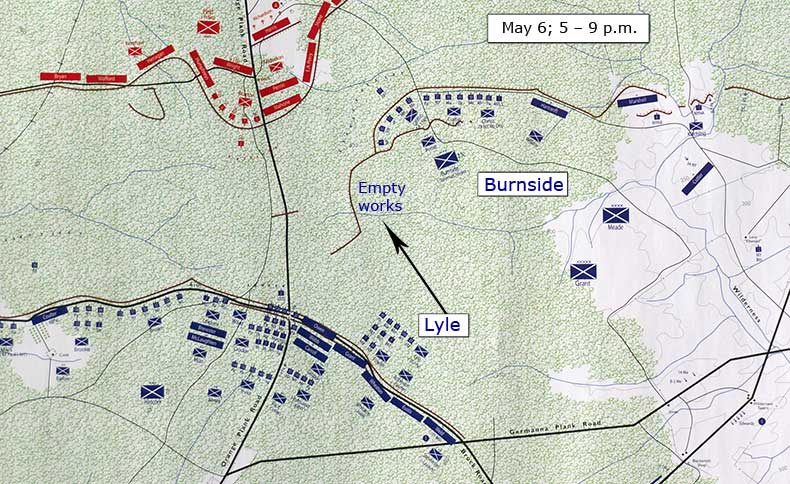 Pictured is a portion of the National Park Service's Map #6 depicting various phases of the Battle of the Wilderness. I used this map as a guide for locating the actual ground occupied by Col. Peter Lyle's Brigade, as shown, the afternoon of May 6. My correspondence with retired Battlefield Historian Greg Mertz, led me to believe the Brigade was occupying the empty works pictured, rather than their position indicated on the map. (I have added the 3 labels to the map to make this graphic). ––B.F. It is difficult for me to believe, with all the troops that occupied the Brock Road during two days of battle, that there would not already be strong defensive works in place along the road, before Lyle’s Brigade arrived the afternoon of May 6. Puzzled, I sought help by sending a note to long time Battlefield historian Gregory Mertz, (now retired). I told him I was searching for earthworks that might have been built and occupied by Col. Peter Lyle's men. Greg knew the battle-ground and its features as well as anyone. After a brief exchange, he directed me to note the earthworks to the left of Burnside’s position, facing predominantly south. “It would be odd for Burnside’s men to build some works that they had no need/not enough men to occupy…” Greg also agreed with me that the position of Lyle’s Brigade in front of the Brock road, as placed on Map #6 didn’t make sense, but perhaps some evidence compelled the researchers to place them there, without specifically knowing their position. He wrote, “Perhaps they were actually in the earthworks to the left of Burnside.” The Lake Wilderness housing development exists on this part of the battle-field today. Greg sent me a diagram in which he overlayed the historic earthworks over a street map of the development. DIAGRAM Using the diagram Greg sent me as a template, I created the graphic below. It shows a portion of the historically documented earthworks overlayed onto a google map screengrab of the Lake Wilderness Housing Development. 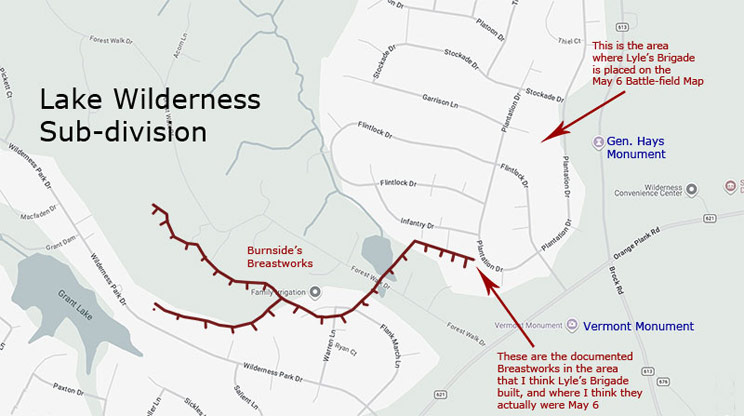 Regarding the diagram, Greg told me, “I think these unoccupied works facing south on Map 6, match up reasonably well with the route of Lyle’s advance on May 5, and given the strange placement of Robinson’s division on Map 6, could have been their position during that phase of the battle, particularly if you have accounts that they constructed earthworks somewhere west of the Brock Road.” I never would have been able to consider this possibility without Greg’s help, because, as I mentioned in our correspondence, I may know the story of Lyle’s Brigade, but he knows the battleground and its features. I was strongly influenced to believe the line of works extending south from Burnside’s lines, were built by Col. Lyle's men, and that this is where Lt. Joseph Stuart of the 13th MA was mortally wounded by a sharpshooter on May 6. I re-examined my source material with this in mind, looking for clues to their location, and found it in Corporal Calvin Conant’s diary entry for May 6th, (quoted above, repeated below).
Then Calvin Conant wrote:
Conant’s diary entry along with my discussion with Greg, convinced me, that the earthworks indicated on the diagram shown, are the earthworks constructed by Col. Lyle’s brigade on May 6. I believe this is where Lieutenant Joseph Stuart was mortally wounded. 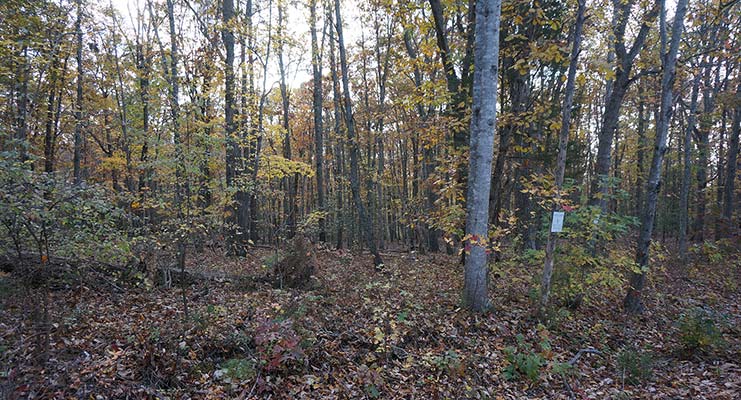 This photograph was taken from Plantation Drive, precisely at the bend in the road, as indicated in the graphic below. We are looking into the woods very near where the line of earthworks ended. Based on the discussion with Greg, I believe this is near to where Lt. Joseph Stuart was mortally wounded by a sharpshooter, the afternoon of May 6, 1864. The white sign in the photo reads, "Park Boundary." 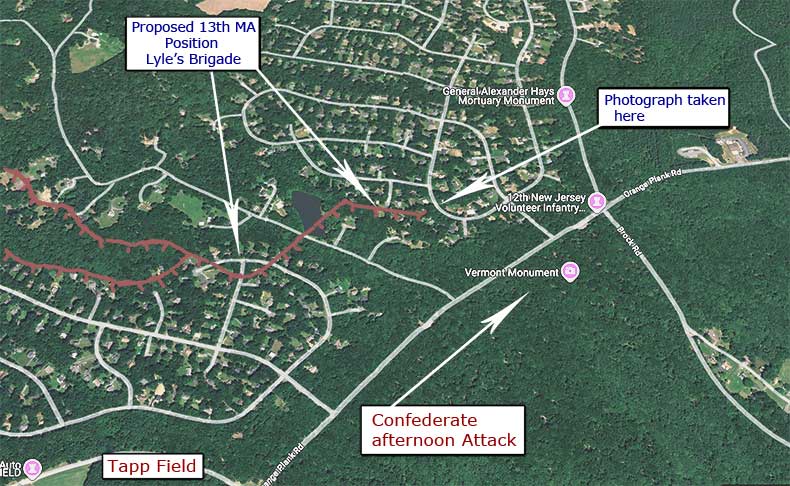 Overlay of satellite image (in perspective) with estimated position of Lyle's Brigade. I have drawn in an estimate of where the earthworks stood, according to the information provided to me on the diagram above. The above photograph of the woods was taken where indicated. Notice some of the historical markers indicated on the map. Confederate artillery was massed at the Widow Tapp Field, the corner of which is showing at the bottom left.. The Vermont Brigade monument to the more than 1,000 casualties that organization suffered is on the right. The monument to where General Alexander Hays fell on May 5th is at the top right along Brock Road. Click Here to View Larger.  Monument to General Alexander Hays as indicated on the battlefield screen grab above. He was killed during the fighting May 5th. “Characteristically riding in front of his soldiers, Hays paused near the 63rd Pennsylvania, his former regiment, and began to address the soldiers. With a sickening thwack, a stray bullet tore through the general's skull and toppled him from his saddle.” [Rhea, p. 203.] His brigade took heavy losses but few accounts of their fight exist. General Grant is said to have remarked, “I'm not surprised that he met his death at the head of his troops; it was just like him. He was a man who would never follow, but would always lead in battle.” [Rhea p. 206.] Members of the 13th MA remembered General Hays at the Battle of Gettysburg on July 3rd. He was also conspicuous at the February 6, 1864 skirmish at Morton's Ford. You can read more about him at those specific pages of this website. Sergeant Austin Stearns' Memoirs, 13th MA, Company K The following is from, “Three Years With Company K,” by Sergeant Austin C. Stearns, (deceased) Edited by Arthur Kent; Associated University Press, 1976. Friday May 6th “Fair and warm. Was relieved at daybreak by the Brigade that had the 9th Mass in it. [Jacob Sweitzer's 2nd Brigade, General Griffin's 1st Division––B.F.] Marched back to the open ground and without halting marched again to the front, then back to the reserve. Heavy fighting at Parkers Store, also at the Plank road. Ordered to the Plank Road. Built breastworks, Lieut. Stuart killed. Gen’l Wadsworth killed. Saw Col Gould and his reg’t.” When ordered to the left, we saw the new Brigade of Mass troops coming to the rear like frightened sheep. Gen’l [Marsena] Patrick had three lines of his Turkey drivers (as the boys called them) to stop the straglers. When we were building breastworks, the rebs, climbing into the trees, picked off quite a number. Our boys went down into the woods and they (the rebels ) soon came down. Col. Coulter of the 11th P. V. in command of a brigade was ordered to the left. Instead of going the way we did, he started his men through the woods, got in the rear of a division of rebs, and after some sharp fighting and tall running, reached our lines. “D—n my heart,” Said Coulter; “I‘d gone through there if it took every man I had.” Sam was stationed at the 5th Corp Field Hospital along Germanna Plank Road, near Wilderness Tavern, on May 5. The notes in parenthesis are his. “The Diary of Samuel D. Webster” [Company D] (HM 48531) are used with permission from The Huntington Library, San Marino, CA. Also transcripts of the original Field Diaries, from his family. Friday, May 6th, 1864 Heavy firing after sunrise along the whole line. During the day the brigade was moved back, and took position on the road leading from one plank road to the other. [Brock Road–-B.F.] While entrenching Lt. Stewart was wounded by a sharpshooter, the ball just passing over Thompson’s head. Left them and stopped at a house on the road in the hollow to right (north) side of it. Burnsides Division came up in the morning and, just after noon I saw the 56th, 57th, 58th, and 59th Mass., and Col. Gould, Major Colburn, Lt. Kinney [Kennay––B.F.] (of Co. C. ) Jim Gibson (our old Color Sergt ) and others. They had just arrived out and already been in a hot fight. Gibson swore he’d not move another step. Keener Shriver’s regiment and Co. ( 7th Pa. Co. I ) “went up" yesterday, sure enough and he with them. There were only 45 left, –– an officer and 44 men.* *According to author Gordon C. Rhea, the 7th PA Reserves (Samuel Crawford's 3rd Division, 5th Army Corps) stuck in the woods, while moving north from the Chewning Farm, to support General Wadsworth's Division, were bluffed by a smaller Confederate force of two companies, after Wadsworth's line collapsed in the May 5th fighting near the Higgerson Farm. The Rebels captured 272 Pennsylvanians, leaving 36th left. Sam says 44 were left.— B.F. Source: Rhea, Battle of the Wilderness, p. 166-167.   
Colonel Jacob Parker Gould, Major Joseph Colburn, and James Gibson, all of the 59th MA. All the boys commented on seeing their old comrades, formerly of the 13th MA, who were now serving as officers in the new Massachusetts Veteran Regiments. “On May 6, only ten days after the regiment left Massachusetts, it was engaged in the battle of the Wilderness, in the vicinity of the Plank road, losing 12 killed, 27 wounded, and five missing. Colonel Gould being seriously ill, Lieut. Colonel Hodges now took command of the regiment.” --from Massachusetts Soldiers, Sailors & Marines in the Civil War. Because so many former 13th MA men were in these regiments, the following lengthy section will look at their organization and subsequent deployment, in which they were immediately immersed in battle. The section also gives a much stronger impression of the chaos that occurred fighing in the woods of the Wilderness. Colonel Sumner Carruth's Brigade at the Battle of the Wilderness
I have poked some fun at Major-General Ambrose Burnside, and pointed an accusatory finger at him for his slowness at the Battle of the Wilderness, May 6. True; if he had been in position on time on the morning of May 6 as ordered, General Meade’s forces would have probably been victorious that day, and defeated the Confederates before General Longstreet's Confederate Corps arrived and counter-attacked. Nonetheless, several former members of the 13th Massachusetts and other brave Massachusetts men comprised the 1st Brigade of the 2nd Division of General Burnside’s 9th Corps. They had a difficult approach to the battlefield. Three of the four Veteran Massachusetts regiments in the brigade, had only left the State a week earlier. They fought hard and took a beating when they were rushed into their first engagement. Thomas G. Stevenson's Division was withheld from Burnside by General Grant, and sent as a reserve force, to the aid of General Hancock, and therefore fought seperately from two other divisions of Burnside's Corps. Thirteenth Massachusetts soldiers, Charles E. Davis, Jr., Sam Webster, Calvin Conant and Austin Stearns all took note of seeing their old friends on the battlefield May 6. It is fitting that a little attention be given to their valiant efforts that day. Pictured is Colonel Sumner Carruth who commanded the Brigade of Massachusetts Veteran Regiments. He was a veteran officer in the 1st and 35th Massachusetts Infantry. Four new “Veteran” regiments were organized in Massachusetts between the Fall of 1863, and the Spring of 1864. It was required in these Veteran regiments, that the members should have served not less than 9 months in some other organization. The term of enlistment was for 3 years. The idea was to recruit experienced military veterans, who had recovered from wounds or sickness, into new units, giving them the advantage of practical military knowledge over other green regiments. The four new organizations were the 56th, 57th, 58th and 59th Massachusetts Volunteers. They were the last 3-year infantry regiments from Massachusetts, mustered into national service, to leave the State for the war. Many former 13th MA soldiers re-enlisted into these new units, and achieved higher rank as either commissioned or non-commissioned officers. Three of these four new units marched directly into combat one week after leaving the State. They took heavy casualties throughout the summer months beginning on the morning of May 6 in the woods on the north side of the Orange Plank Road. The relentless bloodletting continued through until the end of August. There wasn’t much left of them by the end of the year 1864. Most of the 13th MA Veterans were in Colonel J. P. Gould’s 59th Regiment [late Major of the 13th Mass. Infantry]. These men left Massachusetts for the seat of war on April 28. They arrived in Washington, D.C. by train the next day. A night passed at Soldiers’ Rest in the city, then they traveled by boat to Alexandria. They spent another night at the Soldiers’ Rest near the Alexandria depot and then on April 30, marched 2 miles into an open field and made camp. After two nights here, they boarded cars at 2 p.m. May 2nd and proceeded by rail to Bealeton Station on the Orange & Alexandria Railroad. Leaving the cars they marched to Rappahannock Station, which they reached at 11 p.m. at night. Former 13th MA soldier George S. Cheney described the journey in a letter to his hometown newspaper the Roxbury City Gazette. He used the pen-name ASOF, which he had adopted while serving 2 years with the 13th MA, Company E. Cheney mustered out of the 13th Regiment May 25th 1863. He later re-enlisted as a sergeant in Company A of Colonel J. P. Gould’s new command. His former captain, Joseph Colburn, was now major of the 59th. Roxbury City Gazette: Letter from ASOF The Following is downloaded from the long defunct website, "Letters of the Civil War" (accessed through the Internet Archive Wayback Machine). The original site was operated by Tom Hayes of Massachusetts, and was active in the early 2000's. MAY 3, 1864 FROM THE 59th REGIMENT Mr. Hutchi****: --Dear Sir—Last Saturday I took a walk down town; saw the fashions, such as they were, bought myself sundry trinkets, something to eat and returned to the barracks. Marched out of the barracks, drew shelter tents, pitched the same, and at present time have a good prospect of a rainy day. Sunday, May 1.—Were mustered in today for the next two month’s pay. When we shall receive said pay, can’t tell. Leave tomorrow for some place farther south. A pleasant day of May. Monday. 2d—Left Alexandria at a little before daylight. Had a fine but cold ride upon the top of the cars. The living immortal on the top. The sustainer of life (bread) within. We left the cars about 6 miles from (that is above) Warrington Junction. This place I should never have recognized had not the little depot been standing in its old place. All the trees which formerly occupied the line of rail at this point have been received at their root, not the woodman’s axe, but the axe of the soldier. In fact all the wood on both sides of the track, as far as we have travelled, has been removed. Block houses have been built; stockades planted, so to speak, by reason of which an unobstructed view has been obtained. One would hardly suppose a rebel raid possible in this direction. At the Junction may be found numerous camps well fortified. This part of Virginia which 18 months since presented the appearance of a vast wilderness, will soon be redeemed, and with its soil teaming with richness, will become a blessing instead of a curse. On our way to this place we halted for several hours, waiting the balance of the regiment coming up on the next train. Not being on hand as soon as expected, we proceeded to this place. I call it a place for want of some other name. We have pitched our shelter tents, and expect to remain here at least twenty-four hours. Last evening one of those very pleasant thundershowers for which this country is noted, paid us a visit. A gale of wind, rain falling in torrents. We fortunately were under shelter. This morning, 3d inst., we have the prospect of a beautiful day, with plenty of wind. The situation of our camp is very pleasant, being on a knoll with a wide spreading plain in our front and rear. The situation is capital for defensive purposes. We are expecting the 58th Mass. here today, and then we shall have four Mass. veteran regiments within gun shot of our quarters. Major Colburn and other Roxbury officers are well. They bid fair to make as far as discipline is concerned good officers. Major Colburn has most certainly earned his position. Can we say the same of other officers in our midst? Should we stay here any length of time, I will drop you a line. ASOF (Roxbury City Gazette, May 12, 1864, pg. 2, col. 5) [Digital Transcription By Phil Dufrene] Of the 4 new Veteran Massachusetts Regiments comprising their brigade, the 59th MA had the easiest time of it, traveling to the front by boat and rail most of the way, (until the advance across the Rapidan river). The other 3 regiments, the 56th, 57th & 58th MA, had to walk most of it. All but the 56th Regiment, left camp in Massachusetts a week before the Battle. The 56th MA, being the first to leave the State for Virginia was the exception. They left Massachusetts March 21st and settled for a while in camp at Annapolis. Apparently transporting 850 men from Massachusetts to Annapolis, Maryland is a lot more difficult to do than it sounds, as this interesting letter from Lieutenant-Colonel Stephen M. Weld, attests. Letter of Stephen Minot Weld to His Father, March 25, 1864. Stephen Minot Weld, Jr. was born into a long line of an accomplished family, established in the Jamaica Plain neighborhood of West Roxbury Massachusetts. When the war broke out he was a student at Harvard Law School. He wanted to enlist but his father wished him to continue his studies. In October, 1861, with his father’s consent, a sea-captain, Uncle Oliver, obtained a clerk’s position for young Stephen on a captain’s vessel that was part of a secret expedition, sailing south for parts unknown. There were adventurous mis-haps when the expedition got under way, which included running afoul of a dangerous reef, and surviving a treacherous midnight storm at sea. On November 7 the expedition's mission was accomplished when the assembled fleet successfully bombarded and captured Forts Walker and Beauregard at Port Republic, between Charleston, South Carolina and Savannah, Georgia. Upon his return to Massachusetts young Stephen was even more eager to enlist. General Fitz-John Porter was a former student of Weld Senior, who taught for years, at a prestigious boys-school he founded in 1827. So Stephen jr., who just turned 20 years of age, got a commission as 2d-Lieutenant in the 18th MA, and served as a staff officer for General Porter, commanding 5th Corps, Army of the Potomac. His military career was underway. He gained battle experience at 2nd Bull Run, Antietam ad Gettysburg, continuing to serve on various staffs. In the Autumn of 1863, he returned to Massachusetts to recruit and organize the 56th M.V.I. He kept up his journal writing through General Grant’s Overland Campaign from which the following quotes are presented. His memoirs, War Diary and Letters of Stephen Minot Weld, 1861-1865, were privately published for his family to read in 1912. Headquarters 56th Massachusetts
Reg’t. Dear Father, ––We are now comfortably settled in tents about two miles from Annapolis, on the exact ground that the 24th Massachusetts were encamped two years ago. The ground is dry and easily drained, with water, etc., within convenient distance. The railroad runs within a fourth of a mile of our camp, making it very convenient for us to get our supplies. We left camp as you know, on Sunday morning, the men and officers being in the best of spirits, and with but few of the men, I am glad to say, drunk. The day before we left, over forty gallons of liquor were confiscated at General Peirce’s headquarters, being found on the persons of the soldiers’ friend, or rather enemies. We reached Groton at 3 p.m. without losing a man. At every place we stopped, the officers and guards got out, and prevented any civilians from having access to the men. In this way we managed to keep all liquor away from the soldiers. At Groton we shipped the regiment on board the Plymouth Rock and reached Jersey City by 2.30 a.m., experiencing no trouble except from the boat-hands selling rum to the men. At Jersey City we had to wait until 10.30 a.m. before we could get the regiment on board the cars and started. We lost but two men here. We reached Camden at about 7 p.m. with all our men except one. At Newark a citizen was shot by one of the officers for refusing to go away from the cars, where he was selling liquor, and for throwing stones at the officer. I don’t know whether the man was mortally wounded or not. At Camden we took the ferry and crossed to Philadelphia, where we received a supper from the Union Association. I demolished a liquor shop in Philadelphia and took the proprietor prisoner. I had him hand-cuffed and taken on to Baltimore, where I had half his head and beard shaved and then turned him over to the provost marshal. At Philadelphia the colonel and quartermaster left us, and went on to Baltimore to provide transportation for the regiment, and therefore I had command. After taking our supper here, we marched to Philadelphia and Baltimore depot, where we took freight cars for Baltimore. We arrived there at 12 and found the colonel waiting for us. As a dinner was promised us here at the Union Rooms, we marched some two miles from the depot to the place, where we found that we had been taken in, for no dinner was ready, so like the king of old we marched down the hill again. We took the steamer Columbia at Baltimore about 2 p.m. and started for Annapolis, reaching there at 6.30 p.m. in a driving snow-storm. We disembarked as soon as possible, and marched to what are called the College Green Barracks, where the paroled prisoners are kept for the first day or two after their arrival. We found only four of the barracks empty, and had to pack our men in them, putting four hundred where two are usually put. Still it was much better this way than without any shelter at all, for the night was bitter cold and the wind keen and sharp. In the morning we made arrangements with Major Chamberlain to provide our men with hot coffee and meat, until we could draw our rations. Major Chamberlain is in the 1st Massachusetts Cavalry and in charge of the parole camp. He was very kind and obliging to us, for without his aid we could have done nothing for our men, and should have been obliged to have seen them suffer a great deal. As it was, they had a pretty hard time of it. This same morning, that is, Wednesday, [March 23] lots of our men got into the town, and drank much bad whiskey, besides bringing a lot more into camp. About noon camp began to be a perfect pandemonium, and as the colonel was away, the major and I sallied out to restore order. We put all the noisy drunkards in the guard-house, and soon quelled the disturbance outside. In the guard-house, however, confusion reigned supreme for a long time. We tied up any number of men, and finally succeeded in getting quiet restored. One of the worst cases in the regiment, named Casey, I had tied up by the thumbs, and gagged. He then kicked an officer there, and I said to him, “Casey, I will shoot you if you do that again.” Another officer came by and he kicked him, and I drew that pistol Uncle Oliver gave me and fired at him twice. The first shot went through his arm, in the biceps, without touching the bone. The second hit the bayonet in his mouth by which he was gagged, and dropped into his stocking. The bayonet saved his life, for the shot would have gone through his head otherwise. I meant to kill him, and was very sorry I did not succeed. The shots had a wonderful effect in quieting the men, and I had very little trouble with them after that. Yesterday morning we started for our camp outside the city and delighted (?) the Secesh citizens by playing “John Brown” as we marched through the town. We pitched all the tents before night and had the regiment comfortably housed and fed. Considering that some regiments that arrived over a week ago only managed to do the same thing in a week, I think we have every reason to be satisfied… My address is simply, 56th Mass. Vols., Annapolis, Md. I understand that we are the commencement of the 1st Brigade, 4th Division, 9th Army Corps, and that the corps badge is to be a cross with scalloped edges. Please ask Uncle Oliver to apply for our regiment, in case he takes any, on Burnside’s expedition… While we were in the College Green Barracks, a boat-load of prisoners came in from Richmond. There were 500 in the lot that I saw. 500 of the worst cases had been sent to the hospital. Of the 500 selected as being in good health, I must say that I never saw a more horrible-looking set in my life. All ragged and filthy and thin, ––it made one feel sick to see them. It was a good thing for the regiment, however, and I am glad that they saw them. The arrangements for these prisoners are very good indeed. They have a large bath-house for them, where they can take either war or cold baths. I went in and saw some of them bathing. They looked more like skeletons than human beings. The rations for a day consist of one small piece of corn-bread. I saw Adjutant Cheever of the 17th Massachusetts, who said that Linus Comins was still in Richmond… You cant tell how glad I am to get the regiment away from Massachusetts. It is a great relief to me, I assure you. So, the 56th Massachusetts was the first of the four Veteran units to leave the State. They had a little over a month in the field to acclimate to army life. The 57th Regiment left next. The 57th MA left Massachusetts April 18, not quite entirely formed. Company H was organized as a sharpshooter company to be armed with Spencer Repeating Rifles. But the rifles weren’t issued until July 20, 1864. The Company had only 1 officer, a 2nd Lieutenant, when the regiment departed for Maryland. They arrived at Annapolis April 20 and camped near the 56th. While at Annapolis Company H was issued Enfield rifles. A few days later, the 9th Corps troops broke camp and headed toward the city of Washington. After passing through, they crossed Long Bridge and made camp for one day at Alexandria. It would prove to be a difficult move. Lt.-Col. Weld’s journal entries describe the march with brevity and detail, much better than I can. Friday, April 22. –-Made all our preparations for starting to-morrow. Mrs. Burnside was at camp to-day. Five days’ cooked rations were issued. Colonel Griswold was relieved of the command of the brigade, and Colonel Carruth, 35th Massachusetts, was put in his place, as he ranked Colonel G. Day pleasant. 
Saturday, April 23. ––General sounded at 4 a.m. Left camp at 8.15 a.m and marched to within one mile of Patuxent River, about 14 miles, where we encamped. As usual with a new regiment, the men overload themselves and for the first five miles the ground was strewn with blankets, knapsacks and clothing. The day was excessively warm and not withstanding all our efforts, the men straggled a good deal. Captain –––– left his company without leave, probably on account of Captain Putnam’s place in line. Sunday, April 24. ––Left camp about 8 a.m., reveille sounding about 5 o’clock. Marched all day long, the men doing well, especially in the afternoon. The morning march was tiresome, as we had to halt every few minutes. We went into camp about 10 miles from Washington on the Bladensburg Pike, about 9 p.m. Took us a long time to cross a branch near our camp, and when we pitched our tents the rain was falling fast, and everything seemed gloomy and uncomfortable. I luckily had my shelter tent with me, which we pitched with the colors. Wagons did not arrive until 4 a.m. Monday, April 25. ––We started about 7 a.m. and forded the stream at Bladensburg. Marched on to Camp Barry [near Washington], where we halted some time. Here we formed in platoons and marched in review by the President, who was on the balcony at Willards Hotel. He looked ten years older than when I saw him last. Saw Frank Balch. Crossed Long Bridge and camped in front of Fort Scott, Men marched well. Day pleasant though hot. Made about 16 miles. Pictured above are officers of the 56th M.V.I. Major Horatio Deming Jarves on the left, Colonel Charles E. Griswold in the center and Lieutenant-Colonel Stephen Minot Weld, Jr. on the right. 
Tuesday, April 26. –-We remained in camp all day and sent in requisitions for ordnance, etc. Had an inspection of all our companies, and a general overhauling of all our baggage, etc., preparatory for a campaign. Gilmore, our sutler, came out to see us. Weather pleasant. General Stevenson was the only general officer present in the corps. I don't like the way things are conducted in the corps. Every one has to move on his own hook, and things seem very loosely conducted. The 24th Massachusetts and 10th Connecticut had been sent to Fort Monroe when we arrived here. Charley Griswold showed me a letter addressed to me in his valise, to be opened in case anything happened to him. Wednesday, April 27. ––Received orders to move at 5 a.m. Finally started at about 8 o’clock on the Leesburg Pike. Branched off on the Columbia Pike and reached Fairfax Court House about 6 p.m., where we went into camp. Day warm and dusty, and march very fatiguing to the men. One man from the 57th dropped down dead. Marched 15 miles. Dabney (Lewis S. Dabney, Harvard, 1861) came to see us. Met Lieutenant Colonel Chandler of the 57th Massachusetts. Pictured left, is Brigadier-General Thomas G. Stevenson, the commander of the new 9th Corps Division. He did not hold the position for very long. A Confederate sharpshooter shot him through the head while he rested against a tree at Spotsylvania, Virginia, May 10, 1864. An interesting side note about Stevenson is that back in 1861, when he was major Stevenson in the Massachusetts Militia, he commanded the troops at Fort Independence, Boston Harbor, between April 24 - May 21, 1861. He was relieved by then, Major Samuel H. Leonard and the 4th Battalion of Rifles, which became the nucleus of the 13th MA Regiment. Thursday, April 28. ––Started about 7 a.m and marched to Bristoe Station, about 20 miles; getting into camp at 6 p.m. Day cool and pleasant. Men as usual marched well. General Burnside joined us at Manassas Junction. It really seemed like home to go over this country, which I have been through so many times. Thought of General Porter as we passed over the country, through which we were then campaigning. Saw some of the enemy’s scouts at Centreville. Saw Captain Spear, who said we were to relieve the Fifth Corps, who were guarding the railroads. Map of the Region & Marches  As Lt.-Col. Weld stated, the 9th Corps was assigned duty to protect the line of the Orange & Alexandria Railroad, the army’s supply route, while the Army of the Potomac prepared to open the Spring campaign. The 59th Regiment, as already stated left Massachusetts on April 26. The 58th MA left two days later, and traveled to Bristoe Station. It was the last 3 year regiment from Massachusetts to go to the front. When the 58th arrived at Bristoe, Stephen Weld’s command had moved to Bealeton Station. The formation of eight new companies that would comprise the 58th Massachusetts began about the 15th of September, 1863, about the same time recruitment of the other units started to pick up. Recruitment was completed April 25th 1864. Three days later “the companies left Readville in command of Lieutenant-Colonel John C. Whiton, for Alexandria, Virginia, at which place they arrived, without accident, on the evening of Saturday, April 30th. Having stored our surplus baggage at Alexandria, took cars for Bristoe Station on the afternoon of Monday, May 2d, arriving there at 7 p.m., distant some thirty miles. “At Bristoe were assigned to the First Brigade, Second Division, Ninth Army Corps, and on the 4th of May took up line of march for the front.” ––MA Adjt. Gen’l’s Report, 1864. Letter of Lt.-Col. Stephen Weld to His Sister Bealeton Station, Va., May 3, ’64. Dear Hannah. –– I am very sorry indeed that you did not find us at Annapolis. We started quite suddenly and had only about 24 hours’ warning. We marched to Washington, and passed in review before the President, who was at Willard’s Hotel, and then moved across Long Bridge to camp near Alexandria. We remained there one day and then moved on to Fairfax C.H., where we camped one night, moving on the next morning to Bristoe Station, passing over country that I have been through so many times. We camped for the night at B. Station, and then moved to Licking Run, two miles beyond Warrenton Junction. The next morning we reached Bealeton Station, where we are now camped. Our regiment is picketing the railroad for about five miles. The Ninth Corps is to guard the railroad while the Army of the Potomac advances. If they are successful, we shall probably move down to Aquia Creek, and guard that railroad to Fredericksburg… On May 3rd, the day before the army opened its Spring Campaign, the Veteran Brigade was spread out. The 56th & 57th were at Bealeton, the 59th was at Rappahannock Station, and the 58th in the rear at Bristoe. The 9th Corps started moving May 4th. The 58th MA had the most distance to cover and marched from Bristoe to Bealeton. The Adjutant General’s report commented, “took up the line of march for the front. Passed Warrenton, and camped at Bealeton Station at 7.30, p.m., having marched a distance of about 20 miles. The day was very warm, and the roads somewhat muddy. The men, being unused to marching, appeared to suffer severely.” Lt.-Col. Weld observed the hardships faced on the same warm day, durng the march of the 56th & 57th MA. “Wednesday, May 4.–– Started at about 7 o’clock for Brandy Station. Halted there in the sun for four or five hours. At 4.45 p.m. we started for Germanna Ford. Saw Colonel Marshall just before I left. The regiment marched and marched, but as it was separated, the latter half did not reach the ford until next morning, having march 27 miles, 6 miles out of our way. We went into camp at 2 a.m. with about fifty men, constituting all that was left out of four companies. Other regiments were just as bad. Weather pleasant. March the hardest I have ever been on. Saw Colonel Macy to-day and lent him my horse to ride ahead. continued: “Thursday, May 5.––Started at daybreak and marched 6 miles, when we joined the remainder of the regiment near Germanna Ford. We soon started again, and crossed the river on a pontoon bridge at the ford. Heard that the army met with little opposition here. Saw some of General Grant’s staff, who had told us that our army was in position at Mine Run and was to attack this morning. General Grant ordered us to hold the hills and fortifications which command the crossing, which we did. His aide told us that Sherman telegraphed that all looked well, and that he was to attack to-day. Gillmore and Smith attack Petersburg to-day, and we feel of the enemy at Mine run, where he retreated after the crossing of the army yesterday. Heard cannon and musketry about one o’clock, continuing at intervals during the afternoon. Started about 8 p.m. to march, but were ordered back again. The 10th and 4th Regulars joined us to-day.” It can be seen from the diary entry how much incorrect information was floating around at headquarters the day the battle opened. The Massachusetts Adjutant-General [AG] Report for the 58th MA states: “May 5th. Broke camp at 5.30 a.m. Crossed the Rappahannock; and the Rapidan in the afternoon, at Germania Ford. Marched about twenty-two miles, and camped in woods. During the march from Bristoe Station to this place, many men fell out from fatique, ten of whom are reported to have been captured by the enemy.” The AG account of the 59th MA on May 5th is even more brief. “Bivouacked for the night [At Rappahannock Station] and the next day marched to Germania Ford, reporting to General Stevenson.” The Brigade Goes Into Battle, May 6th 1864 Just eight to ten days after leaving Massachusetts the 58th, & 59th Mass., faced their baptism of fire. The 57th was out for 17 days. The 56th at least had a month and a half in the field until that fateful first day of combat. I'll start with the 4 brief entries in the 1864 Adjutant General's report, for each unit, and then follow up with some more detailed accounts of the ordeal. 56th MA: May 6th. Went into action at Wilderness. The regiment suffered severely by the death of Colonel Griswold. Loss––one officer and eight enlisted men killed, three officers wounded, ––one of whom was taken prisoner, ––fifty-four men wounded, ten men taken prisoners––of whom two were wounded. 57th MA: May 6th, the regt. entered the action of the Wilderness with twenty-four officers and five hundred and twenty-one enlisted men, becoming engaged at about ten o’clock, A. M., and continuing in action nearly an hour. One company, H, having been temporarily detached as guard of a wagon train did not participate in the action. During the action, the regt. sustained a loss in killed, wounded and missing, (officers and men,) of two hundred and fifty-one. Colonel William F. Bartlett received a scalp-wound which necessitated his removal from the field, leaving the regiment in command of Lt.-Col. Charles L. Chandler. 58th MA: May 6th. Struck tents and marched about five miles, halting at a place known as “Wilderness Tavern.” At 9 A.M., were in line of battle, and participated in the battle of the Wilderness. Our losses on that day were, seven men killed, twenty-three wounded and four missing. 59th MA: The next day (6th,) we were engaged in our first fight, (ten days after leaving the State.) Our position was on the right of our division, consequently our loss was comparatively small.* *The loss in the 59th was 44, hardly insignificant, except by comparison with the 57th MA: May 6; 12 men killed; 2 officers and 25 enlisted men Wounded; 2 men Prisoners; 3 men missing. [total 12 K; 27 W; 2 Captured, 3 Missing = 44.
Lieutenant-Colonel Weld's Journal, May 6 Friday, May 6. –– Started about 3 a.m. and marched on the Plank Road to a point near General Meade’s head-quarters. From here we were sent to the left and ordered to report to General Birney. All this time the musketry firing was fearful. It was one continual roll, at long intervals broken by the loud booming of a cannon. We went up what was called the Brock Road. We kept receiving orders from Generals Hancock, Birney and others, so that “things were slightly mixed.” We found quite a sharp fight going on, the enemy having been driven two miles since morning. The firing was almost entirely from musketry, as we were in the celebrated Wilderness, where the country is thickly wooded, with a thick underbrush of scrub-pine, briars, etc. Our brigade was filed to the right of the Orange Court House Road, and placed in column of regiments with the left resting on the road. We advanced, being the third line, some half a mile without much opposition. We were engaged in this way about three hours, from 8.45 until 11.45, losing only about six men. At about 12 the enemy flanked our left, and we were sent to oppose their advance. We were posted in a ditch along the side of the road, and on the left. A heavy fire was immediately opened on us, and as some of the men were in confusion from some of the Second Corps running through them, Colonel Griswold ordered the colors forward. Colonel Griswold was shot dead, through the neck, and consequently I was left in command of the regiment. 
As the enemy had crossed the road on our left and right, I asked General Webb, who was to the rear a few paces, whether I should not order them to retreat. He said I had better do so. His actual words were: “Get out of there as d—d quick as you can!” We had to try a double quick-step in order to save our colors and escape being taken prisoners. I tried to rally the men five or six times, but as soon as we stopped we got a volley which started us on again. The men did not retreat until I ordered them to do so. They behaved admirably. I was very much astonished that they did not all run when the Second Corps ran over them. Sergeant Harrigan, our color-sergeant, behaved nobly. When we had gone back about 30 or 40 rods, Captain Adams was wounded and left in the hands of the enemy. We reached the road with about 75 men and the colors, ––more men than were with the colors of any other regiment. We soon collected 100 more men, and by afternoon the ranks were swelled to 300. We were on the Plank Road to Orange Court House, here we were engaged, and after the fight we were placed behind rifle-pits on the Brock Road. We were in action about three and a half hours. …Got a bullet through my boot-leg while we were retreating. The fire was the heaviest I have ever been under. Several of my men, that I drove out from behind trees, were killed by my side. Trees were cut down by the bullets, and bark was knocked into my face time and again by the bullets. We were not able to get poor Charley Griswold’s body. Sent out for it, and also for Zab Adams’s, but could find no traces of either… Pictured above is supposed to be the damaged trees on the Federal Line north of the Plank Road, circa 1864-1865. Photo by G. O. Brown, Library of Congress. [When we were advancing on this morning we passed several rebels lying on the ground, which had been wounded a little while before. One of them asked one of our men for some water. The man stopped at the brook, got him some water, and then went ahead. As soon as we had gone fifty yards or so, the fellow we had given water to drew himself up and shot one of our men. Some of the others went back and quickly put him out of the world. It was a mean, cowardly thing for a man to do who had been treated as we treated him. The firing to-day was the heaviest I have ever known or heard. I think the regiment did remarkably well considering that they were a new regiment, and that the old troops whose terms of enlistment were expiring did not behave very well –– as one might naturally expect where troops who were to go out of service the next day were put into a heavy fight. I have every reason to feel proud of the regiment. Griswold’s death was a sad blow to me, as I was very fond of him. He was extremely brave and behaved like a gallant soldier. He was shot through the jugular vein while holding the colors, which were covered with his blood.] The Brock Road by Artist Correspondent Edwin Forbes  Excerpts From the Book, “Mother May You Never See the Sights I Have Seen” Writer Warren Wilkinson had an Irish immigrant great-great grandfather named Martin Farrell in Company F of the 57th Massachusetts. After reading the 1896 ‘official’ history of the unit, “The Fifty-Seventh Regiment of Massachusetts Volunteers in the War of the Rebellion,” by Captain John Anderson, (with aid from other former members), Wilkinson was dissatisfied. “There were no bad soldiers, for instance. All were fearless and gallant men who cheerfully and willingly shed their blood for God and country, particularly the officers. I doubted that.” Wilkinson also points out there was no mention in the history of any conflict between the large number of Irish catholics in the regiment with their Yankee protestant counterparts. He questioned this too. Curiosity, led him to search other sources for a better understanding of the men and their experiences during the war. He read general studies about soldier life in the Civil war and conducted regiment specific research at local historical societies, libraries, museums and archives, with additional help from other soldier descendants. He visited battlefields where the men fought. These explorations brought him the enlightenment he desired. He carefully documented his research with notes organized chronologically. The notes became a manuscript for personal edification. Then, “two eminent scholars and authors of Civil War history read the rough manuscript, approved of it, and recommended that it be published.” The result is the masterfully written book, “Mother May You Never See the Sights I Have Seen.” What makes the book especially wonderful, is the author’s gift for descriptive prose that I cannot possibly do justice to by paraphrasing. I would like to liberally quote long excerpts from Chapter Five of his book, pages (55-73) to close out this brief examination of the four Veteran Regiments in the battle. I have paraphrased a little, to shorten some of the paragraphs. Its a long read, about 7 pages typed, but well worth it. I have included the author's footnotes. A list of some former 13th MA soldiers who were part of this brigade will follow the story. Quotes from the Book, “Mother May You Never See the Sights I Have Seen,” by Warren Wilkinson “…While they were being held in reserve––with the interminable waiting grinding their nerves raw––Company K, temporarily under Captain Albert Prescott, was detached to help the 35th Massachusetts guard the division baggage wagon train. There were fifty-five men of that company on hand that morning who were detailed on the guard. Fifteen others who had fallen out on the march, …would arrive late, yet in time to go into battle and three of that number would die.” 
Frank Bartlett, [the battle-hardened commander of the regiment] wrote in his diary before the battle that morning, “It will be a bloody day…I believe I am prepared to die.” Not many days earlier, he noted, “My regiment is in no condition to take into action, but I must do the best that I can. It will be a long and hard fight. God, I hope, will give us the victory. The chances I think are even… Give me twenty days and I could make a splendid regiment of this, but man proposes and Grant disposes.” #1 “He was disturbed because of the regiment’s lack of drill in battalion and regimental tactics, which had been curtailed by the severe weather at Camp Wool, and he was quite worried that the companies would not act in concert during the confusion of battle. #2 Colonel William Francis Bartlett, 57th M.V.I., pictured. The photograph is from 1863, after he had received a wound that shattered his wrist at the Battle of Port Hudson, Louisiana, May 27. He was then Colonel of the 49th Massachusetts Infantry. He was also wounded a year earlier during the Siege of Yorktown, in April, 1862, which caused his left leg to be amputated above the knee. He was at that time a Captain in the 29th Mass. “The 57th, along with the rest of the brigade, proceeded down the Orange Plank road pushing through the throngs of Hancock’s soldiers and Southern prisoners as best it could, following the terrible clatter of the fight in front of them, until the men came to an old cart road in the woods on the right, where they halted briefly to remove and stack their knapsacks on the ground with a few lucky soldiers detailed to guard them. #3 “After the men capped their rifled muskets, already loaded, and fixed bayonets, commands were screamed above the rolling wickedness of the gunfire and accompanying din, and the 548 frightened and nervous men of the 57th and their officers, …double-quicked it down the cart path with the brigade through the brambles, briars, and scrub pines in rear of the II corps lines. They took a position on that corps’ extreme right next to the 1st Massachusetts (4th Division, II Corps) and 19th Maine (2nd Division, II Corps) Volunteer Infantry regiments. #4 “…The brigade formed in lines of regiments with the 4th and 10th Regulars in the first rank and the 56th Massachusetts behind them. The 59th Massachusetts was 3rd, and the 57th was in the rear. …While waiting for orders to advance––which were not long in coming––the 1st Brigade, (Carruth) facing west with its flank resting on the Orange Plank road, was instructed by its officers to lie down for safety, and the musicians were ordered to the rear.#5 “The distance covered to the field from their reserve position had been a sweat breaking three miles on the run with full equipment, and the men were winded and tired. “…After Carruth’s brigade had advanced about a half-mile west with sparse opposition, the regulars in the front line fired their first volley at the Confederate lines in front of them which they could not see for all the smoke and tangled forest. The fierce Southern reply came immediately. #6 “Mounted on little black Billy, Colonel Bartlett, unsteady in the saddle with his cork leg, was ordered by General Hancock to have the 57th advance past a regiment that was frozen by fear in position and would not move one way or the other no matter how many times the men were ordered to do so. (It is known that these were veteran troops, but not which regiment…) 
“The 57th proceeded over them in good order –– (“We did it in perfect line,” noted Frank Bartlett) ––stepping soundly on their bodies and heads as they went and listening to their curses and warnings to “Get down, you g—d—d silly fools!” and such. “…Company H, the color company, with its seven color corporals flanking the color sergeant, in place just to the left of right center in the line with the regimental banners proudly unfurled, led the charge with Bartlett in the van. General Hancock later, in great praise of the 57th Massachusetts, called the regiment’s advance “glorious.” #7 “The 1st Brigade’s attack was directed at Confederate Generals Perry and Perrin’s brigades of Anderson’s division of Hill’s corps. Brigadier General Abner Perrin’s troops were made up of the 8th, 9th, 10th, and 14th Alabama Volunteer Infantry regiments, while the 2nd 5th, and 8th Florida composed Brigadier General E. A. Perry’s Southern boys. These Confederates were occupying ground near the Chewning Plateau, slightly to the northeast of Widow Tapp’s meager little farm further west along the [Orange Plank] road, which provided one of the few clearings on the Wilderness battlefield and which was occupied, in part, by Confederate Lieutenant Colonel William Poague’s four batteries of artillery. Poague’s guns were some of the very few pieces of heavy ordnance on the battlefield, and his gunners were doing their level best to smash apart the blue ranks with double-shotted grapeshot and canister. #8 See Map #7.  Photo of the Widow Tapp Farm looking East, Wilderness National Battlefield Park. “There, also on the Tapp farm, the commander of the Army of Northern Virginia, General Robert E. Lee, made his headquarters. “Company H burst to within ten feet of the Rebel breastworks, a conglomeration of fence rails, trees, brush, and any other battlefield trash that could be scavenged, looming deadly in the battle smoke in front of the regiment. Many of the men had to crawl the last fifty yards of the advance on their hands and knees in the nearly impenetrable thickets. The 57th kept good formation for a while in the battle lines that ebbed and flowed continuously, but the soldiers simply could not maintain their ranks in the ghastly tangle and killing gunfire on that field of murder. Many could not see their own colors in the blinding smoke, and became totally disoriented, not knowing where they were or where the rest of the regiment, let alone their company, was. The charge disintegrated into spontaneous, miniature battles, and each man fought with chaotic ferocity for himself. The firing was so profligate that some of the boys drove into it head down and back bent, as if they were in the middle of an intense New England blizzard. #9 Pictured below is a line of Confederate breastworks in the woods of the Wilderness. 
“For many of the Massachusetts soldiers, however, after the first pull of the trigger their earlier apprehension was greatly, almost magically, relieved, and they seemed to take on new personalities. Most of them refused to lie down or take cover, for they reasoned, in the innocence of the first day of their fighting career, that such behavior was shameful, disgraceful, unmanly, and, more importantly, cowardly. And many, but not all, of the pragmatists in their ranks did not dare to dissent and seek shelter for fear of their comrades’ reprisals, not to mention official censure. So the men of the 57th continued their debut in combat as if they were participating in a grand parade-ground pageant. #10 “Some of them climbed to a plateau of exhilaration with the violence and destruction and were transformed into tough, mean, deadly fighters. And for their senseless bravery, they were slaughtered. They fought like savage, wild animals with all of their primal instincts surfacing in a blind, possessed rage of frustration and anger, and in most cases the regard for personal safety was completely repressed. Some were filled with plain blood lust; when a comrade was hit, his friends sometimes exploded in a fury of barbarism, screaming like banshees and shooting like wildmen. And many reacted with cries of insane glee and satisfaction at each shot they fired. “Others were strangely calm. Lieutenant Barton described to his mother how his cousin, Color Corporal Ira Bullard, when his musket had become so fouled that he was unable to discharge it, “Quietly took his wrench from his Cartridge box, unscrewed the Cone on which the Caps are placed, took his primer and Cleaned out the cone, then screwed it on again and blazed away all this under a heavy fire of musketry from the Johnnies.” #11 “The battlefield was a bloody slaughterhouse of sheer frenzy, and wild rabbits became so terrified they were tamed in their fright and sought refuge snuggling against prone soldiers and corpses. Alarmed birds circled and fluttered vigorously above the smoke and squawked in mad protest. Deer bounded wildly in all directions, in sheer panic, seeking safety, and raccoons, squirrels, possums, quail and other creatures of the usually sleepy forest scampered about in dread looking for someplace to escape this human outrage... “…The 57th was suffering horrendously in casualties, even though it was responsible for a good deal of pain and misery inflicted on the other side, as well. “Later that morning, at about eleven o’clock, Colonel Bartlett was struck directly above the right temple by a Rebel Minie ball just after he took a drink of water from Sergeant Edwin McFarland’s canteen. It was only a glancing blow, but the colonel was dispatched to the rear, with his arms around Billy’s neck for balance, exhausted and bleeding, in the company of several very lucky men as escorts. While moving out of the battle lines, he had barely avoided capture in the confusion. Lieutenant-Colonel Chandler then assumed command of the regiment. However, he was soon lost from the majority of the men as he remained in the very front with the colors, and Major Cushing, next in line, was put out of action shortly afterward, with sunstroke. Command of the regiment changed so rapidly that no one could say, at any given time, just who was in charge. #12 
“A Minie ball drilled through young Captain Joseph Gird’s head early in the fight, killing him instantly. He had just finished instructing the men of his company how to behave during the first charge. As he turned around, the Rebel bullet hit, and he threw up his hands as he fell to the ground. #13 “Sergeant Charles Knox of Company C was shot dead square between the eyes. #14 “Charles Everett, Company D’s young drummer boy and quartermaster’s clerk, did not survive, either. Despite Frank Bartlett’s firm order to him to remain in the safety of the rear, he had grabbed a musket and a pocket full of ammunition and had gone to the front lines, where he was soon mortally wounded in the right hip. Captain Warren B. Galucia, commander of Company E of the 56th Massachusetts, as well as a family friend of the Everetts, asked Color Sergeant Robert C. Horrigan of the 56th, as the sergeant made his way to the front, to check on the boy’s well-being. Later the color sergeant reported back to the captain that he had found Everett severely wounded, and that he “had left him lying at the foot of a tree.” The young drummer’s body was never found. #15 “Private David H. Tolman’s career as a Civil War combat soldier was remarkably short ––probably only a few minutes. Tolman, of Company A, tells his story: “At the Battle of the Wilderness we went into the fight in the middle of the forenoon formed lines and I had fired twice and as I was reloading, a spent shell struck me in the left thigh. I was carried to the rear ad taken to the field hospital, until the next morning when were were taken to Fredericksburg where we stayed two nites in the basement of the Methodist church.” Private Tolman never returned to the regiment and was discharged from the service for disability. #16 “Surely there were few greater tragedies during the Civil war than that suffered by the Maynard family of Sterling, Massachusetts. Both Maynard brothers, George, seventeen, and William, nineteen, were killed that bloody day. A third brother, Charles, eighteen and a member of Company C of the 34th Massachusetts, had died from lung disease just three weeks before at Harper’s Ferry, West Virginia. #17 How their parents must have suffered. “Corporal George Hodge, a veteran of Frank Bartlett’s old 49th Regiment, had his arm mangled by a Confederate bullet. Later in the month Acting Assistant Surgeon F. G. H. Bradford found it necessary to remove the arm at the elbow, but the surgery was too much for the young corporal, and he succumbed from exhaustion on June 4. Meanwhile his younger brother, James, was lost during the battle and listed as missing in action and presumed killed. #18 “The men were being mowed down all along the line, and the 57th was losing its men on the average of one every fifteen seconds.  Charles Reed sketch titled, “Wilderness Fighting.” “While trying to rally the left wing of Company H Lieutenant Charles Barker, of the Fitchburg Company, had his thigh blown apart and then was hit in the arm, suffering indescribable agony. Captain Lawrence immediately went to his aid, but while he was bandaging Barker’s leg the captain was critically wounded with a load of buckshot in the neck. Barker tried to improvise a crutch out of a musket, but he could not stand the strain, and so Lawrence, who was not yet feeling the full effects of his shotgun wound, helped him from the field with the aid of one of Company F’s men. “Later, while being transferred in an ambulance to the field hospitals in Fredericksburg, Lawrence, Barker, and several other officers were set upon by some of Colonel John Mosby’s guerrillas––but more on their adventures later.#19 “Corporal Aaron Wilkins and his son, Henry, went down together, the father severely wounded in the right arm and the boy shot in the back and the left thigh.#20 “Private Horace Danyon had deserted Company G at Annapolis but he had been caught and returned to the regiment. Thrown into the 57th’s battle line, he took a Rebel ball and lingered until July 18, when he died in a Washington army hospital.#21 “Corporal John Flemming, whom Company G’s officers thought “worthless,” fell wounded in the head.#22 “Private Frank Smith, of Company G, deserted during the battle, the only man of the 57th to do so.#23 “A good soldier, cheerful companion, a true patriot, and an unflinching hero” is how the Massachusetts Spy eulogized twenty-two-year-old Private Charles H. Leonard of Company H. Shot through the head, the bullet fracturing his skull, Private Leonard lasted until May 17, when he expired from cerebritis at Columbian U.S. Army General Hospital in Washington.#24 “The regiment was torn to shreds in that morning’s bloodbath. Company G put 58 men on the line and lost 39 of them––over 67 percent––and Company F followed a close second with 25 out of 42, or nearly 60 percent, down or prisoners of war.#25 “Around ten o’clock, there was a lull in the fighting, followed not long after by a furious and frantic Confederate assault at eleven. Brigadier General Gershom Mott’s 4th Division of the II Corps, holding the left and unprotected tip of the miles-long Federal battle line that extended out across the Orange Plank road, was flanked and broken in following a headlong surprise attack by the men of General James Longstreet’s corps of ragged, frenzied Confederate infantry led by Lieutenant-Colonel G. Moxley Sorrel. The Union ranks were rolled up “like a wet blanket, “ as General Hancock later–and aptly–portrayed the Northern disaster. Again, this is Map #7. “The decimated 57th was soon caught by that turn of events on the left of the Federal line, as the destruction swept along the Yankee front like the fires raging through the woodland, infecting the troops with terror. Private Harrington had finally found the regiment and breathlessly described the scene on the spot at that time: “Our men are falling back on our left 15 min later our regt has fallen back it could not be got into line and is broken.” #26 At last, with no other choices left, the men were ordered by Frank Bartlett, just before his wounding, to fall back with the other regiments to the rifle pits along the Brock road, as the Union lines continued to buckle and snap under the pressure from Longstreet’s flanking movement and as the rest of the IX Corps’ 1st Division disintegrated from a front-end smash by Hill’s men on the Federal right. Many of the Union soldiers began to panic, and the retreat turned into a rout, with feet flying through the snarled and tangled forest. 
“Further east on the Brock road, however, the scene, augmented by thousands of additional men, was greatly expanded from what it had been when the 57th went into battle earlier that morning. Still more II Corps men had left the front lines and the soldiers were walking for the most part calmly, but determinedly, rear-ward in huge clogging masses for safety as if they were “returning dissatisfied from a muster.” As before, the rallying cries and begging and threatening of their officers fell on deaf ears, and the multitudes ignored everything but the sanctuary of the army’s rear. It was not that they were cowards or shirkers––far from it; they were, like the other soldiers who had been retiring down the road earlier that morning, just played out, finished. And that was that.#27 “There were no clear lines or identifiable landmarks on the Wilderness battlefield, and, out of sight of roads, everyone was bewildered. Men ran in the wrong direction, and many were captured in that way, with the 57th losing its fair share of prisoners of war, thirty-two in all that May 6.#28 Regiments and companies were disoriented, and inextricably mixed with others. Brigades were in the same shape. No one could tell where anyone else was in the incredible disorder, with visibility generally only a few yards in any direction. “As the withdrawal swiftly disintegrated into an unholy stampede through the forest, the men of the 57th ran as fast as they could for the haven of the trench lines on the Brock road, praying aloud to sweet Jesus that they would not get shot in the back, but many––like eighteen-year-old Henry Wilkins, as noted earlier––were. “A soldier in the 13th Massachusetts Volunteers remembered seeing the boys of the 57th that day, “coming to the rear like frightened sheep.” #29 Their reckless bravado of just several hours ago had evaporated. 
“Some of the soldiers smashed their rifles to smithereens against trees along the way so that they would not fall into Confederate hands. “Nothing could stop those terrified, sprinting young men until they reached comparative safety in the vicinity of the Brock and Orange Plank road intersection. There, Colonel Daniel Leasure, formerly of the veteran 100th Pennsylvania Regiment and now commander of the 2nd Brigade of Stevenson’s division, mounted a brass twelve-pounder field piece that was on station in the dusty road, and he bellowed orders at the top of his lungs until a semblance of ranks was re-formed out of the remnants of several regiments, including a few of the men of the 57th. He was helped by commissioned and noncommissioned officers alike, who had finally come to their military senses, and the ever-present––in the rear at least––and ever-despised provost guards, formed in three lines that day and derisively called by the men “turkey drivers,” who were prodding soldiers into line with their bayonets and sabers. “Leasure then cried, “Advance first line,” and after the artillerymen fired a round of grapeshot into the oncoming Rebels, the reorganized infantry soldiers let go a volley and drove the Confederates back to a point just about where they had their lines originally. However, the Northerners could not hold the position. They were beaten back quickly, and the Union rout rearward to the Brock road trenches continued.” #30 The Story of the Colors 
“During the mad retreat, the regiment’s colors became tangled in the underbrush close to the front lines, and when Colonel Chandler saw what was happening, he shouted to Leopold Karpeles, “Color Sergeant, what’s the trouble?” “Colonel, the rebs are around us,” the color sergeant yelled back to Chandler. Chandler then pointed to Karpeles, who had again mounted a stump waving the regimental banner, and hollered above the racket to the fleeing soldiers, “For God’s sake boys, don’t forsake your colors!” Thirty-four of the 57th’s men halted and rallied around the color sergeant. First Lieutenant Henry Ward, of Company G, ordered those soldiers to lie down and hide the flags. “I directed him to conceal the colors, as we were surrounded by the enemy, front, flank, and rear,” remembered Ward years later in a letter to John Anderson. The soldiers released the banners from the brush and quickly furled them. Chandler, Ward, and thirty-four men, including Sergeant Karpeles and Company I’s Sergeant Edwin McFarland, and one other officer, second Lieutenant Charles H. Royce, of Company C, remained behind to protect the regimental standards. “Francis Harrington was one of the group, and he scrawled hastily in his diary during the fight that “there is about 20 [actually 34] of us and Lt. Col. [Chandler] have rallied around the flag and going [through] heated times.” “…The pathetic little band of soldiers remained surrounded by Hill’s men, who advanced and retreated over them several times, and they only escaped capture because they went unnoticed in the utter confusion of the great battle. “While we were lying on the ground we could see the rebels going up the plank road,” wrote McFarland. “One came into the brush where we were. Colonel Chandler pointed his revolver at him and told him to surrender. He threw down his gun, and lay down beside us and we brought him in a prisoner.” “The men remained in this precarious position, along with some soldiers from the veteran 45th Pennsylvania Volunteer Infantry, though-out most of the day and were only able to find refuge in the regiment’s lines at sunset. “We crawled on our hands and knees a long distance, I don’t know how far,” recalled McFarland, “but it was a number of hours before we reached our lines. I remember at last finding ourselves near the [Brock] road we went over in the morning and came back up that road… I remember seeing the sun almost down when we reached our regiment.” “Meanwhile, most of the rest of the men, with the Rebels in pursuit close on their heels, shooting at them and trying to needle them with their bayonets, had finally made it back to the Brock road. The used-up survivors of the 57th, except for the thirty-seven men still on the field and a number of others temporarily lost in the confusion, leaped into the safety of the shallow, hastily dug rifle pits in the area and quickly returned a pounding volley into the pursuing Southerners. The battle on the left of the Army of the Potomac’s position, continued like this until about noon that Friday, when the gunfire gradually subsided due to the sheer exhaustion of the troops on both sides. Sporadic shooting was kept up throughout the day, but the worst fighting was essentially over for now in the southern part of the line. Both of the contesting armies were nearly fought out.” Massachusetts Adjutant-General William Schouler concluded his discussion of these four new Veteran regiments by writing the following in his masterful book, "Massachusetts in the Rebellion." These regiments were ordered to the Army of the Potomac, and reported to Lieutenant-General Grant, only a few days previous to the advance of the army towards Richmond. They suffered severely in officers and men. Col. Griswold, of the 56th, was killed in the Wilderness. Lieutenant-Colonel Weld was taken prisoner. Colonel Gould, of the 59th, was so severely wounded, as to cause amputation of the leg, of which he died. Lieutenant-Colonel Hodges was killed in the explosion of what was called “the mine.” Colonel Bartlett, of the 57th, was taken prisoner, also, in “the mine.” NOTES I have kept Warren Wilkinson's notes, but changed the numbering to correspond with my edits. ––B.F. #1.
Palfrey, Winthrop Francis, Memoir of William Francis Bartlett.
Boston: Houghton, Osgood, 1878. (p. 99). Bibliography Warren Wilkinson's Cited Sources Adjutant General, Commonwealth of Massachusetts, Record
of Massachusetts Volunteers, vol. 1. Boston: Wright, Potter,
1896. Sources Fitchburg
Sentinel, May 20, 1864 (local and war news). Former 13th Mass., Soldiers in These Regiments Here is a list, probably not complete, in alphabetical order by last name, of former 13th Massachusetts Veterans who belonged to these regiments. Cyrus E. Barker, 59th M.V.I., Formerly of Co. E, 13th MA, He was discharged, January 13, 1863, for wounds received at Antietam. He enlisted December 30, 1863, and mustered into the 59th January 14, 1864 as sergeant. He was wounded July 30, 1864 at the Battle of the Crater, and taken prisoner August 19, 1864 at the Battle of the Weldon Railroad. He was exchanged March 14, 1865, and died the next month, April 9, at Annapolis, Maryland. His 21 year old widow Annie filed for a pension. Source: Acton Memorial Library, Acton, MA. Samuel A. Bean, 59th M.V.I., Captain, Company K. [Mustered out as Sergeant, Co. E, 13th MA, for promotion, July 1, 1863 into 1st U.S. Colored Troops. Discharged for promotion into 59th M.V.I., Jan. 13, 1864. ] Mortally Wounded June 17, 1864, with the 59th M.V.I. Died June 25, 1864. (Pictured below). Albert H. Bryant, Surgeon, 58th M.V.I., [Physician, Mustered into Co. H, 13th MA July 19, 1861. Mustered out, May 20, 1862.] Appointed Assistant Surgeon, 36th MA. Bryant wrote a letter to Senator Henry Wilson, whom he knew in April 1862 asking for a promotion. He shows up on the roster of the 58th MA as Surgeon. (Pictured). [Source: Executive Correspondence Collection; 13th Regiment; Massachusetts State Archives, S. Boston, MA]. Pictured left to right, Sanford K. Goldsmith, Surgeon Albert S. Bryant. Joseph Church, 59th M.V.I., 1st-Lieutenant, March 3, 1864. [Mustered into Co. C, 13th MA, as private, August 28, 1862. Mustered out April 16, 1863, promoted to 1st-Lt. 6th Rhode Island Infantry. Roster says he was born in R.I.] Church shows up on the roster of officers in the 59th. It may be the same man, though the name is fairly common. Joseph Colburn, 59th M.V.I., Major, later Lieutenant-Colonel. Resigned, February, 1865. [Formerly Captain, Co. E, 13th MA, resigned, February 3, 1863]. (Pictured above). Silas Coolidge, 59th M.V.I. [Mustered out of Co. F, 13th MA, October 11, 1862. Reenlisted February 9, 1864. Died July 1, 1864. John Copeland, 57th M.V.I., [Mustered out of 13th MA, January 7, 1863.] Killed May 6, 1864, in the Battle of the Wildernesss. Charles H. Cotting, 59th M.V.I., 2nd-Lieutenant Co. D. [Mustered out of Co. I, 13th MA, December 16, 1863.] He survived the war. (Pictured). William W. Davis, 59th M.V.I., 1st-Lieutenant. [Wounded at Gettysburg, with the 13th. Mustered out of 13th MA, August 22, 1863]. Wounded, at Petersburg with the 59th. Arm amputated. (Pictured). Pictured left to right, William W. Davis, Charles Cotting & Samuel Bean. John Foley, 59th M.V.I., 2nd-Lieutenant, Co. B. Commissioned Dec. 16, 1863. [There are two John Foley's in the 13th Regiment Roster. One is distinguished from the other with the middle initial "H." John H. Foley was 23 (place of birth not listed) when he mustered into the 13th MA as 2nd Lieutenant, Co. G. Since that is Major Gould's original company, he is the most likely candidate to be the 2nd Lt. in the 59th Mass. Colonel Gould's new command. John H. Foley: Wounded at Fredericksburg while with the 13th. Mustered out of 13th MA, as 1st-Lieutenant, March 29, was promoted to 1st Lieutenant in March 1862. He was wounded Dec. 13, 1862 at Fredericksburg. The roster says he afterwards served as 2d-Lt. in the Massachusetts Heavy Artillery. There is also a record of a John H. Foley, b. 1839, in Ireland, who received the meddle of honor for actions in the Indian Wars out west in 1872. The dates line up with John H. in the 13th MA & 59 MA roster]. The other John Foley, (born in Ireland) was 26 when he mustered into the 13th MA, Co. C. The roster says he mustered out as a musician November 4, 1862. He was wounded at Antietam, Sept. 17, 1862]. There are no other comments in the AG Report that lists John Foley as a 2nd Lieutenant in the 59th M.V.I. (Pictured). James Gibson, 59th M.V.I., 1st-Lieutenant. [Original 13th MA Color Sergeant in 1861. Promoted 2d-Lt.., April 1, 1863. Resigned Nov. 9, 1863 for promotion to 1st-Lt. in 59th M.V.I.]. (Pictured above). Sanford K. Goldsmith, 59th M.V.I., 1st Lieutenant. [Wounded, July 1, 1863, at Gettysburg. Mustered out of 13th MA, January 6, 1864 to receive commission in 59th.] (Pictured above). Jacob Parker Gould, 59th M.V.I., Colonel. [Original Major, 13th MA. Mustered out April 21, 1864.] Died of wounds received at the Battle of the Crater, August 22, 1864 at hospital in Philadelphia. (Pictured above). Samuel M. Haynes, 59th M.V.I., [Mustered out of 13th MA as Corporal, Co. F, January 6, 1863. Enlisted 59th MA December, 1863. Wounded with 59th, September 30, 1864. He survived the war. Charles Lang, James Augustus Smith & John Foley. Smith is the ancestor of Greg Dowden, one of this website's two founders. Francis Z. Jenks, 59th M.V.I., Received rank of 2d-Lieutenant in 59th June 21, 1864, so he must have enlisted as a Sergeant. [Formerly 2d-Lieutenant in Co. H, 13th MA, he resigned April 30, 1862]. James W. Kennay, 57th M.V.I., [Mustered out of 13th MA as Sergeant, Co. C, April 9, 1864. He had been wounded in a very early skirmish at Dam No. 5, in 1861, while with the 13th.] Listed as 2d-Lt. April 9, 1864, in 57th MA Roster. Promoted 1st-Lt. October 7, 1864. He survived the war. Charles H. Lang, 59th M.V.I., 2nd-Lieutenant, Co. A. [Mustered out as corporal, Co. G, 13th MA, April 19, 1864.] Taken prisoner July 30, 1864, Battle of the Crater, released March 1, 1865. He survived the war. George J. Morse, 59th M.V.I., 1st-Lieutenant, Co. G, age 21. Residence Woburn, Mustered in as 2nd-Lieutenant, October 22, 1863. Promoted to 1st Lieutenant, March 4, 1864. Killed May 12, 1864 at Spotsylvania. Originally buried at Allsop's Farm, Spotsylvania. Buried in Fredericksburg National Cemetery, Grave #(2238). [From the 13th MA Roster: George J. Morse; age, 20; born, New York City; clerk; mustered in as priv., Co. A, July 16, '61; mustered out, Oct. 22, '63 promoted to 2d lieut., 59th Mass.]. John W Sanderson, 57th M.V.I. Captain. [Mustered in as Sergeant, Co. C. Mustered out of 13th MA as 2nd-Lieutenant, July 22, 1862]. Discharged from 57th, November 10, 1864. He survived the war. (Pictured below). James Augustus Smith 58th M.V.I., 1st Sergeant. (Mustered out of Co. I, 13th MA, April 26, 1863, He suffered a severe back strain during the battle of 2nd Bull Run, August 30, 1862, perhaps while assisting a wounded man off the battlefield). Wounded at Cold Harbor with the 58th. Recovered, wounded again in chest and Captured at Peebles Farm September 30, 64. Survived the War. (Pictured). William H. Wilson, 57th M.V.I., 1st-Sergeant, Co. A. [Born, England, Age 18, (at time of enlistment in 13th MA) July 16, 1861. Discharged for disability Dec. 29, 1862. Re-enlisted in 57th M.V.I.]. Killed, May 6, 1864, Battle of the Wilderness, with 57th MA. Ephraim A. Wood, 59th M.V.I., 1st-Lieutenant, Co. H. (Wounded at Antietam while with the 13th MA. Mustered out Nov. 10, 1862.) He is also listed as serving in the 55th M.V.I. Colored Regiment. He survived the war. (Pictured below).   John C. Sanderson, Ephraim Wood. Death of General James S. WadsworthThere was not much for Charles E. Davis, Jr,. to write about in the 13th MA history for the Battle of the Wilderness. To compensate, he devoted a bit of space to eulogize the death of General James S. Wadsworth, a familiar figure to members of the 13th, and a national hero. Wadsworth was indeed worthy of the praise, but a narrative by General Alexander S. Webb, found in Battles & Leaders of the Civil War, suggests Wadsworth's death was due to his own rash behavior. That is not to say others weren't as rash in their behavior during battle, it just seems his death here, could have been prevented had he been willing to be a little more thoughtful of another general's counsel. General Webb's narrative regarding Wadsworth's death during the battle will follow Davis's tribute. Eulogy for General James S. Wadsworth The following is from, “Three Years in the Army,” by Charles E. Davis, Jr; Estes & Lauriat, Boston, 1894. 
Our corps (the Fifth) suffered a severe loss to-day by the death of General Wadsworth, commander of the Fourth Division. We have avoided, as much as possible, the mention of officers not immediately connected with us, but General Wadsworth is an exception. Few officers in the army possessed greater qualifications to excite the admiration of soldiers. We first saw him at Fredericksburg in December, 1862, and almost daily thereafter, until we were established in our winter quarters at Mitchell’s Station. We had read in newspapers accounts of some of his patriotic services in behalf of his government, but the one that appealed most strongly to our young minds was that of serving without pay. To see a man nearly sixty years of age disregarding the pleasures and comforts that opulence can confer, and which are so very desirable at his age, ignoring the risks to health, or danger to life, to enter the service of his country, was an extraordinary example of patriotism, and would have made him a marked figure in any army. During the absence of General Newton after the battle of Gettysburg, he commanded the First Corps until we crossed the Potomac River into Virginia, and we felt rather proud of serving under a man of such lofty patriotism. In the first day’s fight at Gettysburg, he was conspicuous for the courage and gallantry he showed where fighting was the hardest, and strengthened the attachment which we already felt for him as an officer. He was born in Genessee, N. Y., October 30, 1807, and was educated at Harvard and Yale colleges, after which he studied law in Albany, N.Y. completing his course with Daniel Webster. Though admitted to the bar in 1833, he never practiced his profession, as his time was wholly occupied with the management of his family estate in western New York. Although a Democrat, he supported the Free-Soil party of 1848, and continued to act in defence of the anti-slavery movement, being presidential elector in 1856, and again in 1860. When communication was cut off with the capital, which happened for a short time in 1861, he chartered two ships on his own responsibility, loaded them with provisions, and went with them to Annapolis, where he superintended their delivery. He was a volunteer aid on the staff of General McDowell at the first battle of Bull Run, where he was commended for his bravery and humanity. On the 9th of August following he was appointed a brigadier-general of volunteers, and assigned to duty under General McClellan. On March 15, 1862, he became military governor of the District of Columbia, and in the autumn of the same year was the Republican candidate for governor of New York, but was defeated by Horatio Seymour. In December, 1862, he was assigned to the command of a division under General Burnside, taking part in the battle of Fredericksburg. He displayed great skill as commander of the First Division of the First Corps at Gettysburg, his troops being the first that engaged the enemy in the first day’s fight. On the reorganization of the Army of the Potomac in the spring of 1864, he was assigned to the command of the Fourth Division of the Fifth Corps. While rallying his troops, he was struck in the head by a bullet, and before he could be removed the enemy had gained possession of the ground where he laid. Although unconscious, he lingered for two days. Horace Greeley, in his “American Conflict,” says: “The country’s salvation claimed no nobler sacrifice than that of Gen. James S. Wadsworth, of New York. No one surrendered more for his country’s sake, or gave his life more joyfully for her deliverance.” During our march from Gettysburg to Williamsport an incident occurred, which, though of trivial importance, made a deep impression on the minds of those who were a witness to it. We had halted for a rest, when General Wadsworth made his appearance. Seeing one of the boys without shoes he stopped his horse and called to a citizen, who was standing near by, and asked him if he was a Union man, and the man answering that he was, the general told him to take off his boots and give them to that barefooted soldier, adding, “It won’t hurt you to do that much for your country.” Having waited long enough to see his order carried out he passed along. There was so much sincerity, so much tender solicitude for the soldier, expressed in his manner, and the tone of his voice, that the scene is not likely to be forgotten by those who were a witness to it. Monument to General Wadsworth along the Orange Plank Road, Wilderness Battlefield. These roadside monuments sit very close to the busy street, where fast moving traffic is a constant variable. Image taken November 1, 2025. Click here to view larger. In the very interesting book, “Personal Reminiscences,” by L. E. Chittenden, who was Register of the Treasury during the administration of Mr. Lincoln, may be found a sketch of General Wadsworth, of which the following is an extract: Wadsworth fell yesterday. He is in the hands of the enemy, either dead or mortally wounded. I remember now the sharp pang of sorrow that went through my heart when this despatch was laid on my table; for James S. Wadsworth was a lovable man, my model of the very best type of the citizen of a free republic. I first knew him in the Peace Conference. He was then in the prime of life, with a magnificent physique, an open, frank face, a kind heart, and a fearless soul. After our call upon President Buchanan, he regarded our mission in the conference as ended. He said to James A. Seddon, of Virginia, “Why do you persist in your attempt to deceive the North? You secessionists mean fight! You will keep right on with your treasonable schemes until you either whip us or we discipline you. I shall stay here until Congress adjourns on the third of March, because I cannot honorably resign from the conference. Then I shall go home and help my people to get ready for the war in which you slaveholders intend to involve the Republic.” After the conference I heard no more of Wadsworth until, among the first of the seventy-five thousand, he appeared in Washington with a full regiment of his neighbors from the Genessee Valley. They came so promptly, it was said, because they were armed and clothed by Wadsworth himself . . . I loved James S. Wadsworth. Here is what I wrote of him when he fell in May, 1864: “In the Peace Conference or in the world there was never a purer or more unselfish patriot. Those of us who were associated with him politically had learned to love and respect him. His adversaries admired his unflinching devotion to his country and his manly frankness and candor. He was the type of a true American, able, unselfish, prudent, unambitious, and good. Other pens will do justice to his memory, but I thought, as I heard the last account of him alive, as he lay within the rebel lines, his face wearing that serenity which grew more beautiful the nearer death approached, that the good and true men of the nation would prize their government more highly when they remembered that it could only be maintained by such sacrifices.” THROUGH THE WILDERNESS According to Gen. Webb, Gen. Wadsworth's death was caused more from impetuous bravado, rather than tactical strategy. Webb narrates his version of the story in the following excerpt. [MAY 6] During the night of the 5th orders were given for a general attack by Sedgwick, Warren, and Hancock at 5 o’clock the next morning. Burnside, who, with his corps, had been holding the line of the Orange and Alexandria railroad back to Bull Run, set his corps in motion the afternoon of the 4th and made a forced march to the field. The leading division, under Stevenson, [BG Thomas G. Stevenson / Col. J.P. Gould's command included–-B.F.] moving from Brandy Station, crossed at Germanna Ford the night of the 5th, was held in reserve at Wilderness Tavern, and joined Hancock on the Brock road at 8 a.m. of the 6th. Potter and Willcox, coming from Bealton and Rappahannock Station, reached the field about day-light, and were ordered to fill the gap between Warren and Hancock and join in the general attack.#1 Ferrero’s colored division after a forced march of forty miles was held in the rear to guard the trains. 
Longstreet’s arrival on the field was known and reported by General Hancock to General Meade at 7 a.m. on the 6th; indeed, it was found that Longstreet was present when, at 5 o’clock my brigade (of Gibbon’s division) was ordered to relieve General Getty. When I advanced I immediately became engaged with Field’s division, consisting of Gregg’s, Benning’s, Law’s, and Jenkins’s brigades, on the north side of the Orange Plank road. An early war portrait of General Webb, right. Just before 5 o’clock the right of the line under Sedgwick was attacked by the Confederates, and gradually the firing extended along the whole front. Wadsworth’s division fought its way across Hancock’s front to the Plank road, and advanced along that road. Hancock pushed forward Birney with his own and Mott’s divisions, Gibbon’s division supporting, on the left of the Plank road, and soon drove his opponents from their rifle-pits, and for the time being appeared to have won a victory. His left, however, under Barlow, had not advanced. From information derived from prisoners and from the cavalry operating in the vicinity of Todd’s tavern, it was believed at this time that Longstreet was working around the left to attack the line along the Brock road. Instead of attacking there, Longstreet moved to the support of Hill, and just as the Confederates gave way before Birney’s assault, Longstreet’s leading division, under General C. W. Field, reached Birney’s battle-ground and engaged my line. Thus at 8 o’clock Hancock was battling against both Hill and Longstreet. General Gibbon had command on the left. Hancock himself was looking out for the Plank road. Warren’s Fifth Corps, in front of Ewell, had obeyed the orders of General Grant, in making frequent and persistent attacks throughout the morning, without success. The same may be said of Wright of Sedgwick’s Sixth Corps, who was attacking Ewell’s left; but Ewell was too strongly intrenched to be driven back from his line by the combined Fifth and Sixth corps. (See Map Below. Again, Warren did not attack aggressively in his front.––B.F.).  Map #6. This map is oriented to the cardinal points, unlike others on this page; North / South / East / West. Click to view slightly larger. General Burnside, with the divisions of Wilcox and Potter, attempted to relieve Hancock by passing up between the turnpike and the Plank road to Chewning’s farm, connecting his right with Warren and joining the right of Hancock, now held by my brigade. Burnside’s other division under Stevenson, moved up the Plank road in our support, and I placed four of his regiments, taken from the head of his column, on my right, then pressed to the rear and changed my whole line, which had been driven back to the Plank road, forward to its original line, holding Field’s division in check with the twelve regiments now under my command.#2 Now, at this very moment, General Wadsworth (who had assumed command over me because he stated that Stevenson ranked me, and he must take us both in his command) had given to me the most astonishing and bewildering order, ––which was to leave the twelve regiments under my command at his (Wadsworth’s) disposal, and to go to the left, find four regiments, and stop the retreat of those troops of the left of our line who were flying to the Brock road.#3 When I rode off to obey this unfortunate order, General Wadsworth, in order to stop the enemy’s attack upon Birney upon his left, went to the 20th Massachusetts of my brigade and ordered that regiment to leave its log-works and charge the enemy’s line, a strong breastwork on the west side of a ravine on Wadsworth’s front.
Artist Correspondent Alfred Waud covered the Battle of the Wilderness and titled this sketch, "General Wadsworth just before his death." General Wadsworth was told that the regiment could not safely be moved, that I had changed my front on that regiment and held the line by means of it. Wadsworth answered that the men were afraid, leaped his horse over the logs and led them in the charge himself. He was mortally wounded,#4 and my line was broken by Field, and swept off as by a whirlwind. Birney’s line, as a consequence, was broken to pieces, and back to the Brock road went the troops. This attack was directed by Lee in person. [Lee directed the frontal attack later in the afternoon, not this one––B.F.] When I came back from endeavoring to carry out the order that Wadsworth had given me, I found the 19th Maine, under Colonel Selden Connor, on the Plank road. Another regiment also staid with me to hold the Plank road and to deceive the Confederates, by fighting as though they had a continuous line. Colonel Connor was shot in the leg after a long skirmish; I offered him my horse, but his wounds being such as to render him unable to mount, he had to be carried to the log-works. His regiment staid there until I gave the order to break like partridges through the woods for the Brock road. [See Map #7 just below.] Burnside had finally become engaged far out on our right front; Potters' division came upon the enemy intrenched on the west side of a little ravine extending from Ewell’s right. General Burnside says that after considerable fighting he connected his left with Hancock's right and intrenched. Map of Longstreet's Flank Attack & Burnside's Failed Attempt to Occupy the Chewning Farm Map #7. May 6; 9 - 12 a.m. This map shows General James Longstreet's attack on the left flank of General Hancock's lines. The Confederates used an un-finished railroad path to move in secret onto the left flank of the Union lines. The attack met with success, and General Longstreet meant to follow it up with a repeat action on a larger scale. He was however wounded by his own soldiers, confused and thinking he and his entourage were Federal troops. General Micah Jenkins of South Carolina, who was to lead the 2nd flank attack was killed in the same volley. Longstreet had to be removed from the field and was taken to Orange Court-House to convalesce. Not knowing the plan of attack, General Lee organized an afternoon frontal attack to follow up Longstreet's initial success. The map also shows General Burnside's arrival at his assigned position on the Chewning Farm, several hours too late. Click here to view larger. Hancock was out of ammunition, and had to replenish the best way he could from the rear. At 3:45 p.m. the enemy advanced in force against him to within a hundred yards of his log-works on the left of the Plank road. The attack was of course the heaviest here. Anderson’s division came forward and took possession of our line of intrenchments, but Carroll’s brigade was at hand and drove them out at a double-quick. See Map #5, above. Now let us return to our right, and stand where General Meade and General Grant were, at the Lacy house. The battle was finished over on the left so far as Hancock and Burnside were concerned. Grant had been thoroughly defeated in his attempt to walk past General Lee on the way to Richmond. Shaler’s brigade of Wrights’s division of Sedgwick’s corps had been guarding the wagon-trains, but was now needed for the fight and had returned to the Sixth Corps lines. It was placed on the extreme right on the Germanna Plank road, due north from where General Grant was standing. Shaler’s brigade was close up to the enemy, as indeed was our whole line. Shaler was busy building breastworks, when it was struck in the flank, [by Confederate Gen. John B. Gordon's troops.–-B.F.] rolled up in confusion, and General Seymour and General Shaler and some hundreds of his men were taken prisoners. But the brigade was not destroyed. A part of it stood, and, darkness helping them, the assailants were prevented from destroying Wrights’ division. Wright kept his men in order. See Map #2, above. This is in fact the end of the battle of the Wilderness, so far as related to the infantry. Our cavalry was drawn in from Todd’s tavern and the Brock road. Then enemy’s cavalry followed them. They were all intrenched, and General Grant decided that night that he would continue the movement to the left, as it was impossible to attack a position held by the enemy in such force in a tangled forest. To add to the horrors of war, we had the woods on fire all around us, and Humphreys estimates that about two hundred of our men were burned to death. [General Andrew A. Humphreys, Meade's Chief of Staff.–-B.F.]  “The Burning Woods, May 6 –– Rescuing The Wounded. From a Sketch Made At The Time.” ––From Battles & Leaders of the Civil War, Vol. IV, p. 162. The best possible proof that this was an accidental battle can be found in the movements of the troops. There was no intention to attack Lee in the Wilderness. The 6th of May was the last day of the battle of the Wilderness. Ewell had most effectually stopped the forward movement of the right wing of Meade’s army, and Hill and Longstreet defeated our left under Hancock. The fact is that the whole of the left was disorganized. From Hancock down through Birney and Gibbon, each general commanded something not strictly in his command. 
Hancock had “the left,” Gibbon “the left” of Hancock; Birney had his own and Mott’s divisions, and Wadsworth had Webb and Stevenson. The troops of these division commanders were without proper leaders. Pictured standing, left to right, are Generals Francis Barlow, David Birney & John Gibbon standing behind General Winfield Scott Hancock, 1864. We had seen the mixed Second and Ninth corps driven in, in detail, on our left. We knew that the Fifth and Sixth corps were blocked and we felt deeply the mortification consequent upon our being driven back to the Brock road. From personal contact with the regiments who did the hardest fighting, I declare that the individual men had no longer that confidence in their commanders which had been their best and strongest trait during the past year. We are told by General Badeau in his history that at the very time our men were being tossed about on the Plank road, “General Grant lay under the trees awaiting Burnsides advance and revolving the idea of a movement still farther to the Union left, thrusting his whole force between Lee and Richmond.” We did move toward Spotsylvania. Warren’s Fifth Corps was directed to withdraw from the Wilderness after dark on the 7th of May and to move by the left behind Hancock on the Brock road, with Sedgwick (the Sixth Corps) following him, and to proceed toward the court house. General
Webb's Footnotes. #2. The right of the column under Wilcox advanced beyond the Lacy house to Wilderness Run, and found the enemy well posted on high ground, behind the swamps along the creek. An attack here was deemed impracticable, and Wilcox was moved to the left toward the Tapp house in support of Potter who had gone in near the Plank road ––Editors. #3. Of this incident, Col. C. H. Banes, in his “History of the Philadelphia Brigade” (Owen’s) says: “Webb’s First Brigade of the Second Division was moved from its position on the Brock road, and quickly advanced on either side of the Plank road. By 8 o’clock the fighting had become continuous along the entire front of the Second Corps, and was raging at some points with great fury… ...Toward 9 o’clock there was an almost entire cessation, followed soon after by furious assaults that expended their force before anything definite was accomplished, and these were followed in turn by desultory firing… ...A few moments before 12 o’clock, General Wadsworth, whose division had pushed its way during the morning until it connected with [Webb]…. rode through the woods to the Plank road, and began to ascertain the location of the corps with a view to concerted acton. While General Wadsworth was on the edge of the road near the line of battle, and engaged in making these observations, and before his command was really assured of its position, there occurred one of the strangest scenes of army experience. Without any apparent cause that could be seen from the position of the brigade, the troops on our left began to give way, and commenced falling back toward the Brock road. Those pressing past the left flank of the Second Division did not seem to be demoralized in manner, nor did they present the appearance of soldiers moving under orders, but rather of a throng of armed men who were returning dissatisfied from a muster. Occasionally some fellow, terror-stricken, would rush past as if his life depended on speed, but by far the larger number acted with the utmost deliberation in their movements. In vain were efforts put forth to stop this retrograde movement; the men were alike indifferent to commands or entreaties. ...The division of Wadsworth, being on the right of the Plank road, was the last to feel this influence; but, in spite of the most gallant efforts of its commander, it soon joined with the other troops in moving to the rear, leaving the brave Wadsworth mortally wounded.” A.S.W. #4. General Wadsworth and myself had been discussing why I did not have certain men carried off the field who had been shot in the head. I told him that from my observation I had never considered it worth while to carry a man off the field if, wounded in the head, he slowly lost his vertical position and was incapable of making a movement of his head from the ground. I considered such cases as past cure. When I was shot in the head in the works at Spotsylvania Court House on the mourning of the 12th, at the Bloody Angle, the bullet passed through the corner of my eye and came out behind my ear. While falling from the horse to the ground I recalled my conversation with General Wadsworth; when I struck the ground I made an effort to raise my head and when I found I could do so I made up my mind I was not going to die of that wound, and then I fainted. ––A.S.W. Casualties; 1st & 2nd Brigades, Robinson's Division, 5th A. C.History of the 39th Massachusetts, Alfred S. Roe (Grant & Lee) The following is from, “The Thirty-ninth Regiment Massachusetts Volunteers, 1862-1865;” by Alfred S. Roe, 1914. Two such days, as were the 5th and 6th of May in the Wilderness, evidently were as much as even Grant and Lee could endure. The former is said to have remarked to Meade on the 7th, “Joe Johnston would have retreated after two such days’ punishment.” The losses on both sides were frightful; there was little of the spectacular which will always characterize Gettysburg, but men, in all their mortal combats, never grappled in fiercer, more determined struggles than in those of the dense and tangled Wilderness. In his Memoirs, Grant says, “More desperate fighting has not been witnessed on this continent than that of the 5th and 6th of May,” and he was at Shiloh and Chattanooga; evidently the great Westerner was changing his mind as to the fighting qualities of Eastern armies. The Union force had lost 2,265 killed, 10,220 wounded, and 2,902 missing; an aggregate of 15,387. While Confederate data as to numbers are frequently questioned, the Medical and Surgical History of the War makes the Southern losses, 2,000 killed, 6,000 wounded and 3,400 missing; a total of 11,400. The Confederates also had lost Brigadier Generals Micah Jenkins and John M. Jones, both gallant officers, but their greatest personal loss was that of General Longstreet, grievously wounded on the 6th and immediately carried from the field. Thomas Nelson Page refers to the event as the fourth similar incident where, seemingly, the loss of one man ended the hope of rebel victory, as the deaths of A. S. Johnston at Shiloh, “Stonewall” Jackson at Chancellorsville, the wounding of “Joe” Johnston at Seven Pines and of Longstreet, “at the critical moment when victory hovered over his arms.” Reported in the Official Records (1st & 2nd Brigade) Casualties SECOND DIVISION First
Brigade.
*Assigned May 6. Second
Brigade
*Wounded May 6. Essay: 13th MA Casualties at the Battle of the Wilderness The casualty report for the 13th Regiment lists two officers wounded. The first is of course, Major Elliot C. Pierce who is only slightly out of commission after getting smacked with a spent ball early during the advance into battle on May 5th. It was enough however to keep him laid up on his back in the field hospital for two and ½ days. He is ordered to join the regiment on May 7th, and ordered up his horse. He joined the men on May 8th. The second wounded officer is 1st Lieutenant of Company D, Josiah or Joseph Stuart, also spelled Stewart. Records state he was “admitted to regimental hospital August 6, 1864, for treatment of protruding wound of abdomen.” On May 6th Sam Webster wrote, “While entrenching Lt. Stewart was wounded by a sharpshooter, the ball just passing over Thompson’s head.” Thompson, who narrowly avoided disaster, is Walter C. Thompson. Lieutenant Stuart died at a hospital in Fredericksburg on May 10, 1864 and was “originally buried at the Woolen Factory Lot.” He was subsequently removed and buried at the Fredericksburg National Cemetery in grave #2532. A photo of the grave adorns the top of this page. [Information about Stuart comes from the Roster of Known Soldiers Interred at Fredericksburg National Cemetery, National Park Service. The list can be acquired on-line at the cemetery website.] Eight enlisted men are recorded wounded. Of this group, the men who were original recruits, (are in alphabetical order), Corporal John Best, Company G, Private Theodore H. Goodnow, Company I, Private Lyman Haskell, Company K, Private Albert F. Holmes of Company I, Herbert Reed of Company A, and Corporal Edward A. Vorra of Company B. That’s six. Two substitutes from the Summer of 1863 were wounded; Privates Frank Oakley & Patrick Mahan, both of Company I. That’s eight. One other man, Nathan Russell, age 28, a carpenter from Wayland, MA, is listed as being wounded in the Wilderness. He is shown in the roster as having enlisted as late as January 2nd, 1864, for a term of 3 years, at the Draft Rendezvous on Long Island in Boston Harbor. He joined Company F of the 13th Regiment in February, 1864. This makes nine casualties. One man is reported captured or missing, but I find two. I always assumed this referred to Corporal George Henry Hill, captured on May 5th, an original member of Company B, whose memoir, “Reminiscences from the Sands of Time” documents his capture. But another original recruit, Private Nathan Russell of Company F, is listed in the rosters of the regiment, as being captured on May 6th, the day after George Hill. This would increase the casualty list by two making the total eleven. Of these men, in addition to Lieutenant Stuart, Private Theodore Goodnow, Corporal Edward A. Vorra and Private Nathan Russell died. That brings the regiment’s death toll for the Wilderness battle to four. The men who died were all original members of the regiment. Some more details are given as known. The Tragedy of the Goodnow Brothers    Charles E. Goodnow, Theodore H. Goodnow, & Andrew Jackson Goodnow, courtesy of the Marlboro, Massachusetts Historical Society. All three brothers died during the war. A fourth brother, James Howe Goodnow, the oldest, survived. To begin, the Marlboro Historical Society, in Marlboro Massachusetts, has done some excellent work on the Goodnow Brothers; especially Trustee Matthew Sargent who contacted me in 2022. There were four Goodnow brothers from Marlboro, Massachusetts, who served during the American Civil War. Three of them died during the conflict. The first to die was Charles Edward Goodnow, born March 2, 1841. He was reported missing in action (40th N.Y. Infantry) after the Battle of Fredericksburg, and died at Washington, D.C. of Typhoid Fever, January 13, 1863, age 21 and 10 months. Theodore (13th Mass. Company I) was 3 years younger than Charles. Muster Rolls show he was on track to have a perfect reord, being present with the regiment every month of service since leaving the State in 1861. He was wounded in the right arm May 5th while fighting with the 13th Regiment in the Wilderness, and died on August 3rd 1864, in Washington, D.C. at Campbell General Hospital from complications, of the wound. He was 20 years old. While Theo was in the hospital his older brother Corporal Andrew Jackson Goodnow, born September 15, 1839 was captured at Drury’s Bluff, May 16, 1864. Andrew was a Corporal in the 25th Massachusetts Infantry, Company E. He died a month after Theo at Andersonville Prison in Georgia, of scurvy (3 days after his 25th birthday) on September 18, 1864. Andrew is buried at Andersonville. 
The oldest brother was the only one to survive the war. He was James Howe Goodnow, born November 6, 1831. James served til the end of the war with the 36th Massachusetts, Company I, and was discharged June 8, 1865. He lived until 1910. I was unaware of the sad story of this family until I learned of it through correspondence with Matthew Sargent. The town of Marlboro recently (circa 2022) named a new elementary school, the Goodnow Brothers Elementary School in their honor. Corporal Edward A. Vorra, age, 26, Company B, 13th MA, died of wounds received May 5th. I don’t have any additional information on his death other than that which is printed in the company books and the rosters. He was a bookbinder from East Hartford, who enlisted in the 4th Battalion, April 18, 1861, in Boston, where he was living. December 5, 1864 he was detached at Corps Headquarters. Corporal Edward A. Vorra pictured right. Private Lewis Roberts, Co. F, 13th MA, was born in Charlotte, Vermont. He was an original member of the 13th Regiment; his age at enlistment given as 24. He lived in Marlboro at the outbreak of the war and worked like many others in a shoe factory. After enlisting, he had the unfortunate habit of being captured by the enemy in battle and reported a deserter. But it would be difficult to make an assumption not knowing his character. I don't know how many others were repeatedly reported a deserter everytime they were captured or wounded, as I don't usually have the Company muster rolls for each individual. But I know it happened frequently enough for Charles E. Davis, Jr., 13th MA Regimental Historian to preface his roster by writing, “If any injustice has been done any man by this publication, it is due to his own neglect in not seeing that his sevice was correctly recorded at the State House, where clerks have been employed for more than thirty years in readiness to correct any and all mistakes that may have occurred.” Muster rolls show Roberts present with his company from November, 1861 through June, 1862. He was probably present since July 1861, as the early rolls did not state who was in attendance. Remarks from the original Descriptive list say Roberts was absent with out leave, August 30, 1862, which would be the Battle of 2nd Bull Run. He returned to duty September 6th. Muster rolls mark him present September, October & November 1862. He was missing in action at Fredericksburg, December 13, 1862, and listed as a deserter on the Company Rolls, taking with him his gun and all equipments. The regiment acted as skirmishers for the Left Grand Division at that engagement. The charge of desertion was removed when it was learned he was captured at Fredericksburg, and delivered (on parole), at City Point Va., January 13, 1863, and sent to Parole Camp at Annapolis. He returned from Parole Camp May 15, 1863 and was listed as present for duty on May 18th. He was wounded in action at Gettysburg on July 1st 1863 and remained sick at General Hospital, Gettysburg until November 18, when he returned to the regiment. At the Battle of the Wilderness, he was again reported on the Company rolls as a deserter, again taking his gun and all equipments with him. It was later learned he had been captured on May 6th. He was sent to Andersonville Prison in Georgia. On January 14, 1864 he was admitted to the Prison Hospital. He died 8 days later, of pleuritis, (inflamation of the lungs) January 22, 1865, five months after his 3 year term of enlistment had expired. He is buried at Andersonville in grave No. 12, 505. All the charges of desertion were removed. His name does not appear on the soldiers monument in Marlboro, where he lived and worked. I don’t think there is any recognition of his sacrifice in Charlotte, Vermont either, where he was born. George Henry Hill details his adventures in a separate page to follow. To briefly summarize, he was captured in the woods late afternoon on May 5th. He was sent to Andersonville Prison in Georgia. Later when being transferred by train to Florence Prison in N.C., he escaped with two others by slipping beneath the loose floorboards of his railroad car, then rolling under the train station platform to hide from guards and civilians. Unfortunately the trio were re-captured after about a week, while wandering through the countryside trying to reach the safety of Union lines. The three were sent to Salisbury Prison and spent the rest of their captivity there. George was released, late January 1865 to be exchanged and began an angst ridden journey with another squad of prisoners to an exchange rendezvous. He mustered out of Federal Service March 26, 1865. In later years he presided as President of the organization of Former Prisoners of War. Lyman Haskell of Westboro Massachusetts, Company K, was shot in the breast. I doubt he returned to service. The History of Westboro Mass, which usually gives a more thorough record of their local boys’ service simply states he mustered out with the rest of the regiment in Boston on August 1st, 1864. Lyman had two brothers who also served in the war. A brother Abner Haskell, (born October 29, 1839) was one year younger than Lyman. Abner enlisted into the 24th Regiment, Company K, on December 1, 1861, and served in North Carolina, Florida, and Virginia. Abner Haskell died August 29, 1864, at Beverly N.J., from wounds received in the thigh at the the Battle of Deep Run, VA, August 16, 1864. His other brother Charles B. Haskell, (born October 14, 1844) enlisted April 30, 1864 for 90 days in the 6th Unattached Company, Militia. He was stationed at Readville, Mass., and was discharged at expiration of service, Aug. 2, 1864, the day after Lyman's discharge from the 13th MA. John Best and Family 1886  A beautiful post-war, 1886 portrait of John Best and family, courtesy of Nancy Martsch, one of his descendants. Corporal John Best, did return to the ranks in time to participate in the Siege of Petersburg. He was wounded in the Wilderness twice as noted in his friend Calvin Conant’s diary. According to his family, one wound was in the right thigh, the other was the 3rd finger of his left hand which finger was amputated. John mustered out on August 1, 1864, with the others who lasted that long. He returned for a while to the war-front at Petersburg to try his hand as sutler. Not much is known about Albert Holmes. He mustered out August 1st. Holmes, from Nantucket, was a seaman by trade, is noted as having died at sea some time after the war. I have a photo of his discharge signed by Colonel Leonard; (see below). Herbert Reed, Company A, had a spotted record. See the April 1864 Court Martial on that page of this website. Fellow company A comrade Warren H. Freeman wrote in a letter to his father dated May 15, “Herbert Reed was wounded in one of his fingers about ten days since.” I don’t think he returned to service in a hurry, if at all, but that is speculation based on his past record. In June Warren wrote that there were only 10 men left in his Company, but he doesn't name them. Three of the “recruits” or substitutes that were wounded in the battle of the Wilderness transferred to the 39th MA in July when the three year term of service ended for the 13th MA. The 39th MA History kept good records on these soldiers. Nathan Russell, transferred into Co. F, and was discharged from the 39th MA, May 13, 1865. Patrick Mahan, age 37, a laborer from Boston, transferred to the 39th MA, Co D; thence to the 32nd MA and mustered out. Private Frank Oakley transferred on paper but it seems never showed up as No Further Record is stated. Roster of Casualties in the 13th Massachusetts, May 5 & 6, 1864. Died From Wounds 1st Lieutenant Josiah (or Joseph) H. Stuart. Age 20, (at time of enlistment). Height: 5' 6⅞”; Dark Complexion, Dark Eyes, Dark Hair; Born: Boston, Mass., Occupation: Shoemaker; Enlisted June 29, 1861; Mustered in as Corporal, Company H, at Fort Independence by Captain Moore for 3 years: Remarks: Promoted to Sergeant, Sept. 1st 1861. Remarks: Was engaged in following battles, Cedar Mountain, August 9th 1862; Rapphannock Station, August 23rd 1862; Thoroughfare Gap, August 28th 1862; Bull Run, August 30th 1862; Chanitlly, September 2nd 1862; South Mountain, September 12th; Was wounded in the battle of Antietam September 17th, 1862; Returned to duty October 5th, 1862, engaged at Fredericksburg, December 15th 1862; Promoted from Sergeant to Second Lieutenant, March 22, 1863; assigned to Company D, April 1st, 1863; promoted 1st Lieutenant, March 4, 1864. Died May 10, 1864, of wounds received [in abdomen] at Wilderness on May 6th. Buried Fredericksburg National Cemetery, Grave #2532. Corporal Edward A. Vorra, Age 21, (at time of enlistment). Height: 5’ 8”; Light Complexion, Grey Eyes, Light Brown Hair; Born: East Hartford, Conn.; Occupation: Bookbinder; Enlisted April 18, 1861, at Boston by Captain [Joseph] Cary for 3 years. Mustered in as Private, Company B, July 16, 1861 at Fort Independence. Promoted to Corporal Nov. 18, 1862. Remarks: Detached at Corps Head Quarters, December 5, 1863. Wounded as Corporal, May 5, 1864, Wilderness VA. Died. Roster says: Died of wounds May 5, 1864. Priv. Theodore Herbert Goodnough, Age 18 (at time of enlistment). Single, Height: 5’6 ½”; Light Complexion, Blue Eyes, Sandy Hair; Born: Stow, Massachusetts; Occupation: Shoemaker; Enlisted: July 16, 1861, at Fort Independence, Company I, by Capt. Shriber, for 3 years. Remarks: Battles –– Bolivar, Thoroughfare Gap, Bull Run, Fredericksburg, Chancellorsville, Gettysburg, (in pencil in another hand): Wounded May 5, 1864, Wilderness, died Hospital, Washington D.C. August 3rd, 1864. (Roster states he is buried at Arlington, VA, Roll of Honor, Vol. 2, Page 134. The record of his death and interment states, “Body turned over to friends of deceased and taken Home.” The last of his personal effects were, one dresscoat, one canteen, one knife and fork, one pair suspenders, one haversack, one cap, collected by Eliza J. Goodnow, his sister. He is actually buried at Rocklawn Cemetery, Marlborough, MA. Wounded Major Elliot C. Pierce, slightly wounded. Rejoined the regiment May 8th. We will hear much more from Pierce on the coming website pages. Corporal John Best, Age 25, (at time of enlistment). Married; Height: 5’ 7 ¾”; Light complexion, Blue Eyes, Brown Hair; Born: Boston; Residence: Stoneham, Occupation: Shoemaker; Enlisted July 10, 1861, as Private, Company G, at Fort Independence by Captain J.P. Gould, for 3 years. Mustered in July 16, 1861; Remarks: Promoted Corporal May 1, 1864; Wounded at Manassas, August 30, 1862, (another note says taken prisoner at Thoroughfare Gap, but its probably Manassas); wounded at Gettysburg, July 1, 1863, and at Wilderness, May 5 & 6 1864. (Returned to service in time for siege of Petersburg). Mustered out August 1, 1864. Priv. Lyman Haskell, Age 23, (at time of enlistment). Single; Height 5’ 6”; Light Complexion, Hazel Eyes, Black Hair; Born: Westboro, Mass., (November 7, 1837); Occupation: Boot-maker; (another entry says laborer); Enlisted into Company K, as Private, July 16, 1861 at Fort Independence by Captain William P. Blackmer for 3 years. Remarks: Served 3 years. Battles –- Bolivar, Thoroughfare Gap, Bull Run, So. Mountain, Antietam, Fredericksburg, Chancellorsville, Gettysburg. (Additional) Detailed as Guard at Corps Head Qrts. Dec 5, 1863. In Battles of Mine Run and Wilderness. He was wounded in the breast May 5, 1864, and was discharged at Boston, Mass., August 1, 1864, at experation of service. Residence: Marlboro, Mass. 
Albert F. Holmes, Age 22, (at time of enlistment). Single; Height: 5’ 5”; Light Complexion, Hazel Eyes, Brown Hair; Born: Nantucket, Mass.; Residence: Barnstable, MA; Occupation: Sailor; Enlisted as Private in Company I, July 16, 1861 at Fort Independence by Capt. Shriber for 3 years. Remarks: Battles –– Bolivar, Absent sick since October 30, 1862. Wounded in the Wilderness, Mustered out August 1, 1864. Deceased. (Died at sea). At right is the discharge certificate for Albert, signed by Colonel Leonard. Click here to view larger. Priv. Patrick Mahan, Age 37, Height: 5’ 9 ½”; Light Complexion, Blue Eyes, Light Hair; Born: Ireland; Occupation: Laborer; Enlisted July 27, 1863 for 3 years; assigned to Company I. Enlistment credited to Concord, MA, (Another roll says credited to Ashby, MA). Transferred to 39th M. V. I.. July 14, 1863. Roster of 39th M.V.I. states: Transferred into Company D, 39th Mass. Thence to 32nd MA and Mustered out. 13th MA Roster adds: Wounded in the Wilderness. Residence, East Boston, Mass. Priv. Frank Oakley, Age 22, Single; Height: 5 ‘ 3 ¾”; Dark Complexion, Blue Eyes, Brown Hair; Born: England; Occupation: Machinist; Enlisted July 28, 1863 at Truro, for 3 years; Mustered into Company I, July 28, 1863. Remarks: Substitute for Samuel Hardy, per Letter, Navy Department, December 3, 1914. Transferred to the 39th. Wounded in the Wilderness. From the roster of the 39th MA: Unassigned Recruits: They list his age as 32, and state, transferred from 13th Infantry; No Further Record. (The discrepancy in age is probably due to cursive hand written records. It would appear his wound kept him from reporting.––B.F.) Private Herbert Reed, Age 22, (at time of enlistment). Height: 6’ 0”; Light Complexion, Grey Eyes, Light Hair; Residence: Boston, Mass., Occupation: Piano-forte maker; Mustered in as Private, Company A, July 16, 1861 at Fort Independence by Captain James A. Fox, to serve 3 years. Remarks: Missing in Action at Bull Run, August 30, 1862. Reported as deserter October 25, 1862. (Court Martial Files, and the letters of Reed's friend and fellow piano-forte maker, Private Albert Liscom, (posted on this website) show Reed was in hospital outside Washington, D.C. for several months, 1862 –1863. He was brought back to the regiment in late 1863 under arrest and held for court-martial. The case against him was dismissed due to poor case-work evidence. He returned to duty and was wounded in the hand at the Battle of the Wilderness May 5th. Company A comrade, Warren H. Freeman wrote to his father, May 15, 1864 and mentioned, “Herbert Reed was wounded in one of his fingers about ten days since.” Reed mustered out August 1, 1864. He may have returned to service but its not stated, nor mentioned in Warren's letters. Herbert had a younger brother in the regiment, Edgar C. Reed, an 18 year old recruit who enlisted in the Summer of 1862. Warren Freeman's letters home and some other papers from the Executive Collection, 13th Regiment, at the MA State Archives, suggest Edgar was a bit emotionally unstable. Both Reeds mustered out August 1.) Private Nathan Russell, Age 28; Married; Height: 6’; Dark Complexion, Grey Eyes, Brown Hair; Born: Wayland, Mass.; Occupation: Carpenter; Enlisted in Company F, January 2, 1864 at Marlboro by W. H. Wood, for 3 years. Remarks: January 2, 1864 mustered into service by Capt. Goodhue at Draft Rendezvous, Long Island; Paid to Feb 2, 1864 by Capt. H. Dryer, Bounty $50. premium $2.00 Transferred July 13, 1864, to 39th MA. Wounded in the Wilderness. From the 39th MA Roster: Transferred from 13th Mass Infantry; Discharged May 13, 1865. Captured or Missing 
Priv. Lewis Roberts; Age 24; Single; Height: 5’2 ¾”; Light Complexion, Grey Eyes, Brown Hair; Born: Charlotte, Vermont; Occupation: Shoemaker; Residence; Marlboro; Date of Enlistment, June 29, 1861; Mustered in as pirvate, Company F, July 16, 1861 for 3 years by Captain Whitcomb. Remarks: August 30th 1862, Absent without leave. September 6, 1862, returned to duty. December 13th, 1862, Missing in Action. May 18th, 1863, Present for duty from Parole Camp. July 1, 1863, Wounded in Action during fight at Gettysburg. Absent sick in Hospital at Gettysburg, Pa. (In another hand updated later): Dec. 18, 1863 Present for duty. Comments: Battles –– Cedar Mountain, Thoroughfare Gap, South Mountain, Antietam, Fredericksburg, Gettysburg. War Department Letter, October 12, 1893, Died January 22, 1865, while a prisoner of war at Andersonville, GA. From Roster: Taken prisoner May 6, 1864, and died in Andersonville, prison, July 22, 1865, of pleuritis; buried in grave No. 12,505. [The printed roster in the 13th MA History is incorrect. January 22, 1865 is correct date of death, via Andersonville National Cemetery––B.F.] George Henry Hill, Age 20, (at time of enlistment). Height: 5’ 10”; Light Complexion, Blue Eyes, Sandy Hair; Born: Portsmouth, New Hampshire, Occupation: Clerk. Enlisted in Company B, July 27, 1861, Mustered into Federal Service, July 16, 1861 at Fort Independece by Captain [Joseph] Cary for 3 years. Remarks: Promoted to Corporal ——1862. Missing in action at Gettysburg, July 1, 1863, made prisoner taken to Richmond, regularly exchanged and returned to Regiment from Parole Camp, Annapolis Md., October 6, 1863. Action — Cedar Mountain, Rappahannock, Thoroughfare Gap, Bull Run, Fredericksburg, Chancellorsville, Gettysburg. Taken prisoner, May 1, 1864, [May 5 is correct––B.F.] and sent to Andersonville; address, 79 Franklin street, Boston. [George Henry's letters are an important resource on this website. I will post his full memoir, "Reminiscence From the Sands of Time," on a separate page. ––B.F.]. As a side note of interest, Sergeant Austin Stearns Memoir records that Priv. George H. "Nate" Seaver, of Company K, who was of nervous disposition, suffered heart faillure during the regiments advance through the woods in to battle on May 5th. Seaver, who was about age 25 at the time, remained in the Compay until muster out, August 1, 1864. Stearns tells more stories about him in future entries. SOURCES: May 7, 1864: Moving OnThe narrative continues, using Colonel Wainwright's journal, Alfred Roe's 39th MA History, and the usual sources for the 13th Regiment; Charles E. Davis Jr.'s history, Major Elliot C. Pierce's diary, Sergeant Austin Stearns' memoir, and Private Sam Webster's Journal. Corporal Calvin Conant's diary was a welcome addition to the voices in the regiment. Unfortunately the pages for his diary entries on the significant days of May 7 & 8, are smeared and blurred beyond legibility. His handwriting is poor enough when legible. Perhaps with a lot of patience and time, and photoshop effects, I may be able to recover the entries some day. It would be helpful to have the equipment used to read the calcified Dead Sea Scrolls. But until that option is available to me, I'll have to do without. He will return on May 9th. Journal of Colonel Charles Wainwright, Saturday, May 7, 1864 The following is from, “A Diary of Battle; The
Personal Journals of Colonel Charles S. Wainwright, 1861 ––1865.”
Edited by Allan Nevins; Stan Clark Military Books, Gettysburg,
PA, © 1962. May 7, Saturday. Things have been quiet all today; no movement of importance has been made on either side so far as I can learn. Our skirmish line was pushed forward in the morning, but Lee was everywhere found strongly entrenched and consequently no attack was made. The losses in this corps may have been very heavy; some 6,000 or 7,000 as near as I can ascertain. My batteries remain as they were and have entrenched themselves. Stewart moved forward to a point due west of the Lacy house where he commanded the bed of a small branch of Wilderness run which came in from that direction. The two regiments of Heavy Art’y serving with the Reserve were brought up, and temporarily attached to the corps; and my battalion of the Fourth New York was united to them; even my ordnance battery was put into line, and all headquarter and waggon guards were ordered to the front. Grant evidently means to fight all his troops. The Heavies who must number over 3,000 strong formed a brigade under Colonel Kitching, Sixth New York Artillery, and were placed on the left of the Third Division, across the valley road to Parker’s Store. 
About dark, General Warren (pictured) informed me that the whole army was to move during the night for Lee’s right, and shewd me Meade’s order. I wish that I could have got a copy of it. So near as I can remember all trains were ordered to Chancellorsville; we were to lead off the troops so soon as it was quite dark, & move along the Brock road to Spottsylvania C.H. The 2 Corps to follow us so soon as we had passed. The 6th is to go back to Chancellorseville & come around by some road that way; and Burnside to follow him. All pickets to be withdrawn at 1 o’clock. ––Gen’l Warren desired me to remain until all the batt’s were started & see that they were quietly withdrawn, & started in the proper place in the column. ––Robinsons division led off with Martin’s & Brecks batt’s; then Cutler’s (late Wadsworth’s) with Stewart & Cooper; then Griffin with Phillips, Mink & Richardson; finally Crawford with “D” 5th U.S. The head of the column started about 9 o’clock but made such slow progress that it was after midnight when Rittenhouse got into line. Every thing was quiet along our front while I was out there withdrawing the batt’s, nor did any disturbance occur up to the time I left the Lacy house about 1 o’clock in the morning of Sunday, May 8th. The following is from, “The Thirty-ninth Regiment Massachusetts Volunteers, 1862-1865;” by Alfred S. Roe, 1914. One of the saddest features of the Wilderness struggle was the fire kindled by exploding shells and which raged unchecked over much of the fighting area, enveloping in its destroying embrace with equal fury the blue and the gray, whether living or dead and we can never know how many among the missing were thus ushered into eternity. In Northern burial grounds, no unusual sight is that of a cenotaph or memorial to the memory of a departed soldier whose body was cremated or burned beyond recognition in the Wilderness. Save for the industry displayed in the building of rifle-pits, and the fruitless rebel assault on the Sixth Corps at our right, the night connecting the 6th and 7th of May was a quiet one; both sides were weary to the pitch of exhaustion, and both had learned that breastworks had wonderfully preserving qualities and, while Sheridan makes something of a stir at our left, as far away as Todd’s Tavern the day is relatively a peaceful one.  Artist War Correspondent A. R. Waud captured this scene of soldiers rescuing as many wounded comrades as possible from the fires in the burning woods of the Wilderness on May 6th. Very likely the respective heads of the two great armies are taking inventories of their losses and gain, if any of the latter were observable. Both leaders had suffered sufficiently in the Wilderness, yet each one is perfectly willing that the other should attack, and when Grant’s tentative skirmish line fails to draw the men in gray from their intrenchments, the Union commander knows that the time for him to continue his march towards Richmond has come. There appears to be a general agreement among those keeping diaries that the Thirty-ninth, with the other regiments of the brigade remained in or near the intrenchments till well along in the afternoon, when it was withdrawn, and in the rear had the privilege of preparing some thing to eat. Davis, in his story of the Thirteenth Massachusetts, says fresh meat and rations were drawn and cooked and coffee was boiled, a most grateful relief, if only a brief one. Of this day General Warren says that the army took up defensive positions and spent the time getting together the several commands which had been detached to defend parts of the field in the varying emergencies of the previous days’ battles. Of himself he remarks that he had received, on the 6th, eighteen orders to send reinforcements to other parts of the line. It is nine o’cock in the evening of the 7th that the Fifth Corps takes up its line of march towards the left. Men of other corps are seen asleep as we pass by, and it is no craven thought for us to wish that we might slumber also, but “Forward” is the word. Lieutenant Schaff, more than forty years later to produce one of the most remarkable battle descriptions ever given, his story of the Wilderness, an officer on Warren’s staff, says this of the scene:–– “Here comes the head of Warren’s Corps with banners afloat. What calm serenity, what unquenchable spirit are in the battle-flags! On they go. Good-by, old fields, deep woods, and lonesome roads. And murmuring runs, Wilderness, and Caton, you too farewell. The head of Warren’s column has reached the Brock Road and is turning South. At once the men catch what it means. Oh, the Old Army of the Potomac is not retreating, and, in the dusky light, as Grant and Meade pass by, they give them high, ringing cheers. “Now we are passing Hancock’s lines and never, never shall I forget the scene. Dimly visible, but almost within reach of our horses, the gallant men of the Second Corps are resting against the charred parapets, from which they hurled [General] Field. Here and there is a weird little fire, groups of mounted officers stand undistinguishable in the darkness, and up in the towering tree tops of the thick woods beyond the intrenchments, tongues of yellow flame are pulsing from dead limbs, lapping the face of night. All, all is deathly still. We pass on, cross the unfinished railway, then Poplar Run and then up a shouldered hill. Our horses are walking slowly. We are in dismal pine woods, the habitation of thousands of whippoorwills uttering their desolate notes unceasingly. Now and then a sabre clanks and close behind us the men are toiling on. “It is midnight. Todd’s Tavern is two or three miles away. Deep, deep is the silence. Jehovah reigns; Spottsylvania and Cold Harbor are waiting for us and here The Wilderness ends.” Memoir of Major Abner Small, 16th Maine The following is from, “The Road to Richmond,” by Major Abner R. Small, edited by Harold A. Small, University of California Press, 1959. Saturday, May 7th, we stood in expectation of more fighting, and strengthened our works; but the battle was over. Neither side had driven the other. Rumors came that Lee was retreating. We doubted that. What would Grant do? By evening we had our answer; the right of the Union line moved in rear of the left. We heard on the still evening air a sound of distant cheering from the rebels. Had they seen the move? Did they suppose that Grant was falling back? Our division was massed not far from Wilderness Church, and from there, we knew, the turnpike led to Chancellorsville. Would Grant, like Hooker, draw back, and then retreat to the north side of the Rappahannock? No. When we started, at eight o’clock that night, we headed south. Our men knew what that meant. Somewhere, Grant was seen, and a great burst of cheering greeted him as he rode swiftly and silently by.  Artist War Correspondent Edwin Forbes beautifully captured one of the moments General Grant was cheered by the passing soldiers on May 7th. History of the 13th Massachusetts, Charles E. Davis, Jr. The following is from, “Three Years in the Army,” by Charles E. Davis, Jr; Estes & Lauriat, Boston, 1894. Saturday, May 7. We remained in the earthworks until 4 P.M., when we were withdrawn to a hill looking down upon the junction of the Orange pike and the plank-road. Rations of fresh meat were issued, large fires were built, and coffee cooked. Headquarters
Army of the Potomac, (Extract.) At 8.30 P.M., Major-General Warren, commanding Fifth Corps, will move to Spottsylvania Court House, by way of Brock Road and Todd’s Tavern. By command of
In obedience to this order, at 9 P.M. we started for Spottsylvania Court House, and marched all night. As we passed along in the rear of the rifle-pits, we noticed the tired soldiers fast asleep on the ground, oblivious to the steady tramp of soldiers who were marching within a few yards of them. We wished we were in the same blissful state. Finally the extreme left of the line was reached when we entered a narrow, crooked road in the woods which were dark as a pocket. Silently and stealthily the trail was followed in singe file, and with great care, as the path became obscured. We were now in the heart of the Wilderness. Instructions were whispered along from the head of the line to “jump the run;” “look out for the log,” etc., with cautionary orders not to lose connection with each other, nor to get out of the path. In this way we noiselessly marched until nearly daylight, when a halt was made, and the men, tired out, threw themselves on the ground for rest or sleep. We had overtaken the cavalry which was in advance, and now waited for daylight, having marched only twelve miles, owing to the difficulties we encountered on the way. We were now within four miles of Spottsylvania Court-House.  Painting by J. W. Gies, titled, "Flanking the Enemy." Diary of Major Elliot C. Pierce, 13th MA Major Pierce is not finding it easy to keep up with his commmand. Wounded early in the regiment's advance of May 5th, he lay in the hospital all day on the 6th and 7th. By the time he reached the regiment on May 8th, they had already participated in a memorable charge. Their battle was over for the day. The following is from, “Diary of Elliot C. Pierce,” Massachusetts Historical Society, Thayer Family Papers Collection, (Ms. N––1658) Boston, MA. 5/7: Fighting continues. Cannot learn position of the Corps. Am still on my back in the hospital. Received order from General Warren to rejoin Regiment. Ascertaining the army moves tonight I order my horse and attempt to rejoin, did not find the regiment until daylight. Travelled all night with Dr. W. (Dr. Allston Whitney) in rear of brigade. Moved to near Spotsylvania Court House. Sergeant Austin Stearns' Memoirs, 13th MA, Company K The following is from, “Three Years With Company K,” by Sergeant Austin C. Stearns, (deceased) Edited by Arthur Kent; Associated University Press, 1976. Saturday May 7th “Fair and warm. Not a great deal of fighting today. Remained behind our breastworks. Relieved about five o’clock by a portion of the old 3rd corps. Marched back to the left centre, when we were ordered to build fires, make coffee. Various reports flying around. Is this a victory. Bands were playing, and there was cheering in different parts of the line. Reported that Butler and Smith were near Richmond. Also that Hooker was in the Valley. Marched at half past ten.” “The Diary of Samuel D. Webster” [Company D] (HM 48531) are used with permission from The Huntington Library, San Marino, CA. Also transcripts of the original Field Diaries, received from his family descendants. Saturday, May 7th, 1864  Norman Mills Price illustration of the night march through the Wilderness. GENERAL HENRY BAXTER'S 2nd BRIGADE History of the 12th Massachusetts, Benjamin F. Cook The following is from, “History of the Twelfth Massachusetts Volunteers, (Webster Regiment)” by Lieutenant––Colonel Benjamin F. Cook, Boston, 1882.
May 7, 1864. In the morning four companies under Capt. Hastings were attacked, but handsomely repulsed their assailants, losing two killed and four wounded. At nine a.m. the regiment was relieved by the Fifteenth New York Heavy Artillery; and shortly afterwards the balance of the brigade, under Col. Coulter, rejoined us. Remained here till nine p.m., when the march to Spottsylvania Court House commenced; the Fifth Corps moving on the Brock Road via Todd’s Tavern.
History of the 9th New York Militia (83rd N.Y. Vol. Infantry), George A. Hussey The following is from, “History of the Ninth Regiment N.Y.S.M.––N.G.S.N.Y. (Eighty-third N.Y. Volunteers.) 1845-1888”, by George A. Hussey, Edited by William Todd, 1889. The cavalry under General Sheridan had been active during the three days the army had been on the south side of the Rapidan, and reports received during the night of the 6th decided General Grant to move by the left flank towards Spottsylvania Court House, and endeavor to gain that strategic point, and thereby turn Lee’s right flank. The movement was to begin on the following afternoon. At three o’clock, on the morning of the 7th, the Ninth were aroused from their rough bivouac behind the rude breastworks, and marched nearly three miles to the right of the line of battle, where another crude intrenchment was hastily thrown up. Here it remained till about four in the afternoon. Some artillery firing at long range and an interchange of shots on the picket line was all that occurred in front of this part of the line during the day. Colonel Coulter, of the Eleventh Pennsylvania, was again in command of the brigade, and at half-past six orders were received to prepare for a night march. About the middle of the afternoon the wagon trains began to move off, and at dark the infantry followed. It was after nine o’clock before the brigade moved, preceded by some cavalry, as the advance of the Fifth corps. The column passed along the Brock Road in rear of the Second corps, which still remained in their intrenchments. When the men realized that this was not a march in retreat––a second Chancellorsville–-but a movement nearer the enemy, their confidence in General Grant increased. It was a new experience for the Army of the Potomac, and the troops relied on Grant’s ability as much as he did upon their fighting qualities. The confidence was mutual and was well deserved. Return
to Top
of Page | Continue
Reading Next Up: Ancillary Stories |
||||||||||||||||||||||||||||||||||||||||||||||||||||||||||||||||||||||||||||||||||||||||||||||||||||||||||||||||||||||||||||||||||||||||||||||||||||||||||||||||||||||||
|
© Bradley M. Forbush, 2026. Page Updated June 10, 2026.  |
||||||||||||||||||||||||||||||||||||||||||||||||||||||||||||||||||||||||||||||||||||||||||||||||||||||||||||||||||||||||||||||||||||||||||||||||||||||||||||||||||||||||
| |
||||||||||||||||||||||||||||||||||||||||||||||||||||||||||||||||||||||||||||||||||||||||||||||||||||||||||||||||||||||||||||||||||||||||||||||||||||||||||||||||||||||||
 At four