The Battle of the Wilderness
PART 1: May 4th & 5th, 1864

Saunders Field, from the Confederate position, captured by the incomparable photographer, Buddy Secor.
Table of Contents
- Introduction –– Whats On This Page
- Essay: What, What Is Wrong With The Army Of The Potomac?
- May 4th, 1864: The River Crossing
- Captain Ludington and the Wagon Train
- Leonard's & Baxter's Brigades on the March
- Commentary
- Essay: Lost in the Wilderness; Finding the 13th MA on May 5th
- The Battle May 5th 1864: The 5th Corps Caught Unawares
- Colonel Leonard's Brigade at the Battle, May 5th
Introduction –– Whats On This PageGreetings. This page has been a long time in the making. The initial sources I had in my library did not clearly explain the role the “13th Mass” played in the battle on May 5th, 1864. The next day's position was easier to figure out. In particular I had questions about the regiment's position on the battlefield around Saunders Field after they crossed the Orange Turnpike to the South side of the road mid-afternoon. I needed more sources to solve the riddle if I could find them. One resource I knew of, but hadn't yet obtained was in the Boston Public Library Special Collections Department. Upon discovering they now offer scanning services, I requested and received copies of Private Bourne Spooner’s journal, (September 1863 — Post War). Remarkably, Private Spooner's journal contained a comprehensive account of events during the battle on May 5th; precisely the information I was seeking. Once transcribed, anomalies in other accounts fell into place. I was able to complete the page. There were still problems and puzzles to be solved in the narratives of the 13th MA veterans, but these are discussed in the mid-page essay, “Lost in the Wilderness.” 
The Battle of the Wilderness was a stalemate, but it shouldn't have been. That could be said of many battles fought by the Army of the Potomac. This page starts off with a look at some of the more glaring errors committed on May 4th & 5th by the commanders of that army. An essay on this page explores this subject. It is titled, “What, What Is Wrong With The Army Of The Potomac?” ––A rhetorical question found in author Morris Schaff's somewhat philosophical book, “The Battle Of The Wilderness.” The next section on this page is titled, “March 4th 1864; The River Crossing.” The most descriptive accounts available from the 13th MA, the 39th MA, and Col. Charles Wainwright of the 5th Corps Artillery detail the march across the Rapidan. These sources, along with Major Abner Small of the 16th Maine, are the primary narrators throughout the page. Time out is taken in the middle of this narrative to relate a humorous episode that occurred on the day of the march, which highlights General George Gordon Meade’s notorious temper. The episode is titled, “Captain Ludington and the Wagon Train.” Following the general narrative of the march, is a section of observations directly related to Colonel Leonard’s brigade. A couple references about the march of Baxter’s Brigade of the same division are also included. A 3rd Brigade of Marylanders, commanded by Colonel Andrew W. Denison, was added to General John C. Robinson’s 2nd Division during the army re-organization in March, but I have not chronicled their experiences in the battle. Their association with the division is only just beginning, whereas the regiments in Baxter's Brigade have a long connection with the 13th Massachusetts. The long essay detailing the part the 13th Massachusetts played in the battle May 5th, is next. It is titled “Lost in the Wilderness; Finding the 13th MA on May 5th.” I found the primary source material full of puzzles when I initially laid out this web-page. I have tried to clarify the regiment's movements and changes of position as accurately as possible, ––hence the lengthy essay. Memoirs and diary entries are quoted here in part, as needed. The complete quotes and narratives are posted in their entirety later on the page. I apologize that its a bit redundant, but done this way gives context to the reminiscences. One exception is Corporal George Henry Hill’s memoir titled, “Reminiscences From The Sands Of Time.” Only the excerpts from that memoir, that are relevant to the discussion of the regiment's whereabouts May 5th, appear on this page. The entire memoir in all its great length and detail will be posted on a separate page later. It is hoped this section will give readers a good understanding of what the regiment did during the battle on May 5th. Particularly if they have also read the first essay at the top of the page, that addresses certain campaign errors. The next section, titled, “The 5th Corps Caught Unawares,” is the general story of the day’s battle around Saunders Field. Photographs, and resources from the Wilderness Battlefield National Park, along with various soldier accounts found in books and histories are used to reveal the action. Its a broader picture of the fighting along the Orange Turnpike sector of the battlefield. The last section on this page, is titled, “Colonel Leonard’s Brigade at the Battle.” Here is a re-posting of the complete entries of the soldiers' diaries and memoirs in my collection, cited in the previous essay. Bourne Spooner’s reminiscence is a highlight. Readers of this page won’t come away with a detailed description of the heaviest fighting, nor any of the fighting that occurred along the Orange Plank Road to the South. But it is hoped a general knowledge of events around Saunders Field and a better knowlege of the part played by the 13th Regiment, will be understood as opposed to what was written in their regimental history. One last thing ––my notes & comments to the text throughout this page are bracketed and italicized, and signed "B.F." Acknowledgments I want to
thank Retired National Park Historian Greg
Mertz for indulging my theories about the movements of Leonard’s
Brigade on May 5th. The page is dedicated to Mr. Eric Locher, (step-relation to Lt. William R. Warner of the 13th MA) because, he listens with interest. Special Bibliography The following texts were used in researching the battle. These are additional to the usual sources I quote on this site, and on this page, such as the histories of the 13th MA, 39th MA, 16th ME, and 9th N.Y.S.M. etc. Billings, John D.; “Hard
Tack And Coffee,”
Boston, 1887. [Collector’s Library of the CW; 1981.] DIGITAL SOURCES Bicknell, George W., Rev. “History
of the Fifth Regiment Maine Volunteers,” Published by Hall L.
Davis,
1871. PICTURE CREDITS: All Images are from the LIBRARY OF CONGRESS DIGITAL COLLECTIONS with the following exceptions: The banner image of Saunders Field is by photographer Buddy Secor; General Grant in the Wilderness Campaign by H. A. Ogden from Art.com; The photo of Robinson's Tavern was taken in 1910 by Ralph Happel, Chief Historian at the National Park Service Headquarters, Fredericksburg; Portrait Joseph Bartlett, Jacob D. Sweitzer, Major Madison Burt, Major James A. Cunningham & Col. William S. Tilton are from U.S. Army Heritage Education Center, Carlisle, PA Massachusetts MOLLUS Collection; Portrait of General G. K. Warren from the Civil War Artifacts Dealer, Horse Soldier; Portrait of Morris Schaff is from Wikipedia; Illustration of the overturned mule is from Civil War Times Illustrated Magazine, Number 4, (July 1962) "The Army Mule, carrier of Victory by Warren Lee Gross; Historic Picture of Ellwood taken from the site of the Wilderness Tavern, is from National Park Service interpretive marker onsite at Ellwood; Portrait of Major Abner Small is from Maine History (website); The three illustrations: “Union Troops Crossing the River,” [by Edwin Forbes] “Headquarters at Brandy Station,” [from a photograph] & Distributing Ammunition” are from Battles & Leaders of the Civil War, Vol. 4; The Century Company, 1888; “General Meade and the Quartermaster,” by Charles H. Reed is from "Hardtack & Coffee," by John D. Billings; Portrait of Lt. Col. Theodore Lyman is from the Internet Archive from , "Meade's Headquarters, 1863-1865," Boston, 1922; Portrait of Captain Amos M. Judson, is from Hagen History Center, Erie Pennsylvania; Portrait and sketch by Austin Stearns from his memoir, “Three Years With Company K,” by Sergeant Austin C. Stearns, (deceased) Edited by Arthur Kent; Associated University Press, 1976.; Portrait of Sam Webster from the Huntington Library, San Marino, CA; Portrait of John Best and George H. Hill provided by family descendants, Author's collection; Portrait of Theodore H. Goodnow from Findagrave Memorial, posted by Matthew Sargent; Portrait of Herbert A. Reed from Digital Commonwealth at: https://www.digitalcommonwealth.or; Portrait of Elliot C. Pierce, is from a photo taken of the image belonging to collector friend, Joseph Maghe. Digital photos taken by the author, Bradley M. Forbush. Other images as cited with captions. ALL IMAGES HAVE BEEN EDITED IN PHOTOSHOP. Essay: What, What Is Wrong With The Army Of The Potomac?(Title from a rhetorical question asked in Morris Schaff's book, “The Battle of the Wilderness.”) Some Union Errors in the Campaign. 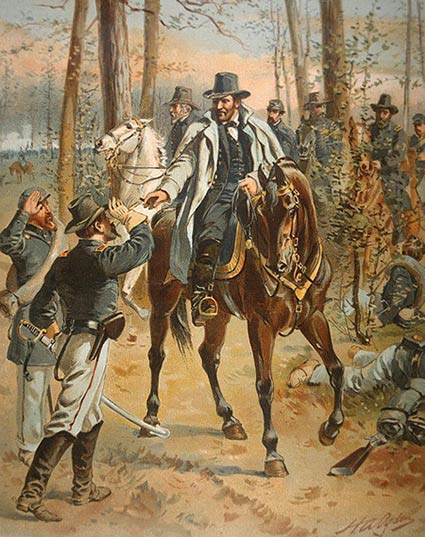
At one a.m., May 4th 1864, in the wee hours of the night the Army of the Potomac stepped off on a new campaign. Spirits were high. The air was filled with excitement that naturally accompanied a grand move of such a large army setting out on a fresh campaign. The troops were well rested, re-organized and recruited to a strength of nearly 102,000 men. From the few glimpses of General Grant the men had caught during the months of March and April, the new commander of all the armies seemed to be a determined man, with a string of victories to back him up. Many hoped that this campaign would bring the bloody war to a close. There were reasons to be hopeful. Notwithstanding, seasoned veterans were more cautious. They would wait and see before passing judgement on General Grant’s abilities. The same high morale had existed in the Army of the Potomac exactly one year earlier, in May, 1863, when General Joseph Hooker launched his Spring campaign. Hooker had likewise revitalized the army during the winter encampment of 1863, after the debacle of General Burnside’s tenure in command. But Hooker's campaign which began with great promise, ended in defeat. By comparison, how would General Grant perform? The new commander of all the armies considered the advance on May 4th a great success. The army crossed the Rapidan River, into enemy territory, un-opposed, on schedule, and in tact. The next days march, as planned, would bring them to favorable ground on which to face the enemy; ––General Lee’s army of 61,000 men. But General Robert E. Lee never did what his opponents expected, and he attacked before the Army of the Potomac could reach that favorable open ground. In the dense tangled jungle forest called the Wilderness, the Federal advantage in men and matériel was rendered meaningless. The subsequent battles of May 5 & 6 dissolved into a bloody stalemate with 17,000 Union army casualties. What went wrong? Some of my takeaways from studying the battle, list the following mistakes: altered plans, faillure of the cavalry to do its job properly, and impenetrable terrain, with a few of the usual command & control problems thrown in. These shortcomings contributed to the poor outcome of the Union effort. I’ll briefly outline these problems one at a time. Altered Plans 
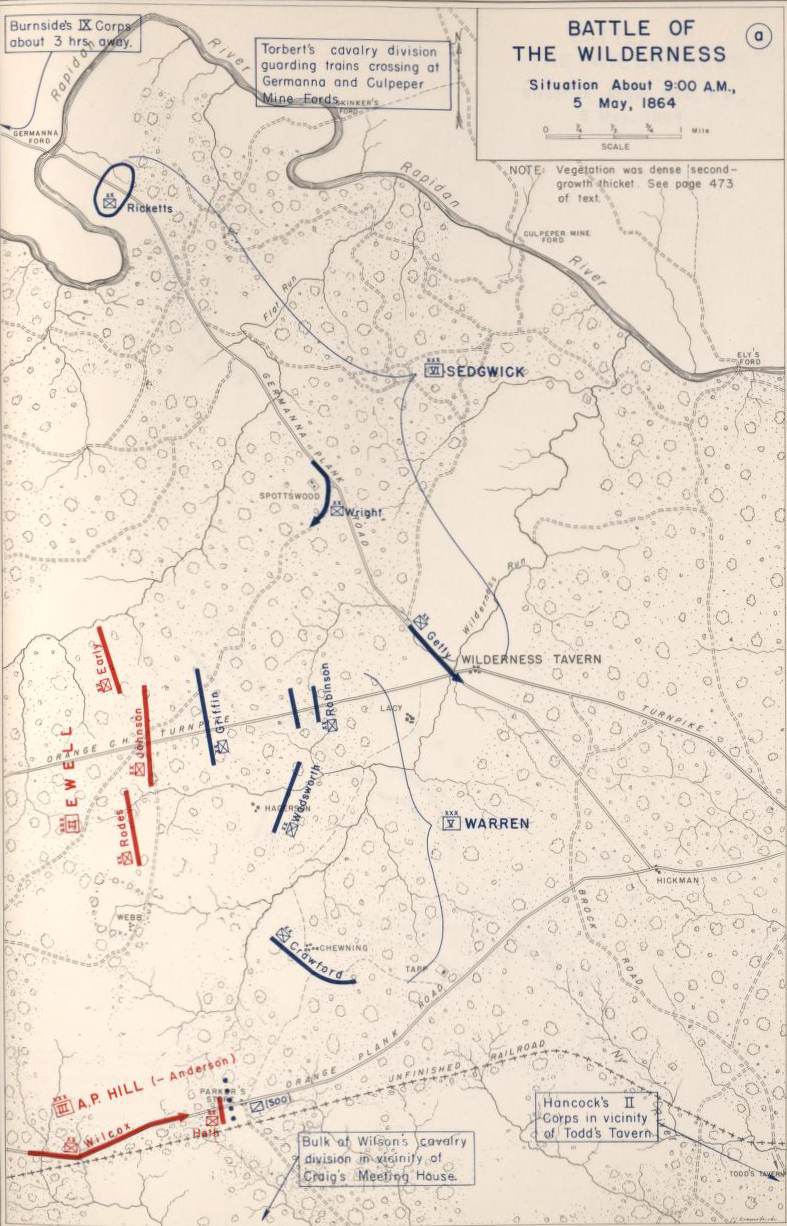
The original plans for the march drawn up by General Meade’s Chief of Staff, General Andrew A. Humphreys, [pictured] brought the armies beyond the forests of the Wilderness on May 4th. These plans were altered. So, the army stopped 5 miles short of its objective to keep within closer support of the slow moving supply wagon train. “If the movement to New Hope Church and Robertson’s tavern as indicated by General Humphreys, had been executed, the Army of the Potomac would have been placed in contact with the Army of Northern Virginia at daylight of May 5th, on comparatively favorable ground.” So wrote the author William H. Powell, in “The History of the Fifth Corps.” General Humphreys himself wrote, “The troops may have easily continued their march five miles farther…” Too much worry about the supply train risked fighting in the woods, which is what occurred.#1 General Grant didn’t really care where he encountered General Lee’s army, as long as it wasn’t in his strong defensive works. But the woods of the Wilderness hampered Grant’s desired objective and confounded General Meade’s efforts to consolidate his larger attack force. He wasn't able to bring the full weight and power of the Union Army's resources to bear against the enemy. Failure of the Cavalry Scouts General Hugh Judson Kilpatrick’s failed cavalry raid to Richmond ruined his chances at a presumed promotion. Instead Kilpatrick was transferred to the Army of the Cumberland. General Grant upon assuming command of all the armies, installed his own officers to command the Federal Cavalry Corps, and Kilpatrick’s 3rd Cavalry Division was re-organized. Brigadier-General James H. Wilson came from the west to replace Kilpatrick. And it was unfortunately this division that General Sheridan assigned to screen the army's advance. Wilson had never led cavalry. His appointment necessitated transferring two experienced higher-ranked brigade commanders into other divisions. A new colonel was put in command of one brigade, while Gen. George Custer’s brigade was removed entirely and replaced with another. In short, the re-organized division didn’t yet have the cohesion and camaraderie between troops and commanders that comes with time and experience in the field. Wilson commanded the smallest of the Army of the Potomac's 3 Cavalry Divisions. Some of Wilson's mistakes were critical. General Phil Sheridan and his Cavalry Division Commanders. Re-organized Cavalry Command: left to right, Brigadier General Henry E. Davies, Jr., who out-ranked Wilson and was transferred out of Kilpatrick's 3d Division to the 2nd Cavalry Division; Brigadier-General David McMurtrie Gregg, commanded 2nd Cavalry Division, Major-General Sheridan, Brigadier-General Wesley Merritt was transferred from the 1st Division (formerly the late John Buford's) to the Cavalry Reserve Brigade; Brigadier-General Alfred Thomas Archimedes Torbert took command of the 1st Division and Brigadier-General James H. Wilson, seated, a former aid to U.S. Grant, replaced Kilpatrick in command of the 3d Cavalry Division. On May 4th, Wilson’s force cleared the path for Genral G. K. Warren’s 5th Corps to reach its destination, Wilderness Tavern. Wilson was at the Lacy farm about 8.30 a.m. [called Ellwood––B.F.] and sent patrols from there, over roads west and south. When Warren’s lead elements appeared on the scene, Wilson ordered his scouts on the Orange Turnpike to ride to Robertson’s Tavern, (called Locust Grove), to clear away any enemy scouts encountered. After giving these orders Wilson’s main body of cavalry rode to Parker’s Store on the Orange Plank Road, a few miles to the south. They reached Parker's about 2 p.m. Then Wilson sent the 5th New York Cavalry west down the road to patrol in the direction of Lee's army. The rest of the division bivouacked for the night at Parker’s. 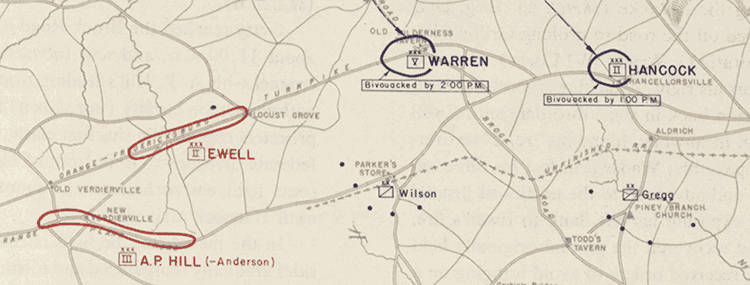 This U.S. Military Academy map, published 1962, shows the position of Wilson's Cavalry at Parker's Store and the relative positions of the Confederate Corps of Richard Ewell and A.P. Hill in relationship to Warren and Hancock's Army Corps, on the evening of May 4th. Wilson had sent scouts down the Turnpike in the early afternoon, but about dusk they left to join the rest of their division at Parker's without noticing Ewell's advance to Locust Grove, [Robinson's Tavern]. Click to view larger. The Turnpike scouts had a small skirmish at at Robertson’s Tavern, then rode a bit further west towards Mine Run Creek. At dusk, the afternoon of the 4th, they left the Turnpike and rode across country from Robertson's Tavern to join the rest of the division at Parker’s Store. Morris Schaff wrote, “The chances are that their dust had barely settled before on came Ewell.” Soon after this patrol left the Orange Turnpike, General Richard Ewell’s Confederate Division advanced 2 miles east past Robertson’s Tavern, and camped within 2 miles of General Warren’s 5th Corps––unknown to anyone. Robertson's / Robinson's Tavern on the Orange Turnpike at Locust Grove 
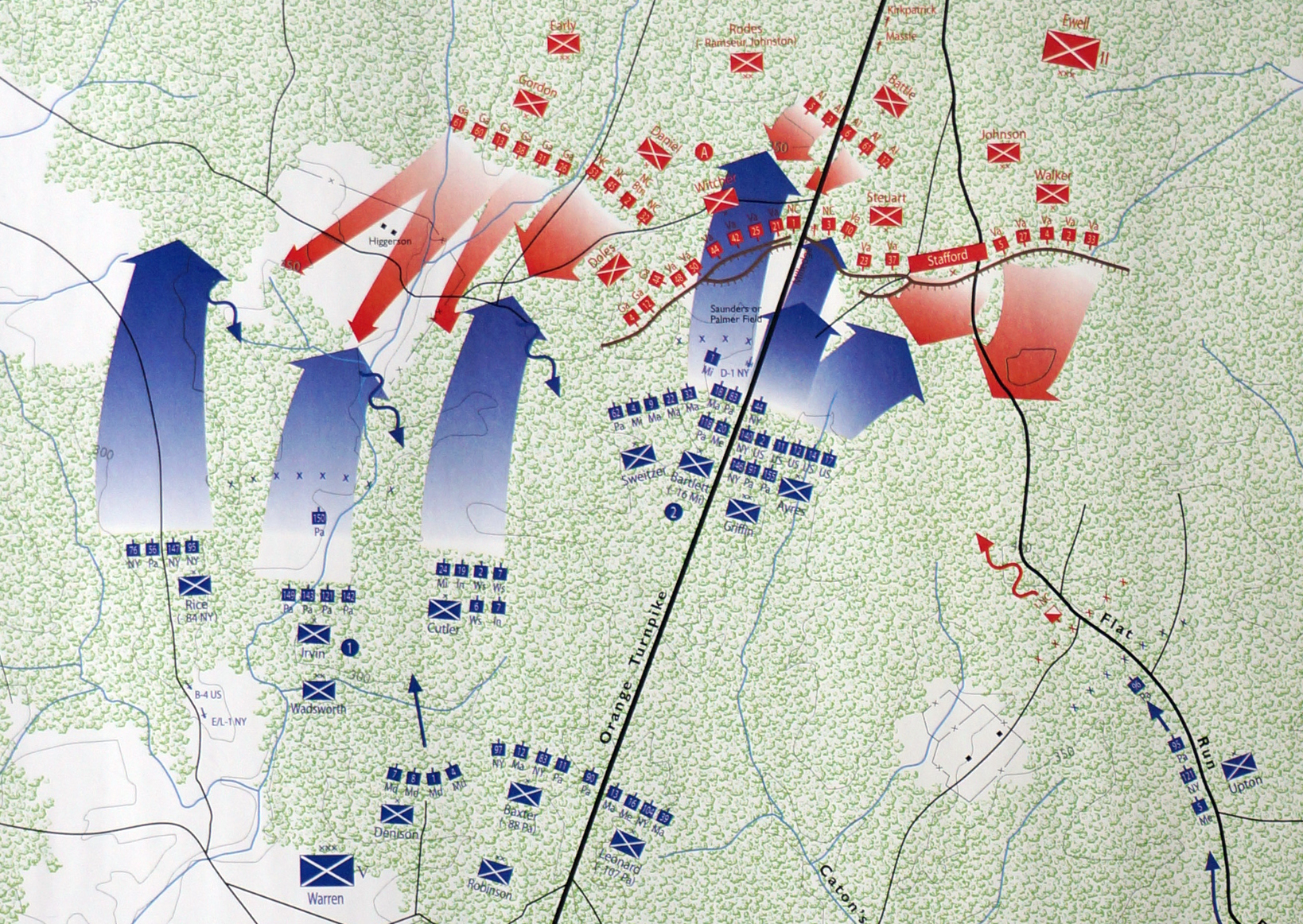
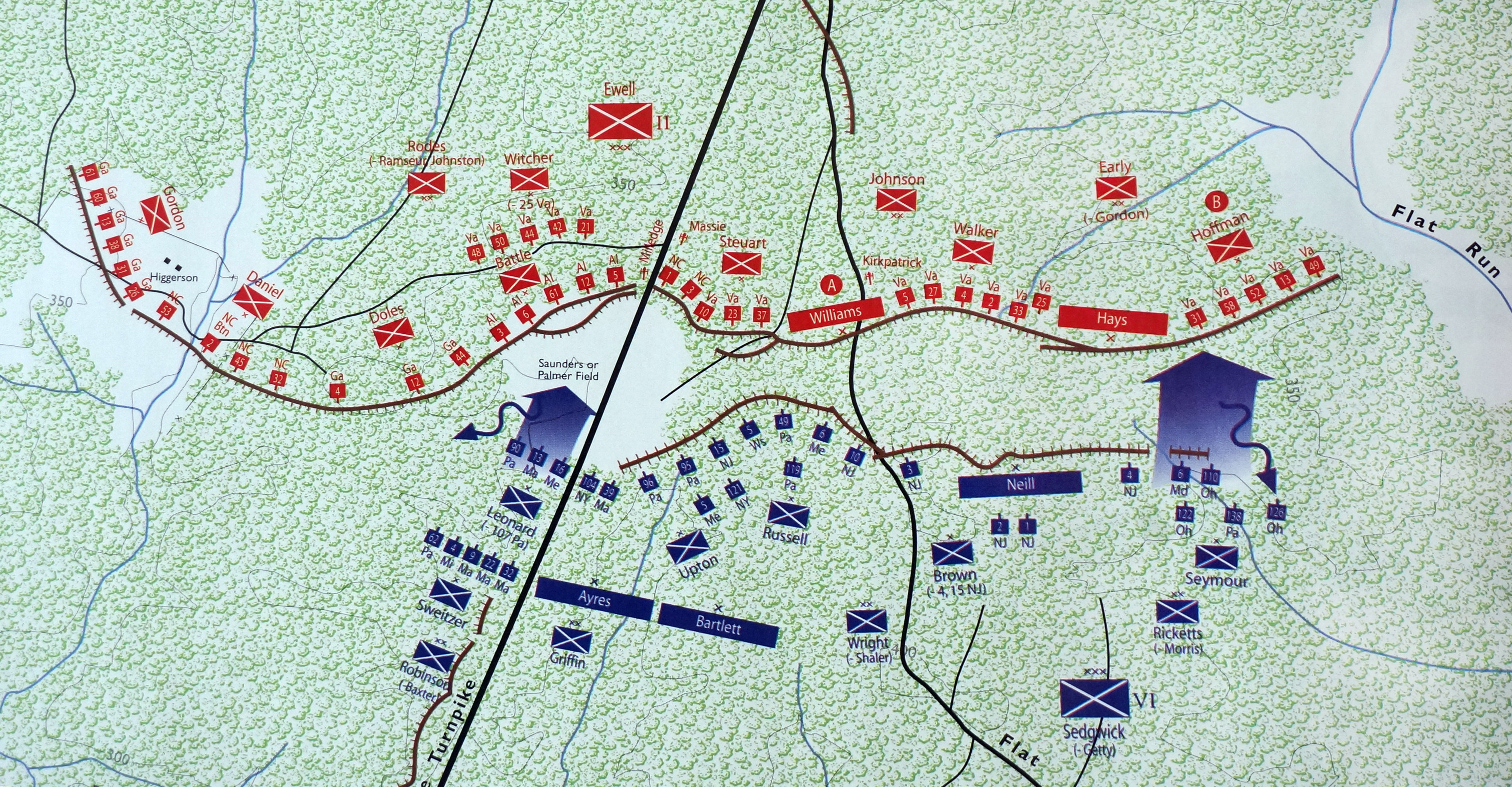
Robertson, or properly Robinson's Tavern on the Orange Turnpike, Locust Grove, VA. The structure still stands today, but has been moved a short distance away. The well pictured here, still exists on the original site; capped. A gas station & strip mall occupy the historic location today. Photo taken in 1910 by Frank Happel, National Park Historian, Fredericksburg. Wilson’s message to his superiors the evening of May 4th, reported the roads were clear. In fact the Orange Turnpike was completely unguarded. Wilson assumed that General Warren's 5th Corps infantry would send out its own pickets to protect their bivouack. Yet he failed to tell this to General Warren, who naturally expected the cavalry to be out paroling the roads and protecting his flank. Warren had no idea the enemy was so close. His pickets only extended a mile west down the road from Old Wilderness Tavern. At 8 p.m. General Meade sent a message to General Wilson exhorting him to keep patrols out to protect both roads. Wilson says he never received the message. Morris Schaff, considering all this writes, “Had they stayed at Locust Grove a few hours longer, what would have happened? Why, the orders issued at 6 o’clock would have been countermanded at once. Warren and Sedgwick would have struck at Ewell early in the morning, and Hancock, instead of going to Todd’s Tavern, would have reached Parker’s store by sun-up, and probably before noon a great victory would have been won.” #2 Another Problem: Impenetrable Terrain The army already knew from past experience the Wilderness was a terrible place to maneuver troops or fight a battle. The landscape favored defensive actions. One example of this would be General Horatio Wright's one and a half mile march through the woods to link up with the 5th Corps near Saunders Field on May 5th. At 11 a.m., Wright’s Division of the 6th Corps advanced down Spotswood Road [or, Culpeper Mine Ford Road––B.F.] to connect with General Warren’s lines north of the Orange Turnpike. A small force of Confederate skirmishers, probably the 1st North Carolina Cavalry, delayed the advance for several hours! Confederate skirmishers were able to delay the Union link up, forcing Warren’s divisions to attack Gen. Ewell's Corps alone, and without support. General Richard Ewell wrote in his campaign report: “Next morning [May 5] I moved down the pike, sending the First North Carolina Cavalry, which I found in my front, on a road that turned to the left toward Germanna Ford.” #3 Author George T. Stevens [77th N.Y. Infantry ––B.F.] described the difficulty of getting down the Culpeper Mine Ford Road, and the effectiveness of the Rebel skirmishers. “At eleven o’clock the corps faced to the front, and advanced into the woods which skirted the road. …The wood through which our line was now moving was a thick growth of oak and walnut, densely filled with a smaller growth of pines and other brushwood; and in many places so thickly was this undergrowth interwoven among the large trees, that one could not see five yards in front of the line. Yet, as we pushed on, with as good a line as possible, the thick tangle in a measure disappeared, and the woods were more open. Still, in the most favorable places, the thicket was so close as to make it impossible to manage artillery or cavalry, and, indeed, infantry found great difficulty in advancing, and at length we were again in the midst of the thick undergrowth.  Artist Correspondent Edwin Forbes sketched the 6th Corps fighting in the woods of the Wilderness. Steven's cont'd: “We thus advanced through this interminable forest more than a mile and a half, driving the rebel skirmishers before us, when we came upon their line of battle, which refused to retire.” #4 The landscape was equally bewildering for an attack force. Author William H. Powell in his history of the 5th Corps described what the fight was like enveloped in such a landscape. “The peculiar nature of the ground fought over made this a weird, uncanny contest––a battle of invisibles with invisibles. There had been wood-fights before, but none in which the contestants were so completely concealed as in this. Here nothing could be seen of the enemy or his doings but the white smoke that belched out of the bushes and curled and wreathed in fantastic designs as it slowly floated upward through the hot air, for it was a very sultry day. The tremendous roll of the firing shut out all other sounds. Here and there a man toppled over and disappeared, or, springing to his feet, pressed his hands to the wounded part and ran to the rear. Men’s faces were sweaty black from biting cartridges, and a sort of grim ferocity seemed to be creeping into the actions and appearance of every one within the limited range of vision. The tops of the bushes were being cut away by the leaden missiles that tore through them, and occasional glimpses of gray, phantom-like forms, crouching under the bank of cloud were obtained.” #5 Another 5th Corps officer in General Ayres' Brigade wrote about their attack on the north side of the turnpike at 1 p.m.: “The forward-march by company-front through the underbrush interwoven with wild grapevines and other creepers, soon became almost impossible. I remember that, in order to break an avenue for my own company, I pushed ahead with my back to the front, forming a passage for my men, who rushed after me in single file, as soon as possible, but without regard to the original formation of the company. As soon as we reached a clearing large enough for the purpose, we would re-form again on the run and try to re-establish the connection with the companies to the right and left of us. Thus we moved forward, unable to see anything else in front of us but tree-trunks and underbrush. I had just noticed that the right company of my regiment, and a few files of the right of my own company were going out of sight, diagonally to the front, losing the touch towards the road and to the left. I called to them with all my might in order to bring them back, but they either could or would not hear me, and we parted company right then and there. The next time I saw some of these men was at the close of the war, when they returned from Southern prisons.” #6 Command Problems 1: Failure to Co-operate The surprise encounter with the Rebels on the morning of May 5th didn’t disturb General Grant too much, he was determined to fight General Lee where ever he found him, but the inability of the Eastern generals to coordinate an attack did bother him, as hours of inaction passed by and the morning slipped into mid-day. The Army of the Potomac commanders couldn’t seem to co-operate with each other and had a great deal of difficulty assembling for an assault. General Warren hoped to attack when the promised 6th Corps troops from General Sedgwick's command arrived to support a charge. But these troops promised to Warren at 9 a.m. didn't receive orders to start on the march until 11 a.m. When they were underway, the enemy, as mentioned above, took every means to bushwack and delay their progress in the deep woods. General Meade informed General Grant at 7.30 a.m., “The enemy have appeared in force on the Orange pike, and are now reported forming line of battle in front of Griffin’s division, Fifth Corps. I have directed General Warren to attack them at once with his whole force.” Meade wrote to Grant again at 9 a.m., this time getting a little cocky at the end of the message, “Warren is making his disposition to attack, and Sedgwick to support him. Nothing immediate from the front. I think, still, Lee is simply making a demonstration to gain time. I shall, if such is the case punish him.” #7 Meade was probably trying to impress upon the new Commanding General of the Armies that he could be aggressive as needed. But the bold words fell flat. Meade and his officers decided at 9 a.m. General Wright’s Division of the 6th Corps would move down Spotswood / Culpeper Mine Ford Road, ––a shortcut through the Wilderness running from Spotswood Plantation to Saunders Field, to support Warren’s attack. The 6th Corps was perfectly poised to do so. It was not until 11 o’clock however, 2 hours later, that Wright’s Division was ordered forward. Confederate bushwackers further delayed their progress.    General G. K. Warren, Engineer Washington Roebling, and General Samuel W. Crawford. Gen. Warren meanwhile had a difficult time lining up his own 3 divisions for battle. General Samuel Crawford in command of Warren’s lead division, did not want to vacate his advanced position on the Chewning Farm, closeby to the morning's designated destination of Parkers Store. He and General Warren’s Chief Engineer, Major Washington Roebling, concurred that it was a key strategic position, situated on a hill commanding the Orange Plank Road, (upon which the enemy was advancing) so they both resisted Warren’s 11.15 a.m. orders to give up the field and move north to connect with General James Wadsworth's Division. To the contrary, Roebling was requesting General Warren send reinforcements to General Crawford! Roebling wrote Warren during the morning, “It is of vital importance to hold the field where General Crawford is. Our whole line of battle is turned if the enemy get possession of it. There is a gap of a half a mile between Wadsworth and Crawford. He cannot hold the line against an attack.”  The Chewning Farm, taken from the location of the farm house that stood during the battle, looking north, in the direction Crawford was supposed to move to link up with Wadsworth's Division. Warren, under increasing pressure from General Meade to attack, replied at 11.50 a.m., “You must connect with General Wadsworth, and cover and protect his left as he advances.” Finally at noon, Crawford began to comply with Warren’s directive.#8 To the north of Crawford, General James Wadsworth was hampered by the dense woods in his effort to connect his right flank with General Charles Griffin's Division at Saunders Field. And General Griffin’s subordinates directly in front of the enemy were counseling Warren to wait until re-enforcements from the 6th Corps arrived before they made any attack. They observed the enemy digging in and expressed to Warren that an isolated charge against well built earthworks by a single division would be futile. Lt.- Colonel William Swan, a staff officer who was on the ground with General Griffin's troops the morning of May 5th wrote: “I know that generals and staff officers all thought that the enemy was in strong force. I remember that word to that effect was sent back to General Warren, and I am sure that not long after I knew that Griffin had been ordered to attack. I think I carried the order from Griffin to Ayres to attack. I remember that Ayres sent me back to Griffin to say that in his judgment we ought to wait, for the enemy was about to attack us and we had a strong position; and I remember that Griffin went again to the front, and then sent me back to say to General Warren that he was averse to making an attack. I don’t remember his words, but it was a remonstrance. I think I went twice to General Warren with that message. The last time I met him on the road, and I remember that he answered me as if fear was at the bottom of my errand. I remember my indignation. It was afterwards a common report in the army that Warren had just had unpleasant things said to him by General Meade, and that General Meade had just heard the bravery of his army questioned.” #9  
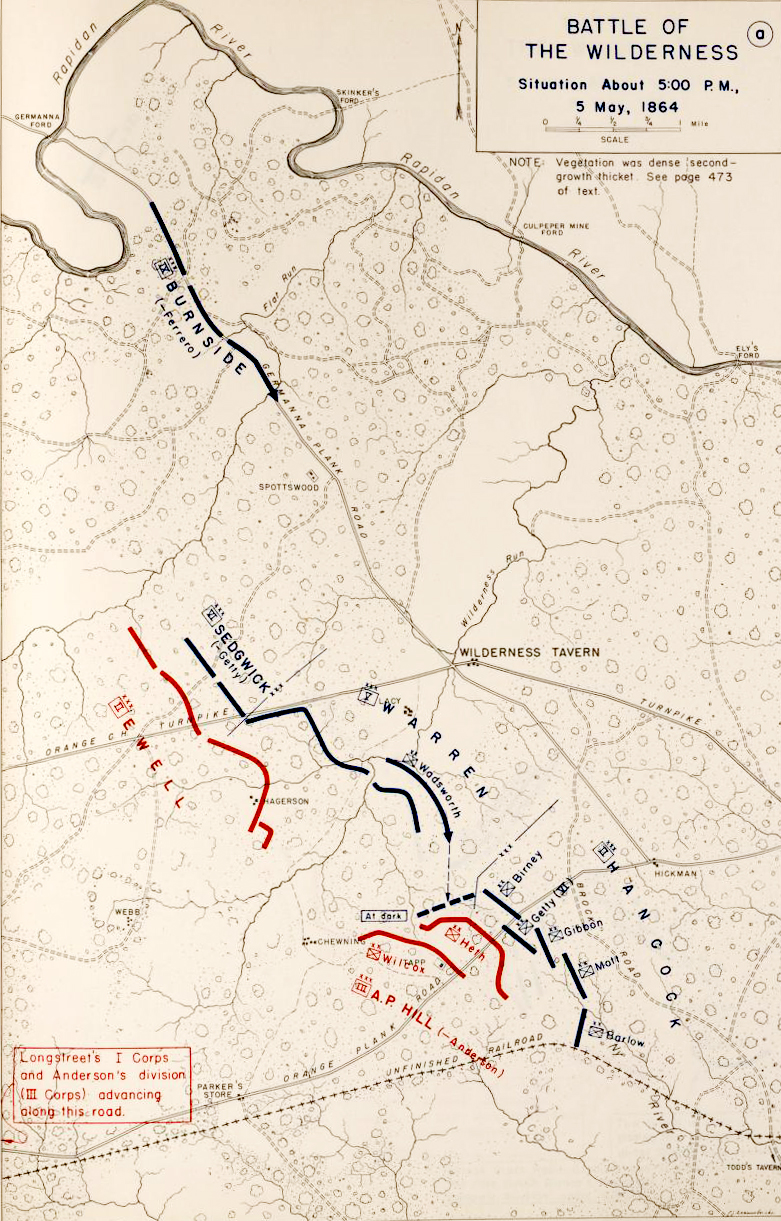
Brigadier-Generals Charles Griffin, commanding 1st Division, 5th Corps, and General Romeyn B. Ayres, commanding Griffin's 1st Brigade. Today, hindsight is everything, but General Warren, with his commanders reporting directly to him that a strong enemy force was in their front, was correct in his assessment of the situation. Warren was convinced that the impatience of Grant and Meade cost them a victory. Years later he wrote in a letter: “Meade and Grant, thought it only an observing brigade of the enemy opposed to me that we might scoop and that by taking time they would get away.” ”We had no certain means of knowing the strength of the rebel force. It would do well to move only with matters well in hand, as the repulse of my force would make a bad beginning.’ Warren reminded Meade, “that the 6th Corps was coming up on my right and that if time would be given them to get in position, as soon as they announced this by attacking I could move with my whole force against their front.” According to Warren Meade sternly replied. “We are waiting for you.” #10 Author Gordon C. Rhea summarized in his 1990 study of the battle: “The attack up the turnpike would be made not by two corps, as Meade had earlier planned, but by two divisions forming a wavering line across nearly two miles of woodland, both flanks open to the enemy. Six hours after Meade’s first order to attack, Warren was at last going forward.” #11 Grant and Meade criticized Warren’s behavior at the Wilderness, but Warren was right and the attack proved bloody and accomplished nothing. In his post-war assessment of things, General Warren reasoned, “Hill would have stood alone and nothing except retreat could save him. Longstreet was not up, and if Gen. Lee had made any attempt to hold on at the Wilderness, we should have finished him there. This is not an afterthought of mine, I saw it at once at the time.” #12 Command Problems II: Divided Command; General Burnside & the 9th Corps General Burnside ranked General Meade so General Grant chose to direct Burnside’s 9th Corps as a separate army. The protocol failed. Author Gordon C. Rhea writes, “On May 5, Burnside stood idle while the nearby 6th Corps sustained fearful losses.” “Grant’s failure to hurry Burnside to Wright’s assistance––and a momentous failure it was, considering that the added weight of Burnside’s three available divisions would have materially advanced the chances of shattering Ewell’s line––remains one of the Wilderness campaign’s mysteries. Surviving contemporaneous sources only deepen the puzzle, since they unequivocally confirm that Grant intended Burnside to lend Wright a hand if it was needed.” At 3 p.m. Grant messaged Burnside, “If General Sedgwick calls on you, you will give him a division.” Burnside replied, “General Potter’s division will soon be up, and I will hold him subject to General Sedgwick’s request.” #13 
George T. Stevens wrote in his history of the 6th Corps, “At half-past three o’clock our sufferings had been so great that General Sedgwick sent a messenger to General Burnside, who had now crossed his corps at Germania Ford, with a request that he would send a division to our assistance. “The assistance was promised, but an order from General Grant made other disposition of the division, and what remained of the noble old Sixth corps was left to hold its position alone. At four, or a little later, the rebels retired, leaving many of their dead upon the ground, whom they were unable to remove.” #14 There was another failure with the divided command. When General Grant decided upon his excellent plan to attack in Hancock’s sector in the early morning hours of May 6, General Burnside’s Corps had a crucial part to play. Grant’s instructions to him were explicit. “Lieutenant-General Grant desires that you start your two divisions at 2 a.m. tomorrow, punctually for this place. You will put them in position between the Germanna plank road and the road leading from this place to Parker’s Store, so as to close the gap between Warren and Hancock, connecting both. You will move from this position on the enemy beyond at 4.30 a.m., the time at which the Army of the Potomac moves.” #15 Burnside’s mission was to assault A. P. Hills flank. “According to an aide after Meade’s review of the projected offensive, Burnside rose grandly to his feet. The commander of the 9th Corps cut an impressive figure. Burnside, throwing his shoulders back assumed a thoughtful look. He declared resoundingly, “Well, then, my troops shall break camp by half-past two!” The assembled generals did not miss the fact that Burnside had added a half hour to the starting time assigned by Grant. The deviation, however, did not seem of consequence to the 9th Corps commander. With measured step, he threw open Meade’s tent flap and strode into the night. As soon as he disappeared, knowing looks passed around the table. Meade’s chief of engineers, Major James C. Duane, leaned forward and stroked his rusty beard. “He won’t be up––I know him well,” Duane reportedly whispered.” #16 Burnside was not in place to attack until 2 p.m in the afternoon on May 6th. Even after the designated start time for the attack was delayed a half-hour, for his benefit, from 4.30 to 5 a.m., he was nine hours late. Theodore Lyman, Gen. Meade’s volunteer aid recorded in his diary: May 6, Friday, All hands up before daylight. Sunrise was at about 4.40. The General [Meade––B.F.] was in the saddle in the gray of the morning. As he sat in the hollow by the Germanna Plank, up comes Capt. Hutton of Burnside’s staff and says only one division was up and the road blocked with artillery (part of which was then passing us). ––The General uttered some exclamation, and Hutton said: “if you will authorize me sir, I will take the responsibility of ordering the artillery out of the road, and bring up the infantry at once.” ––“No Sir” said Meade flatly. “I have no command over Gen. Burnside.” #17 The attack plan was important and Gen. Meade should have taken the initiative here. Lyman was sent to General Hancock’s sector of the battlefield to monitor its progress. Hancock attacked as planned. At 5.40 a.m. Lyman wrote to General Meade, “General Hancock went in punctually, and is driving the enemy handsomely.” If Burnside had been in place, the Federals could have driven the Confederates from the battle field before General Longstreet's reinforcements arrived later in the morning. Longstreet's arrival changed the dynamic of the battle in Hancock's sector. At 6.30 a.m. Lyman wrote to General Meade, “General Hancock requests that Burnside may go in as soon as possible. As General Birney reports, we about hold our own against Longstreet, and many regiments are tired and shattered.” Again, Burnside didn’t get into position and attack until 2 p.m. It was by then far too late to have the desired effect. “Burnside did little more than pecked at Hill and Longstreet.” #18 The split command between Burnside and Meade had terrible consequences for the army. And Gen. Meade failed when he refused to take action to try and hurry Burnside along. Perhaps Gen. Meade had a strong understanding about the touchy relationships between comanders when he said he had no command over Burnside. Otherwise it seems he would have done something. But it seems a shame he didn't try, considering the consequences that hung in the balance. Command Problems III: Jumbled Troops   Brigadier-General Alexander Webb. commander 1st Brigade, 2nd Division, 2nd Army Corps. Brigadier-General James S. Wadsworth, commander 4th Division, 5th Army Corps. The third leadership problem at the Battle of the Wilderness was the jumble of mixed commands. So many brigades and divisions were mixed between the four army corps by necessity, that it was difficult to get unit cohesion from the troops on the ground. General Alexander Webb’s narrative later on the page speaks directly to this issue. One example: When General Wadsworth appeared on the scene, [4th Division 5th Corps] he took command of Webb’s 12 regiments, which included some 9th Corps troops, as well as Webb’s 2nd Corps Brigade. Wadsworth sent Webb on a silly errand, before understanding the strategic importance of Webb’s position, and then launched a foolish charge that got himself mortally wounded. The story speaks for itself. According to Gen. Webb, whose bitterness comes through in his post-war account, his men prepared a strong earthwork to prevent the enemy from advancing beyond its crucial location. Webb told them to hold the works at all cost. But Gen. Wadsworth arrived and ordered Gen. Webb away on a scout. Wadsworth rode up, and ordered Webb's men over the works to charge forward. They explained the importance of their position to Gen. Wadsworth who accused them of cowardice for not wanting to leave the protection of their fortifications. In a show of bravado, Wadsworth leapt over the defenses saying he would charge himself. Not to be out done, Webb's proven troops followed the general to the attack. This resulted in a lot more men getting killed, including Wadworth himself. Aftermath - Morale & Casualties In his narrative, General Webb commented on the devastating impact the battle had on the morale of the soldiers. “From personal contact with the regiments who did the hardest fighting, I declare that the individual men had no longer that confidence in their commanders which had been their best and strongest trait during the past year.” 
Lieutenant Morris Schaff, an aide with General Warren, penned his own battle history and solemnly summed up the situation at battles end. Author Morris Schaff, left, was a young officer recently graduated from the Military Academy at West Point when he joined active service. He wrote many books. Here he is pictured as an older man. “Two days of deadly encounter, every man who could bear a musket thad been put in; Hancock and Warren repulsed, Sedgwick routed, and now on the defensive behind breastworks; the cavalry drawn back; the trains seeking safety behind the Rapidan; thousands and thousands of killed and wounded,… and the air pervaded with a lurking feeling of being face-to-face with disaster. What, what is the matter with the Army of the Potomac? #19 Casualties were so high they were fudged by at least one general. G. K. Warren was observed at his headquarters desk brooding over the reported losses. His aide, Lieutenant Morris Schaff tells the story. It is the night of May 5th at the Lacy House. “After supper, which did not take place until the day’s commotion had well quieted down, I happened to go into the Lacy house, and in the large, high-ceiled room on the left of the hall was Warren, seated on one side of a small table, with Locke, his adjutant general, and Milhau, his chief surgeon, on the other, making up a report of his losses of the day. Warren was still wearing his yellow sash, his hat rested on the table, and his long, coal-black hair was streaming away from his finely expressive forehead, the only feature rising unclouded above the habitual gloom of his duskily sallow face. A couple of tallow candles were burning on the table, and on the high mantel a globe lantern. Locke and Milhau were both small men: the former unpretentious, much reflecting, and taciturn; the latter, a modest man, and a great friend of McClellan’s, with a naturally rippling, joyous nature. The room at Ellwood used by General Warren, exactly as Lt. Schaff described it. “Just as I passed them, I heard Milhau give a figure, his aggregate from data which he had gathered at the hospitals. “It will never do, Locke, to make a showing of such heavy losses,” quickly observed Warren. It was the first time I had ever been present when an official report of this kind was being made, and in my unsophisticated state of West Point truthfulness it drew my eyes to Warren’s face with wonder, and I can see its earnest, mournfully solemn lines yet. It is needless to say that after that I always doubted reports of casualties until officially certified. Shortly after, Warren, accompanied by Roebling, went to a conference of the corps commanders which Meade had called to arrange for the attack which Grant had already ordered to be made at 4.30 the next morning.” #20 The Battle in the Wilderness cost both sides heavily. Irreplaceable was the loss of experienced veteran solders. The bloodletting continued through to early June. By the end, both armies were wholly changed from that with which they had begun. NOTES. May 4th, 1864: The River CrossingHere begins the chronology of the Campaign. Prologue: Memoirs of George Kimball, 12th MA Excerpt from “My Army Life,” by George Kimball; Boston Journal, June 10, 1893. In May the spring campaign began. At midnight on the 3d we broke camp and marched to the Rapidan. At noon next day that stream was crossed at Germanna Ford. Then began a series of battles that lasted up to the very day our term expired. We had still 52 days to serve, but our thoughts now traveled homeward, and we reminded each other of the welcome fact that the day was not far distant when we would greet wives and mothers and other dear ones. We were living in the future while conscious of a present that gave small promise indeed of the fulfillment of our desires. We dreamed of our homes when sleep was permitted and talked of them incessantly amid the roar of artillery and the rattle of musketry. Many, oh how many of those good, brave fellows were to find graves in the depths of the forests that lay in our bloody pathway to the James! How many, of them were to die that the nation might live, with the love of kindred and friends so strongly moving them to heroic deeds! As I write, their faces come back to me again, and I see them once more, as, lighted by love of home and love of country, they press forward at the word, never faltering, never seeking to spare themselves, for to true men honor is dearer than everything else, and stronger even than human ties. 1 shall not attempt to describe the great battles through which we passed in our journey to Petersburg, for I must bring my long story to a close. On the 5th, in The Wilderness, seven of our men were killed and 50 wounded. The next day five more gave up their lives and 20 were wounded, and on the 7th two were killed and four wounded. Letter to General Grant from President Lincoln Executive
Mansion,
Lieutenant-General Grant Not expecting to see you again before the Spring campaign opens, I wish to express, in this way, my entire satisfaction with what you have done up to this time, so far as I understand it. The particulars of your plans I neither know, or seek to know. You are vigilant and self-reliant, and pleased, with this, I wish not to obtrude any constraints or restraints upon you. While I am very anxious that any great disaster, or the capture of our men in great numbers, shall be avoided, I know these points are less likely to escape your attention than they would be mine. If there is anything wanting which is within my power to give, do not fail to let me know it. And now with a brave army, and a just cause, may God sustain you. Yours very truly,
History of the 13th Massachusetts, Charles E. Davis, Jr. The following is from, “Three Years in the Army,” by Charles E. Davis, Jr; Estes & Lauriat, Boston, 1894. Wednesday, May 4, 1864. “On to Richmond” was once more the cry. Joined the Second Division of the Fifth Corps near Culpeper, continuing our march, crossing the river at Germanna Ford, halting at 3.30 P.M. on the south side of the plank-road about two and a half miles from Robertson’s tavern. [I think Davis may mean Wilderness Tavern––B.F.] The weather was hot and the roads dusty. The distance covered was twenty-two miles. The whole army was on the move, and an imposing spectacle it must have been to the lookers-on. The men carried six days’ rations. Two and a half months more and we should be marching toward Boston unless we took up our residence, before that time, in the “promised land.”
Edwin Forbes sketch titled, “The Supply Train,” Few persons, even soldiers, have any idea of the size of a wagon train required to feed, clothe, and provide ammunition for an army numbering a hundred thousand men, say nothing of the ambulances, the wagons for transporting the hospital stores, the baggage of officers, and the books and papers necessary to each regiment. It is said that General Grant’s wagon train if stretched out in a continuous line would reach a distance of one hundred miles. It was an interesting sight to see a “wagon park.” Five hundred wagons, arranged in lines as straight as soldiers on dress parade, were frequently to be seen at the headquarters of the chief quartermaster, where also might be seen harness-makers, all in full operation, where hundreds of horses and mules were shod every month, and wagons and harnesses repaired. A park of five hundred wagons meant a collection of not less than two thousand mules. Multiply the noise made by one mule by two thousand, and you can judge how little chance there is for sleep within a radius of ten miles. 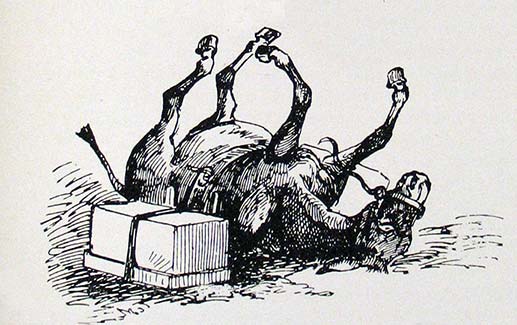 General Meade Addresses the Army, May 4th Headquarters
Army of the Potomac, Soldiers: Again you are called upon to advance on the enemies of your country. The time and the occasion are deemed opportune by your commanding general to address you a few words of confidence and caution. You have been reorganized, strengthened, and fully equipped in every respect. You form a part of the several armies of your country, the whole under the direction of an able and distinguished general, who enjoys the confidence of the Government, the people, and the army. Your movement being in coöperation with others, it is of the utmost importance that no effort should be left unspared to make it successful. Soldiers ! the eyes of the whole country are looking with anxious hope to the blow you are about to strike in the most sacred cause that ever called men to arms. Remember your homes, your wives and children, and bear in mind that the sooner your enemies are overcome the sooner you will be returned to enjoy the benefits and blessings of peace. Bear with patience the hardships and sacrifices you will be called upon to endure. Have confidence in your officers and in each other. Keep your ranks on the march and on the battlefield, and let each man earnestly implore God’s blessing, and endeavor by his thought and actions to render himself worthy of the favor he seeks. With clear consciences and strong arms, actuated by a high sense of duty, fighting to preserve the Government and the institutions handed down to us by our forefathers ––if true to ourselves ––victory, under God’s blessing, must and will attend our efforts. GEO G. MEADE,
About this order, Private Bourne Spooner, Company D of the 13th Mass, wrote in his diary: [May 3] Map of the March 
Map of prominent landmarks on the march of the First & Second Brigades of General Robinson's Division, to Germanna Ford, from their respective starting positions. Colonel Leonard's First Brigade was separated from the rest of the Division during the Winter Encampment. The Division consolidated during the march May 4th. A third Brigade of Maryland troops commanded by Colonel Andrew W. Denison had been added to the division, It is not indicated on this map but started from the vicinity of Culpeper. History of the 39th Massachusetts, Alfred S. Roe Alfred Roe gives more details in this description of the 1st Brigade's march from Mitchell's Station, to Pony Mountain, to Stevensburg, etc. Included is a very brief mention of Virginia's Colonial Governor, Alexander Spotswood, (pictured below), for whom, Spotsylvania, Germanna Ford, and the Wilderness derived their respective names. By the way, there is only one "T" in the name, though the soldiers often spelled it with two. Spotswood is a fascinating, often amusing character full of ambition, fantastic schemes, fantasy dream houses and more. His dynamic personality often irritated his contemporary colonial and royal associates. He is worth far more exploration than is appropriate to present here, –––for those interested The following is from, “The Thirty-ninth Regiment Massachusetts Volunteers, 1862-1865;” by Alfred S. Roe, 1914. THE MARCH May 4th, 1864. At first our own course is northward toward Culpeper, then we bear off to the right, passing the headquarters of the Sixth Corps, and those of the Army of the Potomac skirting the base of Pony Mountain and on to Germanna, remembered well in our Mine Run campaign. Though nominally, for several days a part of the Fifth Corps, we do not actually meet any part of the Corps itself till just before reaching the ford. We cross the river at about 11 a. m., nowhere encountering any opposition from the enemy, who evidently is endeavoring to ascertain what Grant’s objective may be, catching up with the other portions of the the Corps late in the afternoon. After an arduous march of considerably more than twenty miles, burdened by heavy knapsacks filled in winter quarters, our division bivouacked near the Wilderness Tavern.  Artist Edwin Forbes did this contemporary sketch of Wilderness Tavern and the battle-field along the Germanna [Plank] Road and Orange Turnpike. The tavern is long gone. Period Photos of the singular out-building on the right of the tavern exist, as does its chimney which still stands and is preserved by the National Park Service. The picture is cropped upon the left half of the panoramic drawing. In the foreground is the road to Chancellorsville, crowded with ambulances and wounded men. Wagons line the road in front of the tavern (difficult to see at this size). The Lacy House, which would be General G. K. Warren's Headquarters, is visible in the sketch on a hill to the right, but its been cropped out of this view. On the night of May 4th, General Sheridan & Staff were camped around the tavern. A strip mall stands in the foreground area today. A grassy divider to Modern Hiway, Route 3 runs through the site of the tavern. Remains of the Wilderness Tavern Dependency   Pictured at left is a dependency of the old Wilderness Tavern. It can be seen in the sketch above. The ruins of the same structure today, as preserved by the National Park Service, is pictured at right. The original Tavern stood in the background trees of the 2nd photo. Click here to view larger. Alfred Roe, continued: “From this point the almost countless campfires of our army could be seen, always an impressive sight, and never were the soldiers of the Potomac Army in a more impressible mood than after their long period in winter quarters. Of the troop thus in bivouac, Lieut. Porter of Company A wrote, “The men were in the best of spirits. They believed that the supreme effort to bring the rebellion to a close was being made. There were enthusiasm and determination in the minds of everyone. “A year ago the word “Wilderness” was frequently heard as the events of Chancellorsville were discussed and now it is to gain even wider mention; it seems a name quite out of place in the midst of the Old Dominion, not so far from the very first settlements in British North America.” 
“General Morris Schaff in his story of the great battle says this of the section, “What is known as the Wilderness begins near Orange Court House on the west and extends almost to Fredericksburg, twenty-five or thirty miles to the east. Its northern bounds are the Rapidan and the Rappahannock and, owing to the winding channels, its width is somewhat irregular. At Spottsylvania, its extreme southern limit, it is some ten miles wide. “Considerably more than a hundred years before, there were extensive iron mines worked in this region under the directions of Alexander Spottswood, then governor of Virginia. To feed the furnaces the section was quite denuded of trees and the irregular growth of subsequent years, upon the thin soil, of low-limbed and scraggy pines, stiff and bristling chinkapins, scrub-oaks and hazel bushes gave rise to the appellation so often applied. Hooker and Chancellorsville are already involved in memories of the region and coming days will give equal associations with Grant and Meade, while the Confederates, remembering that within its mazes their own shots killed their peerless leader, Jackson, ere many hours have passed will lament a similar misfortune to Longstreet. “Within this tangled thicket, artillery will be of no avail and the vast array of thunderers will stand silent as artillerymen hear the roar of musketry; cavalry will be equally out of the question, but within firing distance more than two hundred thousand men will consume vast quantities of gunpowder in their efforts to destroy each other.” “It is generally understood that General Grant did not expect an encounter with Lee within the Wilderness itself, as is evident in Meade’s orders to Hancock and the Second Corps; indeed on the 5th the latter was recalled from Chancellorsville to the Brock Road at the left of the Fifth Corps, the Confederates having displayed a disposition to attack much earlier than the Union Commanders had thought probable; how Sedgwick and the Sixth Corps held the Union right, Warren and his Fifth the centre and Hancock with the Second were at the left are figures from the past well remembered by participant and student. While every movement of the Union Army has a southern tendency, a disposition to get nearer to Richmond, yet in the Wilderness all of the fighting was along a north and south line, the enemy exhibiting an unwillingness to be out flanked as easily as the new leader of the Potomac Army had evidently expected.”  Army of the Potomac Artillery Crossing the Rapidan River at Germanna Ford, May, 1864. Journal of Colonel Charles Wainwright, Chief of 5th Corps Artillery 
The following is from, “A Diary of Battle; The
Personal Journals of Colonel Charles S. Wainwright, 1861 ––1865.”
Edited by Allan Nevins; Stan Clark Military Books, Gettysburg,
PA, © 1962. Winslow's battery, mentioned in the text would play an important part in the battle. Old Wilderness Tavern, May 4, Wednesday. It was nearly two o’clock this morning when we got our orders to haul out. I had managed a few short snatches of sleep before that time, but do not improve in my ability to go off at any moment and in any place. There is a kind of weird excitement in this starting at midnight. The senses seemed doubly awake to every impression––the batteries gathering around my quarters in the darkness; the moving of lanterns, and the hailing of the men; then the distant sound of the hoofs of the aide’s horse who brings the final order to start. Sleepy as I always am at such times, I have a certain amount of enjoyment in it all. We got off without much trouble in order thus. Rittenhouse,
“D.” 5th U.S. -– 6 10 pdr. parrot Great care was taken not to make any more fires than usual, so as not to attract the attention of the enemy; otherwise the darkness and distance were a quite sufficient cover to our movement. Through Stevensburg, on towards Shepherd’s Grove for another mile or so, and then across country through a byroad, we had it all to ourselves. When we arrived at the head of the Germanna Plank Road we had to wait an hour for the two divisions which were to precede us to file by. It was nine o’clock by the time I reached the ford. After crossing, General Warren directed me to divide the batteries among the infantry divisions for the march through the Wilderness sending Cooper ahead with Crawford’s division which lead; (Martin, Phillips & Winslow with Griffin; Rittenhouse & Mink with Robinson; Breck & Stewart with Wadsworth. 
I hated to break them up so on the first day’s march, before I had time to look after them all, but an unbroken string of artillery over a mile long was certainly somewhat risky through these dense woods. We moved on very slowly, although there was a division of cavalry ahead of us, and did not all get up here until near dark. The First and Third Divisions went into position immediately on the west side of the road; the 2d Div. formed on Griffins right the 4th on Crawfords left making a sort of semi-circle. Cooper, Martin, Phillips & Winslow were posted on the high ground around the house of Major Lacy, a really fine mansion standing on a knoll which commands the country in every direction. Pictured above is a period photo of the Lacy mansion, "Ellwood." The camera is looking at the north facade of the structure. Some of the dependencies are still standing in this image. That may be the plantation ice-house in the left foreground. The area is heavily wooded today. The other 4 Batt’s camped on the
east of the road we had come up by, around a tannery some half mile
before you reach the tavern: my own H’d Qts were hard by, &
Gen’l
Warren’s only a short distance off. The 6th Corps has crossed,
their
advance joining our right, –– Meades H’d Qts are with the
6th; Grant is still on the north of the river, ["A Bowery Boy," pictured; ––(N.Y. City Roughs.) ––B.F.] On the “Mine run” campaign I did not come to this point, which is the intersection of the Orange & Fredericksburg turnpike, with the Germania Plank road, as we cut across the corner through a by road. There is a large opening here of several hundred acres embracing the tavern, Maj Lacy’s & two or three other houses: all the rest of the country seems one vast wilderness of –– half grown pines & scrub oaks. Every thing so far has gone well; all has been done that was expected; one more day without interruption will put us where we want to be: but there is a big stir in Lee’s camps long before this no doubt, & we may run our noses against him at any time. My spring waggon broke down at the very start; the horses ran away with it & smashed the pole, so all the things had to go into the army waggon: Cruttenden sent the broken concern to be mended at once. We had no rain during the day; but some this evening, with a prospect of more during the night. I understand that all the other armies started today also: the campaigning opens with a combined move. Orders have just come for us to move tomorrow morning at five o’clock to Parker’s Store, on the Orange Court House Plank Road, the Sixth Corps moving up to this point. Captain Ludington and the Wagon TrainJournal of Theodore Lyman, May 4th 1864. General Meade's aristocratic aide and friend, Theodore Lyman relates the movements of Army Headquarters on May 4th. He describes the monumental effort to get the army across the Rapidan River without incident, which General Grant considered a great achievement in itself. He mentions quarter-master Marshall Ludington by name in this entry. The story of Captain Ludington's ordeal follows immediately, as it was told in John D. Billings' classic work about life in the Army of the Potomac, titled, “Hardtack & Coffee.” 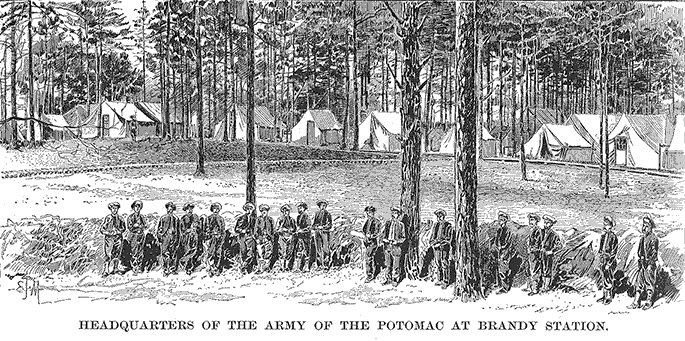 s s The following is from, “Meade's Army, The Private Notebooks of Lt Col Theodore Lyman,” edited by David W. Lowe, Kent State University Press, Kent, OH, 2007. May 4, Wednesday. 
7 a.m. The General unluckily came up with a cavalry waggon train, out of place; the worst thing for his temper! He sent me after its Quartermaster, Capt. Luddington, whom he gave awful dressing to, and ordered him to get his whole train out of the road and to halt till the other trains had passed. #1 The sun getting well up made the temperature much warmer, as was testified by the castaway packs & blankets with which troops will oft at the outset encumber themselves. 8 a.m. Arrived near Germanna Ford and halted just where we had camped the night of the withdrawal from Mine Run. Sapristi, [Good Heavens!] it was cold that night! Though here was green grass in place of an half inch of ice. Griffin’s division was over and his ammunition was then crossing. 8.30 a.m. News from Hancock that he was crossing, Gregg having had no oppositions and having seen only videttes. ––Roads everywhere excellent. [David M. Gregg's Cavalry Division screened the river crossing of Gen. Hancock's 2nd Corps at Ely's Ford. ––B.F.] 9.30. We crossed. There were two pontoons, a wooden & a canvass, the ascent up the opposite high and steep bank was bad, with a difficult turn near the top. #2 We halted just on the other side and Grant & his staff arrived some time after 12.15 p.m. All the 5th Corps, with its artillery and wheeled vehicles across. ––It began at 6.30 a.m. The 6th Corps began to cross at 12.40 and was all over at 5.20 and the canvas pontoon was taken up. A good part of the time, say ½, only one pontoon could be used, because the troops were moving in single column. We may then estimate 15 hours for the passage of 46,000 infantry, with one half of their ambulances and ammunition and intrenching waggons and the whole of their artillery, over a single bridge, with steep, bad approaches on each side; i.e. a little over 3,000 men an hour, with their artillery and wheels. The latter took a good deal of time because of the delay in getting them up the steep ascent. [Gen. Sedgwick's 6th Corps followed the 5th Corps at Germanna Ford. ––B.F.]  Sat on the bank and watched the steady stream, as it came over. That eve took a bath in the Rapid Ann and thought that might come sometime to bathe in the James! Our cook, little M. Mercier, came to grief, having been spirited away by the provost guard of the 2d Corps, as a straggler or spy so our supper was got up by the waiter boy, Marshall. Our camp was near the river, and Grant’s was close to us. Some of his officers; Duff & old Jerry Dent e.g. were very flippant and regarded Grant as already routing Lee and utterly breaking up the rebellion! ––not so the more sober. ––There arrived Gen. Seymour, the unlucky man of Olustee, dark bearded and over given to talk and write; but of well known valor. He was assigned to a brigade 3d Div. 6th Corps, where his command was destined to be of the shortest. #3 NOTES. [by David W. Lowe,
editor of Lyman's notebooks.] Captain Ludington
& General Wilson's
Cavalry Supply Train Here is another incident which will well illustrate the trials of a train quartermaster. At the opening of the campaign in 1864, Wilson’s cavalry division joined the Army of the Potomac. 
Captain Ludington (now lieutenant-colonel, U. S. A.) was chief quartermaster of its supply train. It is a settled rule guiding the movement of trains that the cavalry supplies shall take precedence in a move, as the cavalry itself is wont to precede the rest of the army. Through some oversight of the chief quartermaster of the army, General Ingalls, the captain had received no order of march, and after waiting until the head of the infantry supply trains appeared, well understanding that his place was ahead of them on the march, he moved out of park into the road. At once he encountered the chief quartermaster of the corps train, and a hot and wordy contest ensued, in which vehement language found ready expression. Chief Quartermaster General Rufus Ingalls, poses with his horse and dog. Anyone who includes his horse and dog in their portrait is okay in my book. While the dispute for place was at white heat, General Meade and his staff rode by, and saw the altercation in progress without halting to inquire into its cause. After he had passed some distance up the road, Meade sent back an aid, with his compliments, to ascertain what train that was struggling for the road, who was in charge of it, and with what it was loaded. Captain Ludington informed him that it was Wilson’s cavalry supply train, loaded with forage and rations. These facts the aid reported faithfully to Meade, who sent him back again to inquire particularly if that really was Wilson’s cavalry train. Upon receiving an affirmation answer, he again carried the same to General Meade, who immediately turned back in his tracks, and came furiously back to Ludington. Uttering a volley of oaths, he asked him what he meant by throwing all the trains into confusion. “You ought to have been out of here hours ago!” he continued. “I have a great mind to hang you to the nearest tree. You are not fit to be a quartermaster.” In this manner General Meade rated the innocent captain for a few moments, and then rode away. When he had gone, General Ingalls dropped back from the staff a moment, with a laugh at the interview, and, on learning the captain’s case, told him to remain where he was until he received an order from him. Thereupon Ludington withdrew to a house that stood not far away from the road, and, taking a seat on the veranda, entered into conversation with two young ladies who resided there. 
Soon after he had thus comfortably disposed himself, who should appear upon the highway but Sheridan, who was in command of all the cavalry with the army. On discovering the train at a standstill, he road up and asked:–– “What train is this?” “Captain Ludington.” “Where is he?” “There he sits yonder, talking to those ladies.” “Give him my compliments and tell him I want to see him,” said Sheridan, much wrought up at the situation, apparently thinking that the train was being delayed that its quartermaster might spend further time “in gentle dalliance’ with the ladies. As soon as the captain approached, the general charged forward impetuously, as if he would ride the captain down, and, with one of those “terrible oaths” for which he was famous, demanded to know what he was there for, why he was not out at daylight, and on after his division. 
As Ludington attempted to explain, Sheridan cut him off by opening his battery of abuse again, threatening to have him shot for his incompetency and delay, and ordering him to take the road at once with his train. Having exhausted all the strong language in the vocabulary, he rode away, leaving the poor captain in a state of distress that can be only partially imagined. General Phil Sheridan, pictured right. When he had finally got somewhat settled after his rough stirring-up, he took a review of the situation, and, having weighed the threatened hanging by General Meade, the request to await his orders from General Ingalls, the threatened shooting of General Sheridan, and the original order of General Wilson, which was to be on hand with the supplies at a certain specified time and place, Ludington decided to await orders from General Ingalls, and resumed the company of the ladies. At last the orders came, and the captain moved his train, spending the night on the road in the Wilderness, and when morning dawned had reached a creek over which it was necessary for him to throw a bridge before it could be crossed. So he set his teamsters at work to build a bridge. Hardly had they begun felling trees before up rode the chief quartermaster of the Sixth Corps train, anxious to cross. An agreement was entered into, however, that they should build the bridge together; and the corps quartermaster set his pioneers at work with Ludington’s men, and the bridge was soon finished. Recognizing the necessity for the cavalry train to take the lead, the corps quartermaster had assented that it should pass the bridge first when it was completed, and on the arrival of that moment the train was put in motion, but just then a prompt and determined chief quartermaster of a Sixth Corps division train, unaware of the understanding had between his superior, the corps quartermaster, and Captain Ludington, rode forward and insisted on crossing first. Struggle for precedence immediately set in. The contest waxed warm, and language more forcible than polite was waking the woodland echoes when who should appear on the scene again but General Meade. On seeing Ludington engaged as he saw him the day before, it aroused his wrath most unreasonably, and, riding up to him, he shouted, with an oath: “What! are you here again!”
Then shaking his fist in his face, he continued: “I am sorry now that I did not hang you yesterday, as I threatened.” The captain, exhausted and out of patience with the trials which he had encountered, replied that he sincerely wished he had, and was sorry that he was not already dead. The arrival of the chief quartermaster of the Sixth Corps, at this time, ended the dispute for precedence, and Ludington went his way without further vexatious delays to overtake his cavalry division. 
There never was a corps better organized than was the quartermaster’s corps with the Army of the Potomac in 1864. With a wagon-train that would have extended from the Rapidan to Richmond, stretched along in single file and separated as the teams necessarily would be when moving, we could still carry only three days’ forage and about ten to twelve days’ rations, besides a supply of ammunition. To overcome all difficulties, the chief quartermaster, General Rufus Ingalls, had marked on each wagon the corps badge with the division color and the number of the brigade. At a glance, the particular brigade to which any wagon belonged could be told. The wagons were also marked to note the contents; if ammunition, whether for artillery or infantry; if forage, whether grain or hay; if rations, whether bread, pork, beans, rice sugar coffee or whatever it might be. Empty wagons were never allowed to follow the army or stay in camp. As soon as a wagon was empty it would return to the base of supply for a load of precisely the same article that had been taken from it. Empty trains were obliged to leave the road free for loaded ones. Arriving near the army they would be parked in fields nearest to the brigades they belonged to. Issues, except ammunition, were made at night in all cases. By this system the hauling of forage for the supply train was almost wholly dispensed with. They consumed theirs at the depots. I left Culpeper Court House after all the troops had been put in motion, and passing rapidly to the front, crossed the Rapidan in advance of Sedgwick’s corps; and established headquarters for the afternoon and night in a deserted house near the river. Orders had been given, long before this movement began, to cut down the baggage of officers and men to the lowest point possible. Notwithstanding this I saw scattered along the road from Culpeper to Germania Ford wagon-loads of new blankets and overcoats, thrown away by the troops to lighten their knapsacks; an improvidence I had never witnessed before. Leonard's & Baxter's Brigades on the MarchSergeant Austin Stearns' Memoirs, 13th MA, Company K For the last part of his memoir, Sergeant Stearns would quote from his original field diary before each day's entry, and then elaborate. The following is from, “Three Years With Company K,” by Sergeant Austin C. Stearns, (deceased) Edited by Arthur Kent; Associated University Press, 1976. Wednesday the 4th “Fair, a pleasant day, routed up at 1 A.M. to strike tents and prepare for a march. Marched at half past two towards Culpeper, turned off and went to Stevensburg. From there to Germania Ford, crossed and went to near Wilderness Tavern. Bivouacked at 4 P. M. Marched about 24 miles. One of the hardest marches.” My recollections of this day are very fresh. The day was warm, and we were heavily loaded when we started, but as the day advanced the boys commenced to throw away their things. Over coats and blankets went, knapsacks were over hauled, and extra stockings, drawers, old letters that the boys had treasured up, in fact any thing and every thing that could lighten the load.
Austin Stearns' sketch from his memoirs. At Stevensburg we came upon the camps of other Corps, and such sights of clothing as were there, and all the rest of the way. I commenced by throwing away drawers, stockings then tearing my blanket in two, cutting off the cape of my over coat, knowing from past experience that I should need them in a few days. Some of the boys threw away every thing but their rations. Memoir of Major Abner Small, 16th Maine The following is from, “The Road to Richmond,” by Major Abner R. Small, edited by Harold A. Small, University of California Press, 1959. May 3d the expected orders to march was received; and at two o’clock in the morning of Wednesday May 4th, we started. Our division brought up the rear of Warren’s corps.  Under the bright stars our long column went north towards Culpeper Court House, then turned to the east and marched into a glorious spring day. Wild flowers were up; I remember them nodding by the roadside. Everything was bright and blowing. A little way beyond the clump of houses that was Stevensburg we topped a ridge commanding a wide view, and saw a splendid sight; all the roads were filled with marching men, the sunlight glinting on their muskets, and here and there on burnished cannon. We followed a narrow road that turned south into somber woods, and after a while we came to the Rapidan, crossed a pontoon bridge at Germanna Ford, and marched away from the swift stream into the green quiet of the Wilderness. The day had not been oppressively warm but in the narrow defile among the trees no air was stirring and the heat of the long marching under a heavy load provoked some of our men to throw away overcoats and blankets. We lost a few stragglers. When orders came down the line for us to halt and bivouac for the night we were nearing Wilderness Tavern. Diary of Sam Webster, Drum Corps, 13th MA “The Diary of Samuel
D. Webster”
Wednesday, May 4th, 1864 Are now the 3rd Division of the 5th Corps –– 1st Brigade. The 1st and 5th Corps are now consolidated, two divisions the 1st and 2nd being made from the 5th and two more, the 3rd and 4th divisions, from our old corps, the 1st. All of our 3rd division have been put into the 2nd (now 3rd Div of 5th corps) or into the 1st (now 4th div of 5th corps) : the badges being retained. [Sam is mistaken here. He is in the 2d Division of the 5th Corps, not the 3rd. This detail may not have been as obvious as one would think. His brigade was separated from the rest of the division and corps during the winter encampment at Mitchell's Station when the change was made.––B.F.] Diary of Corporal Calvin Conant, 13th MA The following is from the “Diary of Calvin Conant”
[Company G] Wednesday, May 4, 1864 March about 3 miles and stop for the night. Made about 20 miles to day feel tired and my feet are all blistered to day the sun shone hot and it was dusty.  Artist & War Correspondent Edwin Forbes sketched the army under General Hooker marching through the Wilderness a year earlier on May 2nd, 1863. Forbes was present again for General Grant's Campaign and would add some excellent sketches of the 1864 battle to his portfolio. Private Bourne Spooner's Journal, 13th MA The following is from The Journal of Private Bourne Spooner, Company D. From the Boston Public Library Special Collections. Transcribed by Bradley M. Forbush. Note the date of this entry. Dorchester Mass. Sat. July 23d 1864 A great deal of surplus clothing, tents, fry pans, post &c that had accumulated during the winter had to be left behind and half of what was taken was afterwards disposed with. The night was very dark yet at about One(?) o’clock the line was formed and the column put en route. Our direction lay along the Culpepper road and many supposed we were bound for the Rappahannock and Centreville, but as we proceeded on our course veered towards Pony Mountain which we doubled and marched then directly towards Germanna Ford. Pony Mountain viewed from a high hill at Stevensburg looking west. A few buildings stand, not visible in this image, where the road ends in the far distant middle-ground. They are the remains of the tiny hamlet of Stevensburg. The Baptist Church founded by Rev. Thornton Stringfellow sits atop the high ground. Rev. Thornton Stringfellow is buried here. If you re-read Major Abner Small's account above, he mentions the view from this hill. Pony Mountain is prominent in the background. It was the sight of a Union Lookout station. Lucky Stevensburg is soon to be favored with a modern data center, which will no doubt add to the quaint ambiance of the location. Private Spooner, cont'd: We again fell in, struck on to the plank road and
marched in to the Wilderness. That night after a 
The Conscripts The number of men still serving in the "13th Mass" was not large coming in at just under 200 when they set out on the march. Their number was diminished by another seven who chose to desert. These were conscripts of August, 1863,who decided they would rather not participate in any upcoming battles and so took the opportunity to disapear. The last we heard of the conscripts was in April, when 24 or so transfered to the navy. Three more of them vanished on May 4th. They were Charles Wilson, age 23 of Company G, Thomas Sullivan, age 32, of Company I, and Theodore Thiel, age 31 also of Company I. Four others deserted on May 5th, all of them in Company A. Martin Gerity, age 26, Michael J. Giblin, age 21, Thomas Horton, age 23, and Charles Searles age 31. I count about 52 of the original 186 conscripts, in number who were still with the regiment. Several of them would die or be wounded in the coming battles. The remainder were transferred to the 39th MA in mid-July when the regiment concluded its term of service.
GENERAL HENRY BAXTER'S BRIGADE The following Narratives are from General Henry Baxter's 2nd Brigade; the 9th N.Y. & 12th MA Regiments. History of the 9th New York Militia (83rd N.Y. Vol. Infantry), George A. Hussey This narrative sets the stage for the battle on the 5th & 6th of May. Baxter's Second Brigade fought on another part of the battlefield than the First Brigade, on the evening of the 5th and early the next morning. The descriptions of troop movements and placements in this narrative are very accurate. James Ross, whose letters have been prominently featured on this website was present during this march. Certainly he would have written as vivid a description of it as possible, had he survived the battle. He was mortally wounded on May 6th, during heavy fighting in the woods by the regiment, and died some days later at a hospital in Fredericksburg. His family didn't learn his fate until after the war closed. The following is from, “History of the Ninth Regiment N.Y.S.M.––N.G.S.N.Y. (Eighty-third N.Y. Volunteers.) 1845-1888”, by George A. Hussey, Edited by William Todd, 1889. After tattoo, in the evening of the 3rd, orders to “pack up and be ready to march at ten o’clock” made the camps a scene of bustling activity. The men were to destroy what they could not carry with them, but no bonfires were allowed to warn the enemy of the contemplated movement. Eight days’ rations had been crowded into the men’s haversacks and knapsacks, their cartridge boxes each held forty rounds of ammunition, while ten extra rounds were stored away among crackers or clothing. It looked very much like “business.” At half-past eleven, the Ninth, five hundred and fifteen strong, took its place in the brigade and the march began. The infantry marched, regardless of roads, pushing through fields and woods, fording streams and wading through swamps. Daylight of the 4th found the column passing through the village of Stevensburg, and marching along the plank road towards Germanna Ford. A short distance beyond the town the troops halted an hour for breakfast, after which the march was resumed, few halts being made until the Rapidan was reached. It was found that Wilson’s division of cavalry had laid a pontoon early in the morning, and, crossing over, had driven the enemy back a mile or more from the river. At this point, the river, at its ordinary stage, is only about two hundred feet wide, the water too deep to ford, and the current running swiftly. The engineer corps, assisted by details from other regiments, were soon at work, and by noon another pontoon bridge was thrown across. On the southern bank the enemy had occupied a line of rifle pits, which they had abandoned as soon as they saw the formidable demonstrations made by the Union troops.
Artist & War Correspondent Edwin Forbes sketched the part of the army crossing the Rapidan River at Germanna Ford on May 5th, 1864. There had been no opposition made to the crossing, and, preceded by Wilson’s cavalry, the Fifth corps led the advance of the Army of the Potomac upon a campaign, which did not end until the rebellion was crushed and the remnants of Lee’s army surrendered at Appomattox. The Sixth corps followed in the footsteps of the Fifth, while the Second crossed at Ely’s Ford, a few miles further down the stream. The Sixth corps was to form on the right, the Fifth the center, and the Second the left of the line of battle. General Grant had anticipated some opposition in the crossing; referring to the matter in his Memoirs, he says: “This I regard as a great success, and it removed from my mind the most serious apprehensions I had entertained, that of crossing the river in the face of an active, large, well-appointed, and ably-commanded army.” By one o’clock in the afternoon, the infantry were crossing on the bridges. A strong line of flankers guided either side of the marching column, Company C performing that duty on the part of the Ninth. About four o’clock, the corps reached the vicinity of the Wilderness Tavern, at the intersection of the Germanna and Orange Court House turnnpikes. Line of battle was formed facing southwest, and the interminable underbrush reminded the men of their experience at Chancellorsville the year before. The line now formed was about three miles west of the position occupied by the First corps at that time. Exclusive of the Fourth division of the Ninth corps, which was composed entirely of colored troops, who were not put into action at this time, Grant had under his command about one hundred and eighteen thousand men, while the Confederates had about sixty-one thousand. On the night of the 4th, Wilson’s cavalry had reached Parker’s Store, five miles south of the Tavern; the Sixth corps was on the right of the Fifth, while the Second was on the old battle-field of Chancellorsville. The Ninth corps was still north of the river. Grant had crossed over and established his headquarters near Germanna Ford, and Meade was close by. As soon as Lee became aware of Grant’s movements, he put his army in motion to check the Union advance, and at dark the opposing lines of infantry were but five miles apart, while the cavalry outposts were almost within speaking distance. Narratives from the 12th Massachusetts The 12th Mass., long associated with the 13th, was also in Henry Baxter's Brigade. They had about 3 weeks less time to serve than the 13th, to finish out their 3 year term of enlistment, ––but they suffered far more casualties than the 13th, before that day arrived. The following is from, “History of the Twelfth Massachusetts Volunteers, (Webster Regiment)” by Lieutenant––Colonel Benjamin F. Cook, Boston, 1882. May 4. At noon crossed the Rapidan at Germania Ford. Halted about an hour, and were joined by two other corps. Marched at 1.15 p.m. Went five miles on the plank-road, and bivouacked at Old Wilderness Tavern. The Twelfth was sent out on picket. Total distance marched, seventeen miles. Though––as it afterwards appeared ––the rebels were but two miles away, neither side was aware of the other’s proximity. Commentary
So everything seemed fine within the Army of the Potomac under the stars on the tranquil night of May 4th. The army successfully crossed into enemy territory unchallenged. The left wing of the army under General Hancock was camped at Chancellorsville, 4 miles east on the same road as General Warren's bivouack. Some of General Grant’s staff, “were very flippant and regarded Grant as already routing Lee and utterly breaking up the rebellion! –– not so the more sober.” Theodore Lyman who recorded the remark in his diary, wrote his wife ten days later on May 15, “they have changed their note now, and you hear no more of their facetiousness.”#1 Fifth Corps pickets advanced a mile up the Orange Turnpike to keep an eye out for enemy scouts. The enemy were supposedly miles away. The 13th MA were camped near Flat Run on the Germanna Plank road, as stated in this message to Headquarters. Hdqrs.
Fifth Army Corps, Army of the Potomac, Major-General Humphreys: My whole command is in this vicinity. There was no water to camp on after leaving Flat Lick Run. General Robinson is about 1 mile nearer to you than the rest. He pickets along the plank road to connect with General Getty, of the Sixth Corps, at Flat Lick Run. General Wadsworth throws out a picket-line along the gravel road, 3 miles toward Chancellorsville, to near the junction with the plank road. My position is good. The men are almost all in camp washing their feet, and with a good night’s rest will feel find. I have repaired the bridges here, at least six in number, to otherwise not passable for wagons, and left a large pioneer force to complete the crossings at Flat Lick Run besides calling General Getty’s attention to them. I have one brigade out nearly 1 mile toward Parker’s Store. Respectfully, G. K. WARREN
Cavalry Commander, General James H. Wilson was satisfied that he had done a good job screening the army’s advance on his first real day of responsibility. He sent the following message to General Warren. Hdqrs. 3d
Div., Cav. Corps, Army of the Potomac, Commanding Fifth Corps: My whole division is at this place, patrols and advanced parties well out on the Spotsylvania and Orange roads. No enemy on former, and but small parties on this. Drove them 6 miles, or to within 1 mile of Mine [Run] road. Patrol from here toward Robertson’s not yet reported. Rodes’ division reported to be stretched along the road as far as 12 miles this side of Orange. Will notify you of any changes in this direction. J. H. WILSON,
At headquarters, General Sheridan told Meade a lone division of enemy cavalry was reported near Fredericksburg. If Meade allowed, Sheridan wished to ride out to meet and destroy them while they were isolated. Meade relented and agreed. Sheridan would take his two remaining Cavalry divisions on the raid the next morning, leaving Wilson alone, to screen both wings of the entire army’s advance. Luckily, before Sheridan's expedition got underway, it was learned that the information was false. Good thing too, for by then Wilson's division was in a pickle. The reality was the Union Army was marching blind. General Hill’s 3d Corps of Lee’s army had advanced further down the Orange Plank Road than Wilson’s scouts knew, the evening of May 4th. And General Ewell’s 2nd Division of Lee’s army was just 2 miles from the 5th Corps pickets on the Orange Plank road. The Union commanders were surprised the next morning to find the enemy so near as reported by the pickets of Griffin's Division. But without knowing the force of the adversaries threatening his front General Meade was convinced it was of little consequence, and that Lee’s army would not advance beyond the line of earthworks established the previous winter during the Mine Run campaign. While Meade was redirecting the 5th Corps troops to make an attack along the Orange Turnpike, General Wilson had ridden south as ordered, the morning of the 5th, to screen the continued advance of the army as planned. He left a regiment behind to picket the Orange Plank road toward Verdierseville. The 5th New York Cavalry, commanded by Lt-Col. John Hammond, encountered Hill’s infantry in force moving toward Parker’s Store, the destination of the 5th Corps. Though Hammond’s New Yorkers put up a good fight and slowed the Confederate advance, there were no infantry troops forthcoming to help. General Hill fought his way to Parker’s Store, cutting off General Wilson’s Cavalry Division from the rest of the Army of the Potomac. Wilson could no longer communicate with headquarters. Wilson was eventually forced to retreat when his way forward was blocked by enemy cavalry. After fighting a fine delaying action he barely made it safely to Todd’s Tavern where he found General Gregg’s 2nd Cavalry Division waiting for him. The cancellation of Sheridan’s raid, allowed General Gregg to move south in search of Wilson. Unfortunately, whatever his merits, General “Sheridan had neglected to screen the army’s critical western flank and had failed to discover two Confederate corps approaching on the major thoroughfares from Orange Court House.” #2 He had other ambitions for the cavalry. His lack of interest in scouting, combined with the learning curve necessary for the new cavalry commanders caused deadly consequences for the army he served in the opening battles of the new Spring campaign. Wilson’s retreat prevented a proper screening of Confederate forces to the south of what became General Hancock’s 2nd Corps position during the Battle of the Wilderness. Hancock’s constant worry about his left flank markedly affected his performance on the Plank Road May 6. NOTES Essay: Lost in the Wilderness; Finding the 13th MA on May 5th
The Battle of the Wilderness took place May 5th ––May 7th 1864. The 13th MA played a subordinate, reserve role in the main events of the conflict, yet they did participate and they did take eleven casualties. Tracing their movements on May 5th wasn’t easy. There were no reports from the First Brigade commanders printed in the Official Records of the War of the Rebellion. If Col. Leonard wrote a report it is missing. A musket ball struck division commander, General John C. Robinson (pictured) in the knee at the Battle of Spotsylvania on May 8th. Badly wounded, he didn’t submit his campaign report until a year after the war ended. It is dated April 25, 1866. He omitted any mention of Colonel Leonard’s 1st Brigade at the Wilderness. Robinson wrote: “It was my intention to have made a full report of these operations, but having failed to receive the reports of my brigade commanders, I have been unable to do so.” #1 My key reference point for the regiment at the battle, is a series of 5 detailed maps published by The Fredericksburg, Wilderness, and Spotsylvania Battlefield National Park. The maps approximate the positions of every regiment on the field during the two days fight during key moments of the battle. I initially took these maps at face value, knowing they must have been thoroughly researched. However it is extremely difficult to get everything correct on any battle map. I have seen and heard of alternative opinions regarding the maps, with regard to the placement of troops, and have formulated my own ideas for the location of Col. Leonard’s Brigade, using source materials the Park Service didn’t have when the maps were created. Like at Gettysburg, where a brigade report is also absent, it is necessary to gather and read what the soldiers in the regiments of the brigade and division, wrote in their histories and letters. Also like at Gettysburg, some of the regiments may have acted independently from others in the brigade. My clearest account of what the 13th regiment did on May 5th comes from the journal of Private Bourne Spooner, Company D. I recently received scans of this document from the Boston Public Library Special Collections. Comparing what Spooner wrote, with other reminiscences and diary entries, an idea was formed of the various positions the regiment took during the day. [The 6th of May is a bit easier to follow.] I’ve divided the 1st Brigade’s actions on May 5th 1864 into four distinct phases. PHASE 1 Advance in the morning, down the Germanna Plank Road about 2 miles to General G.K. Warren’s 5th Corps Headquarters at the Lacy House, [Ellwood]. Here they rest on the side of a hill with their backs to the house, until about 1 o’clock p.m. PHASE 2 They form up mid-day on the ground where they are waiting, then cross to the woods on the north side of the Orange Turnpike and advance along the road to the woods at the edge of Saunders Field. Here the regiments connect with the 22nd & 32nd MA of Jacob Sweitzer’s Brigade. They fan out to the north, forming their right flank against Keaton's Run. They help repulse Alabama and North Carolina troops trying to claim two abandoned Federal Field pieces straddling the Turnpike which divides Saunders Field. They may have changed position a couple times in this general area. PHASE 3 Re-enforcements from General Horatio Wright’s Division of the 6th Corps arrive on the scene at 3 p.m. and relieve some of the 5th Corps units north of the turnpike, which fall back, (particularly Sweitzer’s Brigade). Sometime (probably well near 4 p.m.) the 16th Maine & 13th MA cross the road to the woods on the south side of the Turnpike. The 16th Maine forms at the south-east edge of Saunders Field, next to the 90th PA on their right, whose right flank is against the road. The 13th MA swings around the 16th Maine, about a half-mile from the road and move deep into the woods near where General Lysander Cutler’s Iron Brigade of Wadsworth’s Division fought earlier in the day. They are detached from the rest of the brigade, the 16th Maine to their right and rear. I believe the 39th MA remained in position on the North side of the road when the other two regiments crossed to the south side. I have no information at all to draw upon as reference for the 104th N.Y. Like the 13th MA their numbers are small. I just assume they remained in battle-line on the north side of the turnpike. PHASE 4 A charge along the whole line is ordered for 6 p.m. The 13th MA are deep in the woods guarding the brigade's left flank. An attempt to advance is obstructed by a swamp, but they are engaged and suffer some few casualties. They change positions a few times, but spend the night deep in the woods. After a brief summary of what took place before the brigade arrived on the scene, I will discuss these four phases of their day. SUMMARY  Illustration by artist Mark Churms for the Park Service. The subject matter shows Generals Grant and Meade meeting wtih General Warren at the Horace Lacy plantation, called Ellwood. A quote from 5th Corps Commander General G. K. Warren’s report sums things up succinctly. “Set out according to orders, 6 a.m., towards Parker’s store––Crawford, Wadsworth, Robinson; enemy reported close at hand in force and when Crawford had nearly reached Parker’s, Generals Meade and Grant arrived and determined to attack the force on the road near Griffin (Warren’s right division.––B.F.). Wadsworth was gotten into line immediately on the left of Griffin with one brigade of Crawford, Robinson in support. [Denison's Maryland Brigade––B.F.] We attacked with this force impetuously, carried the enemy’s line, but being flanked by a whole division of the enemy were compelled to fall back to our first position, leaving two guns on the road between the lines that had been advanced to take advantage of the first success. The horses were shot and the guns removed between our lines. [Guns removed by Confederates May 6th, evening.––B.F.] “The attack failed because Wright’s (Third) division of the Sixth Corps was unable on account of the woods to get up on our right flank and meet the division (Johnson’s of Ewell’s Corps) that had flanked us. Wright became engaged some time afterward. We lost heavily in this attack; and the thick woods caused much confusion in our lines. The enemy did not pursue us in the least. We had encountered the whole of Ewell’s Corps.” #2 Battlefield Map #1.
Warren’s report is accurate except for the word “immediately” used in describing Wadsworth’s Division and one brigade of Crawford’s Division getting into line to attack. The alignment was ordered at 7.30 a.m. and the attack commenced at about 12: 50 p.m. Click here
to view map larger. General Charles Griffin’s Division comprised 3 brigades, commanded by Brigadier-Generals Romeyn B. Ayres, Joseph J. Bartlett, and Colonel Jacob Sweitzer. General Ayres was north of the Turnpike, Bartlett was south of the road, and Sweitzer was in reserve, straddling both sides. Colonel Leonard would advance and connect with Sweitzer’s right wing in time to help with the repulse of the Confederate counter-charge which tried to claim two Union cannons stranded in the road. General Ayres’s advance through Saunders Field on the north side of the turnpike met much stiffer resistance than Bartlett’s Brigade on the south side. Ayres’ line was outflanked by the enemy concealed in woods far to the right. In fact Ayres and Bartlett had protested vehemently against attacking before troops of the 6th Corps could get up and support their line of battle. They knew an unsupported attack would prove disastrous. But General Warren was under severe pressure from General Meade to attack without delay. Morris Schaff, an aid to General Warren wrote, “The eagle spirit in Meade is up, and a captious wonder pervades his and Grant’s staff why Warren does not attack. No one seems to know or care whether Upton is alongside of Griffin or not; even up to that hour a good many of the wise ones among them were pretty sure that there was nothing very serious in front of Warren.” #3 When Ayres’ Brigade reached the Rebel line across Saunders Field, the men became ensnared in the dense tangle of undergrowth and were overpowered by superior numbers of the enemy. Ayres’ men fell back with heavy loss, pursued by Confederates. General Bartlett’s attack across the south side of Saunders Field had much more initial success than General Ayres’ to the north of the road. Bartlett’s Brigade broke through the Confederate line on the western edge of Saunders Field and pursued the enemy for about ½ a mile down the pike. But they lost order in the woods and without re-inforcements they were compelled to retreat. A soldier in Bartlett’s first line, Captain A. M. Judson, 83rd PA, (pictured, March, 1862) wrote, “At length the order to charge was given; and in an instant the whole three brigades, in double line and with bayonets fixed, ran forward with such a yell as must have made the Johnnies realize, for once, Milton’s phrase of “hell broke loose,” if they never had before. For they no sooner heard it than they got up and dusted without ever firing a shot. Their skirmishers, however, as was their duty, fired a few rounds and then lit out after the rest. Col. Woodward was struck below the left knee with a bullet at the outset, and was helped off the field. We kept on yelling and firing into the woods at every jump; for now that we had got the Johnnies on the run, it was policy on our part to keep them going, lest, by giving them time to halt and take breath, they should turn and give us as such a punch in the ribs as would take the breath out of us. We encountered no enemy and but few of us saw any, except the few skirmishers that had been shot down or wounded in their retreat. On we went, o’er briar, o’er brake, o’er logs and o’er bogs, through the underbrush and overhanging limbs, for about three-quarters of a mile, yelling all the while like so many demons, until we came to another small opening and there halted. We had by this time got into such a snarl that no man could find his own company or regiment. In fact, the whole brigade had to be unravelled before we could again form line and continue the pursuit.” #4   Captain Amos M. Judson, 83rd Pennsylvania, pictured, when he was a young lieutenant in March, 1862. Image Courtesy of the Harmon History Center, Erie, PA. Brigadier-General Joseph J. Bartlett commanded Judson's brigade. General Bartlett's men advanced so far forward they began to take enemy fire from their rear, ––where Ayres’s men were supposed to be. Author Gordon C. Rhea wrote, “Unknown to Bartlett, Ayres had made little headway past Saunders Field and was taking a nasty licking three-quarters of a mile back. Bartlett’s flank and rear were wide open.” “…No option remained but to drop back in hopes of finding an opening to the main Union line.” #5 Captain Judson’s narrative concludes: “It was now Johnnies’ turn to come the game of pull-the-link-horn over us, and right well did they improve the opportunity. Every man saw the danger, and without waiting for orders to fall back, broke for the rear on the double quick. The rebels, in their turn, commenced yelling and sending minnies after us, killing and wounding many of our men…. We ran almost every step of the way back, and when we got there we laid down on our backs and panted like so many hounds which had just come in from a ten hours chase after a gang of foxes. Such was the result of our first day’s battle in the Wilderness.” #6 A distinctive moment in the battle came when General Warren ordered up a section of artillery, Battery D, of the 1st N.Y., to help the first line of General Ayres assault at the beginning of the fight. Lt. Morris Schaff, an aid to General Warren, describes the scene in detail. “The section, under Lieutenant [William H.] Shelton, riding a spirited chestnut and accompanied by his Captain, [George B.] Winslow, on a bald-faced brown horse, trotted down the Pike and over the bridge and went into action briskly; the air around them and over the whole field hissing with minie balls. In the edge of the woods, and on both sides of the Pike, at less than two hundred yards away, the One Hundred and Fortieth [N.Y.] was fighting almost muzzle to muzzle with the First and Third North Carolina. The first and only round from the section crashed through the woods, ploughing its way among friends and foes, and instead of helping, made it much harder for the brave men. And just then, too ––the One Hundred and Fortieth dreading another round every moment, –-on came Battle’s and Dole’s rallied brigades against their left.” [The 140th N.Y. ] “…stood the unequal contest for a moment and then broke. The guns now tried to retire from a position to which many thought they should not have been ordered. But it was too late. Ayres’s second line, which had followed the One Hundred and Fortieth and the Regulars with strong hearts, had been suffering at every step by the bitter and continuous cross-fire from their front and unprotected flank; and by the time they had reached the farther side of the field were so mowed down that they could save neither the day nor the guns. The One Hundred and Forty-sixth [N.Y. Zouaves] of this second line reached the gully as the guns tried to withdraw, but was completely repulsed, and many of them made prisoners. Their horses being killed and officers wounded or captured, and the enemy on top of them, the sun-sparkling guns fell into the hands of the enemy. The brave Shelton was wounded and made a prisoner, his proud chestnut was killed. “It was at this juncture that, pursued by Gordon’s Dole’s and Battle’s brigades, back came Bartlett’s men, almost in a panic. They rushed into the field and actually ran over the North Carolinians about the guns, many of whom had taken refuge in the gully. The Sixty-first Alabama, of Battle’s brigade, was so close behind our people that they hoisted their colors on the pieces and claimed their capture, till the North Carolinians emerged from the gully and said No! “By this time the Regulars and Volunteers were driven back with heavy loss to the east side of the field.” #7 [Brigadier-Generals George B. Gordon, George Dole, and Cullen A. Battle, are all from different divisions of General Richard Ewell’s 2nd Army Corps, C.S. ––B.F.] Monument to the 140th N.Y. Infantry, Saunders Field  Monument to the 140th N.Y. Infantry on the north side of Saunders Field. The monument reads, “140th New York State Vols. / First Brigade First Division Fifth Corps. / Number Engaged 529 / Casualties / 23 Killed, 118 Wounded / 114 Missing” It was into this situation that Col. Leonards’ Brigade advanced to the edge of Saunders field on the north side of the road. Schaff continued: “The victorious Confederates could not pursue beyond the guns, or even stand there, for Sweitzer’s of Griffin’s and the First Brigade of Robinson’s division, under my friend Charles L. Pierson, a gentleman, [39th MA––B.F.] together with our rallied men, now poured such a fire into them from the east side of the field, that they fled back to their lines on the edge of the woods. Meanwhile the gully was full of their men and ours, most of whom were wounded, and who did not dare to show themselves. In an effort to recapture the guns ––whose loss, Griffin, the commander of our West Point battery in my day, felt deeply––the Ninth Massachusetts, an Irish regiment, and the Ninetieth Pennsylvania suffered frightfully, adding to the thickly lying dead in the old field. …The guns stood there that night and all through the next day, for the fire was so close and deadly from their lines and ours that no one could approach them. When Gordon broke Sedgwick’s line at dusk the following night, to the right of the Sixth Corps, the enemy availed themselves of our confusion to draw them off.” #8 Griffin’s attack started shortly before 1 o’clock and was over by 2.30 p.m. Morris Schaff's account of the battle places Colonel Leonard's 1st Brigade in line of battle by the end of the attack. Saunders Field, Picture #3.  Saunders Field View Southwest, to General Ewell's Line in the distant woods, taken from the North side of the road. The Park Service cannon is in the clump of trees, near the dip in the road. This ends the battle summary. What follows is a break down of Phase 1 & 2 of the battle for Colonel Leonard’s Brigade, as the soldiers wrote about it in their diaries and memoirs. I will also re-introduce some of the above elements of the battle into the narrative within the context of the writings from Col. Leonard’s men. PHASES 1 & 2: The March, & The Advance to Saunders Field Leonard’s 1st Brigade consisted of the16th Maine (approximate strength: 523), the 13th MA (approximate strength: 181 men), the 39th MA, (approximate strength: 576) and 104th NY (approximate strength: 204). #9 At first glance its clear the 13th MA and 104th NY are very small units. I have not found any information for the 104th N.Y. at the Battle of the Wilderness. Official records show they had two casualties for the 3 days of the campaign, between May 5th and 7th, with one man killed and one man wounded. ––And that’s all she wrote. Major Abner Small wrote the history of the 16th Maine and embellished what he wrote for his personal memoirs titled, “The Road to Richmond.” His son published the memoir posthumously, in 1939. Major Small’s concise prose makes for a good template of the broader actions taken by the First Brigade on May 5th. The following is from, “The Sixteenth Maine Regiment in the War of the Rebellion; 1861 - 1865;” B. Thurston & Co., Portland, Maine, 1886; (p. 176-177). “Reveille at four a.m. Moved forward to the Lacy House, halted and rested until noon, when the engagement became general. The brigade formed in line of battle, and advanced across the fields and woods, and by the Orange Court-House road about one mile, when the rebels were found in force with artillery commanding the road. Within short range of this battery the woods terminated in an open field. The regiment advanced to the border of this, and, held the point until about sunset; when a charge was ordered, but failed to obtain any advantage. We formed at edge of woods and repulsed every attack of the enemy, until relieved and sent to the rear at daylight May 6th.” Here is Major Small's memoir, “The Road to Richmond, describing the move to Saunders Field.” “About noon, orders came for our brigade to move. We hurried across bushy fields into the forest and out along the turnpike a mile A scattering of men was running in, some of them crying disaster, and ahead of us there was an uproar of yelling and firing. We came to a clearing and filed off to the right of the turnpike and went into line along the edge of an old field. The field, ragged with bushes, sloped down to a hollow and then up to the forest beyond. The fight had swept across it and back again, and now the hollow was filled with wounded, and about where the pike went over it were two fieldpieces, abandoned, the dead horses lying near by. The rebels wanted those guns and tried to get them but our brigade, and the reserve of the troops that were in action before we came up, [Jacob Sweitzer’s Brigade, 32 MA & 22nd MA––B.F.] were now in line, and sent so hot a fire from our side of the field that the rebels drew back to their side and stayed there. The wounded in the hollow called vainly for water. The guns on the pike stood lonely in the sun.” [To be continued.] Now we’ll look at the 13th Massachusetts Volunteers. 
My primary sources for the 13th Regiment’s whereabouts on May 5th are, Charles E. Davis, Jr. author of the regimental history; Sam Webster’s field diary and journal, (Co. D); Corporal Calvin Conant’s field diary, (Co. G); Sergeant Austin Stearns published memoir, “ThreeYears with Company K” which includes his field diary entries, Private Bourne Spooner’s field journal, (Co. D), and Sergeant George Henry Hill’s post-war memoir, “Reminiscences from the Sands of Time,” (Co. B). Of these, Sam Webster, and Calvin Conant's information is the most direct, coming from their respective field diaries. Sam, being a young drummer was assigned to assist the Surgeon, Dr. Lloyd Hixon, with Field Hospital duties. Bourne Spooner’s account is also quite fresh coming from notes he took during the campaign, and set to paper in July, 1864, soon after he got home from the war. Sergeant Stearns copied his original field diary entries too, before embellishing them in his written memoirs. Sam’s Field diary says: A heavily touched up image of Sam Webster as he appeared in 1863, above. Sam's times are off. Griffin's attack didn't begin until near 1 p.m. Sam embellished this entry in his journal, which was expanded upon immediately after his service ended, using the field diaries and letters in his possession: “Thursday, May 5th,
1864 Austin Stearns wrote in his field diary: 
Thursday the 5th “Fair and warm. Revillie at 3 A.M. Marched at sunrise, but only a short distance. Firing in the woods on our right. Was held on the reserve till noon, when we went to the front. The fight has commenced in earnest. Sharp fighting both left and right…” [To be continued.] An excerpt from his memoir: “In coming into the road we passed by Wilderness Tavern, and saw Grant, Meade, and other Corps Generals in consultation. We were held in the road for a few moments, then moved back behind a large mansion that stood on the road leading to Robinson’s Tavern. Firing was going on briskly down this road. While lying here, a portion of the Second Corps march[ed] over the fields to the Orange Plank road, [and] a smart engagement of a few moments occurred there. A little after noon we marched down across the road into the woods, sharp fighting going on in our front. Formed line of battle and continued to advance. …This was a wilderness indeed. There were islands of hard land from a quarter to several acres in extent, surrounded on all sides by low swampy ground, with bushes so thick, and horse briers running to the top of the trees with thorns an inch long woven in and out, [as to make] it almost impassable.” [To be continued.] Private Bourne Spooner gives a bit more detail in his journal entry. He kept up a regular diary until the Overland campaign began. He completed his journal at home in late July 1864, when his 3 year term of service had expired. He used notes from scraps of paper he kept during the campaign to make his post-service entries. “Thursday morning we were called up be-times but oweing to the great press upon a very indifferent road did not get fairly started until quite late. After marching about two or three miles the brigade doubled up and rested on open hill near by the house in which Stonewall Jackson died. [Ellwood ––See bottom of page note about the burial of Stonewall Jackson's Arm at Ellwood, with comments. ––B.F.] “There it remained some hours watching the 6th Corps marching along a road further to the left.” 
Both Austin Stearns and Bourne Spooner mention some troops of the 6th Corps moving south along a country road in their front. As mentioned earlier, General Wright’s Division of the 6th Corps was paused at the intersection of the Spotswood Road and the Germanna Plank Road, some miles back, awaiting orders to advance to General Griffin’s aid. The 6th Corps troops mentioned by Stearns and others is the 2nd division of Brigadier-General George W. Getty, who was leading the 6th Corps march. Getty had reached Wilderness Tavern early in the morning at 7.30 a.m. 2nd Division Commander Brigadier-General George W. Getty, Sixth Army Corps, pictured. Out of necessity Getty’s Division was rushed to the Orange Plank Road 3 miles south in an attempt to beat enemy troops to the Brock Road intersection. If the Confederates arrived first the two wings of Meade’s spread out army would be divided and cut-off from each other. General A.P. Hill’s Confederate 3d Corps was already at Parker’s Store, a mile away from the crucial intersection. General Hancock’s Corps was approaching the cross roads from the south, but chances were Getty could get there quicker. Getty was able to reach the critical cross-roads just in time, and his division successfully fought off Hill’s troops until Hancock's army could link up with him. Getty’s Division performed some of the most heroic deeds of the battle. Private Bourne Spooner continues: “Up to this time no firing had been heard. The army had crossed the river [May 4th] in quiet, No preliminary cannon had been heard to give an ominous warning of what was soon in store, as usually happens; and (suddenly) a few straggling musket shot in the woods as we were resting there was the first intimation we had of the near approach of the enemy. The musket shots were not long confined to one place but soon rattled up and down through the whole length of the woods and then settle into a continuous roar. That soon brought our brigade to our feet and we did not have to wait long for orders to form into line and advance towards the woods.” A good description of the Rebel musketry fire that Private Spooner heard comes from author Gordon C. Rhea’s book, “The Battle of the Wilderness, May 5–-6, 1864.” According to a Federal witness, rebel fire opened from the left and swept “slowly, beautifully in its machinelike regularity, past the brigade front, and lost itself out of sight, and by sound way off, in the woods to its right.” #10 Bourne Spooner continues, with a vivid account of the move through the woods to the front. “We advanced slowly to keep the alignment as perfect as possible. When we got in to the woods there was something of a hubbub. Another brigade and other regiments were overlapping and crowding through our ranks. Finding it almost impossible to advance in line we we[re] put into two columns “by the right flank, file left” and proceeded along the road leading to the scene of conflict seemingly but just in front and sounding terribly in our ears. There was considerable excitement and that together with the difficult nature of the ground produced considerable disorder. However we pushed steadily forward as best we could meeting with the wounded who were limping along and being brought out on stretchers, with here and there a dead man lying by the roadside or beneath a tree with his whan face turned up –––surely not a very pleasant spectacle to behold, and enough to dampen the ardor of the most enthusiastic, but to us it was nothing new. When we had nearly reached the frontline Col. Leonard (who had command of the brigade) ordered the 13th and another regiment to file off into the woods to the right at right angles to the road. “Co. D having the right proceeded until we reached a brook when halt and front were the next orders. Co. D were then deployed as skirmishers in an extension of the same line of the regiment. Then we lay under a severe shelling and exposed also to bullets for perhaps two hours. The rebel battery (which could not be discerned through the woods) changed their tactic and were now flinging canister most profusely through the woods whare we were. The iron hail would whizz into the branches of the trees, and then rattle harmlessly down about our ears. We moved about a while by a half dozen different flanks?? while to the right of the road and then received orders to cross over to the left.” As Lt. Morris Schaff wrote in his book, quoted above, Colonel Leonard’s Brigade advanced to the edge of Saunders Field and connected to two regiments of General Jacob Sweitzer’s brigade, north of the road, in support of Griffin’s attack. The two regiments were the 22nd and 32nd Massachusetts Infantry. Calvin Conant mentions one of these units in his diary: Diary of Corporal
Calvin Conant: At the end of Conant’s diary entry for the day, he wrote along an edge margin, “32 Mass lost 23 Men” This seemed like an arbitrary observation when I first transcribed it. But now I see, Conant is indicating the connection the 13th MA made with the 32nd MA of Sweitzer's Brigade.    Colonel Jacob D. Sweitzer, commanding 2nd Brigade, 1st Division, 5th Corps. Major Mason W. Burt 22nd MA Infantry, Sweitzer's Brigade, & Major James A. Cunningham 32nd MA Infantry, same brigade. The 13th MA joined with Cunningham's regiment on the battle front. The reports of Majors Burt and Cunningham are quoted below. Sweitzer’s two regiments were formed at a right
angle to each other. The 22nd MA was parallel to the road,
the 32nd extended north perpendicular to it. The line of the
32nd MA regiment extended to the north. No. 106. Report of Col. William S. Tilton: –– “We went into line of battle and built breastworks of logs at an oblique angle to the left with Bartlett’s whose right rested on the road. At 12.15 p.m. skirmishing began with the enemy on General Bartlett’s front. We had moved to the right in two lines, our right now resting upon the turnpike (from Orange Court-House to Fredericksburg) in support of Bartlett. Afterward my regiment was changed to the other (right) side of the road, with the Thirty-second Massachusetts on my right, both regiments being placed under my command by Colonel Sweitzer, the commander of the Second Brigade, First Division, Fifth Corps. We moved toward the enemy in this line to relieve Bartlett’s brigade until the left of the brigade was out of the timber on their side of the road, but I remained partially concealed by bushes. I posted the 22nd nearly parallel with the road and the 32nd Massachusetts on the right refused. Here we engaged the enemy, who came out of a wood on the opposite side of a clearing in our front. We there remained under a rather severe fire which we returned, until about 3 p.m., when we were relieved and returned to the position first occupied by us in the morning.” [Wright’s Div. of 6th Corps arrived here about 3 p.m.––B.F.] #11 (Colonel William S. Tilton pictured, left.) There is also ths report from the 22nd Mass. Vols: No. 107. Report of Major Mason W. Burt, 22nd MA Infantry: –– “On the 5th formed lines of battle with the rest of the brigade on the left of the road leading from Wilderness Tavern to Parker’s Store, and after building a breast-work moved out to attack the enemy. The regiment was first formed in the second line but moved to the right of the road and relieved some regiments in the first line; here it remained under quite a heavy musketry fire until about 3 p.m., and was then relieved by a part of the Second Division, Fifth Corps, [Colonel Leonard—B.F.] when we moved back and occupied the works built in the morning. The skirmishers of the regiment were the first engaged with the enemy.” #12 Major James A. Cunningham of the 32nd MA doesn’t mention crossing the road, but begins with his regiment in line on the right of the road at the edge of the wood. He also says the regiment remained at the front until dark. No. 108. Report of Major James A. Cunningham: –– “May 5. ––Early this a.m. the regiment formed in line of battle near its camp of last night, [near Wilderness Tavern is stated ––B.F.] in a pine woods, and immediately built breast-works. Its position was on the right of the brigade. At noon it went out 1 mile beyond the works to meet the advancing enemy. Line of battle was formed in the woods and orders were given to the colonel to govern his movements by the regiments on the left. Obeying this order the regiment advanced to the edge of an open field and lay down, being protected from the enemy fire by a slight rise of ground in front. No further order was received until the one at dark, relieving the regiment and sending it back with the brigade to its position behind the breast-works.” #13 Cunningham's troops may be those that Private Bourne Spooner says in his account, got entangled with their brigade. They seem to have advanced near the same time of day. These accounts give a pretty clear picture of the regiment’s activities up until this point. I believe the 13th remained further back in the woods, than directly in front of Saunders Field. The few soldiers of the regiment sourced, don’t mention the abandoned guns or the open field, but rather speak of being in the woods & bushes, perhaps in a 2nd line of battle in a supporting position. Because of other writings, I think the 39th MA of the brigade was part of the front lines. Griffin’s attack was over by 2.30 p.m. At 2.45, a famous incident from the battle occurred. It is recorded that Griffin showed up at General Meade's and Grant’s headquarters to vent his anger and frustration at the lack of support from the 6th Corps that his division received during the attack. This incident is described later on this page, titled, “An Incident at Headquarters.” At 3 p.m. elements of the 6th Corps led by Emory Upton’s Brigade, finally arrived and connected with the right of General Robinson’s 2nd Division. It had taken four hours for these troops to cover the 1 ½ mile distance from the Spotswood Plantation to the line of battle. Confederate bushwhackers lay in ambush and delayed the advance at every chance. Author Rhea describes the scene. General Wright's Division at Spotswood Plantation  Artist Correspondent Alfred R. Waud sketched Gen. Wright's Division of the 6th Corps marching down Spotswood road [also called Cupeper Mine Ford Road] into the woods, to join the 5th Corps. The inscription below the image says: Spotswood house, on the plank road from Germanna Ford, Sedgwick. Green sheet and tan sheet joined. Tan sheeet is overleaf to second scene, inscribed; Plank road, Wilderness, Sedgwick, Friday. Click to view larger. From “The Battle of the
Wilderness,” by Gordon C. Rhea; 1994. Later, Rhea continued, “As our line advanced, a 6th Corps doctor later explained, “it would suddenly come upon a line of graycoated rebels. lying upon the ground, covered with dried leaves, and concealed by the chaparal, when the rebels would rise, deliver a murderous fire, and retire.” As a last-ditch expedient, Confederate snipers set the woods afire. “The ground had previously been fought over and was strewn with wounded on both sides,” reported [General Emory] Upton, “many of whom must have perished in the flames, as corpses were found partly consumed.” #15 PHASE 3 - Crossing the Turnpike While 3 brigades of the 6th Corps moved into line at
3.30 p.m., heavy
fighting with
the enemy once again broke out. “The hottest fighting took place a
quarter mile or so above Saunders Field, where rebel and Yankee units
blindly groped through dense undergrowth, searching for each other’s
northern flank.” #16 The fight lasted an hour
and
wracked up heavy casualties on both sides, before the soldiers gave up
trying to attack through the dense woods at unseen foes. During
this fighting Confederate Brigadier-General Leroy Stafford was fatally
wounded
and Confederate Brigadier-General John M. Jones was killed. Major Abner Small’s memoir, The Road to Richmond picks up directly where it left off above. “Later in the afternoon, when batteries were firing across the field both ways, we were ordered to the left across the pike. Our men linked up close to the roadway. A shell would burst with a roar in the green defile, and over would rush a battalion with a defiant answering yell; or a dozen men would cross to draw the fire of the enemy, and then over would go a hundred in about three leaps. Few were wounded, and no one, I think, was killed. We formed again, under the pines, and moved out to the edge of the clearing; and there we stayed, while our skirmishers blazed away in front.” #17 Major Small, 16th Maine, pictured. Sergeant Austin Stearns gives us quite a descriptive picture of crossing the road. In contrast to Major Small, Stearns said quite a number of men were wounded. From, “Three Years With Company K,” by Sergeant Austin C. Stearns: “After forcing our way through this jungle for quite a distance, we were ordered to move by the left flank, and as we had been moving down parallel with the road, to move by the flank any distance we must cross the road. The rebs had a battery down there, from which they were throwing grape and cannister, making it exceedingly hazardous to cross. Quite a number of the Brigade were killed and wounded crossing this road, the missiles would come with a swi–––s-s-s-h, filling the air full. I chose to run directly after fire. When over, we formed a line of battle almost at right angle from the other, and advanced up to the edge of one of these impassable swamps of a few rods in width.” Private Bourne Spooner didn’t mention any one getting hurt either. Private Bourne Spooner: “We moved about a while by a half dozen different flanks[?] while to the right of the road and then received orders to cross over to the left. The crossing was a rather dangerous undertaking for the rebel battery had a complete rake of the road and fired away most rigourously when they saw us cross. “We scattered as much as possible and made the transit with the greatest celerity. Besides the 13th the 16th Maine was the only regiment I saw after crossing the road. “When the road was clear the rebs turned their attention to the woods into which we had just come but not knowing precisely whare we were did but little damage.” There is an account of some 6th Corps troops getting badly hurt crossing the road. It must have occurred within this same window of time. Two brigades of General James B. Ricketts 3rd Division were split up, one going to the support of troops north of the road, and one crossing to the south to be held in reserve. Gen. Rickets himself rode with the latter. Some quotes from members of the 10th VT, part of the division, said: “On reaching the Orange pike, however, moving to the position assigned, and along which the brigade essayed to move, it encountered a perfect tornado of shell, that burst above and in the midst of the men, faster, it seemed, than they could be counted. They sprang across the pike at a bound, but in doing so a score were killed and wounded. A shell struck near General Ricketts, killing three horses mounted by officers of his staff, and at the same time wounded an officer on General Griffin’s staff. Our brigade at dark occupied a position on the south of the pike, two hundred yards beyond, where we stayed in line of battle all night.” Another Vermonter recorded in his diary that “the air was full of solid shot and exploding shells as far each side of the pike as could be seen.” A round burst inside a soldier, “completely disemboweling and throwing him high in the air in a rapidly whirling motion above our heads with arms and legs extended until his body fell heavily to the ground with a sickening thud.” #18 So, the 13th MA and the 16th Maine crossed to the south side of the Orange Turnpike between 3:30 & 4:30 p.m. sometime after the link up with Wright's Division of the 6th Corps. The 13th Mass. Vols. Move To The Far Left After crossing the road the regiment moved left. Just how far left initially confused me, for I thought they would have formed on the immediate left flank of the 16th Maine Regiment at the eastern edge of Saunders Field. This is where the N.P.S. Battlefield maps places them. But primary sources point to them moving much further south, deep into the woods. This is confirmed by a careful reading of the material. The swampy ground described by Austin Stearns, and Bourne Spooner, with other clues suggests the regiment was in territory formerly occupied by General James Wadsworth’s Fourth Division during the mid-day charge that supported Griffin’s attack. Map of Various Positions of the Regiment Throughout May 5th 1864  Diagram / Map showing guesstimates of the various positions of the 13th Massachusetts Volunteers, throughout May 5th 1864. Scale = 4 inches to 1 mile. Click to view larger. Diary of Calvin Conant, (cont’d.) Journal of Private Bourne Spooner (cont’d.) “Afterwards the 13th (being on the left of the 16th) was ordered to swing round its left, as we had there was no connection with other troops, to prevent being flanked and Co. D was thrown out in front as skirmishers. We were all then in a complete state of ignorance of the exact status of affairs. These woods had been fought through previous to our occupation of them for a few dead of a Wisconsin and other regiments of the 1st division [Wadsworth's 4th Division actually––B.F.] were lying about; but now there were neither stragglers nor organized bodies of troops to be seen and we little knew whether the others had still held a line of battle in front of us, or had abandoned the ground.” If the 13th MA went deep into the woods beyond the southern edge of Saunders field as indicated, then, that is where it would be possible to encounter casualties from Wisconsin troops. The 2nd, 6th, and 7th Wisconsin Infantry, commanded by Lysander Cutler, fought in this sector earlier in the day. Cutler held the right of General Wadsworth’s Division, closest to Griffin’s left at Saunders field. There is also an impenetrable swamp in this region, and some PA troops were captured there durning General Wadsworth’s noontime advance. The problem is that the particular deep swamp is west of open ground on the Higgerson Farm, and the 13th remained solely in woods. Still, this part of the woods, back then, was riddled with rivulets and branches of Wilderness Run. Todays branch of Wilderness Run is still in this region adjacent to a contemporary housing development that was built in the 1970’s. With three nearby housing developments the natural swampy ground conditions that existed in the 1860’s are significantly altered. I have not discovered the exact place in the tangled woods where the regiment may have fought or maneuvered, nor may I be able to do so, but all the evidence shows they were definitely south of Saunders Field and operating on their own hook without supports. Sergeant George Henry Hill, who was captured on May 5th said the regiment went ½ mile into the woods. 
Excerpt from Hill's
memoir, “Reminiscences from the Sands of Time:” There are some other vital clues from Corporal Hill’s post-war reminiscence. “Colonel Hovey, then in command of the regiment, called for volunteers to go forward and ascertain, if possible, the proximity of the enemy. From a number responding to this call, four were detailed to advance cautiously, each taking distance to cover the regimental front, and report back to him. “…After advancing some six or eight hundred yards I heard voices and distinguished that it was rebel skirmishers in search of wounded comrades. Returning I reported to Colonel Hovey, who detailed a company of the regiment to deploy and cover our front and ordered me to go forward again and bring definite information as to the position of the rebel line of battle. Retracing my steps I passed the place of my former halt and seeing or hearing nothing continued my advance some eighth of a mile, when to my surprise I saw, coming towards me, a man in the uniform of a Federal soldier, unarmed. This proved to be Sergeant Fuller, of the Ninth New York Regiment who had been hunting for his captain's sword which was lost during the engagement earlier in the day. Surprised that he had found no rebels in front, I insisted that he should go back with me, and together we cautiously advanced until within hearing distance of the rebel skirmish line.” This explicit memoir does contain a few minor errors. There is no-one named Fuller in the rosters of 9th N.Y.S.M. until after the war. After painstaking research I discovered George Hill’s Sgt. Fuller, to be Corporal Everett Fuller of the 76th N.Y. Infantry. (His record matches the rest of the explicit details in Hill's story.) They were in Gen. James C. Rice's Second Brigade, of Wadsworth's 4th Division, 5th Army Corps. The 76th N.Y. acted as skirmishers, on the far left of General Wadsworth’s line earlier in the day. Gordon C. Rhea wrote, “The brigade’s skirmish line, consisting of three companies from the 76th New York, was cut off from the main body of troops and wandered for hours in trackless forest. Most of the soldiers were either shot or captured.” #19 Corporal Fuller was in Co. B, one of the designated skirmish companies. He was probably wandering the woods shell-shocked, rather than looking for his captain's sword as he told George Hill. A little more evidence helps to place the 13th MA deep in the woods, but it is a convoluted story. The references come from two mentions of a Confederate Regiment encountered at this new position, which suggests they were located nearby the 61st Alabama Regiment of Brigadier-General Cullen A. Battle’s Confederate Brigade. The two clues are found in Austin Stearn’s and Bourne Spooner's memoirs. Stearns narrative picks up from the last entry, where they are laying on the ground deep in woods in front of an impassable swamp. “We lay on the brush in our front. We heard the order “Halt, front, right dress,” and “order arms,” then an Officer enquire, “What regiment?” and the answer “South Carolina,” the Flower of the South.” Private Bourne Spooner wrote, “The thickness of the under brush prevented a view beyond 20 ft. or so, and I was unable to discern the second skirmisher on either side. “There appeared to be forming a brigade for an attack. They gave a very savage yell, but no charge followed it. One commander very distinctly gave the order for this regiment (the 60th something) to “left dress,” “front” and after wards to “Stack arms.” Lets look at these two references. First, there are no South Carolina troops in this region of the battlefield from General Ewell’s army. So Austin Stearns has remembered incorrectly. But what about the “The Flower of the South” reference? In the 1850’s prior to the war, a children’s book was published that proved to be very popular. It was titled, “Little Eva, The Flower of the South” written by Philip J. Cozans. The story is set in Alabama, the title character being the daughter of a planter. So probably the regiment Austin Stearns mentions is an Alabama regiment, provided he correctly heard the reprise, “Flower of the South.” There is a brigade of Alabama troops deployed over here, and the 61st Alabama Regiment is part of this brigade. This is the only regiment in the region identified in the 60’s number range. This brigade commanded by Brigadier-General Cullen A. Battle, was engaged with General Lysander Cutler’s troops during Wadsworth’s charge, through swampy ground around the battlefield landmark, Higgerson Field. There is some complex deductive reasoning here, but I believe Austin Stearns simply remembered wrong, and that Pvt. Spooner’s 60th something is the 61st Alabama Regiment from Cullen Battle’s Alabama Brigade of General Robert Rodes Division. This would add to the body of evidence that places the regiment further into the woods beyond the south side of Saunders Field. We have not yet looked at the 39th MA and their part in the brigade’s activities on May 5th. The 39th Mass. Vols. 
Alfred Seelye Roe, (pictured) wrote the history of the 39th Massachusetts. He also served in the Massachusetts State Legislature, from which this post-war photo comes. Author Roe’s narrative is mostly exposition on the battle with appropriate quotes from other sources such as Lt.-Col. William W. Swan, who was an aide to General Ayres, and Lt. Morris Schaff, from his book, “The Battle of the Wilderness,” quoted on this page. Roe quotes liberally from General G. K. Warren and John Robinson’s reports. He adds, “Unfortunately no report of our Brigade nor of the regiments composing it are found. Comrade Beck of Company C, has this to say of his observations during the day:––– “Turned out at three o’clock and started at about light; after some delay found the rebels in force; the advance forces of our Corps drove the enemy from his first line of works; we were in reserve till about 12 m., when we were ordered into line-of-battle on the right of the Plank Road; dead and wounded are in evidence and there is hot work ahead. The Rebs have a strong position across a ravine; our artillery could not be placed in position; volley after volley was fired all day from all along, both left and right; we had to lay low, the balls whistled thick around us.; at six o’clock were ordered to charge but were ordered back; it would have been madness, since the enemy had a cross fire on us. We lay in line-of-battle all night; many of our wounded could not be reached, and it was awful to hear their cries; when the stretcher-bearers tried to get them, the Rebs opened a battery on them.” Private John Beck does not mention crossing the road. A Soldier in the 39th MA, Channing Whittaker, wrote a lengthy memoir about his part in the Wilderness Campaign, which will be posted in its entirety on another page of this website. But here are a few short key excerpts. “I can not recall that I knew anything of Griffin’s assault while it was in progress, or of the rout which followed it. I have since learned from General Robinson’s report that at the close of Griffin’s sanguinary assault, Griffin’s Division was relieved by Robinson’s First and Second Brigades, ours, the First, taking the line of battle. “I remember that the Regiment moved to a new position and that later in the day we were lying, faces down, on the grass covered slope of a ridge. Small pines branching from near the ground broke its surface Erect, and close behind us, Lieutenant Colonel Peirson walked back and forth like a sentinel upon his beat, but with his eyes never off of his ready but prostrate men.” Whittaker mentions changing position but does not say they crossed the turnpike. This next passage seems to reference the charge ordered for 6 p.m. “….Still later it was desired that we should lie nearer the top of the ridge. He said to Colonel Davis, “If you will stand here” (at the right of the line to be formed) “I will align the men on you.” When we again stretched ourselves upon the slope our heads were close to its top. Later in the afternoon we were standing in line of battle on the top of the ridge. The line of battle of a Regiment on our left made an angle of less that 180 with our own. For a moment I had a clear, distinct view its front brilliantly lighted by the rays of the declining sun. I saw Colonel “Dick” Coulter on his prancing horse in front of them. The vision though momentary was changeful, unsteady, as if the men were staggering, falling. Our Brigade charged down the western slope. A Battery was in the gully at the foot of the slope, and neither the Federals nor the Confederates could touch it. The Brigade did not reach the Battery but returned to the ridge. The cries of the wounded on the slope were heart breaking. They called for help, for water.” Author Roe adds the following: “Private Horton of “E” says, “We lay all night in the same place, the rebels keeping up the firing We are relieved at 4 a m. and go back and get breakfast.” There is corroborating evidence that the 39th MA fought at the edge of Saunders Field. It comes from General Meade’s intrepid aid Theodore Lyman. He was friends with Charles Lawrence Peirson, then Lt.-Col. of the 39th MA. Peirson must have been of the same social class and standing as Lyman. After the war ended, the two friends visited scenes of the Overland Campaign together in 1866. Like he did during the war, Lyman kept a detailed record of the journey. He sent this description from his journal to his friend General Meade after the visit. “April 13, 1866. Not long after we began to see traces of the rebels rear near the Wilderness fight, ––scraps of rubber blanket, old cartridge boxes, etc., and presently an indication of the site of a hospital, with the grave of an Union officer, who had died three weeks after the action in the hands of the enemy, ––a sad fate! Then came their short second line, and then their first line, just on the edge of a clearing in the thick wood. [Saunders Field––B.F.] To the opposite side of this clearing Peirson’s brigade was brought on the double-quick, and stopped the enemy’s advance when Griffin was forced back May 5. On the opposite slope two guns were abandoned, and attempts were made to get them off without success Peirson’s brigade (under Leonard of the 13th Massachusetts)…. attempted a charge across the open, but was met by a storm of canister at a range of some 350 yards. Upton (who joined on his right, being the left of the 6th corps) refused to budge saying it was madness….” #20 PHASE 4 Orders to Attack at 6 p.m. Its time to move on to phase 4 of the day, ––the attack at 6 p.m. Some while after Gen. Griffin’s failed attack, and after the 6th Corps had finally linked up with the 5th Corps, General Grant thought a renewed co-ordinated assault might actually break General Ewell’s lines. Union Signal Station lookouts had spotted Confederate troops moving south through the woods from General Ewell’s line to Gen. A.P. Hill’s beleaguered front 2 miles south. The movement was reported to headquarters. The high command interpreted this move as General Ewell weakening his line by sending re-enforcements to General Hill. This was part of the impetus for a renewed attack upon General Ewell. What Grant and Meade didn’t know is these troops belonged to General Hill [Cadmus Wilcox’s Division] and had been sent north (unseen by Union soldiers) to connect with Ewell earlier in the afternoon. They were recalled due to the heavier fighting in Hill’s front. So Ewell’s line was unaffected by the move. In fact, during the lull in battle Ewell had re-enforced and extended his lines north of the turnpike using his own reserves. Ewell’s battle line was longer and stronger than it had been earlier in the day. He was dug in and ready to repulse any attacks from the Union forces in his front. General Warren received orders at 4 p.m., to prepare his Corps for another assault on the enemy. The attack on the Orange Turnpike was planned to coincide with a simultaneous attack in General Hancock’s sector along the Plank Road. Notice to Attack Headquarters
Army of the Potomac, Major-General Warren, Comdg. Fifth Corps: General Getty is ordered to attack up the Orange plank road. General Hancock to attack with him, one division on his right the other on his left. The major-general commanding directs that you make dispositions to renew the attack if practicable. General Hancock has just been heard from and will soon attack. The major-general commanding will send you directions when to attack. A. A. HUMPRHEYS,
You will have one brigade of Ricketts’, besides Robinson and Crawford who have not been engaged. A. A. HUMPHREYS —OR P 414 CHap. XLVIII. Enemy Troops Spotted Moving South From
Gen. Ewell's Lines Headquarters
Fifth Corps, Major-General Humphreys, Chief of Staff: General: Our signal officers report a heavy column of the enemy's infantry moving in a field this side of the plank road and going toward General Hancock. Very respectfully, your obedient servant. FRED T. LOCKE, Fifteen minutes later, after receiving the previous message, General Meade ordered General Warren to attack. May 5, 1864––6 p.m. Commanding Officer Fifth Corps: The major-general commanding directs that you renew the attack on the pike immediately. Sedgwick is ordered to renew Wright’s attack at once. A. A. HUMPHREYS, Several Union field commanders were reluctant to charge in obedience to these orders. The Confederates still had a strong position with artillery in play. The Union lines were spread thin. Many of Warren’s battered brigades that had fought earlier in the day were hunkered down in the rear, near the Lacy House. In obedience to this command, the heaviest fighting was done in the woods north of Saunders Field by 6th Corps troops. 
North of the turnpike, the 6th Corps brigades of Emory Upton, David R. Russell, and Henry W. Brown’s New Jersey brigade, for the most part, when ordered to advance, fired from their earthworks and remained in place. Only Gen. Alexander Shaler’s brigade, at the far right of the 6th Corps line, reluctantly went forward as ordered. They had been probing the enemy's position shortly after their initial deployment, and they knew what lay in front of them. Based on evidence from Griffin's early afternoon assault, the high-command believed the 6th Corps line now extended beyond General Ewell’s northern most flank in the woods, and that it could be rolled up accordingly. The opposite was true. The Confederates had reinforced and lengthened their lines. The officers and troops who had been testing the rebel line in the woods, met with heavy resistance, and openly objected to the command to strike. But they were ordered to go in regardless. They did so and took a severe beating. A Confederate soldier on site said he was “astonished at the number of dead and wounded lying on the ground. I never saw dead and wounded lying more thickly anywhere.” #21 Brigadier-General Alexander Shaler, pictured commanded a brigade of New York & Pennsylvania volunteers. It appears Col. Leonard’s brigade made a feeble attempt to go forward. Directly south of the Turnpike, the 90th PA, of General Henry Baxter's Brigade was with them. The 90th, positioned with the road anchoring their right flank, south of the Turnpike, charged impetuously into Saunders Field accompanied by the 16th Maine on their left. The 39th MA supported the attack from their position directly north of the turnpike, but they hardly advanced at all. The Maine boys quickly faltered leaving the 90th PA out front on their own. Major Abner Small’s narrative resumes. “About sunset, a charge was ordered; someone must have decided that the lost guns ought to be recovered. Out into the open went the brigade, and the enemy let fly with everything he had. The noise was terrific; the forest walls around the field echoed and magnified every sound. Under that crashing din we groped for our foes; but the charge failed. We were ordered to retire, and fell back to our line in the swiftly gathering dusk. The lost guns were still on the pike, with no takers, and the dead and wounded lay more thickly on the field.” #22 The 16th Maine reported 40 casualties at the battle, the highest number in the brigade. Nineteen men were wounded and 1 officer with 20 men captured or missing. Saunders Field  Pictured is Saunders Field, south side of the Orange Turnpike, looking west to Confederate General Richard Ewell's defenses in the distant tree line. If the National Park Service Maps are correct this is where the 16th Maine charged. They probably went no further than the rise of ground in the foreground of this picture. The road dividing the field can be seen in the upper right edge of the image. Col. Lyle's Regiment was probably assigned to Col. Leonard’s Brigade on the 5th, because the rest of Baxter’s Brigade moved out with General Wadsworth’s Division around 4 p.m. to support General Hancock a few miles south. The Keystone state’s boys got clobbered and wrote a vivid account of it. The following report is from Samuel Bates, “History of Pennsylvania Volunteers,” Vol 3, (p. 156). It describes the charge of the 90th PA into Saunders Field. Colonel Peter Lyle, pictured. 
“On the 4th of May the division, which had for a long time been separated, was united and moved with the army for the Wilderness. On the morning of the 5th it resumed the march, but had not gone far before it came upon the enemy’s skirmishers. The command was formed in line of battle, and advanced until it reached the open ground, beyond which the enemy was entrenched. The line was established behind a slight rise of ground, with small trees and bushes in front, the right of the Ninetieth being separated from the rest of the brigade by a road which it was impossible to occupy, being raked by the enemy’s artillery. “We lay,” says a report of the battle, “in this position some time, when General Griffin, in command of the First Division, rode up and ordered a charge. Colonel Lyle promptly led his regiment forward, and as soon as it had cleared the shrubbery in front and emerged upon the open field, rebel batteries opened upon it with grape and canister. The order was given to ‘double-quick,’ and with a shout it advanced within close range of the rebel lines. From some misunderstanding, or not having received the same peremptory order from General Griffin that he gave to the Ninetieth, the rest of the brigade did not advance any distance, leaving the regiment entirely alone in the charge. When Colonel Lyle discovered that he was unsupported, he gave the order to ‘about face,’ and what was left rallied around the colors, and under a fierce fire of infantry and artillery returned to its original position. Lieutenant George W. Watson was wounded and taken prisoner, losing a leg, and Lieutenants M’Kinley and Richard W. Davis were also wounded, and of two hundred and fifty-one men, one hundred and twenty-four were either killed, wounded, or captured. A ditch run across the field filled with rebel sharp-shooters, who prevented any of the wounded from being taken off, and they fell into the hands of the enemy.” The regiment was soon after relieved and moved to the rear. On the 6th Colonel Lyle, by order of General Robinson, was placed in command of the brigade in place of Colonel Leonard, and Captain William P. Davis, in absence of the other field officers on detached duty, took command of the regiment.” About this charge the 39th MA Wrote in their history: “In fairness to our Regiment, it should be stated that the left wing heard the orders which sent the Ninetieth forward and, responding, suffered with it. The wonder is that, in the confusion of numbers, noise and misunderstood commands, more errors rather than less, are not recorded. #23 There is an interesting passage in the book, “The History of the 5th Corps” by author William H. Powell, 1896. He states Col. Lyle commanded the 1st Brigade. The 1st Brigade was Colonel Leonard’s. But Powell puts Lyle in command May 5th, and consequently many post-war maps and studies of the campaign repeat the error. Here is Powell’s statement. “Robinson’s division was then ordered to relieve Griffin on the turnpike, where a brisk fire was kept up during the remainder of the afternoon, without advantage to either side. An advance was made by Robinson, but of course it failed. The 1st Brigade, under Colonel Lyle, was ordered to advance upon the Confederates, and the 90th Pennsylvania, having to cross an open field (as in the case of the 140th New York in the morning), was exposed to a terrific fire of musketry and artillery, which nearly destroyed the regiment. For some reason, the troops on the right of this brigade, although protected by the woods, failed to advance with it. This terminated the fighting on this front for the day.” #24 Now lets see what the 13th Mass was doing as the sun faded into twilight. Remember they are deep in the woods well south of Saunders Field. Diary of Calvin Conant: Sergeant Austin Stearns
Memoirs, [Field Diary
quoted]: [Stearns' Narrative]: Just before sunset the order came to advance. We tried, but the swamp was a barrier not easily overcome, [and] before we were half way through we were ordered back. The bullets sang merrily for a while. We lay here in line of battle all night. Drew ammunition. The heaviest of the fight was at our right and some of the wounded were laying between the lines. One Soldier there took on bitterly, and every time any one tried to reach him, called for a fresh amount of bullets. The woods caught fire and burned over a part where the dead were.” We’ll end this essay with Private Bourne Spooner, Company D, one of the assigned skirmishers. Journal of Private
Bourne Spooner: “There appeared to be forming a brigade for an attack. They gave a very savage yell, but no charge followed it. One commander very distinctly gave the order for this regiment (the 60th something) to “left dress,” “front” and and after wards to “Stack arms.” Their skirmishers and ours about this time commenced firing and kept up a steady exchange until about dark, when the rebs sudenly came forward. Lt. Col. Hovey gave the “skirmishers, rally on the battallion,” but we had hardly time to rally before the regiment was moving obliquely forward by the right flank. Before it had time to front and get straightened out a volley was poured into it and being nearly surrounded with out supports it fell back a short distence; but afterwards re advanced and occupied the same ground during the night” The complete entries from these soldiers will be posted in their entirety in the narrative below that follows this essay. I will also include regimental historian Charles E. Davis Jr.’s entry. BIBLIOGRAPHY AT TOP OF PAGE NOTES The Battle May 5th 1864: The 5th Corps Caught UnawaresIntroduction Charles E. Davis, Jr., does not offer much in the way of background or battle detail in his 13th Mass., history, but the narrative of the 39th Mass., by author Alfred S. Roe fills things in nicely. Roe is direct, clear, concise, and short. Colonel Charles Wainwright didn't have much to do at the Battle of the Wilderness, because there was no place for his Corps artillery to be effective. His personal observations and experiences during the day add interest to Roe's overview. A famous anecdote of the battle penned by General Meade's aid, Theodore Lyman, follows Wainwright, titled, "An Incident at Army Headquarters." History of the 13th Massachusetts, Charles E. Davis, Jr. The following is from, “Three Years in the Army,” by Charles E. Davis, Jr; Estes & Lauriat, Boston, 1894. Thursday, May 5. At daylight this morning, the march was resumed in obedience to the following order: Headquarters
Army of the Potomac, Major-General Warren, commanding Fifth Corps, will move at 5 A.M. to Parker’s store, on the Orange Court House plank-road, and extend his right towards the Sixth Corps at Old Wilderness tavern. By command of
We marched about two miles and halted in line of battle. We were soon sent to support Griffin’s division. Early in the afternoon, after several unimportant changes, we took a position in the first line of battle on the extreme left, in the thick woods and underbrush. Here the regiment became seriously annoyed by the enemy’s skirmishers on our flank and rear. Skirmishers were sent to cover our left flank, which was seriously exposed, and very soon they became engaged with the enemy. A charge was made on our front by the enemy and repulsed. The rebels retiring, the line advanced and changed front. At the same time our skirmishers on the flank were attacked with renewed vigor and fell back; finding themselves isolated from the main line, they returned to the earthworks in their rear. We had one officer and eight men wounded. Just before going into action in the morning, Generals Grant and Meade rode up to observe our position, etc., the bullets kicking up a dust all about them. History of the 39th Massachusetts, Alfred S. Roe The following is from, “The Thirty-ninth Regiment Massachusetts Volunteers, 1862-1865;” by Alfred S. Roe, 1914. Alfred Roe gives a simple clear explanation of the movements and progress of the May 5th Battles. In the morning of the 5th of May, General Richard S. Ewell commands the Confederate left with “Stonewall” Jackson’s old army or what may be left of it; next to him, at his right, is A. P. Hill with the divisions of Wilcox, Heth, Scales and Lane; Longstreet has not arrived as yet, the morning finding him as far away as Gordonville, but he is making all the speed possible towards the scene of conflict, and when he arrives his station will be on the rebel right, his lieutenants being Anderson, Mahone, Wofford and Davis. The intricacies of this jungle-infested region are much better known to the Southern soldiers than to those from the North, and this knowledge is a full compensation for any disparity in numbers known to exist. Burnside and the Ninth Corps of the Federal forces are just crossing the Rapidan after a forced march from Rappahannock Station and when they reached the battle line, it will be to occupy some of the thinly covered interval between Warren and Hancock. [Burnside won't arrive to fill the gap in Union lines between General Warren on the Orange Turnpike, and General Hancock on the Orange Plank Road, until mid-morning May 6 ––B.F.] All of the amenities of the long winter months are now forgotten, and war to the death is confronting every combatant, whether in blue or gray. 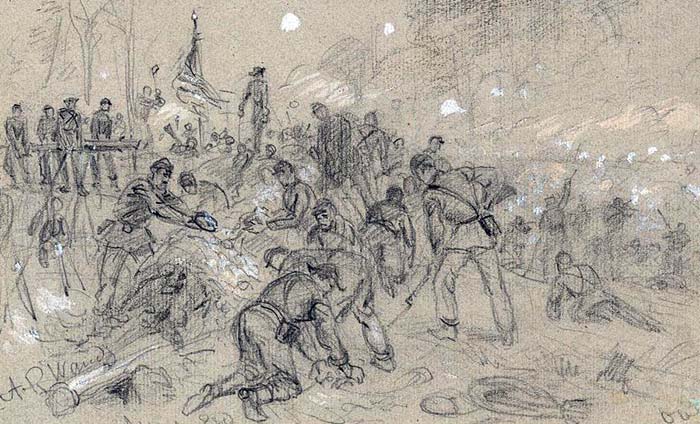 Artist Correspondent A. R. Waud sketched soldiers throwing up breastworks with tin plates,knives, bayonets and their hands during the battle of the Wilderness. Note the men felling trees in the background. In coming days, these men will recount the events of May, 1864, and while the roar of musketry will play a veritable diapason* [scope] of war for them, they will not forget how readily they dropped the musket and, grasping axe or shovel, felled the trees and, weaving them into earth-covered breastworks, interposed thus much protection from the cruel missiles of the enemy. 
If the survivors of the Potomac Army in the battle summer had chosen to wear subsequently as under-guards or supports of their respective Corps-badges, whether, trefoil, Greek or Maltese Cross or shield, the semblance of musket and shovel crossed, no one would have questioned its oppositeness.+ [different from] However averse men may have been to the regular use of pick and shovel, experience soon told them that an old fence rail, a small sapling or a shovelful of earth might ward off a hostile bullet and, lacking the intrenching tools, they were known to throw up, in an incredibly brief time, serviceable defenses, using no more effective utensils than their bayonets, case-knives and tin plates. Future archaeologists, in the Wilderness region, will have difficulty in distinguishing between the works of the Eighteenth century miners and their soldier successors more than a hundred years later. Deeply scarred was the battle-riven surface of the Old Dominion and, centuries hence, poets and historians will wax as eloquent over some of these fiercely contested places as did Charles Dickens over the bloody field of Shrewsbury where “the stream ran red. the trodden earth became a quagmire and fertile spots marked the places where heaps of men and horses lay buried indiscriminately, enriching the ground.” Macaulay, too, never wrote with more brilliant pen than when he described the poppy-strewn plain of Neerwinden, “fertilized with twenty thousand corpses.” If Grant had known as definitely the mind of Lee as the latter appeared to divine the intentions of the Union General, the story of the Wilderness might have been very different. 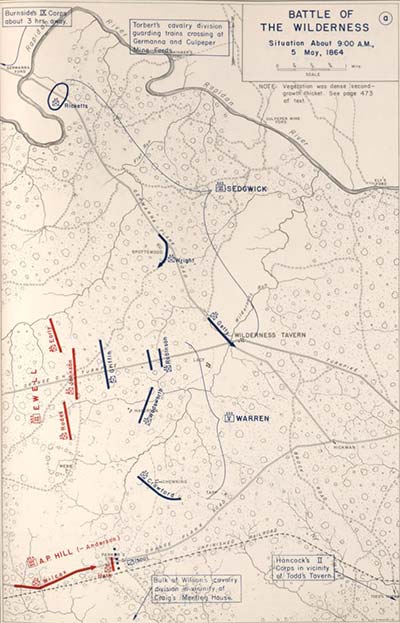
The orders for the morning of the 5th were for Warren to move to Parker’s store, towards the southwest; Sedgwick was to follow Warren, ranging up at his right; Hancock with the Second Corps was to advance, also towards the southwest, his left to reach to Shady Grove Church. The enemy was discovered before Warren reached Parker’s store and he was ordered to attack; Getty and the Second Division of the Sixth Corps were sent to defend Warren’s left flank and Wright with the First Division of the Sixth Corps was ordered up to Warren’s right and at one o’clock Hancock was ordered to come to the support of Getty, all this happening where Grant had expected, at least had hoped for, an unopposed passage. See Battle-field Map #1, click here. Instead of a retreating enemy, Warren opened the great battle of the Wilderness by an attack upon a foe ready for the fray; but let the Fifth Corps Commander tell his own story:–– “Set out according to orders, 6 a.m., towards Parker’s store––Crawford, Wadsworth, Robinson; enemy reported close at hand in force and when Crawford had nearly reached Parker’s, Generals Meade and Grant arrived and determined to attack the force on the road near Griffin (Warren’s right division). Wadsworth was gotten into line immediately on the left of Griffin with one brigade of Crawford, Robinson in support. [Denison's Maryland Brigade supported Wadsworth's attack. ––B.F.] We attacked with this force impetuously, carried the enemy’s line, but being flanked by a whole division of the enemy were compelled to fall back to our first position, leaving two guns on the road between the lines that had been advanced to take advantage of the first success. The horses were shot and the guns removed between our lines. [The guns weren't able to be claimed until evening, May 6––B.F.] “The attack failed because Wright’s (Third) division of the Sixth Corps was unable on account of the woods to get up on our right flank and meet the division (Johnson’s Ewell’s Corps) that had flanked us. Wright became engaged some time afterward. We lost heavily in this attack; and the thick woods caused much confusion in our lines. The enemy did not pursue us in the least. We had encountered the whole of Ewell’s Corps. “The enemy that moved on past Parker’s along the Plank Road was Hill’s corps. General Getty’s division of the Sixth Corps was sent to the intersection of the Brock Road to check the column, which it did, and General Hancock was ordered up from Todd’s tavern, and also engaged Hill’s corps. At this time I sent Wadsworth with his division and Baxter’s (Second) Brigade (Second Division) to attack Hill’s left flank as he engaged Hancock. It was late when this was done, but the attack produced considerable impression. Wadsworth’s men slept on their arms where night overtook them. During the night, I sent instructions to Wadsworth to form in line northeast and southwest, and go straight through, and orders were given to attack next morning at 4.30 with the whole army, Burnside being expected up by that time to take part. With the rest of my force I prepared to attack Ewell in conjunction with a part of the Sixth Corps.” NOTE: Author Gordon C. Rhea, "The Battle of the Wilderness" writes that Division Commander Gen. Samuel Crawford had been reluctant to abandon his position on the high ground of the Chewning Farm that overlooked Parker's Store, and being on General A.P. Hill's flank, he delayed for 3 hours Gen. Warren's orders to move north and connect with General Wadsworth to attack. Major Washington Roebling, of General Warren's staff, was with Crawford, and agreed that the position should not be abandoned. They argued considerably back and forth with General Warren about this, until Warren who was under intense pressure from General Meade to attack, demanded that Crowford move to Wadworth's support. In the end Crawford, only sent one brigade, commanded by Col. William McCandless, who arrived too late to participate in the Wadsworth's charge. ––B.F. webmaster. Alfred Roe, continued: The report of General Robinson, commanding the division, does not add any essentials to the report of General Warren. 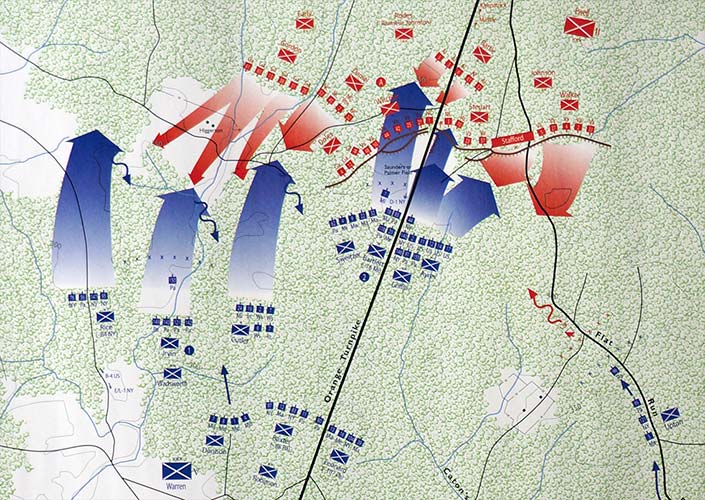 Map #2. This NPS Battlefield map shows Griffin's attack (12 p.m. –- 1.30 p.m.) on General Ewell's Position opposite Saunders Field. North is to the right, South to the Left, West on Top. Sweitzer's Brigade is on Griffin's left, wtih Bartlett in the Center, and General Ayre's on the North side of the road (right on this map). General Wadsworth's 3 Brigades, (Rice, Stone & Cutler) are on the left side of the map attacking in support of Griffin. Although Griffin broke through Ewell's lines, Confederate re-enforcements plugged the gap and drove him back. Colonel Leonard's Brigade, is shown in supporting position at the bottom center on the right (north) side of the road lined up left to right: 13th MA, closest to the road, 16th ME, 104th NY & 39th MA; in that order. During the fight they advanced to the edge of Saunders Field, eventually to connect with 2nd Corps Troops of General Horatio Wright's Division, shown on this map far right, advancing to the battle. General Baxter's Brigade is in line with Leonard on the left (south) side of the turnpike. Baxter's regiments are lined up left to right: 97th NY, 12 MA, 83d NY, 11 PA, & 90 PA, (closest to the road). Denison's Maryland Brigade aligns with Baxter. The Chewning Farm held by General Crawford is just out of frame, Top Left edge of this map. Click Here to view larger. Alfred Roe, continued: “Turned out at three o’clock and started at about light; after some delay found the rebels in force; the advance forces of our Corps drove the enemy from his first line of works; [Griffin's attack––B.F.] we were in reserve till about 12 m., (midday) when we were ordered into line-of-battle on the right of the Plank Road; dead and wounded are in evidence and there is hot work ahead. “The Rebs have a strong position across a ravine; our artillery could not be placed in position; volley after volley was fired all day from all along, both left and right; we had to lay low, the balls whistled thick around us; at six o’clock were ordered to charge but were ordered back;** it would have been madness, since the enemy had a cross fire on us. We lay in line-of-battle all night; many of our wounded could not be reached, and it was awful to hear their cries; when the stretcher-bearers tried to get them, the Rebs opened a battery on them.” NOTES: Journal of Colonel Charles Wainwright, Thursday, May 5, 1864 Wainwright, chief of Fifth Corps artillery advances with General Crawford's Division (leading the march) to the Chewning Farm. Learning of Gen. Griffin's impending attack, Wainwright hurried back to the Lacy House, where he learned of the loss of his two guns in Captian George Winslow's Battery. Much of his commentary concerns this, as it was a big deal to lose artillery pieces in battle. It was Colonel Leonard's brigade, that advanced to edge of Saunders field on the north side of the road to repel the rebel charge that attempted to capture the abandoned guns. The following is from, “A Diary of Battle; The
Personal Journals of Colonel Charles S. Wainwright, 1861 ––1865.”
Edited by Allan Nevins; Stan Clark Military Books, Gettysburg,
PA, © 1962. 
Lacy House, May 5, Thursday. This is the second anniversary of my first battle and has been celebrated in due form. Two years ago, I went into the battle of Williamsburg on the 5th of May; one year after I was in the battle of Chancellorsville; today we have been at it for the third time, and though I have not been under very much fire myself, I have had quite a smell of gunpowder, and am two guns short tonight. We have made no progress today, and virtually hold the same position we did yesterday. The corps started punctually, Crawford leading with the Third Division; followed by Wadsworth with the Fourth, then Robinson, and Griffin to bring up the rear. The batteries moving in the same way they did yesterday. So soon as the Fourth Division was stretched out along the road, I passed on to the front, with Warren’s permission and at his request, to join Crawford. (General Samuel W. Crawford, pictured). The road to Parker’s Store is a narrow country road, most of the way through a dense woods. I reached Crawford just as the head of his column came into an opening of some twenty or thirty acres around a house belonging to one Savarra, about two miles from the Lacy house in a straight line, and one from Parker’s Store. [This is the Chewning Farm ––B.F.] It stands on high ground, so that we could plainly see the store and the Orange Plank Road which runs by it. There was a small body of our cavalry at the store, perhaps a regiment. [One Regiment; Lt.-Col. John Hammond's 5th N.Y. Cavalry ––B.F.] The head of Crawford’s column hadn't crossed the little open ground around Savarra’s house, when we saw our cavalry driven away from the store along the plank road. Crawford halted, and sent back a report of it, with request for orders. The Chewning Farm  See Map #1 above for orientation. This is a photo of the ridge on the Chewning Farm looking swouthwest towards Parkers Store on the Plank Road. The Parker's Store location would proably be visible from the top of the hill if there were no trees blocking the view. Wainwright refers to this as the Savarra Farm because it is labeled such on period maps. The foundation of the old farmhouse is indicated on the property with historical markers. Wainwright, continued: Battlefield Interpretive Marker, Wadsworth's Attack  The sign says: Wainwright continued: Here I found Phillip’s battery and two sections of Winslow’s; the first news that greeted me was that Winslow’s other section was captured and he himself badly wounded. From the stragglers and wounded men coming back down the road, there was no doubt as to Griffin having had the worst of it. Riding forward I met them carrying Winslow back; he was shot through the fleshy part just below both shoulder-blades, the ball coming out over the spine. Soon after I met Captain Martin whom I had given charge of the three batteries with Griffin, and who told me all about it.* Allan Nevins, the editor of Wainwright's published journal, "Diary of Battle" placed an excellent note here regarding Wainwright's narrative, and it's worth repeating. *It was here that the battle of the Wilderness really got under way. When Warren’s Fifth Corps reached Old Wilderness Tavern, advanced Confederate forces under Ewell were but three miles away. Griffin of the Fifth Corps, marching west along the Orange Court House Turnpike early on May 5, reported the enemy just in front of him, and supporting troops were ordered up. Meanwhile, Griffin’s division was directed to press the enemy. A sharp encounter between Griffin’s troops and Ewell’s force followed. For an hour and a half the battle raged, and the turnpike was soon crowded with walking wounded and lines of ambulances with serious casualties. …General Romeyn B. Ayres, who is mentioned here, a graduate of West Point in 1847, had commanded a division at Gettysburg, and was now leading a division in Warren’s corps. A hard fighter, he rose to be major general. It will be seen that Wainwright thinks highly of Ayres’s sportsmanlike temper, and badly of Griffin. It will also be noted that the regulars of Griffin’s command had fought poorly. Saunder's Field, Picture #1.  North side of Saunder's Field View to the East; (Union side). Pictured above is the Fredericksburg, Chancellorsville, Wilderness & Spotsylvania, National Battlefield Park Service's placement of cannon at the Wilderness Battlefield Wayside Interpretation Shed off Modern Route 20. The placement of the gun represents the location of Captain George Winslow's two artillery pieces that were abandoned in the road. Modern Route 20, visible in the picture, follows the path of the Old Orange Turnpike which existed during the battle. Colonel Leonard's Brigade advanced through woods toward the edge of Saunder's field, on the north side of the road, the left side, in this picture. They fought off charging Confederates attempting to carry away the abandoned guns. The wood line on the left of the picture borders a private home and is not the true edge of Saunders field. The wood line on the right of the road indicates the true edge of the field. Wainwright continued: Saunder's Field, Picture #2.  North side of Saunders Field, View West (Confederate side). Pictured is the portion of Saunders Field, on the north side of the road, over which General Ayres' 140th N.Y. & U.S. Regular Army troops attacked General Ewell's intrenchments in the distant woods. The field was littered with the bodies of soldiers sporting the colorful Zouave uniforms of the 140th & 146th N.Y., which units both took heavy casualties during the Union rout. Wainwright continued: Beside Capt Winslow, 4 of the men are wounded: Lt. Shelton was shot in the leg & is a prisoner, & 6 men are missing. General Ayres told me that the loss of the guns was due entirely to the bad behaviour of his brigade and no blame could in any way be attached to the battery. General Bartlett, whom I found with his mouth fairly glued shut, from excessive thirst and hallooing, spoke of them in the same way as did Martin. Griffin alone, on whom the whole responsibility really rests, seemed inclined to shift it off of his shoulders.* *General Warren wrote across the bottom of Col. Washington Roebling's battle report, “the responsibility of sending this section of artillery with the advance rests upon me.” Lieutenant Shelton confirmed that Captain Winslow had received orders to advance the sectuion “in person from General Warren” (Shelton, “Memorandum,” in “The 140th New York Volunteers, Wilderness, May 5, 1864,” by Farley, p. 37 in Farley Papers R.I.). [SOURCE: RHEA, p. 171, note 43.] Saunder's Field, Picture #3  Saunders Field View Southwest, to General Ewell's Line in the distant woods, taken from the North side of the road. The National Park Service placed a cannon in the vicinity of where Lt. Shelton's guns were captured. They would have been just on the other side of the road. Wainwright continued: Illustration of the Lacy House & Environs During the Battle of the Wilderness This beautiful watercolor of the Lacy House and surrounding grounds during the Battle of the Wilderness, adorns one of the Park Service's interpretive markers in the front yard of the house known as Ellwood Manor.  The interpretive marker with this illustration reads: “A Military Scene” As one of the few large open areas in the Wilderness, the broad fields north and east of Ellwood assumed instant importance during the Battle of the Wilderness here. While fighting raged a mile to the west, the fields around Ellwood filled with artillery and wagon trains. Provost guards kept watch over Confederate prisoners; surgeons established field hospitals for the wounded; and rough teamsters held their mule-drawn wagons in readiness to carry ammunition to the front. In the yard of the house and extending northward along the ridge, Union batteries lobbed shells at targets more than a mile away. Click Here to see the un-cropped image larger. Colonel Wainwright, continued: The rifled guns opened several times on the rebels as we noticed columns passing the Savarra house, but we could not judge much of the effect, as the distance was from 2,700 to 3,000 yards. It, however afforded me a chance to judge of the relative merits of the Parrott and three-inch gun at that distance. I found that the elevation required was the same for both; nor was there any perceptible difference in the accuracy. The preference of the three-inch lies in the ammunition and in their greater lightness and shortness. Cooper, who did the 3 inch firing, uses Hotchkiss Ammunition. This about completed all my own operations today. Nor was any of this Corps hotly engaged during the afternoon. 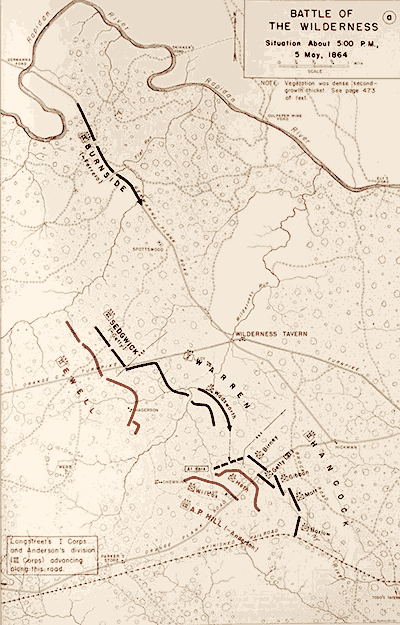
Wadsworth had been ordered in on the left of Griffin during his fight, but did not get in Straight & was pretty roughly handled by the enemy. The loss in our Corps to day is estimated as high as 3,000. No officers of high rank that I know of. When I rode out the turnpike first Morris was with me; it was his first experience under fire, the bullets falling pretty thick at the time. The 6th Corps got up upon our right about noon & formed there; [3 p.m. ––B.F.] that is two divisions of it; Getty passing us on to where the Orange plank road crosses the Brock road about 2 miles to our left. The Brock road runs nearly due south, & is a branch of the Germania road. He got there in time to secure the crossing, was not much engaged until late in the afternoon about the time when Hancock joined him with the 2d Corps, when the fighting became very heavy and lasted until it was quite dark. The roll of musketry was equal to that on Gearys front at Gettysburg: there was but little Artillery firing. Battle Map #3. Opposing Forces on May 5th at 5 p.m. General Henry Baxter's Brigade of Robinson's Division has shifted to the Plank Road Sector of the Battlefield, attached to General Wadsworth's 4th Division, of the Fifth Corps. Click to view larger. Our lines do not join, the only communication being at the rear along the Germania Plank to the Brock road. The wood lies very dense between us & them in a direct line. Wadsworth with his division & Baxter’s brigade of the 2d; tried to push through this wood so as to strike the flank of the enemy engaged with Hancock. [This occurred in the late afternoon, May 5th, with Baxter's Brigade attached.––B.F.] The last news from him was that he had found their flank, but too late to attack to night.** So ends our first day’s fight in this campaign. I have not heard anything as to Hancock’s loss, but it must have been at least equal to ours, for he was much longer engaged; 6,000 men will do pretty well for a beginning. The Ninth Corps they tell me is at the ford and will join us tomorrow morning. **NOTE: Gen. Grant and Gen. Meade planned to exploit Wadsworth's position and attack the Confederate flank at 5 a.m. next morning. Gen. Burnside's 9th Corps was ordered to march to join Wadsworth for the assault, but Burnside was notoriously slow and his corps didn't show up on time. In fact he was 8 hours late!! ––Had he been there the battle would have taken a different turn.––B.F. An Incident at Army Headquarters General Meade's Volunteer Aid, Lt. Col. Theodore Lyman records this now famous incident in his journal regarding General Griffin, reporting to General Meade at Army Headquarters after his failed frontal attack.  Charles Stanley Reinhart illustration of General Grant's Headquarters knoll at the battle of the Wilderness. From the N.Y. Public Library. The following is a retelling of this story using excerpts from two versions. The first is, “Meade's Army, The Private Notebooks of Lt. Col. Theodore H. Lyman” edited by David W. Lowe; 2007 Kent State University Press. (p. 134). The second is Papers of the “Military Historical Society of Massachusetts, The Wilderness Campaign,” Vol. IV; (p. 167-168). Returning to Headquarters found the pike blocked with
ambulances and with wounded on foot, who continually enquired “How far
to the 5th Corps Hospital?” They were chiefly from Griffin’s
Division and also many from Wadsworth’s. Met Joe
Hayes, supported by Dalton, and by a servant on his horse. He was
talking wildly and the blood streamed down his face! A
dangerous wound to look at ––shot in the head. There we were
three classmates together! ––Helped him along till assured he had
enough assistance, when left him with Dalton.* 2.45. [p.m.] Griffin comes in, (pictured) followed by his mustering officer, Captain George Barnard; He is stern & angry. Says in a loud voce that he drove back the enemy, Ewell, ¾ of a mile, but got no support on his flanks, and had to retreat ––the regulars much cut up. He implies censure on General Wright and apparently also on his corps commander, General Warren. Wadsworth also drivin back. ––Rawlins got very angry, considered the language mutinous and wished him put in arrest. ––Grant seemed of the same mind and asked Meade; “who is this Gen. Gregg? You ought to arrest him!” Grant's coat was unbuttoned, and Meade began to button it up, as if he were a little boy, saying in a good-natured voice, “It’s Griffin, not Gregg; and its’s only his way of talking.” ––Rawlins asked me what he had done; told him his reputation as an officer was good. In this charge Bartlett’s brigade, the first line commanded by Hayes, broke and drove the enemy handsomely. ––Bartlett’s horse was killed and he badly hurt in the head by his fall. There is little doubt that Wright made slow work in his advance. *NOTES: Surgeon Ned Dalton, assistant medical inspector, Army of the Potomac, and Colonel Joe Hayes, 18th Massachusetts Infantry. Hayes wound was a deep furrow across his skull but not mortal. Brigadier-General John Rawlins was General Grant's Chief of Staff. Colonel Leonard's Brigade at the Battle, May 5thMemoir of Major Abner Small, 16th Maine Major Small's description of the 1st Brigade's movements and terrain on May 5th, has more clarity than accounts in the 13th Regiment. Although the 16th Maine suffered more casualties than the 13th MA, they also reported light casualties on May 5th in their regimental history.* The following is from, “The Road to Richmond,” by Major Abner R. Small, edited by Harold A. Small, University of California Press, 1959. 
Early Thursday morning we were up and ready to resume the march. By five o’clock there was a stir of troops ahead of us. We followed them a little way and came to a large irregular clearing of rough ground, broken by the ravines of Wilderness Run. In the clearing, the plank road that we had followed from the ford led on southeastwards and crossed near the tavern, the Orange Court House turnpike. A rougher dirt track led southwestwards to the Orange Court House plank road. We turned down the dirt track and halted, beyond the pike near the Lacy farm, where General Warren set up his headquarters. Our division was held there in reserve, while Crawford’s and Wadsworth’s divisions, moving on towards Parker’s Store, and Griffin’s division, heading westwards on the turnpike, disappeared in the forest. Soon, mounted orderlies came dashing out of the woods, hastening towards the crossroads near the tavern, to the headquarters of Grant and Meade, and then dashed back into the woods again; and more than once General Warren went hurrying off; and after a while the Maryland brigade shouldered arms and disappeared in the green thickets. [Col. Andrew W. Denison's 3rd Brigade, 2nd Division; they marched to the support of Gen. Wadsworth's Division.––B.F.] Now and then we heard a muffled sound of firing, and saw smoke rise from the farther reaches of the forest and vanish in the still air; so we knew there was fighting; but how the fight was going, we could only guess. About noon, orders came for our brigade to move. We hurried across bushy fields into the forest and out along the turnpike a mile A scattering of men was running in, some of them crying disaster, and ahead of us there was an uproar of yelling and firing. We came to a clearing and filed off to the right of the turnpike and went into line along the edge of an old field. The field, ragged with bushes, sloped down to a hollow and then up to the forest beyond. The fight had swept across it and back again, and now the hollow was filled with wounded, and about where the pike went over it were two fieldpieces, abandoned, the dead horses lying near by. The rebels wanted those guns and tried to get them but our brigade, and the reserve of the troops that were in action before we came up, were now in line, and sent so hot a fire from our side of the field that the rebels drew back to their side and stayed there. The wounded in the hollow called vainly for water. The guns on the pike stood lonely in the sun. Interpretive Marker at Wilderness Battlefield Park Turn-out on Route 20  Illustration by artist Mark Churms. This interpretive marker reads: “The May 5 fighting in Saunders Field was waxing hot when Captain George B. Winslow received orders to rush two guns of Battery D, 1st New York Artillery, to the front, to support the Union attacks here. Dashing down the turnpike at a trot, Winslow's men crossed the ditch in front of you, unlimbered their guns across the road, and began firing into the entwined masses ahead ––for a time killing friend and foe alike. Winslow quickly saw the impossibility of his task and ordered the cannon to withdraw. Before they could, Union infantry in Winslow's front gave way, and Confederates surged toward the artillerists. The two limbered guns stalled at the ditch. Before gun crews could save the pieces, the Confederates were upon them. With their horses shot and their infantry support gone, the Union artillerymen had no choice but to abandon the guns.” Saunder's Field, Picture #4.  This view of Saunders Field is taken on the north side of the turnpike looking west. Captain Winslow's abandoned guns were left straddling the road where the sign is in the left center of the picture. The modern road, route 20 follows the trace of the Old Orange Turnpike at this location. The clump of trees in the center marks the location of the Wilderness Battlefiled Park Wayside Interpretive Station. Ths small patch of ground to the right of the trees is the rising ground which General Ayres advanced over, only to meet heavy resistance. The tree line in the distance at the top of the ridge is where Ewell's Confederate troops were intrenched on high ground. Abner Small, continued: About sunset, a charge was ordered; someone must have decided that the lost guns ought to be recovered. Out into the open went the brigade, and the enemy let fly with everything he had. The noise was terrific; the forest walls around the field echoed and magnified every sound. Under that crashing din we groped for our foes; but the charge failed. We were ordered to retire, and fell back to our line in the swiftly gathering dusk. The lost guns were still on the pike, with no takers, and the dead and wounded lay more thickly on the field. Saunder's Field, Picture #5; Rebel Earthworks in the Foreground  View East From General Richard Ewell's Position at the West Edge of Saunders Field. Major Small has just accurately described Saunders Field. About noon, the 16th Maine & 13th MA were at the edge of the woods on the north side of the road (to the left in this view). In the late afternoon they crossed the road to the south side, shown here on the right side of the highway. My research leads me to believe the 90th PA anchored their right flank on the road, and the 16th Maine connected with them. The 13th MA went off deep into the woods to the right, about 1/2 a mile. Traces of Confederate earthworks are in the foreground. The lost Union guns so much talked about in Col. Wainwright's narrative and the narratives of everyone else on this part of the battle-field would be off screen to the far left of this image, and more forward to the viewer. The ravine pictured in the middle of this photo was strewn with dead and wounded from General Griffin's previous attack about noon. The extreme difference in the color of the foliage in this image, from the others on this page occurred because this photograph was taken on April 9th, 2025, whereas the others were taken in late April. Click here to view a much larger extended panoramic with more depth. The Charge of the 90th PA: Early Evening Attack May 5th This seems an excellent place to break off from Major Small's narrative for a moment, to insert this story about the evening attack of Col. Leonard's Brigade on May 5th. Very little is written about it in the regimental histories, but this passage about the ill-fated charge of the 90th PA, was quoted in the Hisotry of the 39 MA, of all places. It was found under their entry for May 6 ! Taking a cue from the 39th MA, I found the original narrative in Samuel Bate's History of the Pennsylvania Volunteers, and added it to my essay, “Lost in the Wildnerness,” above.  Apparently the exertions of the extreme march on May 4th and the battlefield movements on May 5th played upon Colonel Leonard's delicate health. Sam Webster recorded in his journal May 6th, “Colonel Leonard commanding the brigade is about used up. Lt.-Col. Hovey commands the regiment. Major Pierce is slightly wounded.” Colonel Peter Lyle of the 90th Penna. assumed command of the brigade on May 6th. General John C. Robinson mentioned the attack of the 90th PA in his official report of the battle. Because he was severely wounded on May 8th he did not submit his report until April 1866: Excerpt From General John C. Robinson's Report in the Official Records: “On the evening of the 5th, while my Second Brigade was engaged on the left, the First Brigade on the turnpike road was ordered to advance against the enemy, and the Ninetieth Pennsylvania Volunteers having to cross an open field, was exposed to a terrific fire of musketry and artillery, which nearly destroyed the regiment. For some reason, never explained, the troops on the right of this brigade, although protected by the woods, failed to advance with it. The following is from, “The Thirty-ninth Regiment Massachusetts Volunteers, 1862-1865;” by Alfred S. Roe, 1914. Of the charge made in the afternoon of the 5th, this story is told in the history of the Ninetieth Pennsylvania, whose Colonel, Peter Lyle, was in command of the Brigade, having succeeded Colonel Leonard of the Thirteenth Massachusetts:–– “The command was formed in line-of-battle and advanced until it reached the open ground, beyond which the enemy was intrenched. The line was established behind a slight rise of ground with small trees and bushes in front, the right of the Ninetieth being separated from the rest of the Brigade [by a road] which it was impossible to occupy, being raked by the enemy’s artillery. We lay in this position for some time when General Griffin, in command of the First Division, rode up and commanded a charge. “Colonel Lyle promptly led his regiment forward and, as soon as it had cleared the shrubbery in front, and emerged upon the open field rebel batteries opened upon it with grape and cannister. The order was given to double-quick and with a shout it advanced within close range of the rebel lines. When Colonel Lyle discovered that he was unsupported, he gave the orders to about face and what was left rallied around the colors and, under a fierce fire of infantry and artillery, returned to its original position …. out of two hundred and fifty-one men, one hundred and twenty-four were killed, wounded or captured. From some misunderstanding or not having received the same peremptory orders from General Griffin that he gave the Ninetieth the rest of the brigade did not advance any distance, leaving the Regiment entirely alone in the charge.” Saunders Field; Picture #5; Reverse Angle  Picture of Saunders Field from the Union position looking west toward Confederate lines in the distant trees. This is the ground south of the road, which the 90th PA & 16th Maine charged over. The road dividing the field can be barely made out in the center of the photo. 39th MA, continued: “It is not to the discredit of Colonel Lyle that he is said to have shed tears over the calamity which befell his brave followers through no fault of his.” 
Alfred Roe, continued: Lt.-Colonel Peirson, 39th MA, also describes the attempt to save these guns to the following effect; –– From, “The Wilderness Campaign; Papers of the Military Historical Society of Massachusetts,” VOL. IV, “The Operations of the Army of the Potomac, May 7––11, 1864;” by Brevet Brigadier-General Charles Lawrence Peirson. Read before the Society November 10, 1879. (p. 212). “We also left behind two guns which were on the turnpike in front of Warren’s position, which were lost by Griffin on the 5th, and were between the two armies until we retired. A brigade of Robinson’s division vainly attempted a charge to retake them, but the plain was swept by canister at 350 yards, and the brigade returned with heavy loss. It was understood that the sixth Corps was to join in this attempt but General Upton, whose brigade lay on the right of Robinson, refused to move, saying, ‘It is madness.’#2 So sensitive were the enemy about the matter, they fired on our stretcher-bearers, who advanced to bring in the wounded; and the wounded were not brought in, but lay all night calling for water and help, to the great distress of their comrades.” *NOTES: Battle Map #4. 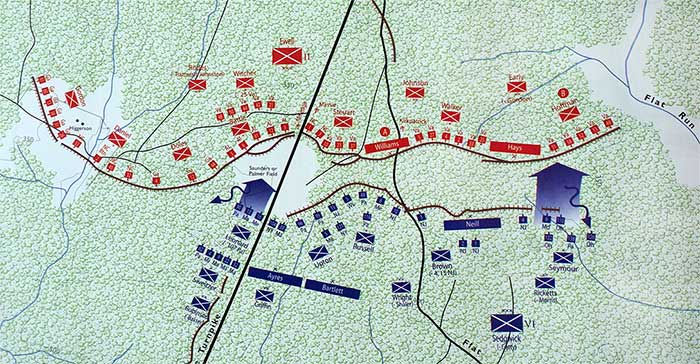 Map #4. Saunders Field, May 5th, 6 p.m. The road shown is the Orange Turnpike which runs east / west. South is to the left on this map; North is to the right. The heavy blue arrow on the left represents Col. Leonard's Brigade,with the 90th PA attached. The three regiments represented on the south side of the turnpike, are left to right, 90th PA, 13th MA, & 16th Maine. North of the turnpike, continuing left to right, the 104th N.Y. & 39th MA. Although careful research went into this representation, the evidence I have collected for the 13th MA says they went deep into the woods beyond Saunders Field to the south (left) on this map. I also think the positions of the 16th Maine and 90th PA are reversed, and that the 90th PA was against the road. The heavy blue arrow on the far right, represents the line of the 6th Corps north of the turnpike. They would realize during their advance through the woods that the Confederate line overlapped theirs. Confederates took advantage of this weakness and rolled up the 6th Corps flank on the evening of May 6th. Click to view larger. Abner Small's May 5th narrative continued: 
Shells were still coming over, and here and there one that burst as it hit the ground would start a blaze in dry leaves. A crash and a flare, a scurry of great leaping shadows, and then the fire would die out and the night would be blacker than before. Once, when the darkness was torn suddenly away, I saw a dogwood all in flower, standing asleep and still. I groped on, stumbled, fell, and my outflung hands pushed up a smoulder of leaves. The fire sprang into flame, caught in the hair and beard of dead sergeant and lighted a ghastly face and wide-open eyes. I rushed away in horror, and felt a great relief when I found our line again and heard the sound of human voices. We manned our works all night in the edge of the woods. There was no moon to light the clearing, only dim stars, and the air was hazy and pungent with the smoke and smell of fires yet smouldering. We couldn’t see the wounded and dying, whose cries we heard all too clearly; nor could our stretcher bearers go out to find them and bring them in; the opposing lines were near, and the rebels were fidgety and quick to shoot. *Total Reported casualties for the 16th Maine was 40 but five of the men reported captured or missing belonged to a small detachment of the 107th PA that were attached to the 16th Maine at the time. The majority of the 107th was happily enjoying a furlough for having re-enlisted. This brings the number of Maine casualties down to 35. Also, the reported casualties included fighting for both May 5th & 6th. See 1st Brigade casualty lists below on next page. The 13th MA reported a total loss of 11 men for the two days fighting. Diary of Major Elliot C. Pierce, 13th MA  Major Pierce kept a diary throughout General Grant's Overland Campaign. It sometimes offers a bit more insight into the movements of the 13th MA during their final 2 1/2 months of service. A spent musket ball hit him early in the struggle on May 5th, so we don't get much information from him here, but we will during future maneuvers. The following is from, “Diary of Elliot C. Pierce,” Massachusetts Historical Society, Thayer Family Papers Collection, (Ms. N––1658) Boston, MA. 5/5: Near the enemy at 10 A.M. quite near our old camp. Our position at the opening of the fight I was struck by a stray ball and felt slightly sick. Reported to (Sur. Cw?) for treatment. I was quite unwell during night. Sergeant Austin Stearns' Memoirs, 13th MA, Company K I cannot reconcile some of Austin Stearns memories with some known battle-field facts, and other statements. He remembers encountering Southern troops in the woods south of the Turnpike in the late afternoon of May 5th. He remembers them as being South Carolina troops, and hears the additional phrase, “The Flower of the South” used to identify them. The problem is there were no South Carolina Troops among the opposing forces in this sector of the battle-field. However there was an Alabama Brigade, commanded by Brigadier Gen. Cullen A. Battle, operating directly in front of the 13th’s alleged position, late afternoon May 5th. “Little Eva, The Flower of the South” was a well known pre-war novel set in Alabama. I believe, according to Austin Stearns narrative, and other evidence given in the journal of Private Bourne Spooner, that the 13th MA Regiment crept through the woods on the south side of the Turnpike and came close up upon Gen. Battle’s Confederate troops. Battle’s Alabamans participated in driving back Union General Charles Griffin’s noon-time assault across Saunders Field, and counter-charged, according to Colonel Charles Wainwright. My best guess is he incorrectly remembered South Carolina, for Alabama. The regiment has future encounters with S.C. troops during the Overland Campaign.––B.F. The following is from, “Three Years With Company K,” by Sergeant Austin C. Stearns, (deceased) Edited by Arthur Kent; Associated University Press, 1976. Thursday the 5th. “Fair and warm. Revillie at 3 A.M. Marched at sunrise, but only a short distance. Firing in the woods on our right. Was held on the reserve till noon, when we went to the front. The fight has commenced in earnest. Sharp fighting both left and right. Was engaged about sunset, but without much loss. Haskell wounded in the breast. Four others missing, cant tell what results will be, hard place for a battle.” In coming into the road we passed by Wilderness Tavern, and saw Grant, Meade, and other Corps Generals in consultation. We were held in the road for a few moments, then moved back behind a large mansion that stood on the road leading to Robinson’s Tavern. The Lacy House pictured in better times; General G. K. Warren's Headquarters During the Battle. Firing was going on briskly down this road. While lying here, a portion of the Second Corps march[ed] over the fields to the Orange Plank road, [and] a smart engagement of a few moments occurred there. [This was Brig-Gen. George Getty's Division .––B.F.] A little after noon we marched down across the road into the woods, sharp fighting going on in our front. [North side of road––B.F.] Formed line of battle and continued to advance. Nat Seaver fell, and I thought was wounded. I found he was troubled with heart disease; the excitement of the coming battle overcame him. I layed him in a good position under a shrub and placed my over coat on it to shade him and went on. This was a wilderness indeed. There were islands of hard land from a quarter to several acres in extent, surrounded on all sides by low swampy ground, with bushes so thick, and horse briers running to the top of the trees with thorns an inch long woven in and out, [as to make] it almost impassable. After forcing our way through this jungle for quite a distance, we were ordered to move by the left flank, and as we had been moving down parallel with the road, to move by the flank any distance we must cross the road.1 [To the South side.––B.F.]  The rebs had a battery down there, from which they were throwing grape and cannister, making it exceedingly hazardous to cross. Quite a number of the Brigade were killed and wounded crossing this road, the missiles would come with a swi–––s-s-s-h, filling the air full. I chose to run directly after fire. When over, we formed a line of battle almost at right angle from the other, and advanced up to the edge of one of these impassable swamps of a few rods in width. We lay on the ground and soon heard a noise of men breaking through the brush in our front. We heard the order “Halt, front, right dress,” and “order arms,” then an Officer enquire, “What regiment?” and the answer “South Carolina,” the Flower of the South [at] this time.2 [See note #2. These must be Alabama Troops.––B.F.] Just before sunset the order came to advance. We tried, but the swamp was a barrier not easily overcome, [and] before we were half way through were ordered back. The bullets sang merrily for a while. [Note: This may be when the 90th PA, which was attached to the First Brigade attacked and lost half its men.––B.F.] We lay here in line of battle all night. Drew ammunition. The heaviest of the fight was at our right [the 90th PA & the 6th Corps ––B.F.] and some of the wounded were laying between the lines. One Soldier there took on bitterly, and every time any one tried to reach him, called for a fresh amount of bullets. The woods caught fire and burned over a part where the dead were. 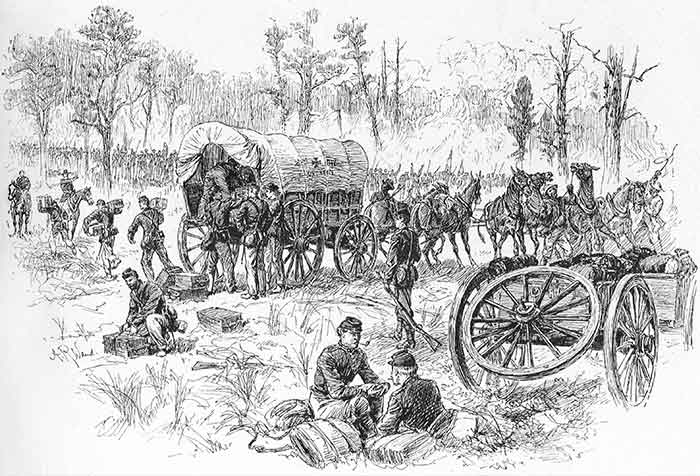 Distributing Ammuniton, from Battles & Leaders of the Civil War; Engraving from a sketch done during the battle by Correspondent A. R. Waud. Austin Stearns, continued: He stopped him and asked him where the regiment was. He said they had been in one of the worst fights yet and the regiment was all cut up with hardly a man left. He was terriably excited or frightened and immediately passed to the rear. Rawlins hardly knew what to do, but thought if the boys had been so terriable handled, the best thing he could do was to go on and perhaps they could help some of the wounded. Going on, he found one of the Brigade Staff, and found the affair had been somewhat magnified and the brigade was safe down farther in the woods, which he soon found. NOTES: Sam's diary account is more immediate than Stearns' memoir. But Sam is a member of the Drum Corps and as such is detailed to help the doctor, Surgeon Hixon, in taking care of the wounded, so there aren't any details about the regiment's engagement. Sam is back behind the lines helping out at the field hospital. He does mention his comrades who showed up wounded. “The Diary of Samuel D. Webster” (Company D) (HM 48531) are used with permission from The Huntington Library, San Marino, CA. Also, transcripts of the original Field Diaries, from his family. Thursday, May 5th, 1864 Just before 12 –– noon –– the line was formed, faced about and moved toward the pike. The left wing (the right as we were facing –– which was inversely ) was swung around and moved down parallel to the pike and beside it, the regiments “taking distance” as they marched. Went with them until they became pretty well engaged, and then had to follow the Dr. back. Established ourselves beside the road and attended to the wounded who came to the rear; quite a number, among them [Lyman] Haskell, of K, and [Theodore] Goodnow, of I. Fight has been quite heavy, and neither party able to claim any great advantage. NOTES: Picture: Herbert Goodnough, Company I, & Edward Vorra, Company B.   Herbert Goodnough [or, Goodnow] pictured left, of Company I; Both Goodnough and Edward A. Vorra, of Company B, pictured right, were wounded on May 5th. Both soldiers were original recruits, who mustered into service July 16, 1861, and would have gone home with the regiment in July. Both died of their wounds, though the dates of death are not stated in the rosters. 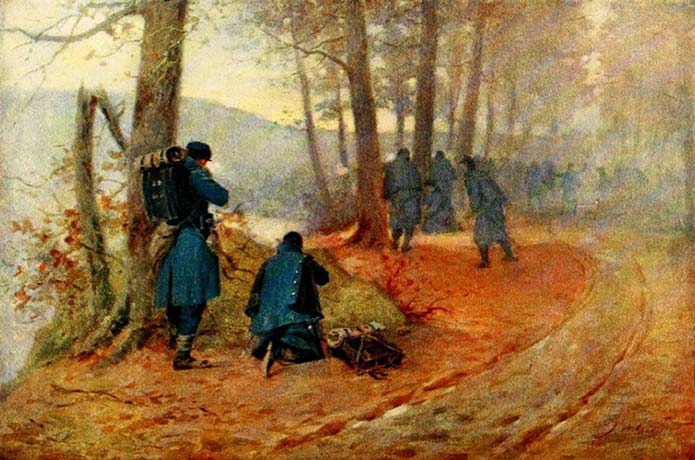 Diary of Corporal Calvin Conant, 13th MA The following is from, “Diary of Calvin Conant” [Company G]; General Collection, Ridgeway Library, U.S. Army Heritage & Education Center, Carlisle, PA.
Thursday, May 5, 1864. 32 Mass lost 27 Men [written on the margin of the page––B.F.] Picture: Corporal John Best, Company G, & Private Herbert Reed, Company A.   John Best of Company G, and Herbert Reed of Company A, were both wounded on May 5th. Best had been wounded at Gettysburg too. Calvin Conant says Best was wounded on both May 5th and May 6th. Herbert Reed of Company A, was a strange duck. A piano tuner by trade, he spent nealy a year away from the regiment in hospital, before being returned to the ranks in late December 1863. He was court-martialed for desertion in April, 1864, during the long Winter-Encampment at Mitchell's Station, but the case against him was so poorly presented he got off, and returned to service. He was wounded in the hand May 5th in the Wilderness. Sidenote: Stonewall Jackson's Arm Regarding another matter, there are mentions of Stonewall Jackson referenced with regard to the Ellwood Manor plantation, house and grounds. Both Sam Webster and Bourne Spooner speak of it. When General Stonewall Jackson was wounded at the Battle of Chancellorsville, in May 1863, he was taken to the Wilderness Tavern Field Hospital, behind Confederate lines, where his left arm was amputated. Chaplain Beverly Tucker Lacy brother of Horace, who owned Ellwood Manor, retrieved the arm and buried it on his brothers estate in the family cemetery. The arm is supposedly still there. After the operation Jackson was transported to Guinea Station where he died a week later on May 10.  When Stonewall Jackson's left arm was amputated at the Wilderness Tavern Field Hospital, Chaplain Beverly Lacy, of Jackson's 2nd Division, retrieved the arm and brought it up the hill to his brother James Horace Lacy's house, Ellwood Manor. Chaplain Lacy buried the arm in the family cemetery. When Jackson died he was buried over 100 miles away. The photo shows the Lacy family cemetery with a marker indicating the burial of General Stonewall Jackson's amputated arm. Journal of Private Bourne Spooner, Company D The best record comes next. Private Spooner (pictured) details a very full account of the regiment's movements on May 5th. The following is from the Journal of Private Bourne Spooner, Boston Public Library Special Collections. 
Thursday morning we were called up be-times but oweing to the great press upon a very indifferent road did not get fairly started until quite late. After marching about two or three miles the brigade doubled up and rested on open hill near by the house in which Stonewall Jackson died. [Ellwood Manor.] There it remained some hours watching the 6th Corps marching along a road further to the left. Up to this time no firing had been heard. The army had crossed the river in quiet, No prelimanary? cannon had been heard to give an ominous warning of what was soon in store, as usually happens; and (suddenly) a few straggling musket shot in the woods as we were resting there was the first intimation we had of the near approach of the enemy. The musket shots wer not long confined to one place but soon rattled up and down through the whole length of the woods and then settle into a continuous roar. That soon brought our brigade to our feet and we did not have to wait long for orders to form into line and advance towards the woods. We advanced slowly to keep the alignment as perfect as possible. When we got in to the woods there was something of a hubbub. Another brigade and other regiments were overlapping and crowding through our ranks. Finding it almost impossible to advance in line we we[re] put into to columns “by the right flank, file left” and proceeded along the road leading to the scene of conflict seemingly but just in front and sounding terribly in our ears. There was considerable excitement and that together with the difficult nature of the ground produced considerable disorder. However we pushed steadily forward as best we could meeting with the wounded who were limping along and being brought out on stretchers, with here and there a dead man lying by the roadside or beneath a tree with his wahn face turned up –––surely not a very pleasant spectacle to behold, and enough to dampen the ardor of the most enthusiastic, but to us it was nothing new. When we had nearly reached the frontline Col. Leonard (who had command of the brigade) ordered the 13th and another regiment to file off into the woods (thick underbrush) to the right at right angles to the road. Co. D having the right proceeded until we reached a brook when halt and front were the next orders. Co. D were then deployed as skirmishers in an extension of the same line of the regiment. Then we lay under a severe shelling and exposed also to bullets for perhaps two hours. The rebel battery (which could not be discerned through the woods) changed their tactic and were now flinging canister most profusely through the woods whare we were. The iron hail would whizz into the branches of the trees, and then rattle harmlessly down about our ears. We moved about a while by a half dozen different flanks?? while to the right of the road and then received orders to cross over to the left. The crossing was a rather dangerous undertaking for the rebel battery had a complete rake of the road and fired away most rigourously when they saw us cross. We scattered as much as possible and made the transit with the greatest celerity. || Besides the 13th the 16th Maine was the only regiment I saw after crossing the road. When the road was clear the rebs turned? their attention to the woods into which we had just come but not knowing precisely whare we were did but little damage. Here we lay in line of battle for some time in a sort of swamp. Afterwards the 13th (being on the left of the 16th) was ordered to swing round its left, as we had there was no connection with other troops, to prevent being flanked and Co. D was thrown out in front as skirmishers. We were all then in a complete state of ignorance of the exact status of affairs. 
These woods had been fought through previous to our occupation of them for a few dead of a Wisconsin and other regiments of the 1st division [Wisconsin men were in the 4th (Wadsworth's Division) in this part of the woods ––B.F.] were lying about; but now there were neither stragglers nor organized bodies of troops to be seen and we little knew whether the others had still held a line of battle in front of us, or had abandoned the ground. The battle had now come to a lull and the sun was sinking lower and lower ––it cast a red glare through the thick trees woods which was beginning to grow dark. I was in a gully which however afforded but little protection. The thickness of the under brush prevented a view beyond 20 ft. or so, and I was unable to discern the second skirmisher on either side. There appeared to be forming a brigade for an attack. They gave a very savage yell, but no charge followed it. One commander very distinctly gave the order for this regiment (the 60th something) to “left dress,” “front” and and after wards to “Stack arms.” Their skirmishers and ours about this time commenced firing and kept up a steady exchange until about dark, when the reb sudenly came forward. Lt. Col. Hovey [pictured, Charles H. Hovey] gave the “skirmishers, rally on the battallion,” but we had hardly time to rally before the reg was moving obliquely forward by the right flank. Before it had time to front and get straightened out a volley was poured into it and being nearly surrounded with out supports it fell back a short distence; but afterwards re advanced and occupied the same ground during the night. Sergeant George Henry Hill is Captured Although George Henry Hill's lengthy account of his capture at the Battle of the Wilderness, and subsequent adventures during the next 10 months, will be posted in their entirety later on, it doesn't seem fair to exclude his narrative from this page. He was so looking forward to going home in July, as indicated by his letters to his father. What follows is an excerpt describing in detail his capture in the woods on the afternoon of May 5th. He was the only soldier in the regiment lost in this manner. For the second time in his brief military career, George was a prisoner of War. He was captured at Gettysburg July 1st, and paroled in September, 1863. His 2nd stint as POW would last much longer.
At about 4 o'clock in the afternoon, during a lull in the battle, which had been raging fiercely all day with apparently small results for either side, our regiment was moved by the left flank some half mile and faced to the front. It was apparent that no skirmish or picket line was between us and the rebel force. Colonel Hovey, then in command of the regiment, called for volunteers to go forward and ascertain, if possible, the proximity of the enemy. From a number responding to this call, four were detailed to advance cautiously, each taking distance to cover the regimental front, and report back to him. As one of this four I had an independent command (myself) and I know nothing of the action or report of the others constituting the detail and have forgotten their names. After advancing some six or eight hundred yards I heard voices and distinguished that it was rebel skirmishers in search of wounded comrades. Returning I reported to Colonel Hovey, who detailed a company of the regiment to deploy and cover our front [Company D] and ordered me to go forward again and bring definite information as to the position of the rebel line of battle. Retracing my steps I passed the place of my former halt and seeing or hearing nothing continued my advance some eighth of a mile, when to my surprise I saw, coming towards me, a man in the uniform of a Federal soldier, unarmed. This proved to be Sergeant Fuller, of the Ninth New York Regiment, who had been hunting for his captain's sword which was lost during the engagement earlier in the day.* Surprised that he had found no rebels in front, I insisted that he should go back with me, and together we cautiously advanced until within hearing distance of the rebel skirmish line. Listening for some time to their conversation, we learned that they were as ignorant of the whereabouts of our line as we of theirs, and that they, like us, were waiting to be attacked, and then, on our hands and knees, we crawled out of harm's way (as we supposed) toward our line. The wilderness ! Who that was ever there needs reminder of the dense foliage and undergrowth through which we struggled-impenetrable at times except by little narrow paths made by feet smaller than those of man. Feeling secure that we had left our enemy behind and would find only friends in front, we boldly followed one of those little paths, until, turning an abrupt angle, we came face to face with four full-fledged “Johnny Rebs,” whose leveled muskets touched our bodies. The far-famed Coon of Davy Crockett never “came down” with better grace than did we as we heard the words “surrender, or we fire.” “Tis easy
in the battle's wrath True to the letter; but under these circumstances we were not "heroes" and not "brave enough to bleed," and so, inwardly cursing our luck and blaming ourselves for over-confidence, we marched back, inside the rebel picket line, which we had such a short time previous left, thinking we were candidates for honorable mention in the Congress of the United States. It was always a matter of dispute between Fuller and myself which was to blame for our capture –– he claiming that but for me he would have safely re- turned to his regiment, and I, that I would never have gone so far beyond our line but for him. No special attention was paid to us, beyond a few questions by General Longstreet** [Gen. Ewell, see note––B.F.] as to what part of our army was in his front, etc., and we were coralled with a large lot of prisoners, previously taken, just back of their field hospital, and were kept awake much of the night by the cries and groans of their wounded, under the agony of surgical operation. Next morning occurred an incident which demonstrates the difference, so marked all through my prison life, between soldiers at the front, whose generosity was so often shown on both sides, and the " hospital beat" and home guard contingent wherever found. While standing near the guard line, talking with a fellow-prisoner, I was accosted by one of the above described hospital attendants thus: "Yank, I reckon I want that hat," and before I could reply my hat was snatched from my head and from that time until my release, ten months later, I was bareheaded. To be continued... *I've identified this soldier at Corporal Everett
Fuller of the 76th N.Y. Vols., Co. B. His record matches the rest
of the details given in this story. Next Up: The Battle on May 6 & 7th Return to Top of Page | Continue Reading |
|
© Bradley M. Forbush, 2025. Page Updated October 25, 2025.  |
| |


 I believe.
Sheridan is up among the barns belonging to the old tavern. I
went up there towards dark to see Kingsbury, and took a look at our new
cavalry leader; he is very short, close build, with rather a
jolly face, but not a great one. He dresses and wears his hair
much in the Bowery soap-lock style, and could easily pass himself off
for one of the “b’hoys.”
I believe.
Sheridan is up among the barns belonging to the old tavern. I
went up there towards dark to see Kingsbury, and took a look at our new
cavalry leader; he is very short, close build, with rather a
jolly face, but not a great one. He dresses and wears his hair
much in the Bowery soap-lock style, and could easily pass himself off
for one of the “b’hoys.”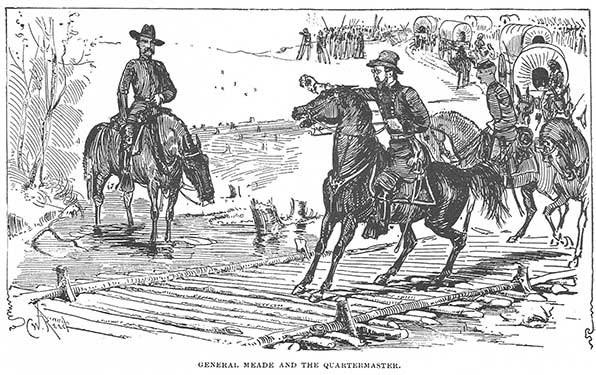


 Colonel William S. Tilton
commanded
both regiments. Here is his official report for May 5th.
Colonel William S. Tilton
commanded
both regiments. Here is his official report for May 5th. Rebel artillery blazed
away during this action and it was in this stretch of time that the the
13th MA and 16th Maine dodged enemy grape & canister to cross
the turnpike to the south side of the road.
Rebel artillery blazed
away during this action and it was in this stretch of time that the the
13th MA and 16th Maine dodged enemy grape & canister to cross
the turnpike to the south side of the road.