The Battle of Spotsylvania Court-House
May 7 – 9, 1864
“Soon we received an order from General Robinson to advance on the double-quick over the plain. It was obeyed as well as it was possible for men to obey after two previous charges following an all-night march. There wasn’t any double-quick in us.” ––Charles E. Davis, Jr. 13th M.V.I.
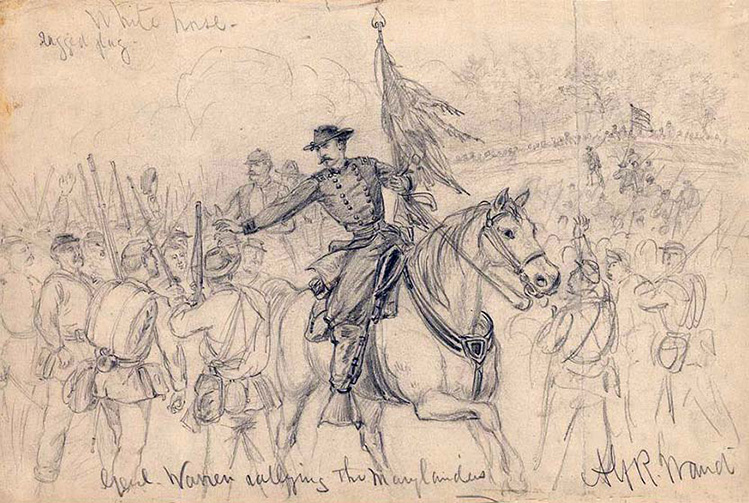
Alfred R. Waud sketch, “General G. K. Warren Rallying the Marylanders.” From the 13th MA Regimental History: “The staff of the national colors was shattered by a solid shot. During the repulse, General Warren took the flag with its shattered staff to rally a Maryland brigade, a picture of which appeared in “Harper’s Weekly” for 1864, page 372.” ––Charles E. Davis, Jr.
Table of Contents
- Introduction
- Night March: Race (?) to Spotsylvania Court-House
- The Battle as it Unfolded: Gen. Warren's Dispatches
- May 8, 1864. Early Morning Charge: Lyle's Brigade
- Gen. Robinson's Second Brigade at Spotsylvania May 8
- The 13th Massachusetts: May 7th––8th 1864
- May 8 Casualties in the 13th Regiment
- General Robinson & Chandler
Robbins; Beard
Mutual Admiration Society
- May 9, 1864, Part 1; The Death of General John Sedgwick
- Lyle's Brigade, May 9, 1864
- Story: "The Veteran; "––Austin Stearns
IntroductionThis website begins its nineteenth year of storytelling in the midst of General Grant’s Overland Campaign. As the chronology approached this two week long period of struggle, an imperceptible impression nagged at my thoughts, “how can you present the long, complex struggle that was, ‘the Battle of’ Spotsylvania Court-House? How can you get through the Overland Campaign?” I worried about this problem, secretly concerned I didn’t have enough primary source material, or time, to do justice to the dreadful month long confrontation. Now that the matter is upon me, I will just plow through with the material I have, in as strait-forward a manner as possible, ––describing the battle as it unfolded, in the soldiers own words. Although the Battle of Spotsylvania Court-House is remembered for moments such as the death of General Sedgwick, and the gruesome salient attacks of May 10 & May 12, the 13th Massachusetts Regiment followed a different path. They remember the battle for the 1 & 1/2 mile charge they made in the morning after an all-night march, and the resulting casualties they suffered, on May 8th. They also remembered General Warren seizing the shattered flag staff and waving their colors to rally the Maryland Brigade. As it turned out ––I have 3 unique unpublished stories regarding the regiment that day, which cannot be found anywhere else. These are: the story of General G. K. Warren and the National Colors of the 13th M.V.I.; the story of General John C. Robinson’s personal nurse, Chandler Robbins; and, an elaboration on Sergeant Austin Stearns’ unique drinking cup, which he intentionally paused in the midst of battle to save, (along with all its memories), from oblivion. The Big Picture Being decidedly through with fighting against strongly intrenched enemy positions in a dense tangled forest, General Grant ordered the Army of the Potomac, (and General Burnside’s independent 9th Corps command) to move south past the dug-in Confederate army on the night of May 7. General Grant's hope was to meet Lee’s army on better ground, where the Federal's advantage in men and matériel could effect the outcome of battle. Their Destination: Spotsylvania Court-House. By chance, elements of Robert E. Lee’s Army of Northern Virginia arrived first. Following the initial unexpected clash, the two armies slugged it out for another two weeks, in a series of bloody charges and counter-charges, with no apparent winner. It was another stalemate, just as “The Wilderness” had been. This page presents the first 3 days of that struggle, May 7––9, and the part the 13th MA played in it. What’s on this page. The Confederate viewpoint sets the stage with excerpts from Major-General Evander M. Law’s narrative found in volume IV of the Century Companies 1888 publication, “Battles & Leaders of the Civil War.” General Law tells how the Confederates just happened to beat the Federal army to Spotsylvania Court-House on the morning of May 8. Union perspectives are provided in part, by General U.S. Grant, General G. K. Warren, and the dispatches of Charles Dana, Assistant Secretary of War. This page is heavily slanted to the actions of General John C. Robinson’s 2nd Division of Warren’s 5th Corps. Colonel Peter Lyle’s Brigade, to which the 13th Mass., belonged, is extremely fortunate to have the writings of Lt.-Col. Charles L. Peirson (39th Mass.) to refer to. Colonel Peirson is from the same stratified class of men to which General Meade’s aide, Theodore Lyman belonged. In fact the two were friends and toured these battlefields together after the war. Lyman recorded the post-war trip in his diary, whereas Peirson submitted a detailed paper to the Military History Society of Massachusetts. His paper is titled, “The Operations of the Army of the Potomac, May 7––11 1864.” Major Abner Small of the 16th Maine, also presents a vivid account of his experiences in his personal memoirs, “The Road to Richmond.” With this calibre of reference material to draw upon, the experiences of Lyle’s brigade are well represented. Then of course, there is the usual source material from the 13th Regiment itself. It is helpful to have Major Elliot C. Pierce’s diary accounts of the regiment’s actions because Pierce is the third ranked officer of the regiment, sometimes commanding, when Colonel Leonard or Lt.-Col. Hovey were sick. His diary entries however, are minimum expressions of the days events, (which sometimes feel off by a day). And, they are sparse with commentary. Corporal Calvin Conant’s diary is equally useful, and, a bit more colorful than the Major’s. Sam Webster adds a few details from his journal, though he is mostly present at the field hospital behind the front lines. Warren H. Freeman’s well known letter collection makes a contribution to the May 8th story, though his letter is dated over a month after the events he describes. He wrote his descriptive letter on June 12th! I guess the constant moving and fighting prevented his writing expressive letters home. The reliable regimental historian, Charles E. Davis, Jr, and the memoirs of Sergeant Austin C. Stearns, keep the story moving with their unique narration as usual. And, there are some special surprises, as mentioned above, with David Sloss’s 1910 letter regarding General Warren & the National Colors of the 13th; excerpts from the pension application of Chandler Robbin’s widow Francis; and Austin Stearns’ hand-written post-war cup story, which he titled, "The Veteran." The list of regimental casualties is also a highlight of this page. I posted information from General Robinson's 2nd
Brigade, before posting the material from the 13th Regiment. The
three regiments represented in this section, the 12th Massachusetts,
83d ("9th N.Y.") New York, and the 11th Pennsylvania Volunteers had a
long association with the 13th MA, so I wanted to be sure their heavy
losses were represented on this page. Its worth noting after reading this material, that the
high command believed General Robinson's Division performed
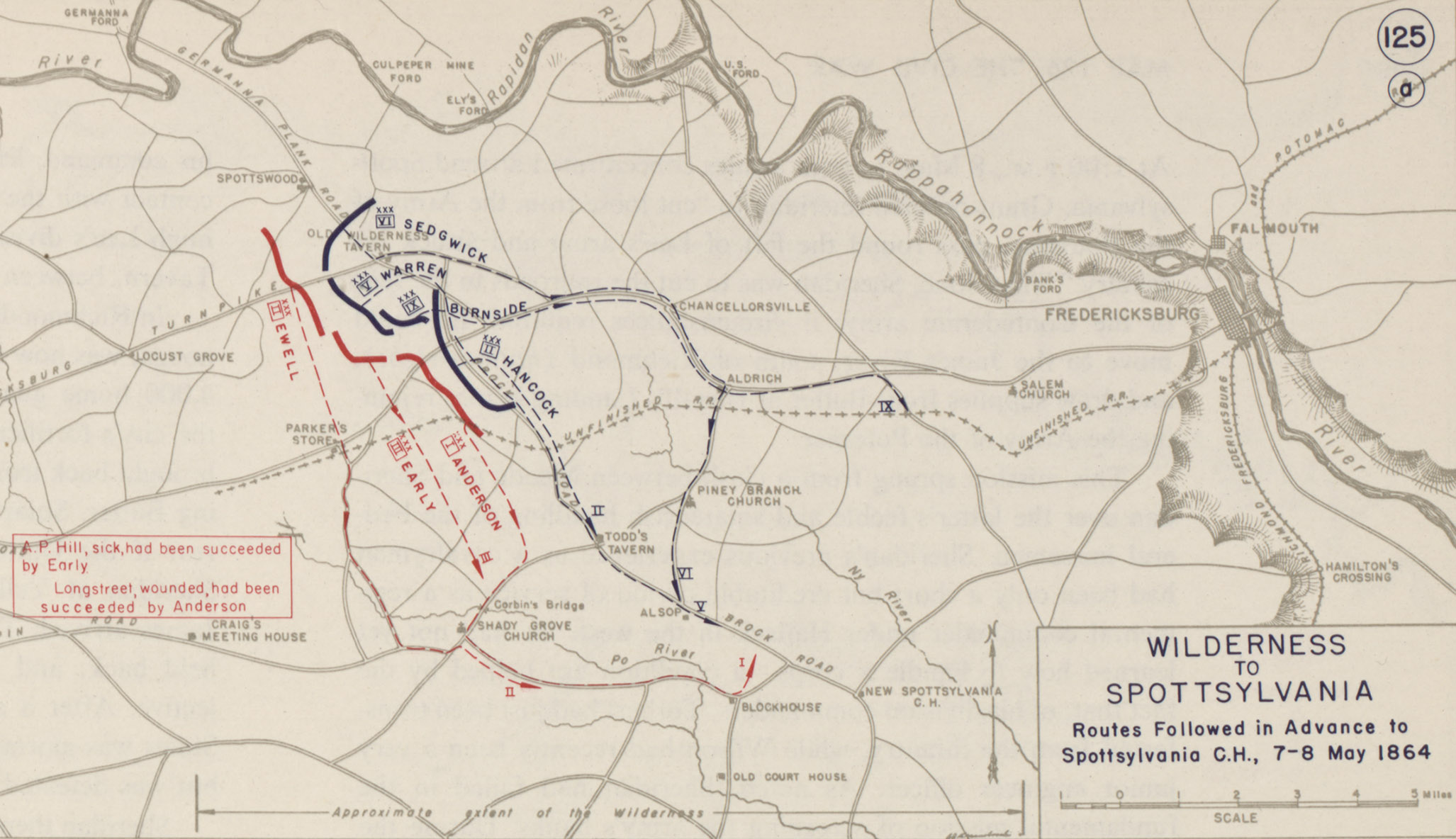
poorly on the morning of May 8th! The Battle of Spotsylvania Court-House was broad and complex. But for the infantry fighters it was a series of changing positions, digging-in, and violent charges, much like the last battle, and those yet to come. The story of the 13th MA at Spotsylvania reflects as much. Maps help fill in the larger picture of events. THE
FOLLOWING SOURCES WERE USED FOR THIS PAGE: PICTURE CREDITS: All Images are from the LIBRARY OF CONGRESS DIGITAL COLLECTIONS with the following exceptions: Morris Schaff's portrait is from Wikimedia Commons; Portrait of General R. H. Anderson, C.S.A. from, Mikel Uriguen's website, Generals & Brevets, long since gone, but still accessible on the Internet Archive Wayback Machine; B&W gouache painting by Norman Mills Price, "The Wilderness," [night march] is from, [illustratedgallery.com]; The following engravings: Todds Tavern, Three cavalry scouts, graphic of cavalry company, "Out of the Wilderness, Sunday Morning May 8," are from Battles & Leaders of the Civil War, The Century Company, 1888; Portrait of Charles L. Peirson is from, “The Thirty-Ninth Regiment, Massachusetts Volunteers, 1862––1865,” by Alfred S. Roe, Regimental Veteran Association, Worcester, Massachusetts, 1914; Portait of Major James Breathed is from, Central Virginia Battlefields Trust: [cvbt.org]; Confederate Artillery Painting is a detail from a Don Troiani work found on Pinterest. (The title of the piece was missing); The Gilbert Gaul painting, "Storming the Ramparts," was found at Ogden Museum of Southern Art, [omsablog.blogspot.com] a blogpost dated August 7, 2009, [image heavily worked over in photoshop]; Portraits of Gen. John Sedgwick, Seth Williams, & The Julian Scott painting, "The Death of General Sedgwick" is from, Wikipedia, [en.John_Sedgwick; Engraving of, "General Warren Rallying the Marylanders" is from Harpers Weekly, June 11, 1864, accessed at, [sonofthesouth.net]; Portraits of Chandler Robbins, Lt.-Col. Charles H. Hovey, & Major Elliot C. Pierce are originally from Army Heritage Education Center, Carlisle, PA, (now in authors collection); Portraits of Warren H. Freeman, David Sloss & D.G. Walker from author's collection; Illustration accompanying the Freeman letter is titled "At Antietam," painted by E. Jahn, is from "Deeds of Valor; how America's heroes won the Medal of Honor,"p.68; by Walter F. Beyer, & Oscar F. Keydel, 1901-1902; Published by Perrien-Keydel Co., Detroit, [accessed at Internet Archive; Portraits of Generals Grant and Robinson, are from "The Photographic History of the Civil War, in 10 Volumes," edited by Frances Trevelyan Miller, Review of Reviews, New York, 1911; Portrait of Samuel M. Morgan is from, "In Memoriam, John Cleveland Robinson 1817-1897, NY State Monuments Commission, 1918, Albany; Austin Stearns' sketch, "Saving the Dish," is from, “Three Years With Company K,” by Sergeant Austin C. Stearns, (deceased) Edited by Arthur Kent; Associated University Press, 1976. Picture of his dish, is found on page 225 of the 1991 Time-Life Book Series, "Echoes of Glory, Arms and Equipment of the Union"; Photograph of the Spotsylvania Battlefield by the author, Bradley M. Forbush, with the exception of one taken by John F. Cummings, from his blog, Spotsylvania Civil War Blog [spotsylvaniacw.blogspot.com] 2014 post, "The Death of Major-General John Sedgwick." ALL IMAGES HAVE BEEN EDITED IN PHOTOSHOP. Night March: Race (?) to Spotsylvania Court-HousePRELUDE The following excerpt is from “The Battle of the Wilderness,” by Morris Schaff, Houghton Mifflin Company, Boston, 1910. (p. 201). Lt. Schaff makes a keen observation about the Army of the Potomac, which applies here to the night march towards Spotsylvania Court-House. 
[Setting: Evening, May 5th.] When night and exhaustion put an end to the fell struggle between Hancock and Hill, it may be said that the first day of the battle of the Wilderness was over. And what a day it had been! Where now were the plans, hopes, and roseate forecasts which the self-reliant natures of both Grant and Lee had made, as they were looking forward to it the night before? All transmuted into solemn, speechfull reality. Grant had telegraphed Halleck as soon as he had crossed the Rapidan safely: “Forty-eight hours now will demonstrate whether the enemy intends giving battle this side of Richmond.” With his intuitive wisdom, he had predicted truly; yet, as a matter of fact, he did not know or care when or where the battle should begin. He meant to find Lee, clinch, and have it out with him for good and all, wholly undisturbed as usual over possible results. And behold, the day had banished the uncertainties of the night before, and had brought him just where he had wanted to be, in conflict with his famous adversary. But, imperturbable as he was, I feel sure it had brought some disappointment to him, –– not because Lee had obviously the best of it, but because he himself had discovered the Army of the Potomac’s one weakness, the lack of springy formation, and audacious, self-reliant initiative. This organic weakness was entirely due to not having had in its youth skillfully aggressive leadership. Its early commanders had dissipated war’s best elixir by training it into a life of caution, and the evil of that schooling it had shown on more than one occasion, and unmistakably that day, and it had had to suffer for it. But never, on that day or any other, did an army carry its burdens of every kind, and it had many, with a steadier or a more steadfast heart. From the Wilderness to Cold Harbor [excerpts] BY E. M. LAW MAJOR GENERAL, C. S. A. In a rare instance for this website, the Confederate viewpoint sets the stage for the battles at Spotsylvania Court-House, with an explanation of how Lee's Army arrived at the important cross-roads first. General Evander M. Law is mistaken however, in asserting Lee was directly responding to the Federal army marching south. Lee reasoned Grant might move south, but he wasn't certain, and his orders to Gen. Anderson were to start for the Court-House the morning of May 8. But Anderson decided to march the night of May 7, because the woods of the Wilderness were burnt over and he could not find a good place to bivouac. 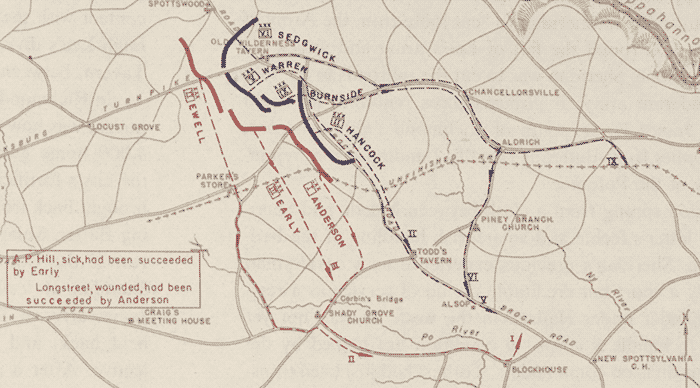 Map of Opposing Forces, Evening of May 7 – Morning, May 8, 1864. Click here to view larger. 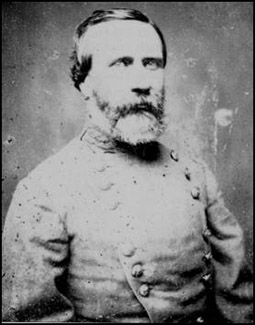
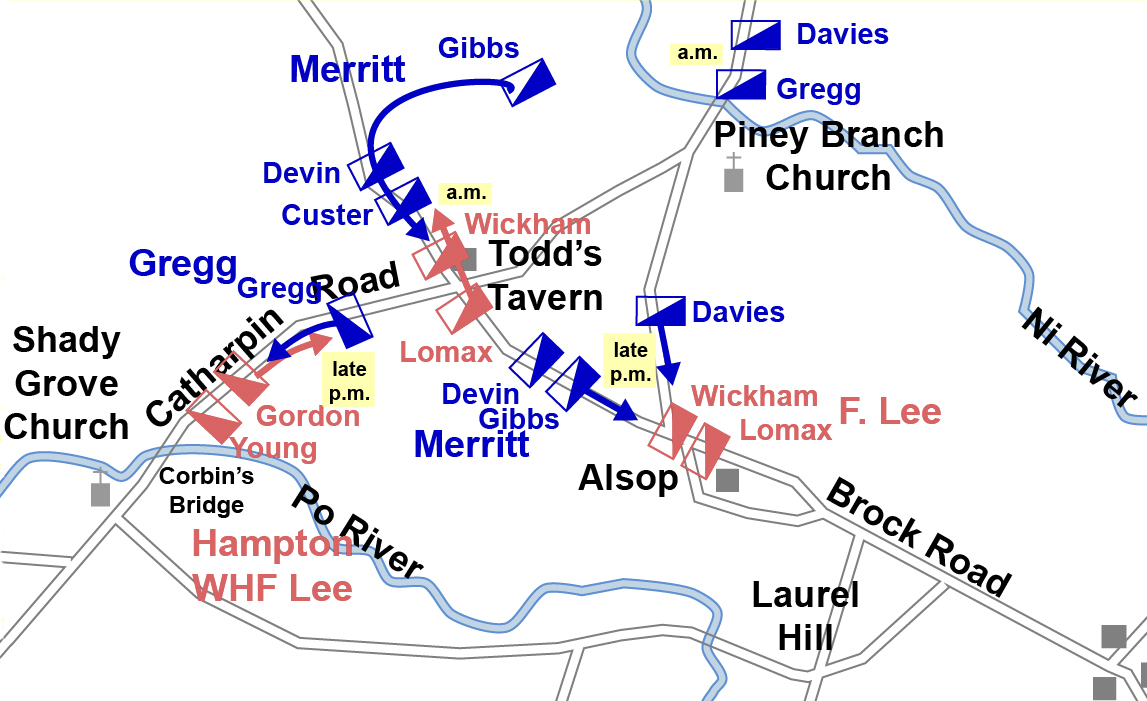
Both sides were now strongly intrenched, and neither could well afford to attack. And so the 7th of May was spent in skirmishing, each waiting to see what the other would do. That night the race for Spotsylvania began. General Lee had been informed by “Jeb” Stuart of the movement of the Federal trains southward during the afternoon. After dark the noise of moving columns along the Brock road could be heard, and it was at once responded to by a similar movement on the part of Lee. The armies moved in parallel columns separated only by a short interval. Longstreet’s corps (now commanded by R. H. Anderson) marched all night and arrived at Spotsylvania at 8 o’clock on the morning of the 8th, where the ball was already in motion. General Richard Heron Anderson, C.S.A., pictured. Stuart had thrown his cavalry across the Brock road to check the Federal advance, and as the Federal cavalry had failed to dislodge him, Warren’s corps had been pushed forward to clear the way. K ershaw’s, Humphreys’s, and Law’s brigades were at once sent to Stuart’s assistance. The head of Warren’s column was forced back and immediately commenced intrenching. Spotsylvania Court House was found occupied by Federal cavalry and artillery, which retired without a fight. The Confederates had won the race. The troops on both sides were now rapidly arriving. Sedgwick’s corps joined Warren’s, and in the afternoon was thrown heavily against Anderson’s right wing, which, assisted by the timely arrival of Ewell’s corps, repulsed the attack with great slaughter. Hill’s corps (now under command of General Early) did not arrive until the next morning, May 9th. General Lee’s line now covered Spotsylvania Court House, with its left (Longstreet’s corps) resting on the Po River, a small stream which flows on the south-west; Ewell’s corps in the center, north of the Court House, and Hill’s on the right, crossing the Fredericksburg road. These positions were generally maintained during the battles that followed, though brigades and divisions were often detached from their proper commands and sent to other parts of the field to meet pressing emergencies. No engagements took place on the 9th, which was spent in intrenching the lines and preparing places of refuge from the impending storm. But the 10th was “a field-day.” [To be continued.] Journal of Major-General Gouverneur K. Warren, Commanding 5th Corps May 7. ––Our army took up defensive positions, and spent the time getting our commands again together, detached to defend parts of the field to meet the varying emergencies of the previous days’ battles. At 9 p. m. the army began to move toward Spotsylvania Court-House, the Fifth Corps having the advance, on the Brock road. We were delayed about one and one-half hours by the cavalry escort to General Meade, and on reaching a point 2 miles beyond Todd’s Tavern were delayed about three hours by Torbert’s cavalry* endeavoring to clear the way for us. They gave it up about 6 a. m. May 8, and got out of our way. General Robinson’s division immediately went forward, lead by himself. He at once cleared out the enemy’s cavalry and the wood with which they had obstructed the road, and advancing rapidly struck the advance of Longstreet’s corps near the Block house. This we forced back till we gained a good position, and were compelled then to await re-enforcements. General Sedgwick’s corps was sent up to crush out Longstreet, and his rank gave him the command. So much time was lost, however, that night came before more than one of the brigades had become engaged, and that but slightly. General Crawford’s division, however, attacked the enemy, captured a color, and many prisoners. *General Wesley Merritt was commanding Torbert's cavalry. Gen. Torbert was unwell.––B.F.  Charles Wainwright Describes the Difficult Night March of May 7 –– 8 Colonel Wainwright, raises an important question. Didn't the fact that this was a night march suggest a sense of urgency to those involved? In particular, shouldn't General Meade have stressed to General Warren, whose 5th Corps led the night-time advance, that celerity was crucial? The followiing is from, “A Diary of Battle, The Personal Journals of Colonel Charles S. Wainwright, 1861––1865,” Edited by Allan Nevins, Stan Clark Military Books, Gettysburg, Pennsylvania, 1962. Sunday, May 8th. –– The night was cloudy, & exceeding dark: we struck the road just where the turnpike to Chancellorsville, and the Germanna Plank Road cross, in such a way as to make it more of a fork than a crossing. The Ninth Corps was moving out on the turnpike, and caused some confusion as it was difficult to distinguish the two roads in the dark. I made the mistake myself for a short distance, which was most lucky as I came across Stewart’s Batt’y wagon & one of his caissons, which had got separated from the Batt’y, & turned them back on to the right road. Rittenhouse was at the head of Crawford's divisions, & Richardson in rear of Griffin’s. So soon as I had all started I tried to push up to the head of the column to join General Warren, but could not get a step beyond Richardson’s battery. The road, which was not wide and made a thorough cut all along here, was literally jammed with troops moving one step at a time. Never before did I see such slow progress made: certainly not over half a mile an hour, if that. Nor could I get around them, for it was so dark that you could not see at all where your horse was stepping. As we pushed along in this way, every lighted pipe being distinctly seen in the darkness, a lot of pack mules from one of Griffin’s head brigades, who had got frightened at something, came down the line on a run. Their great wide packs cleared a broad road through the middle of the line, and their numbers were constantly increased by other mules and horses which they frightened in their passage as much as themselves. I thought the little grey quartermaster’s horse that I was riding was going with them, for he reared up the bank, which I could not see, and fell over backward; he did not, however, get off, nor was either of us hurt at all. When we reached the Brock road, we also struck the right of the Second Corps. They had thrown up a breastwork along the west side of the road, and made a wide slashing in front of it, while the men lay asleep along either side of the roadway. So tired were they that even the passing of the batteries did not awaken them. Along here I managed to get a little ahead but not much until the day began to dawn, so that we could see where there was an opening. I then pushed on at a quick walk until I got clear of the Second Corps. Soon after it was light enough to see I came across Andy Webb, who I was delighted to find was not wounded on Friday as reported. Beyond the lines of the Second Corps Ayres’s brigade were lying down, as there appeared a complete block ahead. Having a clear road, I started my little grey into a slashing trot, at which I found him a marvel, and did not draw rein until I reached Meade’s headquarters at Todd’s Tavern; when I found I had one staff officer and one orderly with me. 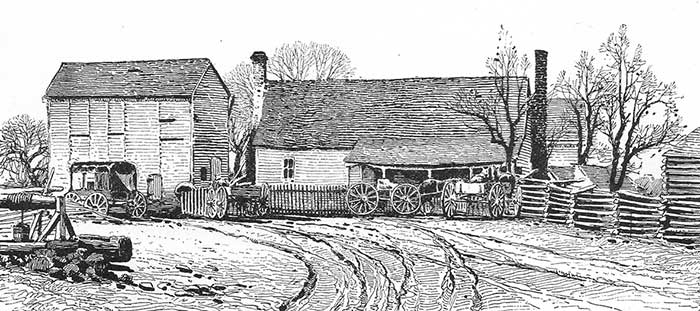 Todd's Tavern in War-Time. From a Photograph. [Battles & Leaders of the Civil War, Vol. IV, (p. 146).] The whole cause of this delay, this dragging along at a snail’s pace, I found caused by a couple of hundred yards of wet road, over which the water ran an inch deep, and where the men were picking their way one at a time. Beyond this I rode nearly two miles without coming across anything that could be called a column. At Meade’s headquarters I found them all asleep, but thought this straggling of the column of sufficient importance to wake Williams up and tell him of it, as I did not know what might be depending on time. Every officer and man was doubtless very tired and the night was very dark, but it is to me impossible to understand the perfect indifference with which officers allow their men to lag and break ranks for such little things. The fact of our march at night was enough to tell every man that we wanted to reach some place without Lee’s knowing it; and one would think that a desire for their own safety would spur them all up to do it, so as to avoid a fight. When I reached General Warren, who had halted Robinson’s division about a mile and a half beyond the tavern, I found them all quietly eating their breakfast, waiting for Merritt to open the way with his cavalry. Perhaps it was on account of my having made such a fuss along the road about the time lost by our corps, so that I felt chagrined; but I certainly thought then that both Warren and Meade were not pushing matters as much as they ought, considering how important it was to reach Spotsylvania Court House before Lee; and now that we have not got there at all today, I am quite sure of it. Warren had no control, I presume, over the division of cavalry under Merritt which was ahead of us; but he should have, as ranking officer at the head of the column, been charged with the securing of a good position at the Court House and have had control of all troops engaged in doing this, or else Meade should have been on the ground himself. I feel sure that had our column been properly pushed we might have got up to Merritt at least an hour before daylight; which would have given the men that much time for rest and breakfast. If then Merritt had pushed ahead at five o’clock, with Warren’s corps close behind him, there is no doubt we should have been ahead of Lee, and got hold of the Court House. 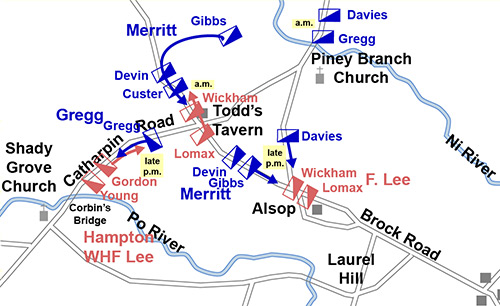 Hal Jesperson has created a series of public domain campaign maps in bright primary colors, for the Battle of Spottsylvania Court House, (and other confilicts) of which this is an inset from Map #1. Because I reduced the size of the original graphic, the scale here is about 1 inch = 3 miles. Visually, there is about 3 miles between the Todd's Tavern intersection and the Alsop Farm intersection. This map shows the cavalry fighting along the road to the Court House the night of May 7, and morning of May 8, 1864. I desaturated the neon colors a bit to better fit the style of my website. Click here to view larger. About six-thirty o’clock Merritt reported that the enemy were too strong for him, and Warren was ordered to clear the way for himself. The General appeared decidedly crusty this morning; why I do not know. He went on with Robinson’s division, taking Martin’s and Breck’s batteries, but directing me to remain where I was and send up other batteries as he needed them. This I did not consider my business; it was for me to make arrangements to have the batteries brought up as needed, but my own place at the opening of a fight is undoubtedly alongside of the corps commander. It was some time before I got orders to move up all the batteries, and a sharp engagement had taken place, our leading divisions being driven back. From hearsay I learn that our men drove the cavalry before them without much trouble, formed line across the open around the Alsop house & moved rapidly over it into the wood beyond nearly capturing one of the rebel guns. This woods is but small & open with two roads running through it quite near together separating at the Alsop House, & uniting again in a long opening about half a mile on. This open ground which begins near the rejoining of these roads, stretches off to the west for a mile or more, varying from 600 yds to a mile in width, a small stream runs through it one of the head branches of the Po river. The road on crossing the head of this valley rises a small ascent, as our men were pushing up this the rebel infantry made their appearance, & drove them all the way back to the Alsop house. Our men behaving very badly it is said. Picture of the Alsop Farm/Brock Road Split 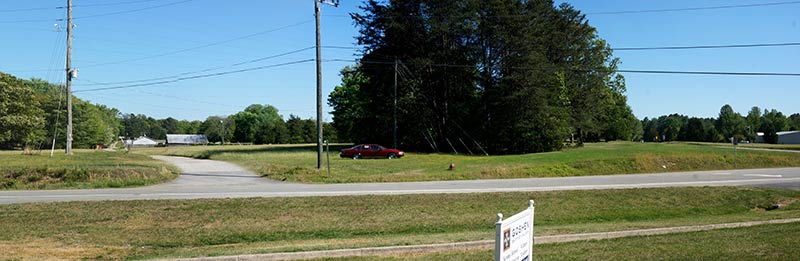 On the map above you can see where the Brock Road splits into a loop at the Alsop Farm. This is what the intersection looks like today, looking generally in a southerly direction. The modern Brock Road follows the outside split on the right of this image. The road in the foreground is the Piney Branch Church Road. The drive leading to the farm buildings is the path followed by Lyle's Brigade of Robinson's Division, which is private property today, still in the Alsop family. Wainwright took the outer road. Lyle's Brigade took the inner road. Enemy resistance was encounterd here beyond the distant treeline of the Alsop Farm. The photo was taken from the steps of the Goshen Church, which occupies the intersection. Click to view close up. Brecks batt’y had been left at the Alsop house which stands on very high ground & is a good position. Martin took his own forward to the rejoining of the roads & went into position there at the time of the enemy’s attack, but was obliged to withdraw when the infantry broke.* Martin himself was hit in the back of neck, the ball just grazing the top of the spine, I met him in an ambulance about a mile before reaching the Alsop house. His Batt’y went into position again on a knoll about half way back to the Alsop house & on the right of the west road, under command Lt. Walcott. Gen’l Robinson too got a bad shot in the leg, so that there is not much doubt but what he will loose it; and Lt Col. Locke Corps Adj’t Gen’l a ball through one cheak coming out at his mouth. *This would be the spot where General Sedgwick is mortally wounded on May 9.––B.F. [Because this is the part of the early morning clash that involves Col. Lyle's Brigade, I'll take leave of Colonel Wainwright here, for now. The journal entry continues at length describing the rest of the days actions from Col. Wainwright's perspective.––B.F.] The Battle as it Unfolded: Gen. Warren's DispatchesGeneral Meade's Instructions to the Cavalry General Meade and Grant's new appointed head of cavalry General Sheridan, had a troubled relationship that was about to rupture. Headquarters
Army of the Potomac, Major-General Sheridan, I find Generals Gregg and Torbert without orders. They are in the way of the infantry and there is no time to refer to you. I have given them the inclosed orders, which you can modify to-day after the infantry corps are in position. GEO. G MEADE,
Continued. Headquarters
Army of the Potomac, General Torbert
or Merritt, You will immediately move your command beyond Spotsylvania Court-House, placing one brigade for the present at the Block house, picketing the roads approaching the Court-House, and disposing the other two so as to cover the trains that will be north of the Ny River, between that and the Orange plank road. It is of the utmost importance that not the slightest delay occur in your opening the Brock road beyond Spotsylvania Court-House, as an infantry corps is now on its way to occupy that place. GEO. G. MEADE,
Headquarters
Army of the Potomac, Brigadier-General Gregg,
You will immediately move your division to the vicinity of Corbin's Bridge and watch all the roads approaching from Parker’s Store, and as soon as General Hancock has occupied Todd’s Tavern you will send a force on the Brock road to notify General H. of the approach of the enemy. GEO. G. MEADE,
General Warren Reports on the Progress of His March May 8, 1864––5 a.m. Major-General Humphreys, General: The head of my column reached General Merritt’s headquarters at 3.30 a.m. I have word that the rear of it got off about 12.30, the delay being caused by the halt at the head of the column from obstruction. I found General Merritt at 3 a. m. just starting out with an order from General Meade to push on and clear away the road. I have had my troops closing in masses as fast as possible ever since, and they drop to sleep as soon as halted. General Merritt has for some time been skirmishing, and his column near me is advancing. I do not know the result in front. He will have to clear the way or make way a little himself for me to get to the front. Perhaps he will succeed without my help; and, if not, a little rest to my men will help them very much. I am aware of the importance of getting on to Spotsylvania Court-House as soon as may be, and should have taken the front and attacked if the cavalry had not been moving up to do it. I have one division now massed. The fighting is about a mile in front of me. G.K. WARREN,
Continued: May 8, 1864––6.45 a.m. Major-General Humphries: I started my troops forward at 6 o’clock; nearly two divisions have passed where General Merritt’s headquarters is. General Robinson’s division had the advance and he has been directed to spare no effort to clear the road. Having now heard from all my staff officers, left to the rear at different points to enforce instructions, I am now going to the immediate front to direct the advance. If anything happens to me, General Crawford is the next officer in rank. My wagons began to haul out at Chancellorsville at daylight. My pickets were not relieved till near 3 a.m. They report the enemy chopping along their front during the night. The head of General Burnside’s corps had reached Chancellorsville before daylight I know, and also that the last of General Wilcox’s division left the Wilderness Run before daylight. The cavalry in my front here have, I think, made no advance to-day. I sent my men forward at General Merritt’s intimation that, under the circumstances, I could push the enemy faster than he could. It is difficult to do much with the troops in an expeditious manner in these dense woods. Respectfully, G. K. WARREN,
May 8, 1864––8 a.m. Major-General Humphreys: The opposition to us amounts to nothing as yet; we are advancing steadily, the enemy uses artillery, two pieces, on the road. General Robinson has gone ahead with a brigade, mostly in line. I follow close with columns filling the road, and artillery; if there is nothing but cavalry, we shall scarcely halt, if our troops can be made to move, but they are exceedingly hesitating, I think. General Robinson’s orders are to use only the bayonet, and carry every battery the enemy shows. It is believed to be Fitzhugh Lee’s cavalry. G.K. WARREN,
General Wilson's Cavalry Arrives at the Court-House But Must Withdraw While Warren was struggling north of the town, Gen. James H. Wilson’s Cavalry brigade arrived in the village via another, more easterly road. But Confederate infantry between Warren & Wilson, forced him away. Hdqrs.
3d Div. Cav. Corps, Army of the Potomac, Lieutenant-Colonel Forsyth, Have run the enemy’s cavalry a mile from Spotsylvania Court-House. Have charged them through the village. Am fighting now with a considerable force, supposed to be Lee's division. Everything all right. J. H. WILSON,
Robinson's Troops Fought with Reluctance Headquarters
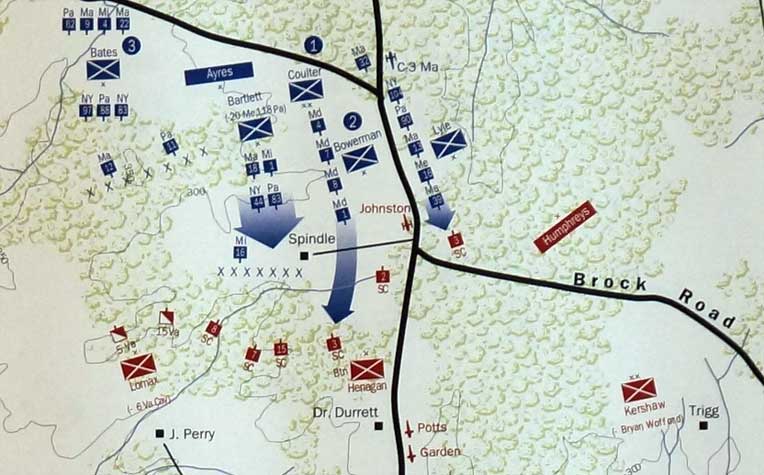
Fifth Army Corps, Major-General Humphreys: I reached the vicinity of the blacksmith shop at the intersection of the road from Piney Branch Church, the road we were on, toward Spotsylvania Court-House. I promptly attacked the enemy here with what was on hand of General Robinson’s division, led by himself in person, and General Griffin’s division by himself. General Robinson's troops fought with reluctance, and fell back, himself severely wounded in the knee. This exposed General Griffin’s left, and part of his command fell back too, all in much confusion, refusing much of our attempts to stop them, till they got out of fire. They will soon stop, and can perhaps be assembled again to-day. General Griffin, however, held on. I sent General Crawford to his support and then General Cutler, and they have held on, and at this time are again advancing in fine style. We have taken prisoners from General Longstreet’s corps. WARREN. [Indorsement.] An aide who brought this says that the prisoners belonged to General McLaws’ division, Longstreet’s corps. I am in hopes this may be some mounted infantry given to Stuart to strengthen him. I hardly think Longstreet is yet at Spotsylvania. Sedgwick’s best division joined Warren just as this dispatch was written. I have told him to call for the one here if necessary, and to attack vigorously without loss of time, but I fear the morale of his men is impaired. GEO. G. MEADE. The Maryland Brigade's Charge at the Spindle Farm 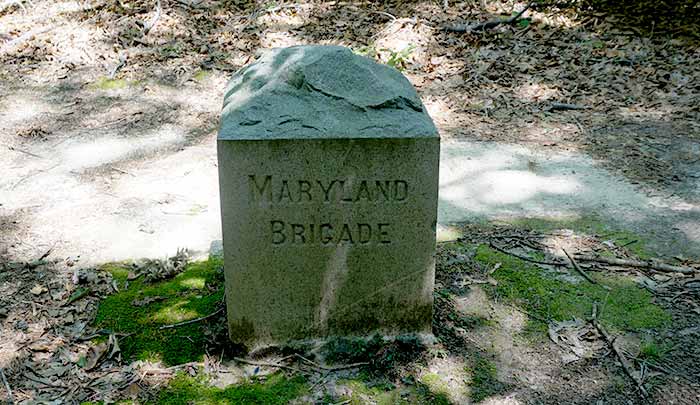 We now take a brief pause to contemplate one of the charges from General Robinson's Divison mentioned in the dispatch above. It is the charge of the Maryland Brigade, made up of the 1st, 4th, 7th & 8th Maryland Infantry. The following is an excerpt from "The Battle of the Wilderness" by Morris Schaff, p. 91-93. If you should visit the field of Spotsylvania, you will find standing in the Spindle farm, within reach of the evening shadows of an old wood, and amid tufts of broom-grass, a gray rectangular stone, and on one of its faces you will read “Maryland Brigade,” and on another this legend, a copy of an order given by Warren, then in the road about where Sedgwick was killed the following morning: “8th May 1864. Never mind cannon, never mind bullets, press on and clear this road,” ––meaning the road to Spotsylvania, that lies but a mile and a half beyond. On the south face is, “Nearest approach on this front.” 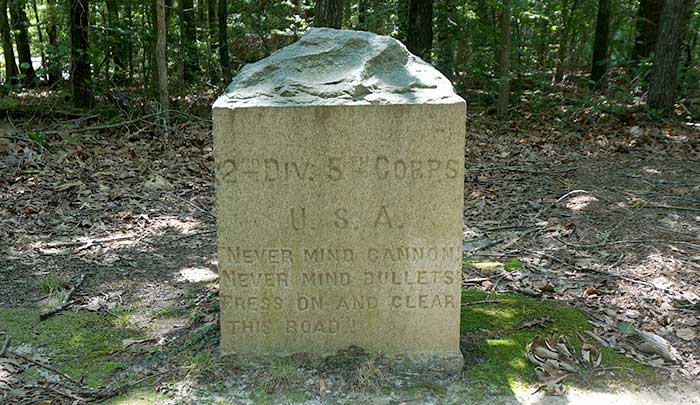 I saw the troops with my own eyes as they tried gallantly to carry out Warren’s order, wondering at every step they took how much longer they could stand it under the withering cross-fire of artillery and musketry; and the whole scene came back to me vividly as I stood by the stone the other June day. And I’ll confess freely, it came back with a sense of pensiveness such as always attends a revisit to one of the old fields. I got there about the same hour as that of the charge, and the day resembled exactly that of the battle, one brimming with glad sunshine; that kind of a May morning when new-shorn sheep look so white in the fields, the brooks ripple so brightly, and joy is in the blooming hawthorn. 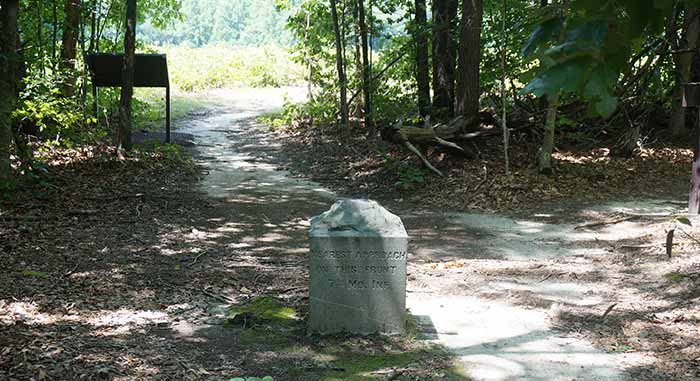 But there, by the stone, all was very still, ––silence was at its highest pitch. Huge white clouds with bulging mountain-tops, pinnacled cliffs, and gray ravines were floating lazily in the forenoon sky, and across the doming brow of one of them whose shadow was dragging slowly down the timbered valley of the Po, a buzzard far, far above the earth’s common sounds, was soaring half-careened with bladed wing. There were no men or herds in sight, the only moving thing was an unexpected roaming wind. Suddenly the leaves in the near-by wood fluttered a moment, and then the broom-grass around waved silently as the wandering wind breathed away. My left hand was resting on the stone, and a voice came from it saying, as I was about to go to other parts of the field,––to where brave, sweet-hearted Sedgwick laid down his life and our batteries had stood,––“Stay, stay a while ! I stand for the men you saw marching across the Rapidan, who after facing the volleys of the Wilderness were called upon to move on at last under the severe order, ‘Never mind cannon, never mind bullets, but press on and clear this road.’ Here many of them fell. Stay a while, I love to feel the warmth of a hand of one who, as a boy, served with them. Do not go just yet, for, here alone throughout the long days in the silence of the dead broom, I am sometimes lonely.” General Meade's Dispatch to General Warren. Headquarters
Army of the Potomac, General Warren: Your dispatch is received. General Sedgwick has one division now with you, and another at this place ready to move forward to support you. Attack vigorously. Let the men know it is our interest to prevent a concentration to stop our march, and that they should drive them. GEO. G. MEADE,
General Sedgwick's Dispatch, 12.10 p.m. Headquarters
Sixth Army Corps, Major-General Humphreys, Brigadier-General [Wright?] reports that Major-General Warren called on him for assistance. He went with three brigades, leaving one at the point indicated. JOHN SEDGWICK
Gen. Warren's 12.30 p.m. Dispatch. Headquarters
Fifth Army Corps, General Humphreys: We have finally succeeded in pushing back the enemy as far as we have tried, but have not quite gained the junction of the Catharpin road with the one I have been moving on. General Wright has brought up his division to support me. I have again suffered heavily, especially in stragglers. The Second Division (Robinson's) is quite disorganized. I have lost no prisoners; the men simply straggle back into the woods fatigued and wounded. I have done my best, but with the force I now have I cannot attack again unless I see very great weakness on the enemy’s left flank. It would be well to send troops of Sedgwick’s near the woods to me, and to move on with Hancock’s down half way. I have fought the division of cavalry and taken prisoners from at least two divisions of Longstreet’s corps. They say his whole corps is here. His men left the trenches last night at 11 o’clock, and are as tired as mine. His wagons are seen moving south on the Catharpin road. Colonel Locke is badly wounded in the face. I have lost the old white horse. Colonel Ryan is killed; my staff is all tired out. Can you not send me from the trains some ammunition, say five wagon loads, and what ambulances can be spared; I have none in the train. My position is good enough if I am not attacked in some unprepared point on my flanks. I incline to think, though, that if I let the enemy alone he will me. I cannot gain Spotsylvania Court-House with what force I have. You can best judge whether I can be spared more assistance from General Sedgwick by being informed of our necessities elsewhere. I would like to have it from both Sedgwick and Hancock. I am out of ammunition. G. K. WARREN,
While I am writing the reports of my officers come in such that I need re-enforcement. I dare not fall back, for then I shall disclose my feeling of weakness. G.K.W. The Spindle Farm 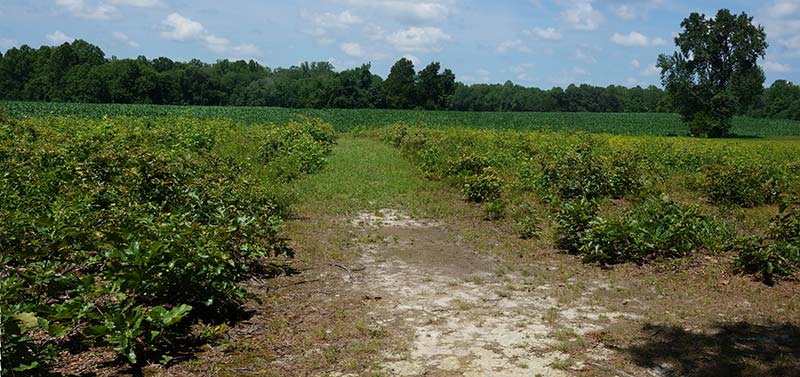 Pictured is the field of the Spindle Farm just outside the woods where the Maryland Marker stands. The photo was taken July, 2026. The Brigade charged through this field directly toward the viewer. The Spindle farm house would have stood in the middle of the field on the left side of the path. View is to the north. The Brock road is just off-screen to the right. A slight pan to the right shows the road intersection where General Sedwick was shot. Dispatch of General Sam Crawford Commanding Warren's 3d Division May 8, 1864––1.35 p.m. [General G. K. Warren:] General: It is reported to me that the enemy are moving a column to our left. My left is well protected and General Wright has come up. There is no doubt that one or more of Longstreet's divisions is in our front. Very respectfully, S.W. CRAWFORD,
It's a pity... Headquarters
Third Division, Cavalry Corps, Lieutenant-Colonel Forsyth,
My troops are now here and between here and the road from Fredericksburg to Spotsylvania. All quiet, no advance anywhere on the Ny. I have 41 prisoners; 2 officers, 1 the assistant inspector-general of Kershaw’s brigade, Longstreet’s corps. It’s a great pity the troops on the Todd’s Tavern road could not have advanced farther. We should have had several hundred prisoners. Send me word what to do and where our infantry is. We cleaned out Wickham’s brigade in about two minutes, scattered him in all directions, killed quite a number, and wounded some 20 or 30. Our artillery had an admirable chance. Second New York and Eighteenth Pennsylvania charged very handsomely. Prisoners from cavalry brigade and two divisions of Longstreet’s Corps. J.H. WILSON,
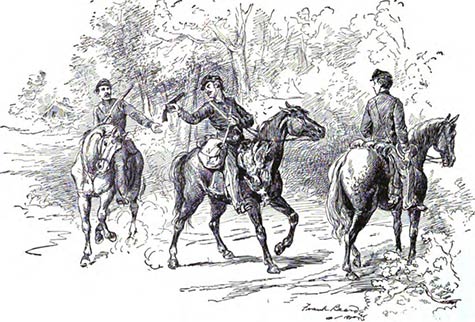
May 8, 1864. Early Morning Charge: Lyle's First BrigadeThe following narratives provide more detail than Charles Davis, Jr.'s account, in the history of the 13th Massachusetts, regarding the charge of Colonel Peter Lyle's Brigade, the early morning of May 8. The accounts are from Abner Small, 16th Maine, and Lt-Col. Charles L. Peirson, 39th Massachusetts. But first, a short paragraph from the 90th PA, which was attached to the brigade when Colonel Peter Lyle assumed command on May 6, 1864. The following short paragraph is from “History of Pennsylvania Volunteers, 1861-1865;” by Samuel P. Bates; Vol. III, 1870. NINETIETH REGIMENT. On the 6th Colonel Lyle, by order of General Robinson, was placed in command of the brigade in place of Colonel Leonard, and Captain William P. Davis, in absence of the other field officers on detached duty, took command of the regiment. The brigade moved to the front early in the day, and during this and the following day was employed in fortifying and in shifting positions for the defence of threatened parts of the line. At nine o’clock on the evening of the 7th, it withdrew from the front, and moving on to the left in rear of our lines, arrive at day-break near Todd’s Tavern, where the cavalry was skirmishing. After a brief halt it formed line of battle, advanced under a heavy fire from the enemy’s skirmishers, and drove them in upon his intrenchments, which were found too strong to be carried. It was obliged to fall back, suffering severely, General Robinson being wounded. The Ninetieth lost twenty in killed, wounded, and missing. In the operations about Spottsylvania the regiment was constantly employed in fortifying and in advancing upon the enemy’s positions. In an unsuccessful charge upon his works at Laurel Hill, made on the 10th, Lieutenant Jesse W. Super and three men were killed by the explosion of a single shell. The loss in the regiment was nearly one hundred. Journal of Major Abner R. Small, 16th Maine The following is from “The Road to Richmond,” by Major Abner R. Small, University of California Press, Berkeley, CA, 1939. (p 135--136.) Shoot, Shovel, and March We were bound for Spotsylvania Court House; and so
were
the rebels, though we didn’t know it then. We were delayed in
starting, mounted troops of the provost guard blocking our way;
it was
eleven o’clock before they moved out the Brock road and we followed
them. We marched, that night, through a forest of black
pines; the road
was narrow, and the trees made it very dark; it was a desolate
and
dismal track. Before daylight we passed Todd’s Tavern, where the
road turned to the southeast, and about a mile beyond the tavern we Our division pressed ahead and deployed, our brigade in the lead. We soon found rebel skirmishers in our front, and drove them back through a mile of woods. Hard going, that was; the rebels had felled trees across the roads and paths. It was broad day and scorching hot when we reached the cleared lands of the Alsop farm. We pushed on beyond the farm and came to a rise of ground and a wooded knoll, and halted to gather our scattered ranks. We were fully two miles from where we had first deployed; and our men had run a part of the way, and many had dropped out, overcome by heat and weariness. My regiment at that moment numbered fewer than two hundred. Beyond a clearing ahead of us there was a forested ridge, and we could see where the rebels had felled a slashing of trees and thrown up breastworks. We were ordered to charge them. Out into the open we went, over rough ground, under fire. We crossed the clearing, and smashed a rail fence at the farther side, and rushed up among the felled trees. We could go no farther. Our men took to cover and fired at any heads that appeared over the works. The rebels were there in force, too strong for us; and they had come to stay. We heard a great uproar as the fighting spread; and then we were ordered to retire. The brigades coming up on our right and left had each been taken in flank by a savage outburst of musketry and artillery, and General Robinson, leading the charge, had been hit and disabled. We all fell back in some confusion; but the men steadied when clear of the flanking fire, and beat off an attempt of the enemy to take advantage of our repulse and our loss of a commander. Not far from the Alsop house we threw up a barricade of earth and fence rails. General Robinson was carried to the rear, and Colonel Coulter assumed command of the division. 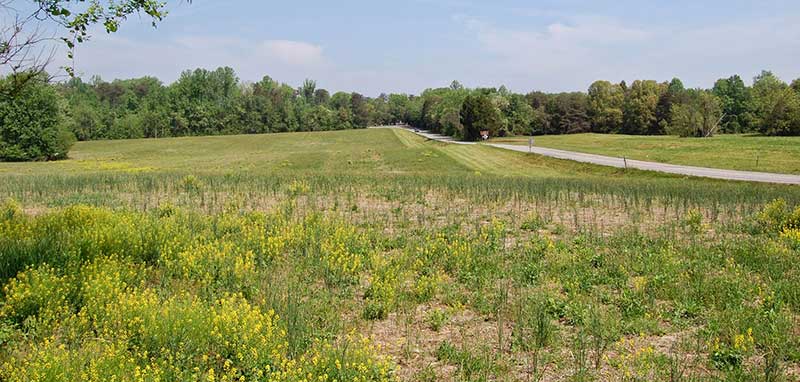 This is a picture of the fields over which the final charge of John C. Robinson's troops took place. Col. Lyle's brigade charged through the field on the right of the road. The Maryland Brigade charged on the left side of the road. The photo was taken by John Cummings to show the approximate position from which a Confederate sniper fired the shot which killed General John Sedgwick, on the morning of May 9, 1864. (The Sedgwick Monument is on the right of the road in the notch of trees on the horizon.) After the failed charge, General Warren formed his line of works along the distant tree line on the left of the road pictured. The Sixth Corps dug in on the right of the road. [Source: Spotsylvania Civil War Blog: Sunday, May 11, 2014. “Death of Major General John Sedgwick - 150th Anniversary, On Location, To the Minute,” posted by John Cummings.] Abner Small continued: My regiment took count of its losses. Two of our line officers, Captain Belcher and Lieutenant Fowler, were wounded severely. Lieutenants Wiggin and Richards were missing; they and some of our men, were taken prisoners in the running fight when the brigade fell back. Three of our men certainly, and perhaps more, were killed, and more than fifty were wounded. One of the first men hit was Corporal Palmer, carrying our national color. While we had been in the woods, the color had been carried in the case to protect it from being torn; but when the charge was ordered, Palmer stripped off the case and flung the ensign to the air A bullet struck him in the arm and side, yet he held up the flag until it was taken from his grasp by our other color-bearer, Corporal Manchester, who gave the state flag into the hands of Corporal Fairbanks. The banners went forward together in the chafe. Palmer crawled painfully to the rear until exhaustion over took him. We found him when we fell back to the farm, and sent him, without hope, to the surgeons. Alfred S. Roe, 39th Massachusetts General Warren was criticized at the Battle of the Wilderness for taking too long to attack the morning of May 5th. Warren wanted to wait for the 6th Corps to connect with his right, before attacking. But the high command, who weren't expecting heavy resistance, after waiting some hours, eventually ordered an immediate charge without 6th Corps support. Warren attacked. The attack failed. The enemy was strong in force as he suspected. Considering his losses, Warren was angry about the whole affair. At Spotsylvania, he acted in an opposite manner. He impetuously attacked the enemy lines before proper support from his own troops arrived. According to Lt.-Col. Peirson, (39th MA), Gen. Robinson's Division attacked before Col. Coulter's Brigade was in proper supporting distance. Lyle's Brigade attacked in column, not line, limiting their ability to fire. This attack also failed. The following is from “The Thirty-Ninth Regiment, Massachusetts Volunteers, 1862––1865,” by Alfred S. Roe, Regimental Veteran Association, Worcester, Massachusetts, 1914. Resuming Colonel Peirson’s excellent paper bearing on this campaign, we find him recording as follows…–– 
“As soon as the cavalry got out of the way Robinson’s division at once deployed, with Lyle’s brigade on the left and leading, the Maryland brigade (Third) coming upon his right, and Baxter’s brigade (Second) supporting still further on the right. In this way they advanced, driving the skirmishers before them by and beyond Alsop’s house, and, reaching a wooded knoll, reformed the line, which had become somewhat disordered, casting off their knapsacks in order to move more quickly, and because the heat made them almost unsupportable. Pushing forward again, they came in sight of a part of a light battery of the enemy, which was firing down the Brock Road, and breaking into a run nearly captured the two guns, driving them well to the rear. The leading brigade had now advanced some two miles since its deployment, and had reached a heavily wooded rise of ground, where they halted for a moment to get breath and some alignment; and having run much of the distance, had left the rest of the division far behind. “The men were very much blown, and many had fallen from the way from sunstroke and fatigue. General Warren here rode up and, saying to General Robinson that his orders were to go to Spottsylvania Court House, ordered him forward. Robinson asked for time to get up his other brigades, but after a few moments of waiting Warren became impatient, and General Robinson ordered an immediate charge upon the enemy’s line, then in plain sight behind some rude breastworks, saying,”we must drive them from there, or they will get some artillery in position.” “The enemy’s line was formed on a ridge across the Brock Road, near its junction with a road leading to the Block House, and was protected by an incomplete breastwork, with small pine-trees felled for abatis and a rail fence parallel with the line to the front. The enemy was hard at work finishing their breast-works. They were two brigades of Kershaw’s division of Longstreet’s corps. 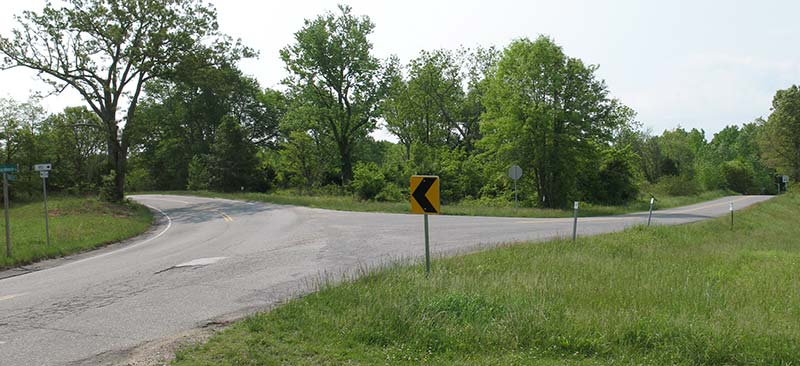 Pictured is the intersection of the Block House Road (right) and Brock Road (left) at Laurel Hill. Confederate infantry arrived here to join J.E.B. Stuart's Cavalry just ahead of General Warren's 5th Corps, and spread out in a defensive line along this ridge, past which the Federals could not penetrate. Image taken May 8, 2016, the same day as the battle.
In the preceding pages General Peirson refers to the fact of the command of the Regiment devolving on himself; it might have been stated that Colonel Davis, a very large and stout man, though doing his best to lead his men whose pace was more than double-quick, was completely overcome by the heat and mounted upon one of the Rebel Battery horses, cut out by Milton F. Roberts of “C,” was carried to the rear. Modesty no doubt influenced general Peirson not to state that he was, himself, hit by a portion of a buckshot-cartridge, three of the missiles lodging in his right arm or shoulder, his sword cane giving place to the stalwart shoulders of Isaac H. Mitchell of “A.” Two of the bits of lead were picked out by the surgeon, the other is there yet. The wound did not keep the resolute officer long from his post. Here is the story as told by I. H. Mitchell, Company A, and transcribed by Channing Whittaker, Company B.:––
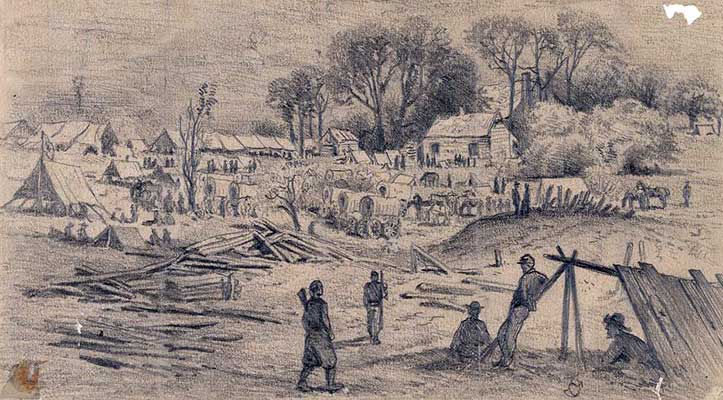 Fifth Corps Field Hospital at Spotsylvania, sketched by Artist Correspondent Edwin Forbes. Alfred Roe, continued: 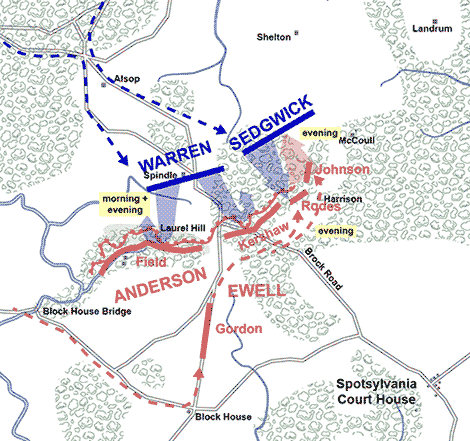
As the day advanced the other corps came into their respective positions, the Second being massed at Todd’s Tavern, protecting the rear of the army and the Ninth was at the extreme Union left, and there was more or less fighting along the whole line at some time in the day. A melancholy train was that made up of ambulances and baggage wagons which on the 8th set out for Fredericksburg, bearing 12,000 wounded men, thence via Belle Plain Landing and the Potomac to be distributed to the great hospitals of Washington and points further North. Sheridan and his troopers also received orders to set out upon their famous raid which would flank Lee’s army, reach the outer defenses of Richmond, slay J. E. B. Stuart, the most remarkable cavalryman of the Confederacy, and leave a gruesome token of its venturesome trip by a trail of decaying horseflesh and freshly made graves for considerably more than a hundred and fifty miles. Map by Hal Jesperson; (cropped & edited). "Battle of Spotsylvania Court House; Action May 8, 1864." The magnitude of this adventure, which began Monday morning, May 9th, may be seen when we know that it comprised 10,000 horsemen, riding in fours and well closed up, yet constituting a column thirteen miles long requiring, according to a rebel authority, four hours at a brisk pace to pass a given point; what an eye opener such a force must have been to the Confederates at home, who had little notion of the resources of the North. Rejoining the Federal army at Chesterfield Station, on the 25th, its results were summed up in having deprived Lee’s forces of their “Eyes and Ears” (cavalry) since all of the mounted rebels started in pursuit, as soon as the move was understood; it had damaged Lee’s communications, liberated nearly four hundred Union prisoners, destroyed an immense quantity of supplies, killed the leader of his cavalry, saved the Union Government the subsistence of ten thousand horses and men for more than two weeks, perfected the morale of the cavalry corps and produced a moral effect of incalculable good to the Union cause. (Note: It also deprived Grant of any useful intelligences too.—B.F.)  Maj. James Breathed's Battery: The Confederate Guns That Shot At Them. Alfred Roe, continued: Returning to the incident of the artillery referred to by Colonel Peirson in his paper, it is interesting to find the same affair recounted by one of the leading Confederates, General Fitzhugh Lee, in one of his war sketches. After alluding to the ubiquity of the cavalry and the work it had done in preparing the way for the arrival of R. H. Anderson’s (Longstreet’s) Corps, he says:–– 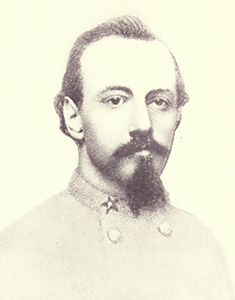
“Major James Breathed, (pictured left) commanding my horse artillery, remained behind and by my order placed a single gun in position on a little knoll. We knew the enemy’s infantry was marching in column through a piece of woods, and the object was to fire upon the head of the column, as it debouched, to give the idea that a further advance would again be contested, and to compel them to develop a line of battle with skirmishers thrown out, etc. The delay which it was hoped to occasion by such demonstration was desirable. Under Major Breathed’s personal superintendence shells were thrown, and burst exactly in the head of the column as it debouched. The desired effect was obtained; the leading troops were scattered, and it was only with some difficulty a line of battle with skirmishers in its front was formed to continue the advance. I was sitting on my horse near Breathed, and directed him to withdraw his gun, but he was so much elated with his success that he begged to be allowed to give the enemy some more rounds. He fired until their line got so close that you could hear them calling out: “Surrender that gun, you rebel scoundrel.” Breathed’s own horse had just been shot. The cannoneers jumped on their horses, expecting of course the gun to be captured, and retreated rapidly down the hill. Breathed was left alone. He limbered up the gun and jumped on the lead horse. It was shot from under him. Quick as lightning he drew his knife, cut the leaders out of the harness and sprang upon a swing or middle horse. It was also shot under him just as he was turning to get into the road. He then severed the harness of the swing horses, jumped upon one of the wheel horses, and again made a desperate attempt to save his gun. The ground was open between the piece and woods; the enemy had a full view of the exploit; and Breathed at last dashed off unharmed, miraculously escaping through a shower of bullets.” 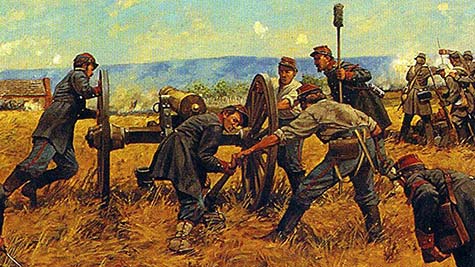
In confirmation of the foregoiing, is the statement of Sergt. Wm. A Mentzer, Company A, as follows: “After advancing about two and one-half miles we came to a piece of artillery on a knoll. While the Rebs fired at us, to our pleasure as well as surprise, they fired over our heads. We drove them from their position about half-a-mile, when they opened on us again. We in the front rank gave them a Yankee yell and charged for the gun. We shot one horse and drove away all the men but one, who dismounted, cut the traces of the dead horse, remounted in a hurry and got away with the gun just as we thought it was ours.” ...Of the exactions of this day, M. H. Mentzer, “A,” says, “Many were exhausted but an officer begged us to cross over one field more. We had been advancing and under fire from early morning, but we started again, a very thin blue line, through a valley, up a rise, when a terrible hail of bullets met us; we lay down and hugged the dirt; a lull, and then distinctly from the enemy came the order, “Now rally––North Carolina and give them H-ll!” Over they came, taking many prisoners from our little line. I started to run as others did but tripped and fell headlong down the hill lying still until they had pushed our boys well back, when I crawled a short distance to cover, several shells bursting in my path as I got away. Out of the way, covered with sweat, dirt and ashes, for the cinders of the Wilderness were yet on us, I fell asleep, and remained here till about four o’clock in the afternoon. “I fell in with a Natick boy, Company I, who had a bullet hole in his wrist; I washed out the wound, tore a piece from my shirt and bandaged it as well as I could, washed his face and hands, made some coffee to cheer him up and then took him to a hospital on the field. Then I set out to find my Brigade and Regiment and found them at twilight; my brother, Sergt. Mentzer, had reported me as dead with a bullet-hole through my forehead; those who saw me trip and plunge forward must have mixed me up with someone that looked like me. It was in the work of this forenoon that General Robinson was wounded and Jeff Cottrell, of “A,” Color Sergeant, was wounded and was carried part way off the field by Charles Goodwin, only to die at last in a rebel prison. My brother, Sergt. W A. Mentzer, then took the colors and carried them until Major Tremlett reorganized the color-guard.” J. H. Burnham also of “A,” recalls, “The march down the Brock Road with the Fifth Corps from the Wilderness, the night of the 7th of May, and our running into Longstreet’s corps, then under General Anderson. The rebels were behind, hastily erected breast works and were ready for us. We advanced across an open field and suffered much from the rifle fire. When near the works, I was hit in the abdomen. Throwing down my gun, I made my way back across the field, over the dead and dying, and lay down under a tree in front of a house. As this was early in the morning of the 8th, I don’t think there were many other wounded men there then, but later others came. “Sometime in the forenoon, a lady came out of the house and asked me if I was badly hurt. She also said that she was from New Jersey. It seems as though she said the place was the Laurel Hill farm, though I understand it is known in history as the Alsop farm. The next day came the ambulances, tents and other outfit of the Fifth Corps. I should like to go there some day and have a look at the place where I expected to give up my life. I carried the ball in my body for months and have it now. I never rejoined the Regiment.” We owe much to Colonel Peirson’s recollections of the service of the Regiment, but in this affair at Alsop’s he fails to recount a story remembered by McDonald of “B.” who says that in the company was a tall Scotchman, Hunter by name, much inclined to stoop and, for this reason was frequently enjoined by the critical Lieut. Colonel to take “the position of a soldier.” In the advance of this trying Sunday, Robert was stooping as usual when a bullet went through his cap. When the ball was over and the opportunity came, Hunter sought the officer and, holding up his headgear, remarked, “Now look at that; if I had ta’en the position of a so’ger, be G-d, that ball wud a gone thru’ my heed.” R. W. Hall of “F” recites an interesting experience of this 8th of May, “I had penetrated the abatis in front of the Rebs and was unable to extricate myself in time, when our boys fell back, and with about one hundred and fifty others was taken prisoner, but I never saw the inside of a rebel prison, as Sheridan in his great raid overtook us toward evening of the following day at Beaver Dam Station on the Virginia Central Railroad, where we were waiting. How plainly I can see General Custer and another cavalry-man in the lead, when they dashed down the road as we were about to take the train for Richmond. Of course we had to keep up with the cavalry during the raid and to dodge the Rebs who, in small squads, contested the way… 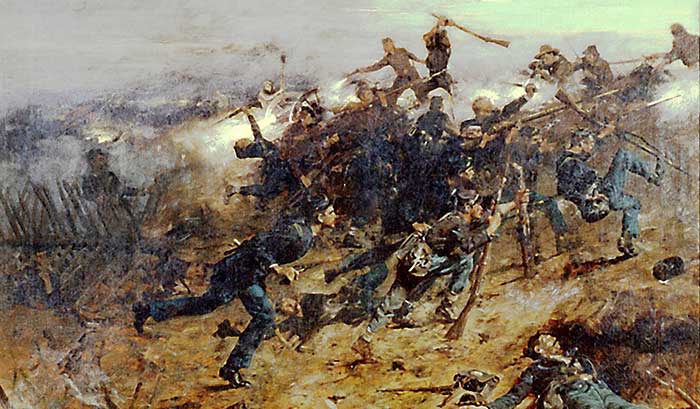 “Storming the Ramparts,” by Gilbert Gaul; Ogden Museum of Southern Art. (This was a difficult image to find, and was of poor quality; so I heavily worked it over in photoshop.––B.F.) [I have skipped some of this narrative regarding Sheridan's Raid. Alfred Roe concluded his May 8 entry with this:] The 8th was a bloody day for the Thirty-ninth the summary of losses revealing ninety-three killed, wounded and missing. Lieutenant Dusseault was wounded in the breast but an army button diverted the bullet. As he wrote in his diary, “I was within thirty feet of the enemy’s works, and when I was hit, I was sure I was killed, as the force of the blow caused me to spin round and round like a top, and I fell to the ground. Finding I was not seriously hurt, I jumped up and joined in the retreat. When we got back, we found Captain W. C. Kinsley of Company K in tears; “Look at my company!” he cried, “Only seven men left out of eighty-seven!” But he was assured that the woods were full of our men and that his would be in shortly. It proved to be so. We were not called on for the rest of the day, and that night we obtained some sleep.” During the closing hours of the 8th, there was digging for the Fifth Corps and the early hours of the 9th found the hard worked soldiers still using the shovel; the night and the following day showing no less than three distinct efforts in this direction for the Thirty-ninth, a record in which the stories of the Sixteenth Maine and Thirteenth Massachusetts accord. Gen. Robinson's Second Brigade
at Spotsylvania, May 8th
|
||||||||||||||||||||||||||||||||||||||||||||||||||||||||||||||||||||||||
 halted while the division closed up, and our men caught a
snatch of
rest. By dawn we were marching again, and presently we overtook
the advance guard of cavalry. They had met the enemy in the dark
and failed to make headway, though they must have tried; some of
them
were lying dead by the roadside.
halted while the division closed up, and our men caught a
snatch of
rest. By dawn we were marching again, and presently we overtook
the advance guard of cavalry. They had met the enemy in the dark
and failed to make headway, though they must have tried; some of
them
were lying dead by the roadside.
 The
firing was so furious that the Maryland brigade of the Fifth Corps gave
way, and almost created a panic; but Warren, seizing one of their
regimental colors, succeeded in rallying them. The Twelfth, by
Gen. Warren's orders, fixed bayonets, deployed under a murderous fire,
and stopped the flight of the fugitives toward the rear. The
Twelfth here lost five killed, eleven wounded. Col. Coulter took
command of the division, Col. Bates was in command of the brigade,
Lieut.-Col. Cook in charge of the regiment.
The
firing was so furious that the Maryland brigade of the Fifth Corps gave
way, and almost created a panic; but Warren, seizing one of their
regimental colors, succeeded in rallying them. The Twelfth, by
Gen. Warren's orders, fixed bayonets, deployed under a murderous fire,
and stopped the flight of the fugitives toward the rear. The
Twelfth here lost five killed, eleven wounded. Col. Coulter took
command of the division, Col. Bates was in command of the brigade,
Lieut.-Col. Cook in charge of the regiment. The enemy had felled trees
across the road and wood paths, and it was half-past seven before the
clearing was come to. Here a narrow wood road branches off to the
right from the Brock Road, runs parallel with it for about a mile, and
then turns again into the main road close to the Alsop’s Farm, distant
two miles from Spottsylvania Court House. When the fork was
reached General Robinson, with Lyle’s brigade in the lead, followed by
Coulter’s, kept on the main road, while Denison’s [Maryland]
brigade
took the narrow road to the right. Upon reaching the farm of
Alsop the division again united, the brigades formed in column of
regiments and, preceded by skirmishers, advanced to within eight
hundred yards of the heavy woods beyond the clearing. Here they
were met by a heavy fire of artillery and, on approaching closer, by
musketry from the Confederate infantry. A charge being ordered,
the
The enemy had felled trees
across the road and wood paths, and it was half-past seven before the
clearing was come to. Here a narrow wood road branches off to the
right from the Brock Road, runs parallel with it for about a mile, and
then turns again into the main road close to the Alsop’s Farm, distant
two miles from Spottsylvania Court House. When the fork was
reached General Robinson, with Lyle’s brigade in the lead, followed by
Coulter’s, kept on the main road, while Denison’s [Maryland]
brigade
took the narrow road to the right. Upon reaching the farm of
Alsop the division again united, the brigades formed in column of
regiments and, preceded by skirmishers, advanced to within eight
hundred yards of the heavy woods beyond the clearing. Here they
were met by a heavy fire of artillery and, on approaching closer, by
musketry from the Confederate infantry. A charge being ordered,
the 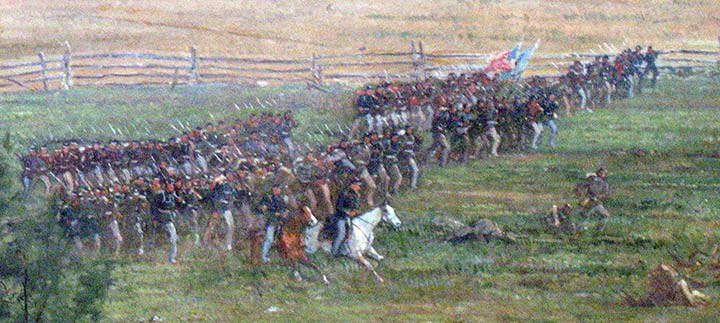
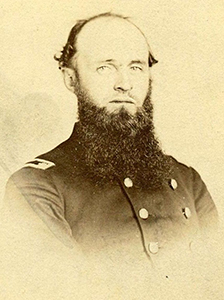
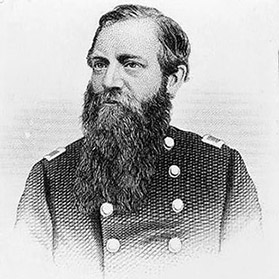

| |
Killed | Wounded | Captured Missing | Aggregate | |||
| Regiment | Officers. | Enlisted Men. | Officers. | Enlisted
Men |
Officers | Enlisted
men |
|
| General & Staff |
|
|
|
|
1 |
|
1 |
| 11th Penna. Vols. | 1 | 4 |
|
35 | |
3 | 43 |
| 97th N.Y. Vols. | |
4 | 1 | 39 | |
3 | 47 |
| 12th Mass. Vols. | |
1 | 2 | 19 | |
1 | 23 |
| 83d N.Y. Vols. | 1 | 8 | 4 | 49 | |
8 | 70 |
| 88th Penna. Vols. | |
1 | 2 | 41 | |
3 | 47 |
| Total | 2 | 18 | 9 | 183 | 1 | 18 | 231 |
The 13th
Massachusetts: May 7th––8th 1864
The following is from, “Three Years in the Army, The Story of the Thirteenth Massachusetts Volunteers, July 16, 1861 ––August 1, 1864,” by Charles E. Davis, Jr., Estes & Lauriat, Boston, 1894.
Headquarters
Army of the Potomac,
May 7, 1864, 3
P.M.
(Extract.)
At 8.30 P.M., Major-General Warren, commanding Fifth Corps, will move to Spottsylvania Court House, by way of Brock Road and Todd’s Tavern.
By command of
MAJOR-GENERAL MEADE.
In obedience to this order, at 9 P.M. we started for Spottsylvania Court House, and marched all night. As we passed along in the rear of the rifle-pits, we noticed the tired soldiers fast asleep on the ground, oblivious to the steady tramp of soldiers who were marching within a few yards of them. We wished we were in the same blissful state. Finally the extreme left of the line was reached when we entered a narrow, crooked road in the woods which were dark as a pocket. Silently and stealthily the trail was followed in singe file, and with great care, as the path became obscured. We were now in the heart of the Wilderness. Instructions were whispered along from the head of the line to “jump the run;” “look out for the log,” etc., with cautionary orders not to lose connection with each other, nor to get out of the path. In this way we noiselessly marched until nearly daylight, when a halt was made, and the men, tired out, threw themselves on the ground for rest or sleep. We had overtaken the cavalry which was in advance, and now waited for daylight, having marched only twelve miles, owing to the difficulties we encountered on the way. We were now within four miles of Spottsylvania Court-House.
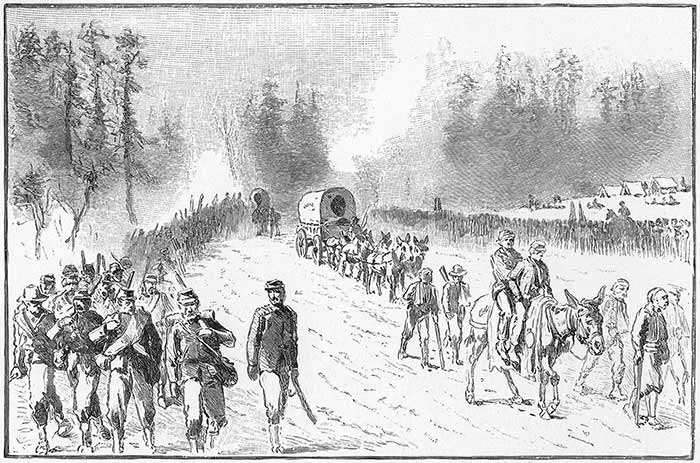
“Out of the Wlderness, Sunday Morning, May 8 ––The March to Spotsylvania.” From a Sketch Made at the Time. [From Battles & Leaders of the Civil War, Vol. IV, (p. 164.)]
Sunday, May 8.
When daylight afforded us an
opportunity of seeing each
other’s faces, it was impossible to restrain our laughter at the
comical appearance we presented The woods where we halted had
been burned over by the fire which had been raging for twenty-four
hours previously, making a bed of black ashes which stuck to our
perspiring faces, so that, on waking, we looked more like drivers of
charcoal wagons than soldiers.
Little time was granted us for rest. Some were hastily cooking their coffee while others were engaged in removing the black from their faces, when we were hurried forward, our division being in the advance.
It was now learned that both armies were hastening to Spottslyvania Court House. Our present position was near Todd’s Tavern, north-east from the town. The cavalry under General Sheridan opened the fight and were soon relieved by our (General Robinson’s) division. As we passed out of the woods we charged the wooded hill in front, occupied by rebel dismounted cavalry, who retreated as we advanced, making a stand on another wooded hill half a mile beyond. Here they kept up a brisk fire, aided by artillery. Another charge was ordered, and up the hill we double-quicked, driving the enemy from the crest across an open plain. We were told by General Warren that we should find nothing but dismounted cavalry, but instead, we found Longstreet’s corps.
A section of a battery was discovered to the south and east of us that had been used to retard our advance The “Johnnies” were busy getting it away, so we directed our fire toward the group of men and horses, hoping to capture it. A company of cavalry now rode out from the woods on the flank and hailed the battery. We supposed it to be Union cavalry demanding its surrender, and consequently reserved our fire. We soon discovered our error as we saw them running off the battery with drag ropes, whereupon we resumed our firing, but were unable to prevent their securing the gun.
A halt of a few minutes now took place, while we returned the fire from still another hill on the Alsop farm. Soon we received an order from General Robinson to advance on the double-quick over the plain. It was obeyed as well as it was possible for men to obey after two previous charges following an all-night march. There wasn’t any double-quick in us.
Though nearly played out, we slowly advanced, while the rebel skirmishers fell back to the crest of Laurel Hill. The firing from the rebel line behind earthworks on the hill now became general, and although the men of our division (the Second) were exhausted, yet we mustered strength enough to make another charge on this division of rebel infantry. As we advanced the firing became more effective. The foot of the hill was gained.
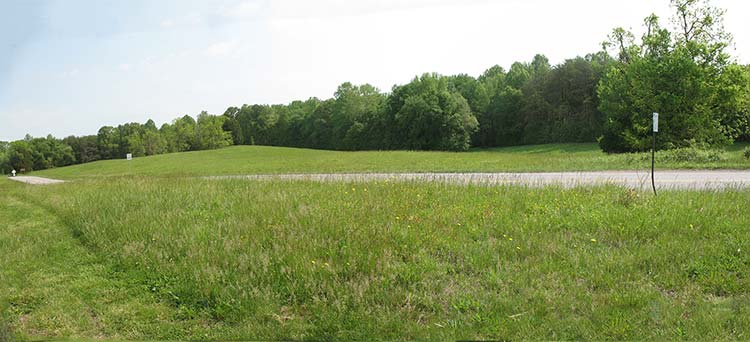
This is the field, on the far side of the road, the 13th charged across, left to right in their final charge of the morning. The picture was taken May 8, 2016.
As the Thirteenth was picking its way through the abatis and underbrush, shouting was heard in our rear. On looking back, we saw a whole brigade of rebels in line of battle, swinging round from the rebel right flank. A general retreat was taking place among our troops in the rear, so we followed suit by taking a circuitous route to avoid the rebel line which was preparing to capture us. Upon reaching the hill from which we advanced we halted and made a stand. Our loss so far was one officer killed and one wounded, and fourteen men wounded and twelve missing––probably captured.
The staff of the national colors was shattered by a solid shot. During the repulse, General Warren took the flag with its shattered staff to rally a Maryland brigade, a picture of which appeared in “Harper’s Weekly” for 1864, page 372.
At night we moved out in front of the earthworks and laid on our arms.
During the day the heat was intense.
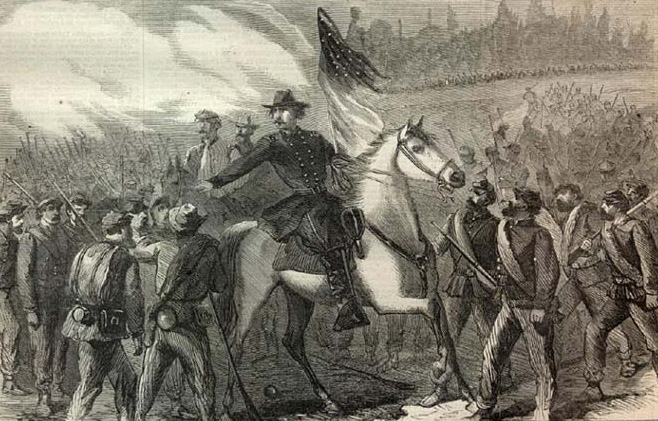
The engraving mentioned above from Harper's Weekly, June 11, 1864. The original sketch is in the banner at the top of this page.
The following is from, “Diary of Elliot C. Pierce,” Massachusetts Historical Society, Thayer Family Papers Collection, (Ms. N––1658) Boston, MA.
5/7: Fighting continues. Cannot learn position of the Corps. Am still on my back in the hospital. Received order from General Warren to rejoin Regiment. Ascertaining the army moves tonight I order my horse and attempt to rejoin, did not find the regiment until daylight. Travelled all night with Dr. W. [Dr. Allston Whitney––B.F.] in rear of brigade. Moved to near Spotsylvania Court House.
5/8: Reported to Captain Hovey commanding Regiment for duty. We move about 5 miles from S.C.H. when we met the enemy. Our Brigade charged and drove them back some distance. The whole Division then charged and succeeded in driving them to their works (about 2 miles from the town.) Where they made a fierce stand driving us back with some slaughter. Sergeant Whitcomb was killed in the last charge. General Robinson looking at the charge from a distant (hill/bluff ?) was wounded in the knees.

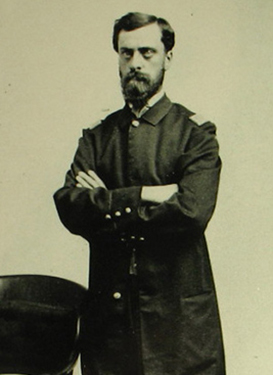
Pictured are, Lieutenant-Colonel Charles H. Hovey, & Major Elliot C. Pierce. Hovey, former captain of Company K was now commanding the 13th Massachusetts in the absence of Colonel Leonard. Major Pierce was second in command, although a slight wound received almost immediately after the 13th went into action near Saunders Field on May 5th, was keeping him away from the front. Both men started with the regiment in July 1861, and both were proven leaders.
When the division stopped briefly to rest near Todd's Tavern, Sam was so tired out he fell asleep with a piece of bread in his mouth.
The following is from, “The Diary of Samuel
D.
Webster” (Company D) (HM
48531); used with permission from The Huntington Library, San
Marino, CA.; and also, transcripts of the original Field
Diaries, shared with me by his descendants.
Sunday, May 8th 1864
Spottsylvania –– Halted this
morning about
daybreak. Laid down on the ground in the woods, which had been
burnt over, and was still smoking in places, and went to sleep
with a piece of hard bread in my hand and a piece in my mouth.
Turned out in a few minutes and, relieving the cavalry, pitched into
the rebels; we suppose, about 3 or 4 miles from Spottsylvania C.
H. They were driven back to “Laurel Hill” in three charges, ––
very long ones, apparently ½ to 1 mile each –– and where our division
“stuck” the army did also.
Gen. J. C. Robinson, commanding the division, wounded. Alden, [Selah B.,] Thompson, [Walter C.,] and others also. Thompson was hit in the back (small of it) by a spent ball, as the line fell back from the last rebel position.
In advancing, as the regiment came out into an open field, the centre was between two gate posts. As it was necessary to move to the left they “left oblique’d” –– a rebel battery playing upon them meanwhile, and down the road along which others were coming. As a shell shell passed Walker, [Dennis G.,] who carried the National Color, he said to Joe Keating, who carried the State flag, “That fellow means me.” The next shell cut the staff at the lower fastening of the silk, caught the upper part of his knapsack and carried it some rods, spilling its contents along its route, and knocking its owner some feet. I helped dress his shoulder which was awfully bruised.
The boys had driven the rebs from the two guns, but seeing a Company of cavalry come out of the woods, who hailed them, thought it all right, and withheld their fire at 150 yards, and Stuart ["Jeb" Stuart, C.S.A.] saved his guns. Just after that in passing the woods Capt. Whitcomb [Charles W.,] was killed. Loss 1 officer and 1 man killed, 1 officer wounded and taken prisoner, 4 men wounded and 12 missing.
After repulse lay in edge of the woods. 2nd Corps came up in p.m. over same road as 5th
The Story of General Warren and the 13th Mass., Flag; May 8, 1864
David Sloss of Company A, carried the State colors for the regiment. He was very active in writing letters to the 13th Massachusetts Regiment Association after the war. This letter or letter fragment was found in the papers of Colonel Leonard at the Gilder Lehrman Collection in New York City. Sloss was about age 71 at the time. In the letter, Sloss is answering William R. Warner's inquiry as to who carried the colors on May 8 during the incident with General Warren. Warner took an acitve interest in the history of the regiment in the post-war years. The 13th Regiment did not document the various color guards throughout their term of service like some other regiments did in their official histories. This transcription from the hand written letter tells a fascinating story.
I've broken it up into paragraphs for easier reading. Author Sloss told most of the story in one long paragraph.
David Sloss & Dennis G. Walker, Company A, 13th MA


David Sloss was a policeman in Chicago after the war. Dennis G. Walker, Co. A, carried the National Colors. He mustered out as Color-Sergt. July 16, 1864; wounded May 8th, 1864 at Laurel Hill. Joseph A. Keeting,Co. C, mustered out as Corporal Aug. 1, 1864. He carried the National Colors from May 8th, to date of discharge.
Letter of David Sloss, July 21, 1910
The following letter was found at the Gilder Lehrman Collection at the New York Historical Society, GLC 3393; Colonel Samuel H. Leonard Papers. Letter, 21 July, 1910, from David Sloss to William R. Warner, (item #62).
Chicago July 21 – 1910
W.R. Warner
Your Postal
came to hand asking who carried the
color the morning of the 8th of May 1864 at Spottsylvania C.H. I
could easily answer by saying Joe Keating but since you have carried me
back to that memorable morn and as I have plenty of time on my hands I
cannot dismiss that event without telling you the whole story which I
think is worth relating.
We left the Wilderness about dark the night of the [7]th May ’64 and got to Tods Tavern where the cavalry were bivouaced around fires we laid down with them until daylight when we advanced into a wood and drove out a lot of mounted infantry Warren told Robinson to take our Brigaid and took the other and said we would eat our breakfasts in Spottsylvania C.H. That was one we missed
We then went about a mile further when we saw a Batt. on the edge of a wood we could see them getting out of their blankets –– the 39 Mass Col Davis were ahead of us when we started to charge but did not go fast enough for me so the two Regts were close together when a shell came down through the center of the two Regts Killing a Lieut of the 39th and hitting D. G. Walker [Dennis] who had the American Colors and breaking the staff. (I had the State color) [Joseph] Keating picked up the flag and tied it with a canteen strap.
We went on about a mile further chasing the Batt. but they got away one of our Lieuts was Killed [Charles W. Whitcomb] in the woods we advanced until we came upon McLaws whole Div. behind a low earthwork
we fired here until we saw the red flag on our left and our men were going down from this flank fire then we broke and run perhaps a [blank] When we saw Warren and staff trying to rally the runners I got behind a big tree and told the boys to stand as we could stand as long as Warren could.
Robinson had been shot falling back his head on his breast and back to a tree Warren pointed to him saying “there is the only solder in your Div you are all a pack of damned cowards.”
Every thing was flying past us when Warren seized the top of Nat. Color over Keating sholder and it parted he waived it about 15 minutes in the Md Brigade that had some formation but they soon got by
Keating went up and asked Warren for it but he would not give it him. I ordered the Guard to go and get it and he gave it to them he saw their was going to be trouble and their was enough around then at this time.
[Transcribed by Bradley M. Forbush.]
AUSTIN STEARNS DIARY & JOURNAL
The following is from, “Three Years With Company K,” by Sergeant Austin C. Stearns, (deceased) Edited by Arthur Kent; Associated University Press, 1976.
DIARY:
Sunday the 8th “Marched in the direction of Spotsylvania C. H., passed Todds Tavern about two A. M., Sheridans Cavalry bivouacked here. Charged the rebs and drove them three miles, when we were repulsed. Dorkham wounded. Rice missing. Gen’l Robinson wounded. The day was extremely hot, several sunstruck.”
NARRATIVE:
The march was a tiresome one. We had our dishes and canteens straped so as to make as little noise as possible. When we passed the campfires of the Cavalry, how good they looked to us tired soldiers. They cheered us on by such remarks as these. “We are glad you’ve come.” “Go on boys you’ll soon find them.” “They are just ahead.”
Coming to a piece of woods that had been on fire and in places still burning, we halted; I dropped to sleep. It didn’t seem more than a minute before the “Fall in” was heard; daylight was just breaking. Moving quickly forward we passed the Cavalry outposts, formed a line of battle on the march, and went out of the woods and into a field towards a wooded ravine. The zyps, zyps of the bullets were coming thick and the prospect of warm work ahead caused me to unhook my knapsack and let it drop.
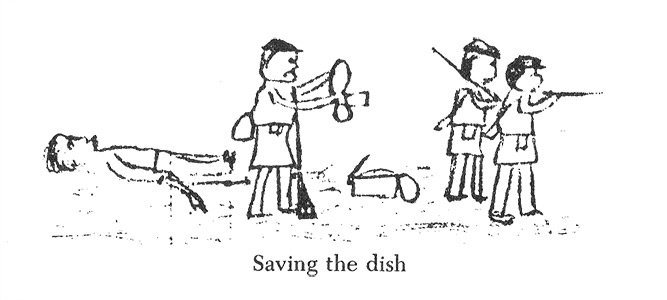
When it struck the ground I heard the old dish rattle and the thought of coffee, soups, and the other dishes that had been made in it, and besides it was the same old dish that I had started with, caused me to stop, turn around, and unstrap the dish from my knapsack and, taking off my canteen, run the strap through the bail and, slipping it over my head, go on.
We went on down through [the] ravine, driving the rebs, coming to a clearing with a house, and to the right a battery which was sending shot after shot at us. One struck the colors, breaking the staff without any injury to the bearer.
After leaving the woods we ran and fired as fast as possible. A squad of Cavalry dashed out of the woods on the left, dressed in blue a swinging their swords for us to stop firing. We thought they were our men and slackened fire, when in an instant over the hill went Battery, Cavalry, and all. A parting volley from us brought down the Capt’s horse and he was taken prisoner.
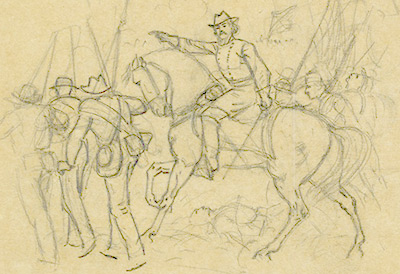
On down past the house, through the woods we went more than a mile; the heat was so intense that many of the boys had fallen out. We halted a moment to get breath when Gen’l Warren ordered us forward and on we went towards a pine woods. Just as we reached its edge came a volley, and then another, and our lines sadly thinned by the heat and our long run, gave way before the breastworks of the enemy. Our Division General, Robinson, lost his leg.
The fighting was now general. The 6th Corps came up and charged the rebels at the same place, but the rebs were too much for us and the whole army was brought to bay.
After the repulse I went into the woods and made some coffee and had a short nap. Just as I entered the wood I saw several of the boys carrying George Emery in a blanket. I thought him wounded, but he was sunstruck instead. Rice we never heard from. We lay at the left of the line until night, when we were ordered to carry ammunition to the front, where we stayed all night. Lieut. Whitcomb killed.
Letter of Warren Freeman, June 12, 1864
A month after the battles at Spotsylvania, Warren Freeman wrote this letter home describing with much clarity, the three charges of May 8. The letter also gives a good preview of how the 13th Regiment would fare in the coming battles.
The following is from, “Letters from Two Brothers Serving in the War for the Union to their Family at Home in West Cambridge, Massachusetts,” Cambridge, Printed for Private Circulation, 1871.
Near Tunsall Station, Va., June 12, 1864.

Dear Father and Mother, –– I received your interesting letter of the 5th inst. three days since. You say that you have not heard from me since May 15th. I think I wrote a few lines home on the 25th of May; but there could not have been much regularity in the mails during the last month.
We moved from the place I wrote you from last yesterday. We marched some six miles to this place; they say it is near Tunsall Station, or some such name. We are about seven miles from the White House and two and one half miles from Bottom’s Bridge. We have a good camp ground, with a spring of water near by. Our regiment has been fortunate thus far, compared with a great many others.
We have been in but one or two regular battles, where our loss was comparatively light. Most of the men we have lost were on the skirmish line; the principal engagement was at Spottsylvania.
We left the right of the army in the Wilderness just after dark on the night of the 7th of May, and marched all night to the extreme left of our line, within some three or four miles of the Court House. We got there just at daylight; we lay down and rested an hour, then we were started up and formed in line.
We passed our cavalry pickets, and our brigade was ordered to clear a small hill of some dismounted rebel cavalry. We charged and cleared the hill, the rebs offering but little resistance. We found a few dead rebs and a lot of carbines which they left. We formed again and advanced through the woods to an open field where we came to a few cavalry and two pieces of artillery, about half a mile distant.
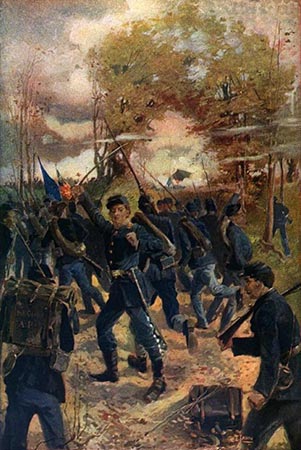
We were ordered to charge again, so we started off for the guns. The rebs did not get a chance to fire more than three or four times. The second shot they fired struck our colors, broke the staff, and tore the flag in four pieces. The shell just grazed the color bearer’s shoulder, and, striking his knapsack, knocked him at least a rod. It bruised and strained him badly but not so but that he will live through it. The same shot took off a sergeant’s arm in Company G. [Sergeant Charles E. Horne.––B.F.]
We came very near capturing the guns; we shot some of the horses, but the rebs worked well and managed to get the guns off. We captured the captain of the battery, a sergeant, and six men. We followed about a half mile on the run, when we halted and formed again and waited for the rest of our division to come up, when we were ordered to charge some rebel rifle-pits in a wood. Here we found some of Longstreet’s Corps, posted behind rifle-pits. We found them much too strong for us, so we had to fall back. There we lost Lieutenant Whitcomb, who was killed, and twenty-four men killed, wounded, and missing.
General Robinson, commanding our division, was severely wounded in the leg, which has been amputated. The division has been broken up, there being no general left to command it. Our brigade was assigned to the First Division, commanded By General Cutler, where we remained for a few days, when General Lockwood took command. He had us for a day or two, when the corps was reorganized. We are now in the Third Division, commanded by General Crawford.
We have lost from our regiment nearly 100 men since the 3d of May. My company now numbers ten men present for duty.
I am quite well. I will write again in a few days if I have a chance.
Please remember me to all who may inquire.
Warren.
CHARLES E. DAVIS, JR.'S NARRATIVE CONTINUES
Charles E. Davis, Jr., continued:
General Robinson, our division commander, lost a leg in the fight to-day. He was a real loss to the Army of the Potomac, as he ranked very high, being considered one of the bravest as well as one of the most efficient officers in the army. While we recognized in him the qualities of a brave, upright, and clear-headed soldier, candor compels us to say that the feeling of regard that many of us felt for him was not unanimous. We were not always just in our estimation of division commanders. We had an impression for a while that he didn’t like us, ––this was a mistake. He hedged himself with so much strict official dignity, that he concealed many of the good qualities he possessed. It took a long time for us to work up the regard which was natural for us to feel for a brave and gallant officer, such as we knew him to be. We had been eye-witness to his bravery and intelligence on plenty of occasions, and to us he was always “Old Reliable.” We got to like him very much, and the fondness which we felt has grown with years, so that to-day we gladly associate his name with Hartsuff and Reynolds, two officers for whom as already stated, the regiment had a great admiration.
We make the following quotations from General Grant’s Memoirs respecting this campaign:
More desperate fighting has not been witnessed on this continent than that of the 5th and 6th of May. Our victory consisted in having successfully crossed a formidable stream, almost in the face of an enemy, and in getting the army together as a unit.
* * * * * * * * * * * * *
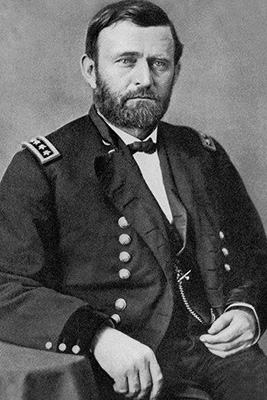
It may be as well here as elsewhere to state two things connected with all movements of the Army of the Potomac: first, in every change of position or halt for the night, whether confronting the enemy or not, the moment arms were stacked, the men intrenched themselves. For this purpose they would build up piles of logs or rails if they could be found in their front, and dig a ditch, throwing the dirt forward on the timber. Thus the digging they did counted in making a depression to stand in, and increased the elevation in front of them. It is wonderful how quickly they could in this way construct defences of considerable strength. When a halt was made with a view of assaulting the enemy, or in his presence, these would be strengthened, or their positions changed under the direction of engineer officers. The second was, the use made of the telegraph and signal corps. Nothing could be more complete than the organization and discipline of this body of brave and intelligent men. Insulated wires ––insulated so that they would transmit messages in a storm, on the ground or under water –– were wound upon reels, making about two hundred pounds of wire to each reel. Two men and one mule were detailed each reel. The pack-saddle on which this was carried was provided with a rack like a sawbuck placed crosswise of the saddle, and raised above it so that the reel, with its wire, would revolve freely. There was a wagon supplied with a telegraph operator, battery, and telegraph instruments for each division, each corps, each army, and one for my headquarters. There were wagons also loaded with light poles, about the size and length of a wall tent pole, supplied with an iron spike in one end, used to hold the wires up when laid, so that wagons and artillery would not run over them. The mules thus loaded were assigned to brigades, and always kept with the command they were assigned to. The operators were also assigned to particular headquarters, and never changed except by special orders.
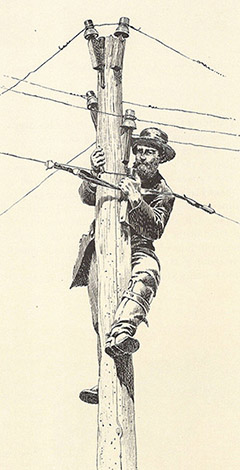
The moment the troops were put in position to go into camp all the men connected with this branch of the service would proceed to put up their wires. A mule loaded with a coil of wire would be led to the rear of the nearest flank of the brigade he belonged to and would be led in a line parallel thereto, while one man would hold an end of the wire and uncoil it as the mule was led off. When he had walked the length of the wire the whole of it would be on the ground. This would be done in the rear of every brigade at the same time. The ends of all the wires would then be joined, making a continuous wire in the rear of the whole army. The men attached to brigades or divisions would all commence at once raising the wires with their telegraph poles. This was done by making a loop in the wire and putting it over the spike and raising the pole to a perpendicular position. At intervals the wire would be attached to trees, or some other permanent object. so that one pole was sufficient to a place. In absence of such a support two poles would have to be used, at intervals, placed at an angle so as to hold the wire firm in place. While this was being done the telegraph wagons would take their positions near where the headquarters they belonged to were to be established, and would connect with the wires. Thus, in a few minutes longer than it took a mule to walk the length of its coil, telegraphic communications would be effected between all the headquarters of the army. No orders ever had to be given to establish the telegraph.
* * * * * * * * * * * * *
On the afternoon of the 7th, I received news from Washington announcing that Sherman had probably attacked Johnston that day, and that Butler had reached City Point safely, and taken it by surprise on the 5th. I had given orders for a movement by the left flank, fearing that Lee might move more rapidly to Richmond to crush Butler before I could get there.
My order for this movement was as follows:
Headquarters
Armies of the U.S.,
May 7, 1864, 6.30 a.m.
Major-General Meade, Commanding A.P.:
Make all preparations during the day for a night march, to take position at Spottyslvania Court House with one army corps, at Todd’s Farm with one, and another near the intersection of the Piney Branch and Spottsylvania Road with the road from Alsop’s to Old Court House. If this move is made the trains should be thrown forward early in the morning to the Ny River.
I think it would be advisable in making the change to leave Hancock where he is until Warren passes him. He could then follow and become the right of the new line. Burnside will move to Piney Branch Church. Sedgwick can move along the pike to Chancellorsville, and on to his destination. Burnside will move on the plank-road to the intersection of it with the Orange and Fredericksburg plank-road, then follow Sedgewick to his place of destination.
All vehicles should be got out of hearing of the enemy before the troops move, and then move off quietly.
It is more than probable that the enemy concentrate for a heavy attack on Hancock this afternoon. In case they do, we must be prepared to resist them, and follow up any success we may gain with our whole force. Such a result would necessarily modify these instructions.
All the hospitals should be moved to-day to Chancellorsville.
U.S. GRANT,
Lieutenant-General.
My object in moving to Spottsylvania was twofold: first, I did not want Lee to get back to Richmond in time to attempt to crush Butler before I could get there; second, I wanted to get between his army and Richmond if possible; and, if not, to draw him into the open field. But Lee, by accident beat us to Spottsylvania. Our wagon-trains had been ordered easterly of the roads the troops were to march upon before the movement commenced. Lee interpreted this as a semi-retreat of the Army of the Potomac to Fredericksburg, and so informed his government. Accordingly he ordered Longstreet’s corps ––now commanded by Anderson ––to move in the morning (the 8th) to Spottsylvania. But the woods being still on fire, Anderson could not go into bivouac, and marched directly on to his destination that night. By this accident Lee got possession of Spottsylvania.
It is impossible to say now what would have been the result if Lee’s orders had been obeyed as given; but it is certain that we would have been in Spottsylvania, and between him and his capital. My belief is that there would have been a race between the two armies to see which could reach Richmond first, and the Army of the Potomac would have had the shorter line. Thus, twice since crossing the Rapidan, we came near closing the campaign, so far as battles were concerned, from the Rapidan to the James River, or Richmond. The first failure was caused by our not following up the success gained over Hill’s corps on the morning of the 6th, as before described; the second, when fires caused by that battle, drove Anderson to make a march during the night of the 7th-8th, which he was ordered to commence on the morning of the 8th. But accident often decides the fate of battle.
May 8 Casualties in the 13th Regiment
Precedence for the following list of casualties suffered by the 13th Regiment, May 8, 1864, is giving to the list of 'Corrections to the Roster' published December, 1895, in Circular #8 of the Thirteenth Regiment Association, Boston, MA. This is a supplemental and more accurate update of the roster printed in “Three Years in the Army,” the official history of the 13th Massachusetts Regiment, by Charles E. Davis, Jr. 1894. Other sources relied upon, especially for the wounded, include, digitized copies of the original regimental books, which include a Regiment Descriptive List with notes. These books were downloaded from the Genealogy Website, Family Search. In its comments for each soldier, the Descriptive List cites 4 Casualty Reports, numbered 1 - 4, of which I do not have copies. The American Civil War Research Database, Historical Data Systems, was also very helpful. The Massachusetts Adjutant General's Report of 1864 was consulted too. A few information anomalies are noted in the text entries.
KILLED
Corporal SELAH B. ALDEN; age 28; born, Lynn, N.H.; cordwainer; mustered in as priv., Co. D, July 22, 1861; died of wounds received [May 8, ] on May 25, 1864 in Natick, MA; promoted to corporal, April 26, 1864. (Source: Circular #8, Dec. 1895). Historical Data Systems adds: Born in 1833 in Lynn, N.H.; Buried in Dell Park Cemetery, Natick, Middlesex County, Massachusetts. Gravesite C2-340. His Widow, (Lucy M. Alden) applied for a pension October 19, 1864, application #69,135.
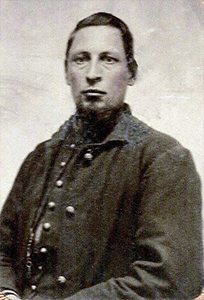
Private WILLIAM SANDERS ; age, 31; born, Germany; engraver; mustered in as priv., Co. E, July 29, '63; killed. May 8, '64. (Source: Circular #8, Dec. 1895). Descriptive list adds, married, Residence: Washington, D.C.; Enlistment credited to Boston.
Private JOHN SCHNELL ; age, 27; born, Germany; cabinet-maker; mustered in as priv., Co. E, July 16, '61; killed. May 8, '64. (Source: Circular #8, Dec. 1895). Descriptive list adds, Married, Remarks: May 8, 1864, Killed in Action, Laurel Hill. War Dept. Letter October 29, 1867.
Private CHARLES A. WILLIAMS; age, 32; born. Mass.; farmer; mustered in as priv., Co. E, July 28, '63; killed. May 8, '64. (Source: Circular #8, Dec. 1895). Descriptive list says: age 35, teamster, single, Residence: Taunton, Credited to Taunton; Remarks: Supposed killed May 11, '64, C Rpt 4, No further record. War Dept. Oct. 15, '66. Historical Data Systms adds: On July 25, 1863 he was drafted into "E" Company, 13th M.V.I., He was killed on May 8, 1864 at Spotsylvania Court House, Va (Missing and presumed killed). Source: Massachusetts Soldiers, Sailors and Marines in the Civil War.
Private ROLLA NICHOLAS; age, 24; born. New Ipswich, N.H.; farmer; mustered in as priv., Co. F, Nov. 1, '61; died of wounds, June 2, '64; wounded, May 8. (Source: Circular #8, Dec. 1895). Descriptive list adds: Single, Residence: Bolton, Enlisted October 28, 1862; Remarks: Died of wounds June 2, 1864 Washington D.C., wounded May 8th 1864, C Rpt 4. Historical Data Systems adds, "He died of wounds June 2, 1864 at Armory Square Hospital, Washington, D.C." He is also listed as having been wounded at 2nd Bull Run, August 30, 1862. He is listed as being buried at Arlington National Cemetery, Arlington, VA; Gravesite: 27-687. Source: Massachusetts Soldiers, Sailors and Marines in the Civil War. [Note: In hopes of cleaning it up considerably, I have heavily worked-over in photoshop, a very blotchy image of Rolla Nicholas, posted above.––B.F.]
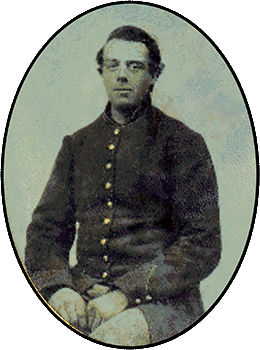
Private THOMAS E. BANCROFT; age, 22; born. Reading, Mass.; farmer; mustered in as priv., Co. G, Aug. 12, '62; missing after May 8, '64; supposed to have been killed. (Source: Circular #8, Dec. 1895). Descriptive list adds, Single, Residence: Reading, Enlisted July 12, 1862; Remarks: Missing since May 8, '64, Believed Killed, War Dept. October, 25, 1869. [The Historical Data Systems posted a photo of Bancroft, pictured right, courtesy Frank Vattelana, which I am grateful to have. However the posted image was of poor quality, and I have heavily worked it over in photoshop. ––B.F.]
Private CHARLES E. COLBURN ; age, 18; born, Dedham, Mass.; shoemaker; mustered in as priv., Co. H, July 16, '61 killed. May 8, '64. (Source: Circular #8, Dec. 1895). Descriptive list adds: Single, Residence: Natick, Enlisted June 29, 1861; Remarks: Missing Since May 8, '64; wounded May 8, '64 C Rpt 3. Supposed Killed at Spotsylvania; No further Record, War Dept. October 6, '69. Historical Data Systems adds, that he was also wounded at 2nd Bull Run, August 30, 1862. [ Note: A letter to his brother, written by Chalres Colburn, dated Feb. 11, 1864 is on file in the Army Archives at Carlisle, PA. In the letter he comments on people at home, and the good sleighing & skating weather there. He is glad the snow is gone in Virginia and hopes it will remain so. He hopes to be skating with friends next year. And, he says he heard Lt. Jenks, (13th MA) had enlisted as Orderly Sgt. in Col. Gould's regiment, and speculates he will get a commission as soon as Col. Gould can do so.––B.F.]
Captain CHARLES W. WHITCOMB; age, 22; born, Brookline, N.H.; shoemaker mustered in as sergt., Co. I, July 16, '61; 2d lieut., Nov. 28, '62; killed at Spotsylvania, Va., May 8, '64. (Source: Circular #8, Dec. 1895). Descriptive list adds: Married, Occupation: Crimper; Residence: Marlboro; Remarks: 2d-Lt. Nov. 29, '62; 1st-Lt. March 30, 1863; Killed in action, May 8, 1864; Spottsylvania. [ Note: On April 28 1864, Colonel Leonard wrote Massachusetts Governor John Andrew, requesting 1st Lieutenant Charles Whitcomb be promoted to Captain in place of Charles Hovey, who was promoted Lieutenant-Colonel. [Source: N.Y. Public Library, Gilder-Lehrman Collection, Col. Leonard's Papers, GLC 3393] Whitcomb died at Spotsylvania before an official reply arrived back to the regiment in the field, but the promotion went through, and he was referred to as Captain Whitcomb by his comrades on May 8, when his death was recorded. ––B.F.]
Corporal CHARLES W. MOSHER; age, 18; born, Alburgh, Vt.; farmer; mustered in as priv., Co. I, July 16, '61; killed. May 8, '64; promoted to corp., Feb. I, '64. (Source: Circular #8, Dec. 1895). Descriptive list adds: Single; Residence: West Alburgh, Vt. Remarks: Corporal, Missing Since May 8, '64; No Evidence War Dept. Sept. 26, 1869; Killed June, 1864. Historical Data Systems adds: Residence: Marlborough, MA; Occupation: Laborer; He was killed on May 8, 1864 at Spotsylvania Court House, VA (Missing and presumed killed).
Corporal JOHN P. PEEBLES; age, 24; born, Alburgh, VT; farmer; mustered in as priv., Co. I, July 16, '61 killed, May 8, 64; promoted to corp. (Source: Circular #8, Dec. 1895). Descriptive list adds: Single, Occupation: Laborer; Residence: Marlboro; Remarks: Corporal, Killed in Action, May 8, 1864, Spottsylvania. Historical Data Systems adds, that he was a Prisoner of War at Gettysburg, PA, July 1, 1863. Source: Massachusetts Soldiers, Sailors and Marines in the Civil War.
Private WILLIAM P. FARQUERSON; age, 18; born, Boston; cooper; mustered in as priv., Co. I, July 16, '6l; killed, May 8, '64. (Source: Circular #8, Dec. 1895). Descriptive list adds: Single; Residence: South Boston; Remarks: Missing Since May 8, 1864. Historical Data Systems adds: He was killed May 8, 1864 at Spotsylvania Court House, VA, (Missing and presumed killed). Source: Massachusetts Soldiers, Sailors and Marines in the Civil War.
Private CHARLES F. RICE; age, 19: born, Danbury, Mass.; farmer; mustered in as priv., Co. K, Aug. 1, '62; killed, May 8, '64. (Source: Circular #8, Dec. 1895). Descriptive list adds: Single; Residence: Shrewsbury, Enlisted: August 1, 1862; Remarks: Absent Prisoner, Town says, Supposed Killed, May 8, 1864. No Evidence, War Dept. January 21, '69(?) Historical Data Systems adds, he was also missing, July 1, 1863 at Gettysburg, PA. Source: Massachusetts Soldiers, Sailors and Marines in the Civil War.
WOUNDED
Corporal GEORGE W. CLIFFORD; age, 18; born, Derby Centre, Vt.; farmer's boy; mustered in as priv., Co. K, Aug. 16, '62; mustered out as Corp., Aug. l, '64; wounded. May 8, '64; residence, West Gardner, Mass. (His obituary is in 13th Regiment Association Circular #33; September, 1920.) Descriptive list adds: Occupation: Laborer; Single; Residence East Cambridge; Remarks: Corporal July 1, 1864; wounded May 8, 1864. Also wounded at Antietam September 17, 1862. Historical Data Systems adds, he was also missing July 1, 1863 at Gettysburg, PA. After the war he was a member of GAR Post #116 (David Farragut) in Gardner MA. He lived in West Gardiner. Sources: Massachusetts Soldiers, Sailors and Marines in the Civil War. Massachusetts GAR: Journal of the Annual Encampment. GAR Dept. of Massachusetts, 1866-1947 (Sargent).
Corporal Josiah Q. CROSBY; age, 29; born, Manchester, N.H.; shoemaker; mustered in as priv., Co. G, July 16, '61 mustered out, Aug. 1, '64; residence, Washington, D.C. (lost an arm; not mentioned in the roster.) Source: Scan of Original Regiment Descriptive Book. Descriptive list adds: Single, Residence: Stoneham; Enlisted July 10, 1861; Mustered in, July 16, 1861; Remarks: Sergeant. Lost Right Arm May 8, 1864, Spottsylvania. Historical Data Systems adds, Wounded May 8, 1864, Spotsylvania Court House, VA, (Severe wound in right arm, amputated). Promoted Sergeant, February 1, 1863; After the war he lived in Washington, D.C. Sources: Massachusetts Soldiers, Sailors and Marines in the Civil War. The Medical and Surgical History of the Civil War.
Private EDWIN C. DOCKHAM ; age, 23; born, Oxford, N.H.; blacksmith; mustered in as priv., Co. K, July 16, '61; mustered out, Aug. 1, '64; wounded, May 8, '64; residence, Worcester, Mass. Descriptive list adds: Single, Residence: Southboro, Remarks: Wounded May 8, 1864. Historical Data Systems adds: Wounded May 8, 1864, Spotsylvania Court House, VA. He was mustered out on August 1, 1864 at Boston, MA. Member of GAR Post #10 (George H. Ward) in Worcester, MA. Died October 9, 1903. After the war, he lived in Worcester, MA. Sources: Massachusetts Soldiers, Sailors and Marines in the Civil War. GAR Dept. of Massachusetts 1866-1947, (Sargent); Austin Stearns, Three Years with Company K. [Note: His wound must have been slight as his record suggests he continued to serve in the ranks til the end of the 3 year term of enlistment.––B.F.]
The Town of Southborough Massachusetts, Record of Soldiers says this about Dockham. Edwin C. Dockham, Son of Charles and Sybil Dockham, was born in Lebanon, N. H., December 6th, 1837; enlisted May 25th, 1861, and was mustered into the U. S. Service July 16th, 1861, as private in Company K, 13th Regiment Mass. Volunteers to serve three years.
He was in the skirmishes at Harper's Ferry, Bolivar Heights, and Falling Waters, in 1861. He was under fire at Cedar Mountain August 9th, and Rappahannock Station August 22d, 1862; at the battles of Thoroughfare Gap, on the 28th; Second Bull Run, the 29th and 30th; Chantilly September 1st; Antietam, September 17th; Fredericksburg Va., December 13th, 1862; Deep Run April 30th, 1863; Chancellorsville, May 3d, 4th and 5th; Gettysburg Pa., July 1st, 2d and 3d; Mine Run Va., November 27th, 1863; Wilderness, May 5th, 6th, and 7th, 1864; Laurel Hill and north side of Spotsylvania, from the 8th to the 14th of May; Near Spotsylvania Court House, on the east side from the 14th to the 21st of May; North Anna River, near Jericho Ford, May 23d; Bethesda Church, May 30th and 31st; near Coal Harbor, June 3d; in front of Petersburg from June 17th to July 14th, 1864. He was mustered out August 1st, 1864.
JOHN EISHMAN; age, 26; born, Prussia; shoemaker;
mustered in as priv Co. A, July 2, '63; transferred, July 14, '64, to
39th Inf. The Regimental Roster does not list Eishman among the
wounded May, 8th, but a comment in the Regiment Descriptive List says
he was wounded that day. The Historical Data Systems website also
lists him wounded, May 8, 1864, and adds: On July 29, 1863, he
was drafted into "A" Co. Massachusetts 13th Infantry. He deserted
on August 28, 1864 from Mower Hospital, Philadelphia, while on
furlough.
He was listed as wounded May 8, 1864 at Spotsylvania Court House,
VA. Source: Massachusetts Soldiers, Sailors, and Marines in the
Civil War; and, The Story of the 13th Massachusetts Volunteers.
Private JOHN FITZSIMMONS ; age, 22; born, Boston; carriage-maker; mustered in as priv., Co. H, July 25, '62; mustered out, Aug. 1, '64; wounded, May 8,'64. Descriptive list adds: Occupation: Carriage Painter; Single; Enlisted August 9, 1862; Mustered in August 9, 1862; Remarks: Wounded May 8, 1864, Cas [Casualty?] Rept 4. Historical Data Systems adds: He enlisted July 25, 1862 as a Private. On August 9, 1862 he musterd into "H" Company, 13th M.V.I.; He was listed as Missing, July 1, 1863, Gettysburg, PA, and Wounded, May 8, 1864 at Spotsylvania Court House. He Mustered Out on August 1, 1864 at Boston, MA. Source: Massachusetts Soldiers, Sailors and Marines in the Civil War.
WILLIAM E. FOSTER; age, 31; born, Bristol, Me.; sailor; mustered in as priv., Co. G, July 16, '61 mustered out, Aug. 1, '64. William E. Foster is not on the list of wounded in the rosters or Circulars of the 13th Regiment. However, the Historical Data Systems website lists him wounded, May 8, 1864, (wounded (date and place not stated) (in 1862). Foster was mustered out August 1, 1864 with the rest of the regiment in Boston. Source: Massachusetts Soldiers, Sailors and Marines in the Civil War.
Sergeant CHARLES E. GERROLD; age, 21; born, Gloucester, Mass.; printer; mustered in as priv., Co. H, July 16, '6l; mustered out as sergt., Aug. 1, '64; promoted to sergt., April 27, '63. Descriptive list adds: Single, Residence: Natick; Enlisted: June 29, 1861; Mustered in: July 16, 1861; Remarks: Corporal December 6, 1862, Sergeant April 1, 1863; wounded May 8, 1864, C Rpt 4. Note: Historical Data Systems adds, Born in 1840. Gloucester, MA; After the war he lived in Natick. He was a member of GAR post #23 (Joseph Hooker) in East Boston, MA, and a member of Post #63 (General Wadsworth) in Natick, MA, where he was Post Commander; and GAR Post #159 (John A. Hawes) in East Boston, MA. Gerrold died August 22, 1925. [Note: The data system estimates the date of his wounding at Spotsylvania, as May 15. I would credit the Descriptive List as being correct in this instance, stating his wound occurred May 8.––B.F.]
Corporal EDWIN R. JENNESS; age, 19; born, Roxbury, Mass.; teamster; mustered in as priv., Co. E, July 16, '61; mustered out as corp., Aug. 1, '64; wounded. May 8, '64; residence, 764 Shawmut avenue, Boston. (Source: Circular #8, December, 1895, Corrections to the Roster. Note: The roster in the regimental history, lists the date of his wound as May 8, 1863. The year is corrected to 1864 in Circular #8). Descriptive list adds: Single; Residence: Roxbury; Remarks: Corporal March 1, 1863. Wounded May 8, 1863; C Rpt 4. [Note: Entry has wrong year, May 8, '63; but '64 is correct.––B.F.] Historical Data Systems adds, Jenness was a member of GAR Post #26 (Thomas G Stevenson) in Roxbury, MA, and that he held the office of Post Commander there. He died October 31, 1912. [Note: Historical Data Systems estimates the date of his wounding as May 15, 1864, but the 13th Regiment Association Circulars say, May 8. Jenness was present at the 13th Regiment Association Annual Dinner, July 29, 1911. His attendance and passing are noted in Association Circular #25, December, 1912. ––B.F.]
Note: There is an anomaly here, moving alphabetically through the list of May 8 casualties. The Regiment Descriptive book entry for Private James Miller, age 24, a substitute, born in Prussia, mustered in, July 28, 1863, and assigned to Company K, has three conflicting hand-written notes concerning his record. The first entry is crossed out; it reads, Deserted September 19, 1863. Written beside that it says Wounded May 8, '64, C Rpt 4. The next line says, Died Sept. 19, '63; Rappahannock Stn., VA. W.D. Oct. 6, '69. The Massachusetts Adjutant General's Report of 1864 lists him as a deserter from Rappahannock Station, Sept. 19, 1863. This is probably the correct record and the one listed at Historical Data Systems. Most of the Drafted men mustered into service in July 1863, deserted.
JAMES RYAN; age, 19; born, Ireland; shoemaker; mustered in as priv., Co. I, July 16, '61; mustered out, Aug. 1, '64; wounded, July 1, '63 wounded, May 8, '64; deceased. Descriptive list adds: Single; Residence: Boston; Date of Enlistment: July 25, 1861; Date of Muster: July 25, 1861; Remarks: Wounded July 3, 1863; C Rpt 3. [July 1, 1863 is correct date. [Note: Whomever entered the dates on the Descriptive List consistently listed the incorrect date of July 3, 1863 for soldiers in the regiment wounded at Gettysburg.––B.F.] Historical Data Systems lists the July 1, 1863 Gettysburg wound, but not the May 8, 1864 Spotsylvania Court-House wound. Massachusetts Adjutant General's Report, 1864, states Ryan mustered out August 1, 1864.
Sergeant WALTER C. THOMPSON; age, l8; born, Woburn, Mass.; clerk; mustered in as priv., Co. D, July 20, '61; mustered out as sergt., Aug. I, '64; wounded, Dec. 13,'62. (Wounded slightly in the small of his back. He returned to the regiment in a couple of days. Source: Sam Webster's Diary, Huntington Library, San Marino, CA). Descriptive list adds: Single; Residence: Boston; Date of Enlistment: July 20, 1861; Date of Muster: July 23 1861; Remarks: As Sergeant, Wounded December 13, 1862; C Rpt. 1; wounded May 11, 1864; C Rpt. 4; June 21, 1864; C Rpt 5. [He was wounded again in June, 1864 at Petersburg, VA.––B.F.]
Private WILLIAM O. WARD; age, 18; born, Stoneham, Mass.; shoemaker; mustered in as priv., Co. G, July 16,'6l; mustered out, Aug. I, '64; wounded, Sept. 17, '62; residence. Warren, Me. Descriptive list adds: Single; Remarks: Wounded May 8, 1864; Cas. Rpt 4. Historical Data Systems says after the war he lived in Warren, Maine.
Sergeant DENNIS G. WALKER; (pictured) age, 24; born, Scarboro, Me.; seaman; mustered in as priv., Co. A, July 16, '61; mustered out as color-sergt., July 16, '64; wounded at Laurel Hill, Spotsylvania, May 8, '64; residence, Hyde Park, Mass. (Wounded by a shell at Laurel Hill). Roster says, mustered out August 1, 1864. Descriptive list adds: Rank: Wagoner; Residence: Boston; Remarks: Discharged for wounds, July 16, 1864; wounded as Color Sergeant May 11, 1864 [May 8 is correct date––B.F.] ; C Rpt. 4. Historical Data Systems adds: He was born March 30, 1837 in Scarborough, Maine. After the war, he lived in Hyde Park, MA and was a member of GAR Post #121 (Timothy Ingraham) in Hyde Park, MA. Source: Massachusetts GAR: Journal of the Annual Encampment. [Three of his letters are posted on this website. See Site Map Page,––B.F.]
JOHN WILSON; age, 23; born, England; sailor; mustered in as priv., Co. K, July 27, '63; deserted, Aug. 19,'63; arrested; returned to duty, Oct. 6, '63 and served with regt.; wounded. May 8, '64; transferred to 39th Mass. Vols. Descriptive list adds: Occupation: Caulker; Single; Residence: Lawrence; Enlistment credited to Billerica; Date of Enlistment: July 28, 1863; Date of Muster: July 28, 1863; Remarks: Substitute; Transferred to 39th M. V. July 13, 1864; Wounded May 8, 1864. C Rpt. 4. Other notes: See Letter War Dept. Nov. 10, 1893. Transferred to [company] C, 39th M.V. and then to 32nd Mass.
CAPTURED
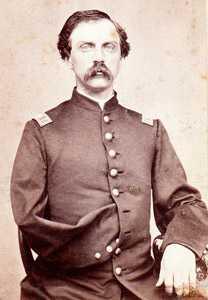
CHARLES E. HORNE.; age, 21; born, Farmington, N.H. shoemaker; mustered in as 4th sergt., Co. G. July 16, '61 mustered out as 1st lieut., Sept. 18, '64; promoted, 1st sergt., Jan., '63, to 2d lieut., July 1, '63, and 1st lieut., March, '64: wounded at Gettysburg, July 1, '63, and at Spotsylvania C.H., May 8, '64; at latter place lost right arm; was also taken prisoner and confined in Libby until Sept. 8, '64; residence, Stoneham, Mass. Descriptive list adds: Single; Residence: Stoneham; Date of Enlistment: July 10, 1861; Date of Muster: July 16, 1861; Date of Muster Out: September 9, 1864; Remarks: 2d Lt. May 1, 1863; 1st Lt. March 8, 1864; wounded July 3, 1863, [July 1 is correct––B.F.] C Rpt 3. Historical Data Systems says: He was Mustered Out on September 9, 1864; listed as wounded July 1, 1863 at Gettysburg, PA; and POW May 8, 1864, Spotsylvania Court House, Va (Severe wound in right arm amputated). After the war he lived in Stoneham, MA. Source: Massachusetts Soldiers, Sailors and Marines in the Civil War, & The Medical and Surgical History of the Civl War.
SAMUEL C. F. SEABURY; age, 20; born. New Castle, Me.; clerk; mustered in as priv., Co. C, July 16, '61; mustered out as Corp., Aug. 1, '64; taken prisoner at Spotsylvania Court House, May, '64; residence, Waltham, Mass. Descriptive list adds: Occupation: Clerk, Single; Residence: Boston; Corporal July 1, 1864. Historical Data Systems adds: POW May 8, 1864, Spotsylvania Court House, VA. Born September 14, 1840 in New Castle Maine; After the war he lived in Waltham, MA; Member of GAR Post #29 (F. P. H. Rogers) in Waltham, MA. Source: Massachusetts Soldier, Sailors and Marines in the Civil War; GAR Department of Massachusetts, 1866-1847, (Sargent).
DENNIS SPELLIN (SPELLAN) ; age, 44; born, Ireland; farmer; mustered in as priv., Co. I, Dec. 22, '63; transferred, July 14, '64, to Co. B, 39th Mass. Vols.; transferred, Jan. 2, '65, to Co. D, 32d Mass. Vols.; discharged, June 29, '65; wounded. Descriptive list adds: SPELLAN, DENNIS; Married, Residence Southboro; Enlistment credited to Southboro; Remarks: Transferred to 39th M. V. July 14, 1864. Historical Data Systems says: On December 12, 1863, he mustered into "I" Company, 13th M. V. I. He transferred out on July 14, 1864, into Company "B" 39th M.V.I. On June 2, 1865 he transferred into "D" Company, 32nd Massachusetts Infantry He was Mustered Out June 29, 1865 at Washington, D.C. His record, printed in the Town of Southboro Record of Soldiers states he was wounded at Weldon Railroad by a piece of shell. [While with the 39th Mass.] Source: "A Record of the Soldiers of Southborough, Mass. During the Rebellion from 1861-1866, Together with Extracts From Public Documents," Mirror Steam Job Press, Marlboro, MA 1867.
Sergeant Austinc C. Stearns records in his diary, that George Emery was Sunstuck during the march and battle at Spottsylvania Court House, May 8 1864.
GEORGE F. EMERY; age, 19; born, Kendall Mills,
Me.; carpenter; mustered in as priv., Co. K, July 16, '61 mustered out
as corp., Aug. 1, '64- promoted to Corp., July 1, '64; residence,
Arriba, Cal. Descriptive list adds: Single; Residence:
Westboro, Remarks: Corporal, July 1, 1864. SOURCE:
"Three Years in Company K." Sgt. Austin Stearns writes Emery
was being carried on a stretcher suffering from Sunstroke.
39th Massachusetts & 16th Maine Casualties, May 8, 1864;
NOTE: The 16th Maine & 39th Massachusetts had the highest number of casualties listed for the 1st Brigade of Robinson's Division, between May 8 - 22, 1864. Side by side comparisons for all the regiments in the 1st Brigade as well as all of the 3 Brigades of the division were not reported untl May 22nd, inclusive. But losses on May 8 are mentioned in their respective regimental histories. The Thirty-ninth Massachusetts history states (p. 188) on May 8, 1864 they lost 93 men, Killed, Wounded or Missing. Major Abner Small of the Sixteenth Maine, stated that 2 officers of the regiment were severely wounded, 2 missing & prisoners; and at least 3 men were killed; with more than 50 wounded.
General
Robinson & Chandler Robbins; Beard
Mutual Admiration Society

After his serious wounding, at the Battle of Spotsylvania Court-House, May 8, General John C. Robinson requested Private Chandler Robbins, Co. K, 13th Massachusetts Regiment, be his personal nurse, to give aid during his convalescence.
Gen. Robinson submitted the following report of the battle.
“At 9 P. M. on the 7th the army commenced the flank movement to the left, the Fifth Corps leading, with my division in advance. Our march was impeded by darkness, bad roads, small streams, and fallen timber; yet, knowing the importance of reaching Spotsylvania Court House before the enemy, the troops were urged forward as rapidly as possible. At daylight on the morning of the 8th I overtook the advance of the cavalry, which was engaged with the enemy. I immediately deployed two brigades, holding the third in reserve, pushed by the cavalry (commanded by Brigadier-General Merritt), and drove the light troops and artillery of the enemy from one position to another, through woods and across open fields about three miles. Coming to another field I could plainly see the enemy’s line in the edge of timber beyond. I here halted and re-formed the division, and again advanced to the attack. The division was soon checked, and it became evident that here was the enemy’s main line, but his strength was undeveloped. Knowing that my brave men would follow, wherever I led the way, I placed myself at their head and led them forward to the attack. At this moment a part of Griffin’s Division advanced out of the woods on my right. Cheering my men on, we arrived within fifty yards of the works when I received a musket-ball on the left knee, resulting in amputation of my leg. This unfortunate wound caused the result I feared, for as I was borne off the field I saw that our troops were repulsed and the attack had failed. Our loss this day was heavy.”
In the 1996 book, Medical Histories of Union Generals, the author, Dr. Jack Welsh writes,
[General Robinson] “was severely wounded in the left knee joint by a musket ball. He turned his horse to the rear and had to be assisted off of the field. Gen. John Gibbon reported seeing him lying on a litter along the side of the road with a broken leg. He was admitted to the division hospital and transferred to a general hospital on May 11. On May 15 he underwent an intermediary circular amputation in the lower third of the femur because of the fracture.”
From Alsop’s Farm General Robinson was carried in an ambulance to Aquia Creek, from whence, with four hundred others who were wounded, he was taken to Washington. There he was met by his brother, Henry L. Robinson, in whose house he remained during convalescence. His leg was amputated by Surgeon-General Barnes, U. S. A. Immediately following the operation he became so weak that much anxiety was felt for his recovery. President Lincoln called on him often and those kindly visits afforded him much consolation during his suffering. It was not very long, however, until he was able to got to Binghamton.” [Binghamton N.Y. was General Robinson's home.]
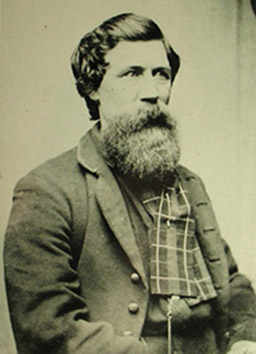
Hospital Nurse Chandler Robbins of Company K, 13th MA accompanied General Robinson to Washington.
Robbins, an original member of the 13th regiment began working extra duty in the Regimental Hospital early in his military career. At age 41 upon enlistment, he was almost the oldest member of the regiment and probably the oldest member to serve 3 years. [Joseph Fairbanks of Westboro was the oldest volunteer at age 51. He was forced to muster out due to his age in May, 1862].
According to muster rolls, Chandler detailed as a hospital steward, in November and December 1861, and continued thereafter, until the end of his enlistment. Comments for Robbins in the Regimental Descriptive book, state, “Detailed in Regiment Hospital Department December 6, 1861. Never done duty with Company since that date –– Always in Hospital Department.”
Working in the Regimental Hospital early on made him a close associate of Dr. Alston Whitney the regiment’s surgeon. Dr. Whitney proved his operating skills at the Battle of Cedar Mountain, August 9, 1862. One observer wrote the most difficult medical cases were given to him. Presumably, Dr. Whitney was busy with casualties from General John Pope’s Summer Campaign through the whole month of August, because he took ill in September. The entry for September, 1862, in Robbin’s muster roll states: “left the regiment for Washington, D.C. to take care of Surgeon Whitney.” He is also listed in Washington for October, 1862. A Special Order in January, 1863 continued to detail Robbins in the Hospital Department. He was again with Dr. Whitney, June 15, 1863, when the Division Hospital at the Fitzhugh House in Stafford County, Virginia, was captured by advancing Confederates. The patients that were well enough to be removed, had already been evacuated to safer locations before the enemy advance. Dr. Whitney would not abandon the severely wounded still in his charge, so he remained behind at the hospital, but he gave permission to those on his staff to escape if they wished. Chandler Robbins remained with the doctor. It was the worst cases that were left behind. The Confederates seized the hospital supplies and sent the staff and wounded patients to Rebel prisons in Richmond. Crude ox carts transported the captives over rough ground to dirty hot railroad freight cars which carried them to Richmond. The journey was tortuous. Several patients died on the way. Among the wounded patients was Corporal John S. Fay of Marlboro, Massachusetts, recently struck by a shell, April 30, 1863. Dr. Whitney amputated an arm and a leg from Fay to save his life. Fay wrote a detailed account of the capture and subsequent ordeal at Libby Prison which can be read on this website here.
Dr. Whitney was confined at Libby Prison in Richmond through November, 1863. Private Robbins got off much easier and was paroled two weeks after his capture, July 1st at City Point, VA. Muster rolls show him at Camp Parole Annapolis, Maryland for the months of July and August, 1863. He returned to Army headquarters October 4th.
Robbins was an interesting fellow. His biography states the following.
“Mr. R. was born in Plymouth in 1819, where he learned the trade of a wheelwright, and removed to Westboro about forty years ago. He was one of the “forty-niners,” going out to California via the Straits of Magellan, on the first ship fitted at Boston for the then new gold regions. He was connected with the Fremont surveying party there, which was led by the famous path-finder himself and guided by Kit Carson. In the two years of his absence he had a varied experience, which included surveying, mining and exploring, and a few hours captivity among the Indians. On his return trip, via the Isthmus, the train which carried the proceeds of his labors was robbed, leaving Mr. R. little but his experience. His descriptions of what he saw in South America and California furnished many interesting stories for friends at home.
“During Mr R.’s early years in Westboro he worked at sleigh-making, and was afterward auctioneer and commission merchant for a short period.”

“…. At the breaking out of the rebellion in 1861 Mr. Robbins was among the first who responded to the call of country…and was detailed at once for hospital service. ….Three times he was taken prisoner, being twice paroled on the field and once after a short confinement in Libby Prison. His work brought him in contact with high officials, many of whom owe much to the careful nursing he gave them.”
Another article said of him, he was, “well known to all members of the old Thirteenth Mass. Vols. as "Daddy." During the war he was almmost constantly employed as a nurse in the field hospital where he won a most enviable reputation as an attendant upon the sick and wounded, so that his services came to be in constant demand by general officers who were so unfortunate as to be wounded.”
Robbins went with wounded General Robinson to Washington as his personal nurse. The following interesting items concerning his time with General Robinson were found in his widow Frances Chandler's 1883 pension application file.
There were several pass book receipts from the Department of Washington dated May 13-18 and renewed through June, 1864, signed by Lieutenant Erastus R. Robinson (the General’s nephew) allowing for Robbins to be on leave in that city. The following interesting communications were also in the file.
Letter of Lt. Erastus R. Robinson to S. M. Morgan of Gen. Robinson's Staff
(Captain Samuel M. Morgan, a long time aide to General Robinson, pictured.)
Washington D. C.
June 1st 1864
Dear Harris
The General desires me to ask that an order may be
made detailing Chandler Robbins Co K 13th Mass Vols (who is with the
General now as nurse) to him; also send or cause to be sent
Robbin’s
Descriptive List. The General is improving rapidly. He has
for the past four or five days sat up a few minutes. Yesterday he
was in a chair about an hour. I hope that you have received some
of my letters by this time, but I understand that few or none go to the
Army. I send this by Lieut Col Pearson 39th Mass vols.
Since the 19th of May I have in each of my letters tried to defend my
self against the charge of neglect, that you accuse me of. Now as
I am almost certain that this will reach I shall speak for the last
time. Ever since the
General was brought up here (May 10th)
I have written at least every three days to you concerning him.
Remember me to the Staff,
and believe me
Truly Yours
Erastus R. Robinson
To
Capt S M Morgan
A A G 5th Corps
A. of P.
PS
Have Robbin’s
order dated from the day he left (May
9th)
The General wishes to be remembered to all of his Staff
E.R.R.
General Samuel W. Crawford writes to Frederick T. Locke
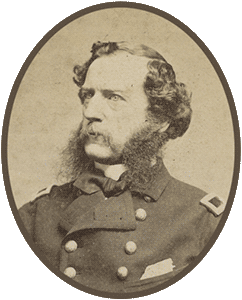
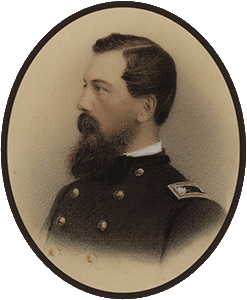
Letter of General Samuel W. Crawford, left, written to Frederick T. Locke, right, General Warren's Adjutant, forwarding Gen. Robinson's request to have Robbins detached as his personal nurse.
Head Quarters, 3d Div. 5th
Corps
June 21, 1864.
Lieut. Col. Fred.k T. Locke,
Ass’t Adj’t Gen’l.
Colonel,
Brig. Gen’l Robinson, now
absent from wounds, has
sent a request to have Private Chandler Robbins Co.
“K,” 13th Mass. Vols. ––now with the General, detailed as
his nurse, and asks that his descriptive list be sent to him.
I respectfully recommend that an order be issued to that effect
I am, Colonel,
Very Respectfully,
Your ob’t Serv’t
(sd) S. W. Crawford
Brig. Genl. Comd’g.
Head Qtrs, 5th Army
Corps,
June 22d, 1864.
Respectfully
forwarded, Approved
(sd) G. K.
Warren,
Maj. Gen’l. Comd’g.
General Meade Says No
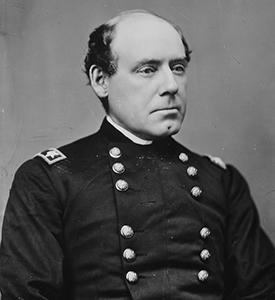
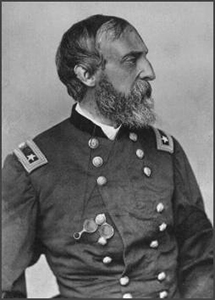
Assistant Adjutant-General Seth Williams, left, replied to General Warren that the commanding General Meade, could not grant General Robinson's request, with regards to Private Chandler Robbins.
General seth Williams to General Warren; forwarded to General Crawford
The denial is referred back to General Crawford.
H’d Quarters, Army of the
Potomac,
June 25, 1864.
Respectfully returned. The Commanding General regrets that he cannot approve this application. He considers that, at the present time, the exigencies of the service require that every able bodied soldier should be with his proper command in the field. Private Robbins will therefore be at once recalled to his Company.
By command of
Maj. Gen’l. Meade,
(sd) S. Williams,
AAG
H’d Qrs. 5th Army Corps,
June 25th,
1864.
Reply returned to Brig. Gen’l Crawford, Comd’g 3d Division, for compliance with his endorsement of H’d Qrs. Army of Potomac.
By command of
Maj. Gen’l Warren,
(sd)
Fred. T. Locke,
Ass’t
Adj’t Gen’l.
C.O. 1st Brig. 5th Div. 5th A.C.
Gen. Robinson's request was denied. I presume Chandler Robbins returned to hospital duty with the hospital department, where ever that might have taken him, sincce the 2nd Division was broken up after May 8. General Robinson went home to Binghamton, New York and soon recovered. He returned to duty on September 24, 1864, having been appointed to the command of the district of Northern New York.
Chandler Robbins mustered out of the 13th MA with the regiment on August 1, 1864. To finish his story, “After the war closed he established a furniture store... [in Westboro] and engaged in the business to some extent to the time of his last sickness, in connection with upholstering and repairing.
“For twenty-two years, to the time of his death he was town undertaker, in which capacity he learned much of the sorrows and afflictions of the community, and the words of comfort and material aid he contributed to many suffering ones during his long service will cause them to cherish his memory.”
Robbins died at age 61, of cancer of the liver April 11, 1880. It was written of him, “Mr. R. was of a pleasant, genial nature, and a man of strict integrity of character who was always ready to give what assistance he could to his fellow-men and do a neighborly act. Consequently he had many friends and few, if any, enemies.”
Soon after his widow, Francis applied for a Widow's Pension, but because his death was not caused by any related military service injuries the parole board denied her claim.
May 9,
1864, Part 1; The Death of General John Sedgwick
Journal of Major-General Gouverneur K. Warren, Commanding 5th Corps
May 9. ––The Sixth Corps all took position on my right, and we intrenched. Had a brisk skirmish at night to force the enemy’s pickets back. General Sedgwick killed in the morning.
Dispatches of Charles A. Dana, Assistant Secretary of War.
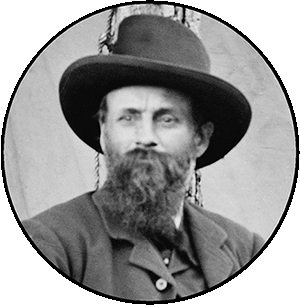
Charles Dana was a talented newspaper man, who made a good reputation for himself, at the New York Tribune. His politics for the most part agreed with elder Horace Greeley, but their bold personalities clashed. After a ten year stint, Dana resigned. Secretary of War, Edwin Stanton hired him to be "Assistant Secretary of War." When Grant's Spring Campaign began, and he disappeared into the woods of the Wilderness, President Lincoln was so anxious for information that Dana was sent to find the army, stay with it, and keep the Administration informed of its progress. Here is another of his field dispatches.
Hdqrs.
Armies of the United States,
Four miles north of Spotsylvania Court-House
May 9, 1864––12 noon (Received 4 p.m. 10th.)
General Wilson, with his division of cavalry, occupied Spotsylvania Court-House yesterday morning for an hour, but as Warren’s corps had not yet made its appearance, and as columns of rebel infantry were gaining position on both his right and left, he fell back to Alsop’s. Prisoners were taken by Wilson, who reported that two divisions of Longstreet’s corps had just come up, they having marched all night. General Grant at once gave orders for attacking these troops with the whole of Warren’s corps, to whose support Sedgwick was hurrying up, in order to destroy them before the rest of the rebel army could arrive.
Warren, however, proceeded with exceeding caution, and when he finally did attack, sent a single division at a time, and was constantly repulsed. The general attack which Generals Grant and Meade directed was never made, for reasons which I have not yet been able to learn, but successive assaults were made upon this and that point in the rebel positions, with no decisive results. The last assaults were made just before dark, when the fighting was very sharp.
What number of men we lost is not ascertained, but the condition of the hospitals indicates that it is not so large as was to have been supposed. This morning the rebels are massing on our left, apparently for the purpose of both covering the road to Richmond, and preventing General Grant from going to Fredericksburg. There has been no fighting except by skirmishers. General Sedgwick was killed this morning by a sharpshooter; ball struck him in the forehead. General Robinson was wounded in the leg yesterday. General Morris was similarly wounded to-day.
Colonel Ryan was killed yesterday. Richmond papers of the 7th report General Jones killed; Paul [Micah] Jenkins and Stafford mortally wounded; Longstreet severely wounded. General Grant’s orders last night were not to renew the fighting to-day; but if, as now appears to be the case, Lee has left anything open in front of our right by massing on our left, he may attack at this weakened point of their lines, with a view of passing toward Richmond on that side. This attack, if determined upon, will be made by Hancock, who holds our right, with the Sixth Corps in the center, and the Fifth on left. Hancock is supported by one division of Burnside, held in reserve at Piney Branch Church, while two divisions, under Wilcox, are posted at the Gate to watch in that direction, and come down to support Warren in case of need. Burnside himself is at Alrich's, covering rear and trains. Sheridan, with Cavalry Corps, moved from Alsop’s at 4 o’clock this morning to attack Stuart, open a way for themselves to cut Lee’s ammunition trains, and after doing all possible damage, strike the James River, and communicate with General Butler. To-morrow morning this entire army will have five days’ rations in their haversacks; there are also five additional days’ in the wagons. Our surgeons find plenty of ice in the ice-houses of the country. General Hobart Ward is under arrest for running away in the Wilderness battle. General H. G. Wright has been put in command of Sedgwick’s corps. Imboden’s cavalry reported to be in the country north of the Rapidan, picking up our stragglers.
C. A. DANA.
Hon. E. M. Stanton.
Secretary of War.
Spotsylvania National Battle-field Park; The Spot Where General Sedgwick Died
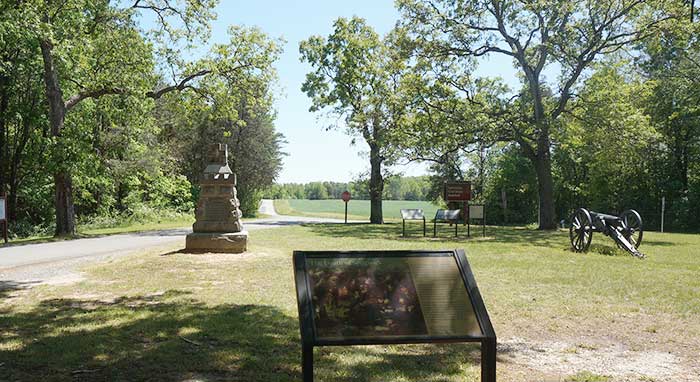
Site of the mortal wounding of Major-General John Sedgwick. The grassy field in the distance is the Spindle Farm.
The Death of
General John Sedgwick
By Martin T. McMahon, Brevet Major-General, U. S. V.; Chief of
Staff, Sixth Corps
This article is from Battles & Leaders of the Civil War Volume IV; The Century Company, 1884, 1887, 1888. (p. 175).
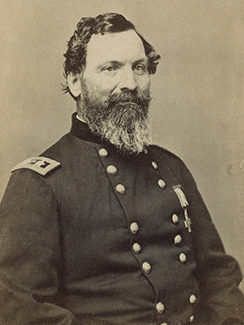
On May 8th, 1864, the Sixth Corps made a rapid march to the support of Warren, near Spotsylvania Court House. We arrived there about 5 p.m., and passed the rest of the day in getting into position on Warren’s left. After nightfall General Sedgwick rode back into an open field near General Warren’s headquarters and, with his staff, lay down on the grass and slept until daylight. Shortly after daylight he moved out upon his line of battle. We had no tents or breakfast during that night or morning. The general made some necessary changes in the line and gave a few unimportant orders, and sat down with me upon a hard-tack box, with his back resting against a tree. The men, one hundred feet in front, were just finishing a line of rifle-pits, which ran to the right of a section of artillery that occupied an angle in our line. The 1st New Jersey brigade was in advance of this line.
After this brigade, by Sedgwick’s direction, had been withdrawn through a little opening to the left of the pieces of artillery, the general, who had watched the operation, resumed his seat on the hard-tack box and commenced talking about members of his staff in very complimentary terms. He was an inveterate tease, and I at once suspected that he had some joke on the staff which he was leading up to. He was interrupted in his comments by observing that the troops, who during this time had been filing from the left into the rifle-pits, had come to a halt and were lying down, while the left of the line partly overlapped the position of the section of artillery. He stopped abruptly and said, “That is wrong. Those troops must be moved farther to the right; I don’t wish them to overlap that battery.” I started out to execute the order, and he rose at the same moment, and we sauntered out slowly to the gun on the right. About an hour before, I had remarked to the general, pointing to the two pieces in a half-jesting manner, which he well understood, “General, do you see that section of artillery? Well, you are not to go near it to-day.” He answered good-naturedly, “McMahon, I would like to know who commands this corps, you or I?” I said, playfully, “Well, General, sometimes I am in doubt myself”; but added, “Seriously, General, I beg of you not to go to that angle; every officer who has shown himself there has been hit, both yesterday and to-day.” He answered quietly, “Well, I don’t know that there is any reason for my going there.” When afterward we walked out to the position indicated, this conversation had entirely escaped the memory of both.
I gave the necessary order to move the troops to the right, and as they rose to execute the movement the enemy opened a sprinkling fire, partly from sharp-shooters. As the bullets whistled by, some of the men dodged. The general said laughingly, “What! what! men, dodging this way for single bullets! What will you do when they open fire along the whole line? I am ashamed of you. They couldn’t hit an elephant at this distance.” A few seconds after, a man who had been separated from his regiment passed directly in front of the general, and at the same moment a sharp-shooter’s bullet passed with a long shrill whistle very close, and the soldier, who was then just in front of the general, dodged to the ground. The general touched him gently with his foot, and saiid, “Why, my man, I am ashamed of you, dodging that way,” and repeated the remark. “They couldn’t hit an elephant at this distance.” The man rose and saluted, and said good-naturedly “General, I dodged a shell once, and if I hadn’t, it would have taken my head off. I believe in dodging.” The general laughed and replied, “All right, my man; go to your place.”
For a third time the same shrill whistle, closing with a dull, heavy stroke, interrupted our talk, when, as I was about to resume, the general’s face turned slowly to me, the blood spurting from his left cheek under the eye in a steady stream. He fell in my direction; I was so close to him that my effort to support him failed, and I fell with him.
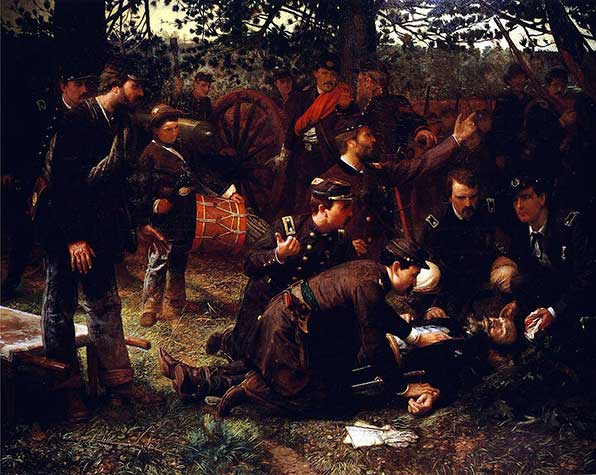
Julian Scott painting titled, "The Death of General Sedgwick, May 9, 1864," (1887).
Colonel Charles H. Tompkins, chief of the artillery, standing a few feet away, heard my exclamation as the general fell, and, turning, shouted to his brigade-surgeon, Dr. Ohlenschlager. Major Charles A. Whittier, Major T. W. Hyde, and Lieutenant-Colonel Kent, who had been grouped near by, surrounded the general as he lay. A smile remained upon his lips but he did not speak. The doctor poured water from a canteen over the general’s face. The blood still poured upward in a little fountain. The men in the long line of rifle-pits, retaining their places from the force of discipline, were all kneeling with heads raised and faces turned toward the scene; for the news had already passed along the line.
I was recalled to a sense of duty by General Ricketts, next in command, who had arrived on the spot, and informed me, as chief-of-staff, that he declined to assume command of the corps, inasmuch as he knew that it was General Sedgwick’s desire, if anything should happen to him, that General Horatio G. Wright, of the Third Division, should succeed him. General Ricketts, therefore, suggested that I communicate at once with General Meade, in order that the necessary order should be issued. When I found General Meade he had already heard the sad intelligence, and had issued the order placing General Wright in command. Returning I met the ambulance bringing the dead general’s body, followed by his sorrowing staff. The body was taken back to General Meade’s headquarters, and not into any house. A bower was built for it of evergreens, where, upon a rustic bier, it lay until nightfall, mourned over by officers and soldiers. The interment was at Cornwall Hollow, Connecticut.
*Condensed from a letter to General J. W. Latta, President of the Sedgwick Memorial Association.
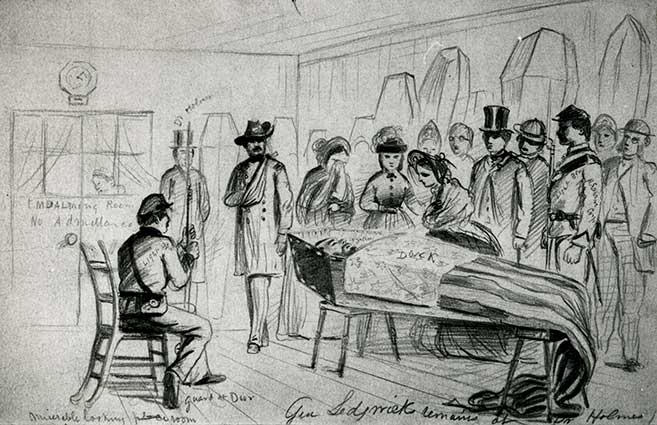
The caption of this drawing by artist / correspondent James E. Taylor, is, General Sedgwick's remains at Dr. Holmes; [Embalming Room).
Excerpt From Lt.-Col. Theodore Lyman's Letters
General Meade's aide, Theodore Lyman, wrote to his wife a series of journalistic letters of which this one is a continuation. He relates the killing of General Sedgwick as he received it from Col. Martin McMahon, the author of the above sketch.
Headquarters
Army of Potomac
Friday, May 20, 1864
To-day has been entirely quiet, our pickets deliberately exchanging papers, despite orders to the contrary. These men are incomprehensible ––now standing from daylight to dark killing and wounding each other by thousands, and now making jokes and exchanging newspapers! You see them lying side by side in the hospitals, talking together in that serous prosaic way that characterizes Americans. The great staples of conversation are the size and quality of rations, the marches they have made and the regiments they have fought against. All sense of personal spite is sunk in the immensity of the contest.
In my letter of yesterday I got you as far as the evening of Sunday the 8th. On Monday, the 9th, early, Burnside was to come down the Spotsylvania and Fredericksburg road to the “Gate,” thus approaching on the extreme left; Sedgwick and Warren respectively occupied the left and right centre, while Hancock, in the neighborhood of Todd’s Tavern covered the right flank; for you will remember that the Rebel columns were still moving down the Parker’s Store road to Spotsylvania, and we could not be sure they would not come in on our right flank and rear.
Betimes in the morning
General Meade, with three aides, rode back to General Hancock, and had
a consultation with him. 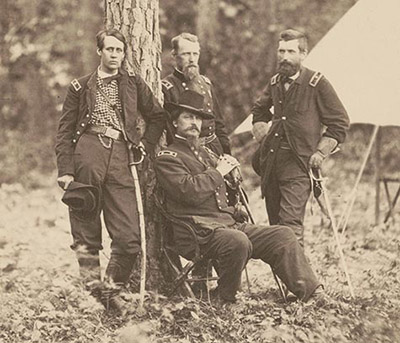 The day was again hot and the dust thicker and
thicker. As we stood there under a big cherry tree, a strange
figure approached; he looked like a highly independent mounted
newsboy; he was attired in a flannel checked shirt; a
threadbare
pair of trousers, and an old blue kepi; from his
waist hung a big cavalry sabre; his features wore a familiar
sarcastic
smile. It was General Barlow, commanding the 1st division of the
2d Corps, a division that for fine fighting cannot be exceeded in the
army. There, too, was General Birney, also in checked flannel but
much more tippy than Barlow, and stout General Hancock, who always
wears a clean white shirt (where he gets them nobody
knows);
and thither came steel-cold General Gibbon, the most American of
Americans, with his sharp nose and up-and-down manner of telling the
truth, no matter whom it hurts….
The day was again hot and the dust thicker and
thicker. As we stood there under a big cherry tree, a strange
figure approached; he looked like a highly independent mounted
newsboy; he was attired in a flannel checked shirt; a
threadbare
pair of trousers, and an old blue kepi; from his
waist hung a big cavalry sabre; his features wore a familiar
sarcastic
smile. It was General Barlow, commanding the 1st division of the
2d Corps, a division that for fine fighting cannot be exceeded in the
army. There, too, was General Birney, also in checked flannel but
much more tippy than Barlow, and stout General Hancock, who always
wears a clean white shirt (where he gets them nobody
knows);
and thither came steel-cold General Gibbon, the most American of
Americans, with his sharp nose and up-and-down manner of telling the
truth, no matter whom it hurts….
It was about ten o’clock, and I was trotting down the
Piney Branch road, when I met Colonel McMahon, Adjutant-General of the
6th Corps; I was seriously alarmed at the expression of his face,
as he
hurriedly asked where General Meade was. I said, “What is the
matter?” He seemed entirely unnerved as he replied: “They
have hit General Sedgwick just here under the eye, and, my God, I am
afraid he is killed!” It was even so: General Sedgwick,
with a carelessness of consequences for which he was well known, had
put his Headquarters close on the line of battle and in range of the
sharpshooters. As he sat there, he noticed a soldier dodging the
bullets as they came over. Rising from the grass, he went up to
the man, and, laying his hand on his shoulder, said, “Why what are you
dodging for? They could not hit an elephant at that
distance.” As he spoke the last word, he fell, shot through the
brain by a ball from a telescopic rifle…
The dismay of General
Sedgwick’s Staff was a personal feeling; he was like a kind
father to
them, and they loved him really like sons. 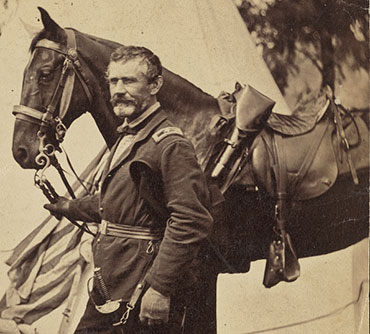 So fell “good Uncle
John” a pure and great-hearted man, a brave and skillful
solder. From the commander to the lowest private he had no enemy
in this army….
So fell “good Uncle
John” a pure and great-hearted man, a brave and skillful
solder. From the commander to the lowest private he had no enemy
in this army….
I found General Meade with Generals Wright, Warren, and Humphreys consulting together in the same spot where Grant sat yesterday among the bullets, for no apparent reason. You never saw such an old bird as General Humphreys! I do like to see a brave man; but when a man goes out for the express purpose of getting shot at, he seems to me in the way of a maniac… In the afternoon there was some fighting on the right centre, without result; Burnside pushed down on the left, driving the enemy before him; and so the day closed, our army crowding in on Lee and he standing at bay and throwing up breastworks. [Gen. A.A. Humphreys, pictured.]
Sedgwick Monument, Spotsylavania National Battlefield Park
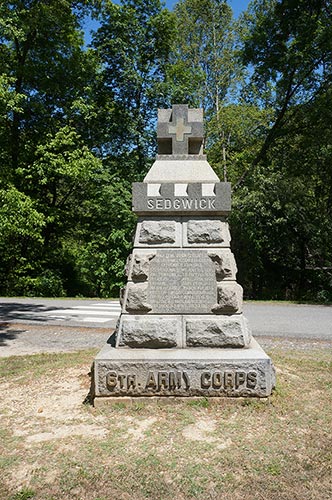

Lyle's Brigade, Monday, May 9, 1864
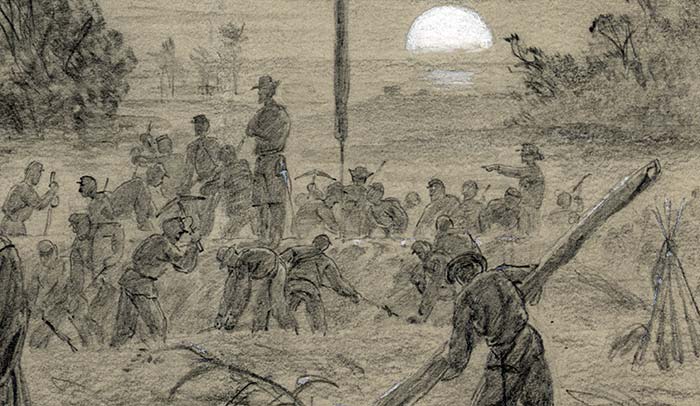
Alfred E. Waud captured men of General Warren's 5th Corps entrenching on the Weldon Railroad, a scene which would take place in the coming month of September, 1864. This detail from the sketch appropriately suits the narration here, for the 9th of May.
The 9th of May was relatively quiet on
both sides of the line. Each army strengthened their
defenses. In the writings below, the history of the 39th
Massachusetts, as always, has some excellent exposition to fill out the
story of the First Brigade. Several brief diary quotes from
soldiers in the 13th Regiment outline the activities of the day that
effected them.
Major Elliot C. Pierce, 13th Mass., continued:
5/9: After falling back
yesterday we threw up
earthworks.
(Capt. H. being exhausted I was commanding Regiment). We advanced
from there in the Centre and took position nearer the
centre of the right which was ascertained to be very strong
(as usual). [Capt.
H. is Charles H. Hovey, whose official commission as lieutenant-colonel
had not yet reached the regiment in the field.––B.F.]
Charles E. Davis, Jr., 13th Mass., continued:
Monday May 9.
Moved from our position in the
centre to the right, halting three times
to build earthworks. Were placed on the skirmish line with the
“Bucktails,” taking part with the corps in its grand charge.
After
dark we again advanced, driving the enemy back, after which we threw up
more earthworks.
Corporal Calvin Conant, 13th Mass., continued:
Monday, May 9
Last night about 10 we moved out
to the front and laid in line of
Battle the Reg was sent out to cut & lay logs to
build breast
works awful hot every body is Plad out
I received a letter from home to day fell in and moved up to the right built a line of brest works the 2d corps Advance to the left of us About 6 oclock advanced our lines to the front about 10 P M
Sam Webster, 13th Mass., continued:
Monday, May 9th, 1864
Spottsylvania –– We went back
with
the Doctor (Hixon) and fixed at the
roadside a place to attend to the wounded yesterday. This morning
I
visited the regiment. Col. Leonard is played, and Col. “Dick”
Coulter
of the 11th Pa is in command of the Division, which is temporarily
split and the Brigades attached to the others. Gen. G. K. Warren,
Com'd'g Corps rallied the Md. Brigade yesterday on our poor old broken
colors. (Picture of this in Harpers Weekly) Moved our
quarters around
to the Division Hospital at old mill, and put up tent for the first
time since leaving Mitchell’s station. Gen. Robinson was sent
off,
his
leg shattered. Gen. Sedgwick killed.
Sergeant Austin C. Stearns, 13th Mass., continued:
Monday May 9th “Moved to the
right and
built breastworks.
Advanced, and built another line, and at dusck advanced and another
line
was built. Heavy detail for Skirmishers from the regiment.
Casualties
of the army heavy. Rawson and Comstock sick, Sedgwick killed.”
This was a day to be remembered for hard work. Early in the morning we went but a short distance, where we halted behind a battery; the bullets were coming over quite thick. The battery boys had been drawing rations and a box with a few in it was lying there. Gen’l Sedgwick of the 6th Corps came along and stopped at the box, picked up one of the crackers and went on eating it. Within five minutes we heard he was dead, killed by one of those bullets.
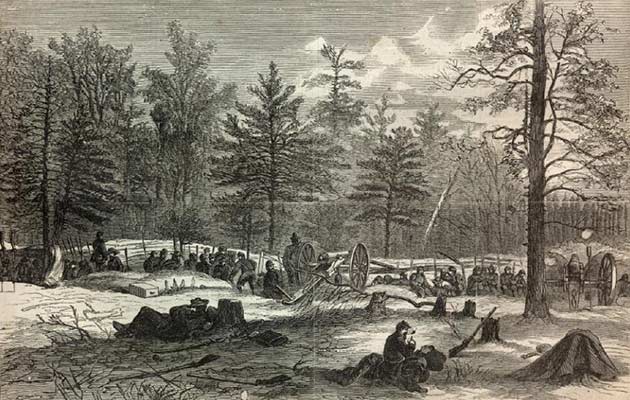
A. R. Waud sketched the ground, and the
scene where General Sedgwick was killed. You can see men
clustered in a group to the left of the center cannon. According
to Austin
Stearns the 13th Regiment was close-by. One of the ration boxes Stearns
descried can be seen in the engraving.
We moved off to the right a half mile or more and in a pine grove we built a strong line of works. We had hardly finished them before we were ordered to advance and on coming to a clearing, we were again ordered to build, but before the works were far advanced we were again ordered forward, this time in plain sight of the enemy. It was growing dark and it promised to be an all nights work, as we were ordered to build a strong work for we would receive a shelling in the morning. A heavy detail was made for the skirmish line, which so reduced our working force as to make it doubly hard for those that were left.
Major Abner Small, 16th
Maine, from “Road
to Richmond,” continued:
About eight o’clock in the
evening we advanced again, to
the right of the place where we had halted before charging, and threw
up breastworks. Our men were digging all that night and
Monday forenoon. Troops of Sedgwick’s corps were busy on our
left. Early in the morning I caught sight of General Sedgwick,
standing with an officer of his staff near a battery in the corner of a
field. A moment later he slumped against his companion, and they
both fell to the ground. The officer got up, but the corps commander
lay still. A rebel sharpshooter had killed him.
Monday afternoon and evening, as Hancock’s corps came up on the right of Warren’s, our regiment several times changed position to the right and each time threw up breastworks. By nine o’clock that night we were at right angles with our line of the morning, and facing south, and our weary men were still digging. When at last the work was done we got some rest, but the dawn of another day was near; we slept only two hours.
Alfred S. Roe, 39th Mass.,
continued:
May 9.
Of the day itself and the new
positions of the several
corps, Colonel Peirson remarks, “The 9th was another hot and dusty day,
and the Fifth and Sixth Corps occupied it in pressing the enemy
and developing his position, seeking points of assault. The enemy were
still passing down during the morning the Parker’s Store Road, in
dangerous proximity to our right and rear, and Hancock’s Second Corps
was at 10 a.m. moved into position on Warren’s right, making lines of
battle along the crest commanding the valley of the Po, the artillery
shelling the rebel trains which were in sight, causing them to take a
more sheltered road.”
The new position of the opposing forces might be stated, briefly: from the north-west to southeast, a distance of two miles, were Hancock and his Second Corps at the right, next to Warren and the Fifth; then Sedgwick with the Sixth; and at the extreme Union left, Burnside and the Ninth Corps. At the rebel right was Hill’s Corps, now under Early; the extreme left was held by Longstreet’s men, under Anderson; and the intermediate distance, including the famous Salient, was occupied by Ewell’s Corps.
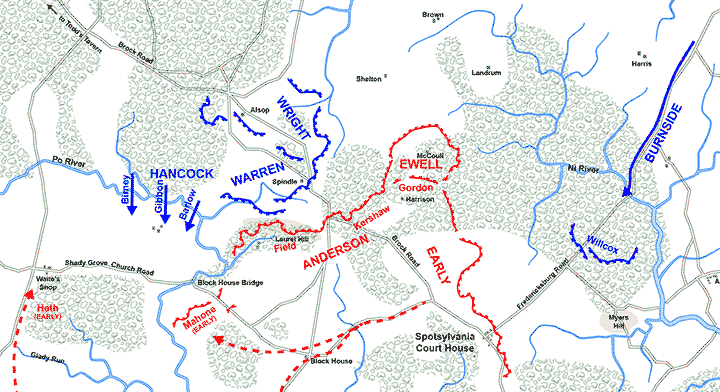
Another wonderful Hal Jesperson map showing the positions of the armies on May 9, about 4 p.m. General Hancock has crossed the Po River on the Union right hoping to exploit a weakness in the Confederate line. But General Lee responded by moving troops across from the right of his line to the left of his line to meet the threat. Outside of this action it was a relatively quiet day for the armies. Except of course, for the death of General John Sedgwick.
The event of the 9th which emphasized it in the annals of the campaign was the death of Sedgwick, Commander of the Sixth Corps. Since the fall of Reynolds at Gettysburg, no similar misfortune had befallen the army of equal importance; universally respected, all but idolized by his own men, his very presence at any time was worth whole brigades to the cause he loved.
“While standing behind an outer line of works, personally superintending and directing as was his custom, the posting of a battery of artillery at an angle which he regarded of great importance, he was shot through the head by a rebel sharpshooter, and died instantly. Never had such a gloom rested upon the whole army on account of the death of one man as came over it when the heavy tidings passed along the lines that General Sedgwick was killed.”
He was Connecticut born, West Point, 1837, having as classmates, Hooker, E. D. Townsend, and Wm. H. French, late Commander of the Third Corps, all of the Union Amy; while his rebel fellows included Braxton Bragg, Pemberton of Vicksburg fame, and one might wonder whether Jubal Early, over at the rebel right, had a twinge of sadness over the summary taking off of the man who, in earlier times, had stood by his side on the West Point parade ground. Born in 1813, Sedgwick was not yet fifty-one years old when sought by the enemy’s bullet.
Some of the besetments of army life and duty at this time are well set forth in the story that Lieutenant Dusseault, of Company H, tells of his efforts to replenish the supply of ammunition for the brigade:
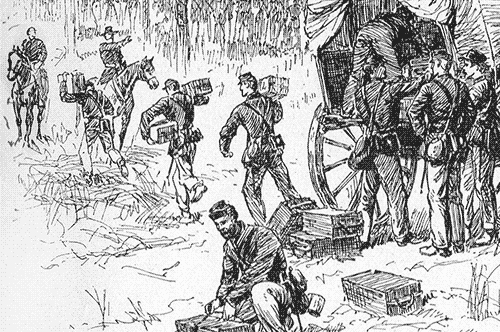
“That same night ––and it was a dark one too –– I was detailed to go back to the ordnance train for ammunition. I had sixty men from the five different regiments of our Brigade to help me. I was ordered to bring 25,000 rounds (twenty-five boxes).
We had secured the requisite amount and were returning to the brigade in the thick darkness. As it took two men to carry a box, which was supported on a blanket between them, it was impossible to keep the men together, and as I did not know them, many of them dropped their burdens and ran away. When we got back to our camping place, we found that the brigade had moved on a mile and a half further. When I came to my superior officer, I had but seven boxes to deliver to him. Rousing from his sleep, he ordered me to go back immediately and secure the rest, and then turned over and went to sleep again. It had to be done and at about two or three o’clock in the morning I reported the second time, not with the lost boxes, but with enough others that had been obtained in a way which I will not stop to explain.
“Through the
Wilderness"
by Alexander S. Webb, Brevet Major-General, U.S.A.
from Battles & Leaders of the Civil War, Vol. IV, Century Company,
1888 (p. 165).
General Webb's long narrative of events at the start of the Overland Campaign, continue here with a brief excerpt covering events on Monday May 9, 1864. He explains with a bit more exposition the movement of General Hancock's 2nd Corps, as shown on the Jesperson map in the section above.
On the morning of the 9th Burnside’s corps moved across from the Plank road to the Fredericksburg road at the crossing of the Ny river. This brought him east of the court house one and a half miles. He pushed over the river one division under O. B. Willcox. Stevenson’s division came up at noon. [56th, 57th, 58th & 59th Mass.––B.F.] Potter’s division remained a mile in rear on the Fredericksburg road. Willcox fought a brigade of R. H. Anderson and some dismounted cavalry.
Hancock moved east to the right of Warren, and intrenched overlooking the Po. On the morning of the 9th Sheridan started on a raid around Lee’s army.
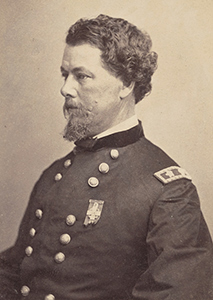
In front of Hancock the Po River ran from west to east, then it turned due south opposite Warren’s right. The Confederate left rested for a time on this south bend, and the bridge over it at the crossing of the Shady Grove Church road was fortified by Longstreet. [When Gen. Longstreet was wounded May 6, Gen. R.H. Anderson assumed command of the corps.––B.F.] While the several corps were adjusting their lines on the 9th, General Sedgwick, our most esteemed general, was killed by a sharp-shooter, and Horatio G. Wright took command of the Sixth Corps. (Gen. Wright, pictured.)
General Burnside had reported to General Grant on the 9th that he had met the enemy on the east of Spotsylvania Court House, and he had added to his report that he judged, from the indications in his front, that Lee was about to move north toward Fredericksburg. It was therefore determined that Hancock should make a reconnoissance toward Lee’s left, crossing the east and west bend of the Po River, moving south as far as the Shady Grove road, turning the enemy’s left; then to move east, and cross the Po River again by the Block House road bridge.
Hancock crossed three of his divisions (Mott was with Wright) at different points at 6 o’clock in the morning, forcing the crossing, and meeting a very stubborn resistance in front of Barlow, who was on his left, and but little in front of Gibbon, who was on his right. He now laid three pontoon-bridges over the river, it being fifty feet wide and not fordable, and then pushed due south toward the Block House bridge, but reached that point too late that night to attempt a crossing.
Story: "The Veteran; "––Austin Stearns
In this story about his uniquely shaped
cup, Austin Stearns tells how it originated, and continued with him in
service through 3 years of good and bad times.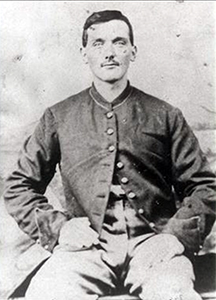
It all started when his tinsmith brother-in-law, who was married to Austin's sister, (she being "Mrs. Clark") forged a custom cup at the request of Mexican War Veteran, Charles F. Parker, age 37, of Southboro, MA, who enlisted into the Westboro Rifle Company as corporal. Clark decided to make cups of the same design to give to his two brother-in-laws, Austin and Jonathan Stearns, as well as some of the local neighborhood boys who enlisted with them. Each custom made cup had the soldier's name embossed in the tin. By my figuring the others who received the custom made tin dippers were, Willard Wheeler, Dan Warren, and perhaps Bill and Tom Gassett. There were 7 cups in all. As is related in the story only one survived the war.
As a side note, Austin Stearns rarely mentions his younger brother Jonathan, in his memoirs, though the two served together for three years. Jonathan (pictured) was five years younger than Austin. He settled in Philadelphia after the war.
The Veteran.
or The Story Autobiography of a Dish.
I am nothing but an old tin dish. My sides are battered and burned and there is nothing about me that is pleasing to the eye, or that would attract attention, but I have a history, and if you will bear with me I will give a short account of my self.
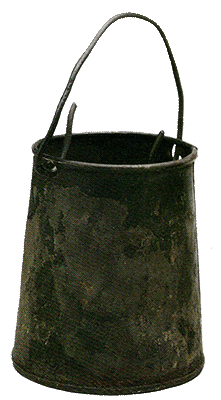
I was designed by Copl. Charles Parker* and made by Clark & Perry, tinsmiths of Ashland Mass. There were six Hopkinton boys, and two of them brothers of Mrs. Clark in the same Company with Parker, so mr. Clark made a group of 7 dishes, one for each. We were made with handles and the name of each boys was stamped upon it, and also on the bottom. If you look closely you can see my masters name now.
Oh how bright and shiny we looked that morning in July ’61 when Mr Clark string us on a wire and carried us down to Fort-Independence in Boston Harbor and gave us to the young men, who were there learning to be soldiers. How proud we were of our looks, but not more so than those who then became our masters. Now we were part and parcel of Co. K, 13th Regt. Mass Infantry. Towards the last of July ’61 we with the other belongings of the soldiers started for the seat of war. In the earlier days of the war, there were what was called “Company Cooks,” or men detailed to do the cooking.
My master being fond of me, kept me in a good degree of cleanliness, washing and wiping me as often as once a week, or oftener if water was plenty. I noticed when he wiped me with grass or leaves he chose the greenest. The fall and winter passed by without any thing worthy of note. My master going regularly three times a day to the cook house to get his rations. I always accompanied him to hold his coffee. In the spring of ’62 Company Cooks were discontinued with us, and each man with the exception of bread had to cook his own rations and make his coffee, I was now put to a severe test, for I was then set on a bed of hot coals, and my shiny sides were change to what you see them now.
It was down at Rappahannock Station in the summer of ’62 that my master lent me to one of his comrades to make his coffee, he only filled me half full, and when I got hot the solder melted on the upper half of my handle, and when he drew me away from the fire my handle was useless. He returned me to my master with the remark that I was –––––––an old dish. My master thought differently; for he went & with out a file or tool of any kid, twisted off a piece of telegraph wire using I fear using many swear words, and with his bayonet he pierced my sides and made a bale as you see it now, not very handsome, but very serviceable. I was suspended now, by a stick or oftener the bayonet or ramrod, in the blaze and smoke of the fire, In addition to coffee I have had soups of all Kinds, Beans, Rice, Potatoes, and in fact all the nameable and unnameable dishes that were ever concocted by the ever fertile brain of the soldiers cook in me.
If skillygalee, and
lobscouse were not not cooked in me, I was used to mix them in. I
used to be strapped to my masters Knapsack or havasack, and at times
his canteen: he has carried me thousands of miles through many of
the most desperate battles fought by the army of the Potomac, and many
times in the thickest of the fight. 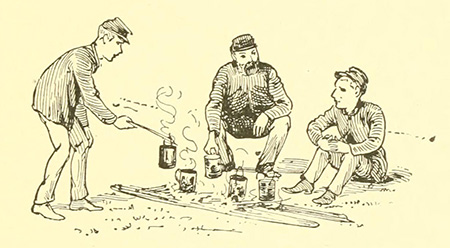 I
had been so long
with him, I had almost become a part of him, for of all the articles he
had when he started for the seat-of-war, I was the only one he had left
I
had been so long
with him, I had almost become a part of him, for of all the articles he
had when he started for the seat-of-war, I was the only one he had left
After I was old and burned and smokey he got a little cup that he called his drinking-cup, at which I was at first Jealous of, ––but I soon found out that it could never take my place, and as long as I did not leak, I was supreme.
In the spring of ’64 my masters time was almost out, and it was after we had passed through the three days fighting in the Wilderness, and I had rode all night strapped to his knapsack to prevent my making a noise by rubbing against my old friend the canteen, down towards Spottsylvania, halting Just a few minutes for the dawn to come, so we could see, as the cavelry outpost said the enemy were in a revine Just ahead. The morning was very hot and My master was very tired, and when we started, passing the cavelry out-posts they smiling to think that we were releaving them of a very disagreeable job, said “you will find them soon.”
The bullets began to sing and we were in for hot work, my master unhooked his knapsack, let it drop to the ground. I thought my time had come and I should be left to an inglorious fate and so when I struck the ground, I made as loud a noise as I could to attract his attention He heard me, stopped, turned round, and coming where I lay, Kneeled down and unhooked me from the Knapsack, and taking off his canteen passed the strap through my bale, and putting the same on said “Old dish we have been so long together that if one goes both go.”
I was happy, for I knew if master was spared to go home, I should go too. My fondest hopes were realized, for after two months more of hard service, and when we were lying before Petersburg, the order came for the regiment to pack up and go home. Many of the boys threw their cups away, but my master put me in his haversack, and I arrived home in safety, as I have said before, I am only an old tin dish: no poet has ever sung, or romancer told story of my doings, and like the other old and servicable friend of the soldier ––the army mule –– have only received abuse, when we did our best to serve.
I will relate an incident, that happened to one of my kind. One night in bivouace, when the boys were busy cooking their supper, my friend filled with water and coffee, was perched upon rails, in a very careless position, when nearly ready to boil, a member of the awkward squad thought to change his position; he hit the rail with his foot, and my friend fell off, spilling its contents; it so enraged the owner that without saying a word to the one causing the mischief, he kicked the cup, and with expressions like these “Darn that cup” –– “Darn the man that made that cup” –– and “Darn the man that won’t darn the man that made that cup, Hurrah for Jeff Davis”. He kicked and stamped it out of all semblance of ever being a cup, and out of the limits of our bivouace, came sullenly back, and took a seat by the fire amidst the shouts and laughter of his comrades. In less than half an hour he was trying to borrow another dish to make coffee in.
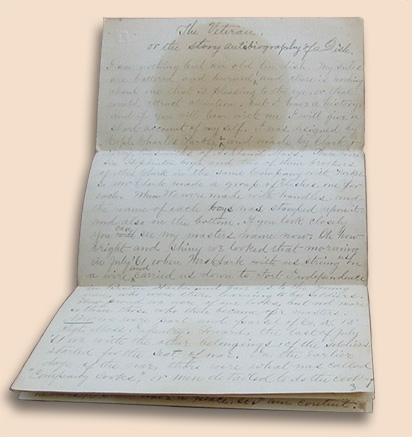
A few years ago in the town where I was a fair was held, by the local grand Army Post and I was among the relics that were on exhibition. My master had labeled me “The Veteran” whatever that might mean, and a paper stating my service and the uses I had been put to. My mistress wanted to clean me up, scrape my burned and blistered sides, and as she said make me respectable, but my master objected, and as I had no voice in the matter I went in the condition in which I was in. I created considerable comment, and some said, “What a horrid old dish”, And “Do you think any one would eat or drink any thing made in it?” Others sneeringly remarked the “Old Vet” and passed by without a second look. A few came and gazed at me long and earnestly, and said I was rightly named, for I was in truth a Veteran.
I sit around in unused places, but at times my master gets me out, and as he fondles me says, “this is my old dish, and where he went I went also, and that as long as he lives, I shall have a place,” so I am content.
NOTES:
*Charles F. Parker's record from the roster states, upon enlistment, he was a "shoe-click" and a
veteran of the Mexican War. He was age 37. Parker mustered
out, April 6, 1863.
I purchased this document for not much money when it showed up for sale
on ebay. Its rewarding to own something that was so
personal to Sgt. Stearns, a great chronicler of the 13th
Regiment. The handwriting is in neat cursive,
brown ink, with
occasional corrections or revisions written in pencil, above the
corrected word. A few words are
crossed out, near these corrections, and sometimes a misspelled word
has a letter crossed out. This shows the editing process
Austin Stearns went through with his story. I tried to copy the text as
close as possible but I did not follow the line breaks or places where
a word was hyphenated and continued on the next line. A few
sentences are marked with numbers as if there were notes.
The 3 sheets of paper are folded in thirds and a
circular grease stain
penetrates all three sheets, where the tin dish rested upon it.
—Bradley M. Forbush, transcribed May 21, 2020.
Next Up: Battle of Spotsylvania Court-House, Part 2
Return to Top of Page | Continue Reading
© Bradley M. Forbush, 2026.
Page Updated August 30, 2026.