Introduction
The
nine week period Companies C, I & K were detached from the
Regiment at Harper's Ferry was eventful, but it was not
written about in the official history. (Company C
went to
Monocacy Bridge but would join the other two companies at Harper's
Ferry on September 30th). Companies I & K were
headquartered
at Lock 33 of the Chesapeake & Ohio canal on the Maryland side
of the
Potomac
River, directly across from the town. They guarded the river
fords that connected Virginia to Maryland from Sandy Hook to
Two
Locks, (3 miles above the town). Major Jacob
Parker Gould,
head-quartered at Sandy Hook, a mile below the town, commanded the
detachment.
At
this time Confederates battled Union troops in Western
Virginia for control of the mountain
passes that connected the state. A strong Confederate
offensive
was expected. Scouting parties of the 13th Mass., frequently went over
to
Harper's Ferry and the Virginia side of the river to confiscate any
materials that could be useful to the U.S. government, or the rebels.
On
September 2nd one of these parties commanded by Captain Schriber of
Company I, was attacked at Harper's Ferry by Confederate Cavalry.
One
Confederate was killed, and one man of Company I, wounded slightly.
The other 7 companies were still at Sandy Hook, and some were rushed to
the Ferry as re-enforcements. This engagement is known as the
skirmish at Beller's Mill. You can read more about it on the
Sandy Hook page of this website.
 On
September 15th a heavy skirmish took place along the
Potomac
river
opposite the 13th Mass. pickets. It
started when John L. Spencer was shot and killed while riding along
the
tow path of the C & O canal on a scout. Enemy fire
pinned
down the other men in the party for 2 1/2 hours.
Spencer was the first man of the regiment killed by the
enemy.
The engagement is known as the skirmish at Pritchard's Mill.
This fighting was quite different from the relative quiet the
rest of the regiment experienced 40 miles away at
Darnestown, but the
detached
companies had some lighter moments too. On
September 15th a heavy skirmish took place along the
Potomac
river
opposite the 13th Mass. pickets. It
started when John L. Spencer was shot and killed while riding along
the
tow path of the C & O canal on a scout. Enemy fire
pinned
down the other men in the party for 2 1/2 hours.
Spencer was the first man of the regiment killed by the
enemy.
The engagement is known as the skirmish at Pritchard's Mill.
This fighting was quite different from the relative quiet the
rest of the regiment experienced 40 miles away at
Darnestown, but the
detached
companies had some lighter moments too.
Members of
Company I acquired one of the most interesting relics of the Civil War
in late September; the "John Brown Bell." The bell
came from the engine
house of the famous little building known as "John
Brown's Fort," which stood on the grounds of the ruined federal
arsenal. Members of Company I, formerly with the Marlboro
Volunteer Fire
Department wanted the bell as a souvenir for their building back home,
which didn't have a fire bell at that time. The bell was taken from the
ruined
arsenal grounds and kept until Major
Gould
obtained permission from the Government for the boys to keep it.
The bell was carefully boxed up and brought along to
Williamsport when Company
I
moved there to join the rest of the regiment on October 31st.
But, it would be another 30 years before the bell finally
arrived
in Marlboro, -- its intended destination. Today, it hangs
from a
tower in the Marlboro Massachusetts town square.
Picture
Credits: Lt. Charles B. Fox, Lt. William H. Jackson, Corporal
George E. Marshall, Lt. David L. Brown,
&
Priv. Chandler Robbins, from Army
Heritage
Education Center, (AHEC) Carlisle, PA; Panoramic of Harper's
Ferry by John Hamil ©2008, (titles added by Brad Forbush);
Images of
Harper's Ferry, The Engine House, Bell Cupola, Marines Storming the
Engine House, Lock 33, Canal Boats, Virginius Island, and Herr's Mill,
from Historic Photo Collection, Harper's Ferry NHP;
Company C from my private collection; Photo of the
John Brown Bell Tower & scan of Joseph Barry's book cover by
Brad Forbush; Lauriman H. Russell from the Marlboro Historical Society;
His map from John Buszek's "History of Marlboro" website; Major J. P.
Gould downloaded from the web; Col.
John White Geary & all
other images, Library of Congress. All images have been
altered
in
Photoshop. Painting of John Geary attributed to artist J.M.
Boundy, circa 1867, from the State Museum of Pennsylvania, PA
Historical and Museum Commission. Used with permission.
Return to
Table of Contents
Austin
Stearns Description of the Region

View from Maryland
Heights, © John
Hamil, 2008.
From "Three
Years With
Company K" by Sgt. Austin Stearns, deceased, Edited by Arthur Kent; AU
Press, 1976; (p. 25 -
27) used with
permission.
"Perhaps a few
words
about the country would not be amiss. The Blue Ridge runs in
an
almost north east and south west direction, while the Potomac's course
is generally south east. It looks as though, in some far
remote
ages, the river broke through the mountain barrier and it's waters
found an outlet to the sea, for the pieces of rock in the river bed,
and the jagged appearance of those on it's banks all testify to such an
event.
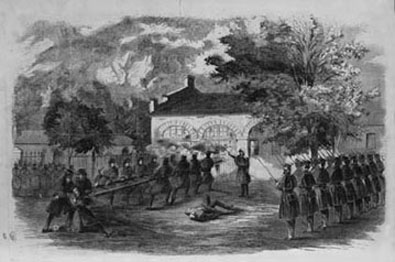
The Ridge takes to it's self names.
For
instance, the principal ridge is called the South Mountain Ridge.
At the Ferry - Maryland Heights. At the east of
South
Mountain Ridge across Pleasant Valley is the Catoctin Ridge.
The place where the river runs through is called
Point of Rocks. To the west is Elk Ridge, and still farther
away
is Old North Mountain Ridge. The Shenandoah River comes up from the
south west and empties it's waters into the Potomac at the Loudoun
Heights.
The Baltimore and Ohio Railroad came
down from the west and crossed
from the Point to the Maryland side on a bridge now in ruins.
Everything about the Ferry bore marks of war.
The fine large
houses on the side and top of the Heights - the residences of the
oficials of the works - had not escaped. A road wound round and up a
hill to the village of Bolivar. Loudoun Heights commanded the
place, and from the Maryland Heights (which commanded both), the
country could be seen for miles up the river. Sandy
Hook was
a mile down the river on the Maryland side, where the headquarters of
Major Gould were, in Command of the detachment.

Captain Scriber established his
headquarters on a canal boat
- so
[as] to be ready to retreat at any time, his men said.
Blackmer
took for his quarters the rooms over the store on this side, which
stood up close under the Heights.
The canal was on the Maryland side
of
the river,
and there was a road that ran up about a mile to the Lock (Lock 33) and
turned up into the Valley between the Ridges. There were two locks in
the Canal at the Ferry; up the river about a mile there was one Lock
and a mile beyond this were two more.
This
was
the
limit of our picket duty this way. Down the river we went as
far
as the Hook, and at times still farther down."
Return
to
Table of Contents
Skirmish
at Beller's Mill, September 2nd
On September 2nd, Companies I &
K, of the 13th Mass, marched into
Virginia to confiscate some grain at Beller's
Mill. On the return from the mill, Confederate
cavalry fired upon the two companies. Members of
Company K were crossing the Potomac in boats, while Company I was still
in town. For men of Company I, the engagement is memorable,
due to the heroic(?) actions of their mysterious Captain R. C. Shriber.
More details about this engagement are posted on
the Sandy Hook Page of this site. Information about Captain
Shriber can be found on this page. The following
article (which is also posted on the Sandy Hook page of this site)
gives news of the week
following the skirmish.
WESTBORO
TRANSCRIPT
September 21, 1861
Regular
Army Correspondence, No. IV.
Sandy Hook, Md.,
Sept. 9th 1861.
Messrs.
Editors: As far as my experience goes ‘Regular
Army
Correspondents’ serving in the ranks, too often find the regularity of
their communications disturbed by unexpected orders, marches,
etc. Don’t you find it so?
To night, (or this morning –
it being 12 ½ A.M.) I am an occupant of
the guard house! Not as a prisoner, however, but as an
officer of
the guard; while five members of Company K., bound prisoners of
Morpheus, lie stretched upon the floor beside me.
The telegraph and papers must
have furnished you ere this, with their
account of our skirmish with the rebels at Harper’s Ferry on Monday
last. Though we troubled the ‘seceshers’ a trifle, the
newspaper
reports give us rather more credit than we deserve, perhaps.
During the forenoon of Sept. 2d both companies stationed here (I and
K), crossed the river as a guard while grain was being procured,
marching about a mile and a half into Virginia, to a mill.
After
a halt of two hours, Company was ordered to return to advance and
recross the river first. As they marched through the streets
of
Harper’s Ferry they sang their favorite “Hallelujah’ song.
John
Brown’s body, etc.
With the purpose, perhaps, of
adding fresh fuel to the fire of the
‘Southern harts,’ if any such should happen to be beating within sound
of their voices.
When two-thirds across the
river, a ball came whizzing over the boat,
and striking but a few yards ahead; which was the first intimation
given that an enemy was upon the hills of Harper’s Ferry. A
few
shots were fired from the boat into the clump of bushes and yard in
which the enemy were concealed, and from which a scattering fire was
directed at the boat; but none of their shots hit the mark nearer than
the papers hit the truth in their report of the affair. On
reaching shore, the company were posted where they could command good
shots if the enemy should again be seen. But the firing was
now
turned upon company I, who were still upon the Virginia side, at the
base of the hill occupied by the enemy: whereat we were
ordered
to re-cross to their aid. We did so; and found them by the
flag-staff at the Arsenal, they having had to retreat, with one man
wounded. The two companies then formed into platoons, and
taking
different streets marched up the hill. Before reaching the
summit, we learned that the rebel cavalry, number 30 or 40 men, under
command of Col. Ashby, had retreated, taking off one man killed by a
shot through the head and breast,* and 4 or 5 wounded. A
platoon
of Company K found a loaded rifle lying in the grass, and spotted with
blood, which they keep as a trophy. The ‘twenty-five
prisoners’
reported taken, are minus, we not having had sufficient practice in
‘double-quick to catch up with the retreating foe. At
nightfall
all returned, with a detachment that had been sent to our relief.
Later in the evening, a fresh
alarm started both companies up the canal
to prevent any passage of cavalry across the river; and Co. K spent the
time till 10 P.M., in erecting plank barricades, while Co. I remained
on guard till morning. The later are now in possession of
several
rifles taken on a scouting expedition into Virginia the next day; and
yesterday afternoon a small party of them captured a valuable horse,
belonging to a rebel surgeon who had come into Harper’s Ferry to gather
information, - himself escaping by a back-door arrangement.
During the week quite an
amount of fatigue duty has been performed by
both companies, erecting barricades, digging rifle-pits, &c.,
along
the bank of the river,- proving to us, at least, that ‘carrying
knapsack, gun and bag, ‘with the other duties of a soldier,’ is harder
work than farming.’ Those who enlist to escape the drudgery
of
farm work must have suffered grievous disappointment ere this.
On Friday last, one of our
members had a narrow escape. A
spent
ball from one of the enemy’s pickets passed through the side of the
shed in which he was and struck him in the back; with so little force,
however, that it dropped harmlessly at his heels.
Nearly every day straggling
shots are fired upon our guards, and upon
the canal boats, thus far without damage; and almost nightly some
quaking or startled sentinel discerns signals or moving lights upon the
far-off hills of Virginia, in the lightning bugs that hover but a few
yards from his post; and discharge their pieces at innocent and
unsuspecting swine, whose movements they mistake for the clatter of
horsemen or the tramp of rebels. But no such ‘rude alarms’
now
disturb the stillness of the quarters, unless the drum sounds the long
roll to ‘fall in.’
Yesterday afternoon our worthy
Captain Blackmer conducted Divine
service, preaching a brief, practical sermon. He has
officiated
for the Chaplain on two or three occasions.
We are now expecting to leave
this place within a few days, to rejoin
the regiment who left their camp on Monday evening last, and are now
within twenty miles of Washington. Our transportation will be
effected by means of a scow, on the ‘raging canawl,’ a hoped-for sail
of forty miles.
My next letter will probably be from ‘camp.’
Yours for the War - .
(The
man wounded Sept. 2nd was George Brown of Southboro; struck in the
fleshy part of the arm and thigh, but no bones
broken-webmaster). (digital
transcription by Brad Forbush).
*NOTE: If this is the same man
Joseph
Barry mentions in his book (see "Scouting Parties" section of this
page) the Confederate man killed was a man named Jones, shot in the hand and breast.
Austin Stearns
describes the same action:
"One day a
detachment
of I and K under Major Gould went over the river to the "Sacred soil'
and up the Shenandoah to some Flouring Mills, where there was quite a
quantity of wheat stored. After staying an hour or so we went back, K
in advance. All was quiet til the boat I was in was half way
across the river, when the bullets commenced to whistle over our heads,
fired at us from Bolivar Heights. It seemed they had been
watching us all the time. As we outnumbered them, they had
not
dared to open fire till we were partly over the river. Co. I
was
coming down Shenandoah Street and they were fired upon too.
We
did not return their fire till we were over, for the boat was crowded.
Orders came to recross. We went back, threw out a
line of
skirmishers, and advanced up the hill, the rebs retreating as we
advanced. We picked up a gun, a Mississippi rifle, which
Chandler
Robbins sent home to Westboro.* The
citizens said
they carried away three in a wagon. We went over beyond the town and
stayed till night. Nothing more was seen of the rebs."
(Three Years
With Company K; p. 34 - 35; used with permission).
Confederate Lt. Col. Turner
Ashby, C.S.A., reported
in September, 1861,
from his camp near Halltown, "I had occasional skirmishes
with the enemy in this vicinity, they having crossed twice - once at
Harper's Ferry and again at Shepherdstown. I have driven them
back each time without loss, having only 1 man wounded, and he doing
well. I have killed several of them each time. They
fire at every man, woman, child, or horse that passes the river upon
this side. I have sometimes allowed my men to return their
fire with long range (small-arms) guns, wth some known effect."
[Turner Ashby, Correspondence with Adj. General's Office, C.S.A.,
O.R., Series I. Vol. 5.]
*Note: For
more information about Chandler Robbins and the rifle he
captured see the section Scouting Parties on this page.
Return
to
Table of Contents
Mysterious
Captain Shriber
Introduction
During the skirmish mentioned
above Captain Shriber of Company I distinguished himself
when,
"at the first fire he jumped into the
Shenandoah to
hide behind a
stone wall that protects the Winchester and Potomac railroad from the
strong current of the river. Although he shielded himself
against
fire, he was not equally successful against the river which at this
place is both deep and rapid and he had much difficulty in saving
himself from being drowned. As it was, his fine
clothes
were much damaged and a red sash, which he wore around him, left a
stain on his uniform which could not be removed by any amount of
washing. It would appear as if a soldier's uniform eternally
blushed
for the cowardice of the unworthy wearer. This
officer was
loaded down with medals and badges of merit which he said himself he
had gained in the Crimean campaign, fighting against the Russian Bear.
Our hero was certainly a poor specimen of the men who fought
at
Alma and Sebastopol, if, indeed, he ever saw the Crimea, which is very
doubtful. His men however, on this occasion showed a good
deal of
gallantry and, under Lieutenant Brown, of the same company - his name
needs no concealment - they stood their ground like good soldiers until
the enemy retired."
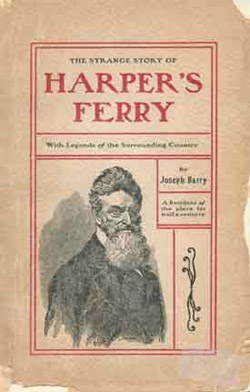
The
preceding is from Joseph Barry's
Book
"The Strange Story of Harper's Ferry;" 1903.
Moses
Palmer and David Brown worked
hard to
organize the rifle company that became Company I of the '13th Mass.';
elected Captain and First Lieutenant of the company
respectively.
But before leaving Fort Independence, Governor Andrew appointed R. C.
Schriber Captain of the company. Palmer and Brown were bumped
down a rank.
Joseph Barry concludes his comments on Captain
Schriber thus:
"The officer whose conduct in the
skirmish was
so
discreditable would have been left to oblivion, had not his behavior to
some ladies of the place been as disgraceful as his cowardice in
battle. But, notwithstanding his name is mercifully omitted."
Researcher Richard Humphrey, current owner of the
original Company I
field books, has put together the following article on Captain
Schriber.
"Captain
R.C. Shriber"
By Richard Humphrey ©2000.
"Captain Shriber
was a somewhat mysterious
character in this story of interesting characters. The very spelling of
his name and his origin is not totally known. The Descriptive
book of the Company lists only “Robert C. Shriber, Captain, July 16,
1861.” There is nothing more in this book. Charles
E.
Davis, Jr. lists him as “Charles H. R. Screiber, age 26,
mustered
in as Capt., July 16, ’61; mustered out, April 1, ’62.”
Serg’t.
Austin C. Stearns in “Three Years withCompany K” refers either to
“Captain Scriber” or “Captain Schriber.” Of course
the
Captain signs his letters R. C. Shriber.
Both Charles Davis and Sergt. Stearns have
something to say about
Captain Shriber.
Stearns says “Captain Scriber
had a good deal of
trouble with his men. Some were in the guard-house about all the time.
Some were fond of whiskey, and would contrive all ways to get it. He
seemed to have a particular grudge against one named Sullivan; he told
him he would put him in the guard-house and keep him there almost
forever. One day he was drilling them in the manual of loading and
firing. He told them to load – aim – aim higher:
about one
half mistook the order for aim – fire, and fired. It was fun to see the
Dutchman rave and storm, using language not generally heard on drill.
More of the men were put in the guard-house.”
Some of the documents of Court Martial against
Horace L. Crocker,
Thomas Thompson, George F. Washburn and Henry J. Callahan have
survived. One proceeding brought by R. C. Shriber is as
follows:
Charge
& Specification preferred against Private Henry J. Callahan of
Company I 13th Regiment Mass., Volunteers
Charge. Drunkeness while on Guard.
Specification. In this that Private
Henry J.
Callahan of
Company
I 13th Regt. Mass, Volunteers was drunk while on Guard on or about the
night of September 7th 1861 between the hours of 12 o clock
midnight & 2 o clock of the morning of the 8th Sept.
1861
This at or near Harpers Ferry Lock Md.
R.
C. Shriber
Captain Commanding Co. I
13th Mass Vol.
To which Charge and Specification the prisoner
Private
Henry J.
Callahan of Company I 13th Regiment Mass. V pleaded as Follows
Of the
Specification
Not Guilty
And not guilty of the charge
The Court after mature deliberation upon the
evidence
adduced
finds the
prisoner Private Henry J. Callahan of Company I. 13th Regt.
Mass
V.
Guilty of the Specification
& Guilty of the Charge
and does therefore sentence him Private Henry J.
Callahan of Co. I.
13th Mass Regt. Mass. V to the stoppage of one half of each of two
months pay. The other half to go direct to his wife.
The Proceedings, findings & sentence in
the above
case
is
approved, and will be
Harpers
Ferry Lock Md
Sept. 12 1861
Evidence brought before the Garrison Court Martial
which
convened at
Harpers Ferry Lock Md. Sept 12 1861 in the case of Private Henry J.
Callahan Co I 13th Regt. Mass. V.
Corporal E. A. Albee sworn
Went as Corpl. Of guard to place Callahan on post. Tried to
awake
him, pinched him, called him, raised one leg. Then called
musician James M. Gleason Co. I and Private William A. Alley to
assist. Gleason raised him from the floor and then dropped
him.
Did not state he was drunk. Said, could not wake
him. Did
not smell his breath. He vomited before this time.
When
waked was a moment recovering and then did his duty.
Private Wm. A Alley of Co I
13th Regt Mass.
V. sworn
Was returning from Knoxville – had wrong countersign
and was
detained. Went in and saw no one. Corporal was
relieving. Soon came to relieve sentry & put on
Callahan. Confirms previous witness. Thinks the man
was
dead drunk. Did not smell liquor. There was no
light.
Did not know prisoner except from the calling his name by
others.
Musician James M. Gleason Co I 13th Regt Mass. V.
Confirms
the testimony of previous witness.
Sergt. Howe sworn
Belongs to Co I. was Sergt
of the Guard. Callahan was arrested next morning.
Did not
prefer charge. Callahan lay from 9 to 12 o clock on floor, vomiting
part of the time. Left at 12 o clock for Main Guard. Was
informed
by Gleason & Alley that Callahan was drunk. Went down
and
aroused him without much difficulty. Thinks he had been
drinking.
Statement of Prisoner
Between 2 & 3 o clock P.
M. went to Sandy Hook after
water.
Drank two glasses of Ale and one small glass of Whiskey.
Drank no
more. Was at Guard house the remainder of the day.
Sandy Hook Md.
Sept. 14,
1861.
I hereby
approve of the decision of the Court Martial and the verdict rendered
in the cases presented to them for trial, with the exception that I
would suggest that the Court Martial consider the propriety of changing
the sentence of Henry J. Callahan so that he may be deprived of one
months pay and that sum be sent to his wife.
J.
P. Gould Major
I direct that the Captains immediately
carry into
effect the
punishments returned by the Court Martial
J. P. Gould Major
Commanding Post.
Notes on Private Henry Callahan.
From the Descriptive book of Company I No.
27: Henry
J. Callahan, Age 23, 5” 8”, Dark Complexion, Blue eyes, Black hair from
Boston, Mass., Printer. In battles of Bolivar and Bull
Run.
Deserted April 23, 1863 from hospital at
Frederick, Md."
Muddy Branch Camp
Headquarters Gen. Banks Division
October 31 1861
Lieut M. P. Palmer
Co. I 13th Mass Vol
at
Williamport MD
My Dear Comrade,
In all hurry a few lines for you - I am detailed
as ast.
Aide-de Camp to the General until his regular staff officers come from
Washington - I may be back in Williamsport by 10 days, but it might be
earlier I would therefore beg of you to make out as soon as possible
for me, the claims my company has agaisnt me as a whole and individuals
- please announce this at evening roll call. I shall take the
battery of R.I. Artillery, the Marylanders are too shabby, probably I
shall be detailed from the artillery back to the general.
Are you all well? I can not deny that I
miss after
all you and Lt Brown and my company, whatever the men may be, they grow
dear to ones heart, nothing new otherwise. There will be no
fighting this winter - God Bless You and Lt Brown and my company. -
See that my property which
might be in the hands of any of the
members of the Co. is looked after.
Believe me ever to be your
Sincere Friend and Faithful Comrade
R.C. Shriber
Capt 13th Mass Vol Ast. Aide de Camp to Gen Banks
Send me my letters back by messenger.
Headquarters Gen. Banks
Division
Frederick City Md December 14th 1861
To 1st Lieutenant M. Palmer
Comdr Co. I 13th Mass Regt
Williamsport, Md
My Dear Comrade,
Owing to the pressure of business here
at headquarters it has
been almost impossible for me to write earlier to you though I thought
often of you and Lt. Brown and the Company in general. It is
my painful duty to announce to you that poor Kiltridge really
dies in Baltimore.* The enclosed papers will make
you acquainted with the case and that what he left - you better have
these things sent up to your company and sell them keeping the money
till called for but throwing it for the present in the company funds.
The same thing ought to be done with Spencers Money. -
Do not omit to report the death of
Spencer and K. and the
circumstances under which it occurred to the Adjutant General of the
Army as proscribed in the army regulations - I have omitted so to do in
the case of Spencer - I understand that the sick in Baltimore are doing
well and Pierce will rejoin the company before long - it always makes
me glad to hear good news from the company and the regiment and the
praise you got from the Lieut-Col was rejoicing to me - General Banks
attributes the 13th as the finest regiment and the behavior of the men
during the recunt little fights have warrented again its good
reputation.
I am anxious to see the company filled
to its standard number
again. Why does Brown not go to Boston and
Marlborough. I am sorry that the matter of my promotion is so
lengthy at Washington so that you might get yours, but they have there
so much to do that I feel it will take a month before it will come out.
How is Fanny and her mother?
Let me know about them.
My horse Fanny is completely broken down - the horse I got
from Lt Brown is a strong good animal but stumbles when the least
fatigued. If you will send me your horse, by a man from
Williamsport, I can sell him for you to an aide-de-camp for a fair
price
or come yourself with him - Tell Mr. Brown that I will pay him on the
1st of January, and that if he likes I will give him a draft on any
place he wishes by return of mail. I enclose an order for
your horse, detail through Leonard a cavalry man to bring him.
Whatever you ask I am assured you will get if at all
reasonable. Put down a minimum price and a maximum.
I will look out for your advantage - Maj Gould will soon be
back in W. He knows nothing of the horses!!! I
spoke to him. The Sutler received his leggings and I had to
pay him $4.25 additional
for leggings not accounted for so that if I pay
Maj Gould for Spencers Coffin, I will be quit with the company funds.
Your and Lieut Browns promotion is certain. Gen.
Banks on my
application recommended you to the Colonel who has promised me that no
one else will be nominated. Sergent Horne may have a chance.
I think we will stay here in winter quarters. Now
my dear friend - God Bless You and Comrade Brown and all, I have to see
you soon.
Ever
Yours Very Truly
R.C.
Shriber
----------------------------------------------------------------------
Headquarters Gen. Banks
Division
Frederick City Md.
Decbr. 13th 1861
Pass the
bearer
And a horse through all the Guards and
Picketts between Williamsport and
Frederick,
to which latter place he will bring the
latter
for delivery to the undersigned
R.C. Shriber
Deputy Ast Adj. Gen
& Aide-de-Camp
NOTE: Kittridge is Lewis
Kittridge; age,
28, born Germany; farmer; musterd in as priv., Co. I, July 16, '61;
died, Nov. 23, '61, Baltimore. Spencer, is John L. Spencer,
KIA Sept. 15, 1861 during Pritchard's Mill Skirmish. Pierce, is John
Pierce, Co. I, who accidentally shot himself leaning on his gun while
on guard. He was sent to the hospital in Baltimore.
We know when he
officially
left Company I from the Company I
Order Book. Probably an actual promotion arrived from
Washington at this time since he had been gone, off and on, since
October, 1861.
Orders No 164
Section II
Headquarters 13th Regt
Mass Vols
Camp Manassas Va June 28th 1862
In consequence of information received at these
Headquarters.
The promotion of Capt. R. C. Shriber of Co. I. Lieut M.P.
Palmer will command said Company until further orders. Capt R. C.
Shriber will be dropped from the Roll of said Company tomorrow morning
and report as lost by promotion. By Order of
S.H. Leonard Col.
D.H. Bradlee.
Adjt
"There is a three page report from
R.
C. Shriber
Aide-de-Camp and Acting Inspector-General to Brig.-Gen. James
Shields, WINCHESTER, March 26, 1862 which relates in flowery
prose
how he almost single handedly won the Battle of Kernstown and ends with
“Most respectfully, your obedient, humble servant.” There is
nothing humble in the message and I am not going to waste space here.
R.C. Shriber is mentioned in
Official
Records three
times. Two of the three are unimportant mentions as commander
of
Company I (O.R. series I. vol V pg 198
& 240
). In O.R. I. XII page 353 there is an important mention in a
message by Jas. Shields to Brig.-Gen. Carroll on June 7,
1862.
Here as Gen Shields refers to deterioration in the
situation “Colonel Shriber is at work.” The index
confirms
that
this is R. C. Shriber.
And there is this message I found on
the internet at ehistory:
May 24,
1862
R.C.
Shriber, Lieutenant Colonel,
U.S. Army, and Assistant Adjutant
General, Headquarters, 1st Division, Department of the
Rappahannock. Near Fredricksburg, Virginia. To Carleton
White,
Clerk, Columbus, Franklin County, Ohio.
Signed:
Lieutenant Colonel R. C. Shriber, Chief of Staff and Acting Assistant
Adjutant General 1st ( or Shields } Division
So this man has managed to
string a
grand title and
get on the good side {?} of his general, and reaches the pinnacle of
his career.
We have a good idea when he was
dismissed from the Army.
Just after the battle of Cedar
Mtn. (Battle
of Cedar Mtn. August 9, 1862), the following is related in “Three Years
With Company K” by Serg’t. Austin C. Stearns on Page 90:
“In a few days
we marched down the west side of the mountain and pitched our camp
close up under the south side. At our first halt and before
we
had taken rest Col. Leonard said: ‘Men of Massachusetts have
you
heard the news? R. Morris Copeland and Cap’t Schriber have
been
dismissed from the service.’ Of what particular offence
Copeland
was guilty I do not know, but Schriber could have fraud wrote
after his name and not over express it. And so they weeded
them
out, but not as fast as they deserved to be.”
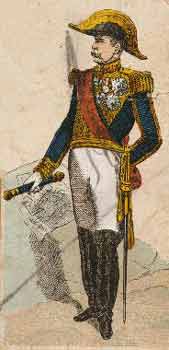
The best summation of the career and
character of
Captain Shriber is given by Charles E. Davis, Jr., on page 10
of
“Three Years in the Army.” He does this without ever
mentioning
his name.
“We had scarcely reached the water
before it was
discovered that again the cause of alarm was a pig who made sufficient
noise in his wanderings to alarm the officer in command of the
detachment, who thought it was the enemy. This time it was a
Prussian idiot, who playing the role of Don Quixote, deprived us of a
night’s sleep. On the way back to camp, at daylight, he was
the
subject of comment, and some there were who boldly expressed a wish
that he might be sent where the wicked cease from troubling.
The appointment of this officer to
our
regiment was one of the instances of attempting to graft foreign fruit
on to a native tree. As it proved a lamentable failure, no
apology is necessary for showing him up as a warning to future
governors in making such attempts. The fact that he had
expressed
a contemptuous opinion of Yankees doesn’t count for much, of course,
but that was no reason why he should make himself or the regiment
conspicuous by peculiarities in dress or manners.
Eccentricities
of this kind were unbecoming in a man of such mediocrity as
he.
Evidently the air we breathed was unsuitable for a man of his expansive
nature, and we were glad when he shook the dust of the Thirteenth from
his feet, remembering that ‘Pride goeth before destruction,’ we watched
his career with interest as he sailed aloft, unconscious of his
elephantine conceit, soaring higher and higher until he reached the
rarefied air of a lieutenant-colonel in a Maryland brigade, where
swindling and conduct unbecoming an officer were frowned upon.
Having reached this giddy height he exploded like the
sky-rocket,
whose flight he so much resembled, and like it plunged to earth again,
followed by the fiery tears of his mysterious friends.
Notwithstanding he was dismissed from the service, he is,
probably, now in ‘Fair Bingen on the Rhine’ relating the heroic deeds
he performed in Yankee land to save the Union. He was the author of
‘Company I, run!!!’"
© Richard Humphrey, 2000
*NOTES: The
Massachusetts Adjutant
Generals report shows Schriber received a commission as Major in the
1st Maryland Cavalry, April 1st 1862. He had been gone, off
and
on, from the regiment frequently since October. Captain Moses
Palmer and Lt. Brown were promoted to their rightful place.
Lt. William R. Warner attributes Shriber's command "Company
I, Run!" to the Battle of Bolivar Heights, (see Warner's journal entry
in the Bolivar Heights section on this page.) -
B. F.
Return
to
Table of Contents
Scouting
Parties
The presence of the '13th Mass.,'
represented a build up of Federal troops along the Potomac River, under
Major-General Nathaniel Prentiss Banks commanding the
Department of the Shenandoah. Banks replaced General Robert
Patterson July 25th and soon relocated headquarters to
Darnestown, Md.
The men of the 13th
opposite Harper's
Ferry made occasional foray's across the river into Virginia to
confiscate materials that might be of use to the Confederates.
The Virginia side of the river at this time, was
irratically defended by Southern Militia, Lt.-Col. Turner Ashby's
cavalry was the most active, headquartered at Charlestown, 7
miles from Harper's Ferry. The majority of Southern
Militia raised in this region were
at Winchester, 30 miles south, training to be soldiers.
Harper's Ferry resident and local
historian Joseph Barry, describes the character of the men in the
13th Mass.
Excerpt from
"The Strange
Story
of Harper's Ferry" by Joseph Barry; (p. 111-112).

After the departure
of the
main army
for
Darnestown the 13th regiment of Massachusetts Volunteers was left at
Sandy Hook as a corps of observation and a guard for the ford at
Harper's Ferry. These men were uncommonly zealous in
shooting at
rebels as long as they -- the 13th -- were on the Maryland side of the
river with the broad Potomac between them and the enemy, or
rather
between them and Virginia for, now, it rarely happened that a
Confederate soldier appeared anywhere within gun shot of them.
Crouching under the buttresses of the ruined bridge on the
Maryland side of the river in the now dry bed of the canal, or among
the thickets and rocks of the Maryland Heights, the gallant 13th kept
up a constant fire on the few inhabitants of Harper's Ferry, suspecting
or affecting to suspect them of being rebels.
Everything that moved about the streets
they shot at
vindictively. The appearance of even a mullein leaf swaying
in
the wind elicited a volley from these ever vigilant guardians of the
nation, and it was lucky for the place that they were indifferent
marksmen, else it would have been wholly depopulated....
Sometimes the 13th would send
detachments in skiffs across
the river and on one or two occasions they were encountered by parties
of Confederates who would occasionally lurk in the cemetery and behind
the fences on Camp Hill and keep up a scattering fire on the “Yankees”
in the town. In one of these skirmishes a rebel
soldier
named Jones was killed near the graveyard, a bullet having penetrated
through the palm of his hand and then into his stomach."*
*Probably the skirmish of
Beller's Mill;
September 2nd.
Excerpt
from
"Three Years With Company K"
Austin Stearns describes a
few such
expeditions in his Memoirs, “Three
Years with Company K,” Austin Stearns, (p. 28-30).
"We frequently crossed the
river to the
sacred soil
of Virginia. I remember of crossing over on the ferry boat
one
day -- five or six of us; we tried to manage the boat ourselves.
The current was quite rapid and we lost control of her --
away
she went -- down the river, striking one of the piers of the bridge,
turning her completely round. Down we went toward the rocks,
but
good fortune favored us; the current here turned in shore. We
caught hold of some bushes, holding her fast, escaping a good ducking
if nothing more. Someone went for the boatman; he came and took us over
with out any difficulty.
"We amused ourselves by
walking about,
looking over
some of the unoccupied houses, bringing away some things that were
amusing if not very useful.
…I was on an expedition under Lieut. Fox that went
over
to the
Loudoun
side and up in the valley two or three miles. We captured four or five
horses, then went for the geese -- getting a dozen or so; these we
cooked and tried to eat. I might as well have tried to chew
leather as the flesh of the goose I had. I have never tried
to
eat goose since."
 “We had several
members who
were troubled
with an optical illusion - especially in the night when on
guard. They
could see millions of boats, loaded to their utmost capacity with
rebels armed to the teeth crossing the river to massacre us, advance,
take Washington, and subdue the North. Just at the critical
moment, when the Nation's life hung by a thread, he would fire.
The Corporal with a file of men would double quick to his
post to
find out the cause. He would relate what he saw; but the dull
eyes of the Corporal could see nothing but the running water on it's
way to the sea. The next week an extract from the heroic
soldier’s letter would appear in the Westboro paper, through the
kindness of friends, giving the details of the nation's narrow
escape through his vigilance.
“We had several
members who
were troubled
with an optical illusion - especially in the night when on
guard. They
could see millions of boats, loaded to their utmost capacity with
rebels armed to the teeth crossing the river to massacre us, advance,
take Washington, and subdue the North. Just at the critical
moment, when the Nation's life hung by a thread, he would fire.
The Corporal with a file of men would double quick to his
post to
find out the cause. He would relate what he saw; but the dull
eyes of the Corporal could see nothing but the running water on it's
way to the sea. The next week an extract from the heroic
soldier’s letter would appear in the Westboro paper, through the
kindness of friends, giving the details of the nation's narrow
escape through his vigilance.
All the boats, scows,
and
skiffs, for miles up
and down the river, we had destroyed or taken to our side.
Lieut. Fox with a score of men
-- I was one of
them -- had been down the Virginia side and destroyed everything we
could find that would float. Other parties had gone up the
river
on the same kind of errand.”
Drug
Store
Clean-out (Austin Stearns, continues)
"There was a most violent
seccessionist who kept a drug store in the Ferry, who at all times
never failed to show his hatred toward us. His insults were
unbearable, so one day [when] we were ordered to the Ferry, proceeding
to his store, we commenced to clean it out. We made a clean
sweep of everything he had, and carried it across the river.
Some of it was used for hospital purposes, but the greater
part was, I think - by the cigars smoked, and the general appearance of
the boys - used here. We saw no more of the druggist."
Lysander
Parker's Recollections of the Clean-out.
Lysander "Dixie"
Parker of Company I,
has another
such remembrance found amidst “The Story of the John Brown
Bell;” a pamphlet prepared by members of the John A. Rawlins
Post
43, G.A.R. Copyright 1910 by Rawlins Building Association,
Marlboro, Mass.
“One thing quite amusing which
is still
fresh
in memory was the seizure of a stock of goods at a drugs
store. The Full Company was at this raid with overcoats
belted on
the outside. When we entered the store the captain gave
strict
orders that everything should be sent down to the boats, to be
forwarded to Washington, and that we must not appropriate anything
ourselves. The store was quickly cleaned and the company
ordered
to fall in. When the order came to front, the spectacle which
confronted the captain was indeed ludicrous. Above the belt,
around the body and up to the chin, could be seen very prominent the
shapes of cigar boxes and the necks of bottles, and the expressions on
the boys faces would have excited the risibilities of any army mule --
The captain had to smile but said nothing, and of course the contents
inside the overcoats were all sent to Washington. One night,
after sampling the contents of some of the bottles, the boys had lots
of courage and crossed the river without orders, in search of pigs and
poultry, and came very near being captured.”
WESTBORO
TRANSCRIPT
October 12, 1861
Westboro
From
Co. K. – A
printed letter from a
member of the company states that they have been having the equinoctial
storm
out there, and that it was very severe. The writer says: “We
have had to lay on the ground, wet to the skin, and
it was cold enough to freeze even a Northerner.’ ‘The river,’
he continues, ‘has risen three
or four feet since the rain, sweeping the remains of the bridges burnt
by
secessionists, in large piles down the river. Timbers which
were being used in the reconstruction of the bridges were
also carried away.’
They appear to have once more ‘invaded
the sacred soil,’ and
to have found good picking. They got
about ten boxes of tobacco, fine cut in papers, lots of champagne and
whiskey,
six or eight hundred cigars, some looking-glasses, two mules, three
horses,
three or four saddles, one tent, a barrel and a half of flour, and four
or five
guns. Quite an assortment.
He further says: “I
have not received any letters from home for some time. We are
badly situated to get anything by mail
or express without much delay. We are
right down between two mountains and can see nothing but the mountains
and the
sky; and we can’t hear as much as we can see.’
(digital
transcription
by Brad Forbush)
Chandler
Robbins; Sending Souvenirs Home
 Chandler Robbins
was already a
good story teller and interesting character when he enlisted in Company
K, the Westboro Rifles. Born in Plymouth, Mass.,
1819, Robbins settled in Westboro, Mass. about 1840, a wheelright by
trade. He married Francis Mellen in 1842 and had 5 children
with her, only two survived. He left Boston in 1849 on
the first ship to leave for the newly discovered California Gold fields
via Cape Magellan. Chandler Robbins
was already a
good story teller and interesting character when he enlisted in Company
K, the Westboro Rifles. Born in Plymouth, Mass.,
1819, Robbins settled in Westboro, Mass. about 1840, a wheelright by
trade. He married Francis Mellen in 1842 and had 5 children
with her, only two survived. He left Boston in 1849 on
the first ship to leave for the newly discovered California Gold fields
via Cape Magellan.
"He was
connected with the Fremont
surveying party there, which was led
by the famous path-finder himself [John C. Fremont]
and guided by Kit Carson.
In the two years of his
absence he had a
varied experience, which included surveying, mining and exploring, and
a few
hours captivity among the Indians. On his return trip, via the Isthmus,
the
train which carried the proceeds of his labors was robbed, leaving Mr.
R.
little but his experience. His
description of what he saw in South
America
and Califonia furnished many interesting stories for friends at home.” -Westboro Chronotype, April, 1880.
Robbins, at age 42, was one of the first
in Westboro to enlist
at the outbreak of the war. While at Harper's
Ferry he served as Company Cook. Of this occupation
regimental historian Charles Davis writes,
"At this time of our service men were
detailed
in
turn, in each
company, to do its cooking. It was soon discovered, however,
that too many cooks did, indeed, spoil the broth. Rather than
waste all the food that was issued the companies soon settled down to
one man, with an assistant, and they were relieved from all other
duties. It required the patience of Job to cook for
ninety-eight men, as we know from experience. One week at it
was convincing proof that a good cook was a "heap" bigger man
than
McClellan."
Robbins was soon detailed
as hospital steward, for which he gained
a reputation as a committed and caring individual. In 1864,
when
General John C. Robinson was severely wounded at the Spindle Farm, he
requested Steward Robbins be assigned as his personal nurse. Three
times Robbins was taken prisoner being twice
paroled on the field, and once after a short confinement in Libby
Prison. In the following letter, Mr. J. F. B. Marshall,
Westboro
Selectman, receives a gift from Private Chandler Robbins, who captured
it after the skirmish of September 2nd.
WESTBORO
TRANSCRIPT
October 12, 1861.
Mr Marshall, of the Military Committee of this
town, has
received from Chandler Robbins, of Co. K, an old Harper's Ferry musket,
captured from the rebels in a late dash upon them. By the
accompanying letter, it appears that the rebels came down to the river,
on the Virginia side, and fired upon the men, who immediately gave
chase. Several shots were exchanged, but the rebels finally
fled,
leaving two killed and a number wounded. Company I (of
Marlboro)
had one man wounded. The musket sent to Mr. Marshall fell
from
the hands of one of the killed rebels. On the return of our
men
to camp, both companies claimed the musket ; but Mr. Robbins, taking
advantage of the nine points of law which are said to arise from
possesion, retained the prize in behalf of Co. K., till opportunity
offered to forward it to Mr. M., with the request that he would
preserve it as a memento from the company.
Mr.
B. B. Nourse recieved several articles, - among them a venerable old
shave and bevel, which he inclines to the opinion must have been
dropped overboard from the ark by some careless member of Noah's
family, while in the vicinity of Harper's Ferry. Also a
Minnie
ball, which seems to have been fired at Mr. Robbins while acting in his
official capacity of cook. The ball struck the rock upon
which he
had his cooking utensils arranged, without injuring himself or his pots
and kettles. He very much deprecated the carelessness of the
rebels.
Several other articles were
sent in
the same package, - among them two or three pieces of the bell that
hung in the Harper's Ferry Armory when it was burnt. Some of
Co.
K's boys went over and raised it out of the water in which it laid
three feet deep, and broke it up to send home.
The following, from Mr. Robbins' letter, shows the
estimation
in
which the labors of the Military Committee in their behalf are held by
the company.
"Having a few leisure
moments,
I take liberty to address the Committee through you. My words
of
gratitude come truly from the heart, and I cannot doubt that they
express the minds of others of Company K. What I write now is
a
part of what I wanted to say to friends left behind on the eve of our
departure ; but my heart was too full to express my feelings at that
time. * * * For one, I must
say to you,
gentlemen of the Committee, and our lady friends, one and all, in
Westboro and out, who took so deep an interest in our welfare, so
bountifully providing for our wants, that you have our most sincere
thanks : and I hope that by our faithful labors in the cause
in
which we are engaged, we may win such laurels as will in some measure
repay you.
Return
to Table of Contents
Engagement
at Pritchard's Mill & The Death of John L.
Spencer; September 15th 1861
ROXBURY
CITY GAZETTE
September 19, 1861; (pg. 2, col. 6.)
Point
of rocks, Md., Sept.16.
Yesterday,
as six men of the Massachusetts 13th regiment
were riding upon the
tow-path, two miles above Harper's Ferry, they were fired upon by the
rebels on
the opposite side of the river, and one of them was killed. A
considerable
force of the rebels was posted behind the warehouse and other
buildings. Capt.
Schriber, of the Massachusetts
13th, directed the fire of a 12-pounder against
the building, dispersing
the rebels. It is supposed that five or six of them were
killed.
Thomas
Harper,
who was wounded by the rebels last Thursday, is in a dying condition.

Major Jacob Parker Gould
commanded the small
detachment
of 13th Mass. troops, but Gould had to report to Colonel John
W. Geary of
the
28th Pennsylvania Volunteers, commanding all the troops in the vicinity
of Harper's Ferry. Geary was an ambitious
man. At a young age, he put himself through college after
paying
off his father's debts; working as a surveyor and engineer on the
Allegheny Portage Rail Road. Active in local militia, he went
to
the Mexican War as Lieutenant-Colonel. in the 2nd
Pennsylvania.
He fearlessly led them in a charge at Chapultepc.
Geary was
wounded 5 times. He returned home a hero, moved west, and
became
San Francisco's first mayor. There, he cleaned up the
vigilante
gangs of that wide-open city. President Pierce called on 36
year
old Geary to bring an end to the bleeding in Kansas territory
appointing him Governor; August, 1856. In 3 months time, with
the
force of Federal troops, Geary faced down both pro-slavery
&
anti-slavery factions that were terrorizing the region. The
six
foot, six inches tall Geary was truly a commanding figure.
When
the Civil War broke out, he raised two regiments and took command of
the 28th Pa. Vol. Inf.
This
painting of
John W.
Geary is attributed to J.M. Boundy, artist, circa 1867; oil on canvas;
from the State Museum of Pennsylvania, PA Historical and Museum
Commission. Used with permission.
Making things hot for the
Union troops at Harper's Ferry was
Turner Ashby and his Confederate cavalry who frequently
picketed the Virginia shore. Ashby's friends at Harper's
Ferry
kept him apprised of federal troops' activities.
Likewise
Col. Geary was informed by his friends in town, of Confederate plans to
occupy Harper's Ferry on September 14th with 3,000 troops aided by
Ashby's cavalry. Geary was skeptical, but increased
his
vigilance. The morning of September 15th, a mounted scouting
party led by Lt. David L. Brown, Company I, received a
sudden
volley from concealed Confederates on the opposite shore near
Pritchard's or Peacher's Mill. John L.
Spencer, Co. I, was killed
instantly, the first man of the regiment killed by the enemy.
The rest of his party were pinned down for more than two
hours. This opened a general skirmish along the river at
Harper's Ferry.
Colonel Geary's report follows:
(Official
Records of the War of
the Rebellion, series 5, vol. 5).
SEPTEMBER
15, 1861. – Skirmish at Pritchard’s Mill,
Va., near Antietam Ford, Md.
Report
of Col. John W. Geary, Twenty-eighth Pennsylvania
Infantry.
POINT OF
ROCKS, MARYLAND,
September 17, 1861.
SIR: On the night of
the 13th instant I
received reliable information that about 2,200 rebels were stationed in
an offensive attitude between the Shenandoah and Shepherdstown, on the
Virginia shore of the Potomac. This force was composed of infantry (the
greater portion of them being in the neighborhood of the Old Furnace
and Pritchard’s Mill. The number of them actually engaged is
variously estimated at from 500 to 600, while they had a reserve of
1,500 or 1,600 within a short distance behind the hills and along the
railroad in the direction of Martinsburg), cavalry, and artillery, with
four pieces of cannon. Their object seemed to be to attack
the
right of my command, resting about 3 miles above Harper’s Ferry, on the
Maryland side of the river, and threatened that they would turn that
position, gain the rear of my pickets, and capture a considerable
portion of my command, consisting of two companies of the Thirteenth
Massachusetts Regiment. This information reached me at 11
o’clock
at night; and one hour after I proceeded from my camp at this place
with three companies of riflemen, (B, I and L) of my regiment, a
section of the New York Ninth Battery, with two rifled cannon,
commanded by Lieut. J.W. Martin. After a very rapid and,
owing to
the extreme [heat] of the weather, fatiguing march of 12 miles I
reached Harper’s Ferry about daylight on the morning of the
14th.
I found the rebels then engaged in making an attack upon the troops
stationed above my command near Sharpsburg. Those troops made
a
handsome defense, and before I could proceed to their assistance the
rebels retired, under pretense of having received orders to report at
once at Manassas.
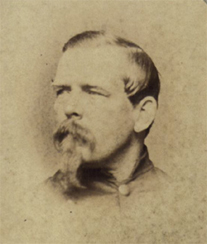 On the morning of the 15th I
acquired
considerable knowledge of the position of the enemy, and desiring to
assure myself more particularly with regard to their movements, I
detailed scouting parties to such points as the rebels
were said
to be, to ascertain the truth. One of these parties, consisting of an
officer (Lieutenant Brown,)(pictured)
1 sergeant, and 6 privates, all of the
Thirteenth Massachusetts Regiment, mounted, by my direction pushed
forward as far as Antietam Ford; this party, returning, while opposite
Pritchard’s Mill, were fired upon suddenly from a body of men perfectly
concealed. One man of the party was instantly killed on the
spot,
and, owing to a continuous fire kept [up] on the remaining portion of
the party, it was impossible for them to move from the position to
which they had taken themselves to prevent further losses as the enemy
deployed down the river.
On the morning of the 15th I
acquired
considerable knowledge of the position of the enemy, and desiring to
assure myself more particularly with regard to their movements, I
detailed scouting parties to such points as the rebels
were said
to be, to ascertain the truth. One of these parties, consisting of an
officer (Lieutenant Brown,)(pictured)
1 sergeant, and 6 privates, all of the
Thirteenth Massachusetts Regiment, mounted, by my direction pushed
forward as far as Antietam Ford; this party, returning, while opposite
Pritchard’s Mill, were fired upon suddenly from a body of men perfectly
concealed. One man of the party was instantly killed on the
spot,
and, owing to a continuous fire kept [up] on the remaining portion of
the party, it was impossible for them to move from the position to
which they had taken themselves to prevent further losses as the enemy
deployed down the river.
About the same time a number
of the enemy made
their appearance on the apex brow of the Loudoun Heights, also on the
road leading around its base to Harper’s Ferry, and commenced firing.
At the same [time] a considerable number of them opened fire from the
heights back of Harper’s Ferry and from all parts of the railroad along
the river up to Pritchard’s Mill. The latter were deployed,
well
covered behind the embankments of the railroad and bushes, and secreted
in houses, barns, and lime quarries.
I stationed Company L, under
command of
Captain Barr, of my regiment, upon that portion of the Baltimore and
Ohio Railroad below the abutment of the burnt bridge, in the direction
of Sandy Hook, with instructions to clear the Loudoun Heights and the
road at their base, which they did, causing the enemy quickly to
retire, leaving 5 or 6 killed and wounded on the ground. I stationed a
company and a half of the Thirteenth Massachusetts Regiment, commanded
by Major Gould, from the bridge upward to the first lock on the canal,
a distance of about 1 ½ miles, to defend against attacks from the town
and surrounding heights. I also left one piece of artillery with Major
Gould’s detachment in such position as to sweep the several streets of
Harper’s Ferry. I placed Company B, Captain Warden, of my
regiment, above the lock, where the right of Major Gould’s command
rested, and deployed it along the river about 1 mile. This
company rendered very efficient service by its good marksmen at long
range and seriously galled the enemy. I then advanced with
one piece of
artillery, commanded by Lieutenant Martin; half of Company I,
Thirteenth Massachusetts Regiment, commanded by Captain Schriber; and
Company I, commanded by Captain McDonough, Twenty-eighth Pennsylvania
Volunteers. The combined advance, numbering about 130 men,
took
possession of several dry basins along the canal and a point known as
Maryland Ore Banks, which afforded an excellent shelter to my men. Thus
situated, a very spirited fire was maintained for something over two
hours, the fire of the enemy gradually slackening as they were
dislodged by our artillery and sharpshooters, until about 6 o’clock the
firing entirely ceased. (The enemy were driven from every
point
they occupied and sullenly retired beyond the range of our guns toward
the interior). During this affair considerable damage was
done to
the mill, houses, and barns in which the rebels had taken shelter
within reach of our cannon.
As far as can be ascertained
through Virginia
sources deemed reliable there were 18 of the rebels killed and about 25
wounded. It is impossible to ascertain exactly what the
casualties of
the enemy are, from the fact [that] the river divided us from them, and
we have partly to rely upon the Virginians themselves for our
information. Our loss was 1 killed and 3 slightly wounded.
The wounds
all occurred from fragments detached from the bands around the James
shell, discharged by our own artillery.
Philadelphia
Inquirer
The engagement
was briefly described in the Philadelphia Inquirer
Philadelphia
Inquirer
September 17,
1861
Affairs On The Lower Potomac
Colonel Geary
Repulses a Rebel Attack.
Point of Rocks, Sept. 15
– About three o’clock this
afternoon a force of five hundred Rebels attacked a portion of the
troops under
Colonel Geary,
stationed about
three miles above Harper’s Ferry.
Colonel Geary
commanded in
person, and the fight lasted about three hours.
The enemy were driven
from every house and breastwork, and
no less than seventy-five of them are reported as killed and wounded.
Our loss is one killed
and a few slightly wounded. Our
troops behaved like veterans. Companies
B, D, and I of the Twenty-eighth
Pennsylvania Regiment, and two companies of
the Thirteenth Massachusetts, were engaged in
the conflict.
During the fight a Rebel
was seen taking aim at Col. Geary,
when the Colonel grasped a rifle
from a soldier, and shot him on the spot. Our troops are in fine
spirits.
Col.
Geary’s Official Despatch.
The
Death
of
John L. Spencer
Captain
Moses
Palmer, a principal organizer of Company I, kept the bullet
that killed Spencer. Palmer's descendants still have the
misshapen bullet with a piece of paper that reads “This is the
ball that killed John L. Spencer of Co. “I” 13th Regt. Mass. Vols.
Spencer was shot on the tow path of the Canal near Sandy Hook, Md. and
was shot by the Rebels from the Harpers Ferry side of the River Potomac
-- first man killed in the Regt. His body was sent to
Marlboro.
The ball passed through his body killing him instantly.”
M.
P. Palmer, Comdg Co “I”
The loss of Spencer was
keenly felt. The
following
letters give more detail.
WESTBORO
TRANSCRIPT
Sept. 21, 1861
From a letter received by Mr.
David B. Goodale, - from which we are
permitted to make extracts, - we learn that Mr. John L. Spencer, a
member of the Marlboro Union Guards, was shot on Sunday afternoon last
by the rebels, while out on a scout under command of Lieut.
Brown. The ball entered the right side, about four inches
below
the arm-pit, and passed directly through the body, so that it was
picked out just beneath the skin. This sad occurrence took
place
while Capt. Blackmer of Westboro was preaching, and he immediately
discontinued divine services. Spencer was highly esteemed by
Mr.
Goodale, in whose employ he remained a number of years, and was a
member of the Sons of Temperance in Marlboro. His body was
forwarded to Marlboro.
John Pierce, of the same Company, shot himself,
accidentally, while on guard duty a few days ago, by leaning on his
gun. He was sent to the Hospital at Baltimore, and it is
thought
by the physicians that he will recover.
George Brown, of Southboro,
belonging to the same Company, wounded some days ago, is recovering.
The above Company is having a pretty busy time;
evidently
being in an exposed position, and constanty engaged in skirmishing.
They have improved in drill and discipline, with a fair
prospect
to take the palm from the pet lambs of the regiment.
(digital
transcription by Brad Forbush).
WESTBORO
TRANSCRIPT
September
28, 1861
From Harper's
Ferry. – C. R. Brigham under date of Sept. 14th, 15th,
and 16th, writes that they had just been into Virginia, and seized
another 12-pounder, two mules, worth $150 each, and one
prisoner.
They had the fire engine, previously captured, into working order; and
Corporal Jones and Private Geo. Emery were making themselves useful in
building carriages for the captured guns. As soon as the four
other expected pieces of artillery should arrive, they would probably
make an attack on Charlestown (the place of John Brown’s trial), 8
miles distant.
In regard to the skirmish of
the 15th, he writes: “This A.M.,
a
scouting party of 6 from Co. K and 6 from Co. I, started out on
horseback. * * Nothing special transpired in camp until 3
o’clock, when the drum sounded to fall in for religious services, Capt.
Blackmer acting as chaplain. The services
commenced, - and
so did the rebels. Word came that our pickets
were being
fired
upon, and 4 companies and 1 piece of artillery were immediately sent
forward. The rebels kept up their fire from behind a log
house
across the river; but the artillery soon shelled them out. We
had
the pleasure of seeing some 6 or 8 of them fall, and probably double
that number were killed in and about the house and the woods behind
it. The only loss to our forces was John L. Spencer, of Co.
I,
killed. He was with the scouting party, and was killed at the first
volley. The men of that party used up all of their own
cartridges, and those upon the body of Spencer, and then were forced to
lay in the water of the canal two and a half hours. The
artillery
fired 29 shots, at a cost of $77, besides about 1500 rounds from our
rifles.
‘Since the regiment came out
here there has been one killed, (SPENCER )
one wounded by the enemy, one by our own men, (EDWIN SMITH) and one by
his own carelessness.’(JOHN PIERCE).
‘We have just learned that the rebels are planting
a
battery in the
woods where we had the fight yesterday. We expect to have
another
set-to right away.”
(digital
transcription by Brad Forbush).
Letter
of William Henry
Forbush; Spencer's Funeral

Harpers Ferry Lock Sept 17th 1861
Dear Mother
I have rote you two letters
this week and now
I will write you another in My last I told you
that one
of Com. I Men
had bin killed and now I will tell you of his funeral the
Orderly
Sargent Kimbal came into our Mess room yesterday Morning and wanted 12
Men to go as Berriers to the Funeral and Fly and Myself and 10 others
went we went without our Equipments then we went
into the
room and placed the coffin or rather a box on two barells
the
American Flag was wrapped around the coffin the
coffin
was
made of rough boards
P2
And he had one of our New
Winter under Coats
on and pants and Stockings
and green leaves at the head of the coffin and a bunch of snow balls on
his breast after we fetched him out and
placed him
on the
Barrells then the Company made there
Apperance
Comp I of
which he was a Member. they had there
Guns and
Equipments on they fell
in front of the Coffin and then Capt Blackmer came out and Spoke to
them and us telling them that there was some thing Singular about this
Mans death only the Night before he was up all
Night with
the Man that Shot himself accidentally and did not leave his side all
Night and then to think he was the first
one to be
shot dead the
P 3
Next day
but he said it
was glorious to
die in such a noble cause
and at his Post he said who will be called
next God
only knows he said we had bin verry Lucky about
Loosing our
Men since we Started the man stood the first Man
in the
ranks of his company in the lines
Then he offered a prayer and then we started for
Sandy
Hook a distance of two Miles and we carried him all the way
6 of us would carry him and then 6 more when they got tired,
we
carried him in the Midle of the ranks and the Company on each
side the two drummers had there drums Muffled and drapped in
Mourning and they played all the way and
when we got
there we sat
P 4
The coffin down and the
Company came up and
fired 3 rounds over the
coffin some 300 Shotts and then we placed him in
the cars
and left there Sargent with him to go to
Massachusetts Marlboro
Mass his Father Living in New York State somewhere
but
they
didn’t Know where and so they were goin to take him there to the Man
that he used to work for and
then we came
back but the Minister
said perhappse this man was taken to warn? the?
others? that Such an hour as we think not we may be
taken Mother I am on guard to day and it is most
time to go
out and relieve My Man I am on the Post with Mr.
Joseph
Fairbanks today but I must close
I am all right and [page torn] some and
Tough as a
nut but I
must close Good bye Love to
All
Wm Forbush
Arrival of the Body at Marlboro,
Massachusetts
WESTBORO
TRANSCRIPT
Sept. 28, 1861
The body of John
L.
Spencer, who was
killed by the rebels in Virginia
last week Sunday, was received in Marlboro, last Thursday afternoon and
was deposited in the Town House. On Friday afternoon The Hook
and
Ladder Co. the two Engine Companies, accompanied by the Onamog
Divisions Sons of Temperance, - of which Spencer was a member – turned
out in large numbers, to perform the last sad obsequies to the memory
of the departed patriot. A procession was formed at the Town
Hall. The remains were taken in charge and the solemn
courtege
moved to the Congregational Church where the formal Ceremonies were
performed by Revs., and Mssrs. Anthony, Bailey and Wakefield.
A
feeling of sadness, pervaded the assemblage, and when the rites were
over the mortal remains of John L. Spencer, were consigned to the tomb
to await the action of his friends at or near Rouses’ Point.
Co. I of which Spencer was a
member have forwarded to us a series of
resolutions on the death of their brother in arms, which we cheerfully
publish.
Harper's
Ferry Lock,
Sandy Hook, Md.
Sept.
16,
1861.
At a meeting of the Officers
and members of Co. I Capt. Shriber, 13th
Regiment Mass. Vol. (Union Rifles Marlboro,) it was unanimously resolved:
That we deeply mourn the loss
sustained, by the death of John L.
Spencer, which reached him in the gallant execution of his duties, as a
defender of his country’s government, in an action on the banks of the
Potomac, Sept. 15th. His kindness of heart had won for him
without an exception the deep attachment of all his comrades, his
promptness and bravery made him much respected by his officers, and his
generosity and politeness made him much respected by all who knew him.
Resolved;
That we desire to
convey to his parents
and
relatives
our deep sympathy in their bereavements, trusting that it might be a
comfort to them to know that the whole company feels with them the loss
sustained, and that it was for our country’s sake, that he gave his
life.
Resolved;
That we convey
our heartfelt thanks to Major Gould
and
Captain Blackmer, of the 13th , Capt. Richardson, of the 21st Mass.
Vol., and those members of Co. K. 13th and 21st Mass. Vol. who bore the
remains of our comrade to their final resting place, and the Union
Relief Committee of Baltimore for their kind assistance.
Resolved;
That
the clerk of the
company will transmit a copy of these
Resolutions, to the Marlboro Journal, for insertion, and also a copy by
letter to the relatives of the deceased.
L.H.
Russell,
Committee
A. G.
Howe,
on
C.W.
Whitcomb.
Resolutions.
(digital
transcription by Brad Forbush).
Spencer's
Final Resting Place

John L. Spencer's remains were sent to Franklin
County, New
York. He is buried next to his mother Rebecca, wife of
Charles, at Bangor Cemetery off Country Route 53.
The three markers in the plot are:
SPENCER
John L. SPENCER Died Sept. 15, 1861
AE 26 years (NOTE:
There is an illegible inscription on the bottom of this stone.)
Separate stone in
the same lot:
Silas W. SPENCER Died Sept. 9, 1851
AE 23 yrs. (NOTE:
There is an illegible inscription on the bottom of this stone.)
SPENCER
Rebecca Wife of Charles SPENCER
Died Oct. 7, 1866
AE 71 yrs. (NOTE: There is an illegible inscription on the
bottom of this
stone.)
NOTE: This cemetery was
transcribed between 27 May and 4 June 2000 by Joyce M. Ranieri. It was
checked
against earlier records owned by the House of History, Malone
New York.
Discrepencies were resolved by re-visiting the cemetery on 5 June 2000.
Return
to
Table of Contents
The
John Brown Bell

Members of Company I, obtained
a
fascinating souvenir of Harper’s Ferry
-- the bell from the firehouse known as "John Brown's Fort" located on
the grounds of the ruined Federal Arsenal. The bell took 30
years
to finally reach its intended destination, Marlboro Massachusetts,
where it is now enshrined in the town square. Years after
the war, James Gleason,
a younger participant in the story, used to give occasional talks on
the bell, and accompany it in parades. When Gleason
died, and
as others aged, surviving members of Company I, decided
to record an official statement about this important relic.
Lysander Parker gives an
account of the first leg of the journey in a pamphlet
published, 1910 by Post 43, G.A. R. Rawlins Building
Association,
Marlborough, Mass.
Excerpt from
"The Story of the John Brown Bell" Post 43, G.A.R., 1910.
“Our Company tendered their
services to
the U.S.
Government May 20th, 1861, and was ordered to report at Fort
Independence, Boston Harbor, June 29th, and became Company I of the
13th Massachusetts Volunteer Militia.
"We were mustered into the
U.S.
Service July
16th and left Boston for the front on the 29th. On the 23rd
of
August, we went into camp two miles from the Potomac, and about six
miles from Harpers Ferry.
"On the same date, Companies
I, K and C, and a
section of Rhode Island Artillery under command of Maj. Gould, were
detailed to go to the river and guard the fords which connected Harpers
Ferry with the Maryland side. While there we received orders
to
go to Harper's Ferry and take everything of value to the Government and
remove it across the river where it was to be shipped direct to the War
Department. We immediately pressed into service two scows, lashed them
together, then stretched a rope diagonally across the river, the
highest point being on the opposite shore. Another line was
there
made fast, with the other end passing around a pulley on board the
scows. With this device, we easily pulled the boats across
the
river, and although heavily laden on their return, with the assistance
of the current and use of poles, we landed our freight on the Maryland
side. From the Arsenal and Hall's Rifle Works, we took a large quantity
of minerals, also fifteen thousand stands of arms, and various other
things of less importance. Being on historic grounds, our thoughts
naturally turned towards the engine house, for 'twas here that John
Brown fought his last fight for the liberation of the slaves.
Again in imagination we could see the old Spartan as he felt
the
pulse of his dying son with one hand and grasped his rifle with the
other.

"In vain we
searched for
something to take
with us as a souvenir, for others had been there before us and
appropriated everything of value. We finally decided to take the bell
and send it home for the Fire Department, as the Hook & Ladder
Co.
had none. Brown had planned to use this bell to sound the
signal
for the slaves to rally and flee to the mountains of Virginia, and
there to make a stand and fight for their freedom. The
question
was how we should remove it from the belfry. We were equal to
the
occasion as the sequel proved.
"On Fast Day, which
occurred
Sept. 26, 1861,
Lieut. David L. Brown and fifteen others of Company I crossed the river
and procured a rope at a store nearby, then climbed to the roof of the
engine house, disconnected the bell from the belfry, and proceeded to
lower it. Just as it reached the edge of the roof, the rope
parted and the bell dropped, and striking on a flagstone, chipped off a
few pieces from the flange, but not enough however to injure the tone
of the bell. We then loaded it on the scows and took it
across
the river.
"Realizing that our treasure
was the property
of Uncle Sam, we thought best to consult proper authority before
proceeding further, and immediately through Major Gould, Provost
Marshal of the 13th at Sandy Hook, we made direct application to the
Government for it and in due season received permission from the War
Department to appropriate the bell. It was then boxed by Levi
Taylor and Algernon S. Smith and placed on board the canal boat
“Charles McCardell.” This boat was used during the time we
were
there for the officers quarters and there it remained until we rejoined
our regiment.
...On the 31st of October we
received
orders to return to our regiment,
which was stationed at Williamsport. The canal boat
accompanied us and
the bell was landed at Williamsport Lock.
"Our regiment remained at
this
place during
the winter. While there, we made the acquaintance of William Ensminger,
who with his wife owned and managed two or three canal boats.
Mrs. Ensminger being an excellent cook, we engaged her to
bake
the bread of our company while we remained.
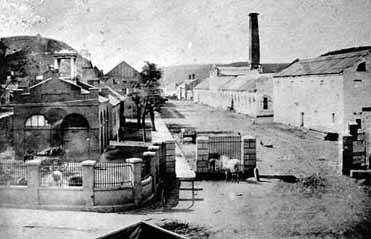
"Opinions there as well as at
Harpers Ferry
concerning the War were about equally divided. The Union and
Confederate Armies were constantly being recruited from both
centers. The war spirit was in the air and something must be
done
with the bell. Unlike the ark of the covenant, it was too
heavy
for us to carry in our wanderings. Our salaries, eleven dollars per
month, were hardly sufficient for us to ship the bell to Marlborough,
and at the same time meet the demands of the sutler when pay day came
around. We finally made a trade with Mr. Ensminger to care for the bell
until called for. We also left with him our regimental hats,
a
very gaudy affair, with a big black feather on one side and the
American
eagle on the other. During the winter we accumulated an extra
quantity
of clothing, which, being too cumbersome to carry on the march, was
left in care of the same party.
"The first day of March, 1862, we
were
ordered
across the river into the enemy's country. Bidding farewell
to
our new found friends, we marched away, and the bell for some time was
forgotten. There it remained for thirty years."
To be continued...
The
taking of the bell was reported in
the newspapers.
PHILADELPHIA
INQUIRER
October 3, 1861
Pg. 1
From the lower
potomac
Interesting from general Banks' column.
Darnestown,
Sept. 30. – The first frost
of the season was experienced here last night.
Capt. Collis'
independent company of
Crimean Zouaves, 101 in number, arrived at head-quarters on Saturday
night, after performing a march of thirty-one miles in nine
hours. They are now doing duty as Gen. Banks’
body-guard. Each one of the number has seen service in the
late Continental wars of Europe.
Capt. Williams,
late Assistant
Adjutant-General of Gen. Banks’
Division, left here yesterday, via
Washington, to take command of the Massachusetts Cavalry.
The Rebels have given up all idea of
crossing the river, unless Maryland assumes a hostile attitude.
Sandy Hook, Sept. 30. – On Thursday
last, Major Gould
and Captain Scriber,
of the Thirteenth Massachusetts,
under the guidance of Major McDaniels,
of the special service went over
to Harper’s Ferry and succeeded in recovering two valuable bells
belonging to our Government, one of which weighed 1700 and the other
900 lbs., together with a fire engine and other articles captured by
the Rebels. On the same day they arrested a Mr. Magraw, who
had been engaged in the laudable occupation of robbing the Unionists
for the benefit of the Rebels. Letters were found in his
possession
showing that he was in constant communication with the Rebel
leaders. The officers confiscated his mules, wagons and other
articles. Magraw
remains a prisoner. There is plenty of evidence to
prove him guilty of the grossest treason.
The four large pieces of ordnance
which
were recently recovered from Harper’s Ferry have been fitted up in an
ingenious manner, by Captain Scriber,
and frequently pay their respects
to the Rebel scouts when they visit the Ferry. The same
officer has collected large quantities of railroad spikes, which he
wires in suitable bundles, and discharges them in place of canister
shot. Captain Scriber
declares that he can keep the Secession
Army from crossing here with these novel projectiles. Great
credit is due to Major Gould
and captain Scriber,
for their mechanical
skill in the erection of batteries and fortifications fronting Harper’s
Ferry and ford, extending a distance of several hundred yards, the
latter perfectly protect our forces from any attack.
There are but very few families
remaining in Harper’s Ferry, and these being Unionists, earnestly
desire the before-named officers with their commands should remain.
(This story
will continue
later at this website but if the
reader is
anxious to read the rest of the story visit the links page and follow
links for the John Brown Bell).
Return
to
Table of Contents
Lauriman
H. Russell &
His Maps

Civil
Engineer Lauriman H. Russell was born in 1820.*
He was
41 when he enlisted as a buglar, in Company I, of Marlboro.
The roster lists him as age 34, incorrectly. He was
one of 17 children. Two brothers served in the
'13th Mass.' with him, twenty-three
year old Benjamin, and twenty year old John.
Russell
was highly respected in the
community prior to the war, O. W. Albee,* local educator,
abolitionist,
State Representative for 4 years, and State Senator for 2 years was a
personal reference when Russell advertised his services..
Lauriman put his engineering skills to good use while with
the regiment at Harper's Ferry. He drew at least two maps there, and
another later on, at Four
Locks up river, when Company I was picketing
that place.
The first Harper's Ferry map
was drawn September 14, 1861 and
is signed
in the lower right corner. The original map is still in the
possession of the family of William Barnes, Russell's
comrade. The map
notes the location of "Fort Fox," built by the soldiers under
the
direction of 2nd
Lt. Charles B. Fox. A captured 12 pound canon was mounted at
the fort to fire railroad iron across the river at Confederates.
Also depicted are the headquarters of Companies I
& K;
picket
posts, barracades along the river, and the location of the
John
Brown Bell at the Engine House on the grounds of the ruined Federal
Armory.

Fort Fox is in the lower
left corner,
Russell's signature in the lower right. Map is dated Sept.
14th 1861. A better image of the map can be found at John
Buczek’s Marlborough
History Website. See 'Links' Page.
A second map is referenced in
Mr. Boyd B. Stutler's 1963 book,
"West
Virginia in the Civil War." Referencing the Battle of Bolivar
Heights, Mr. Stutler writes,
"Most
important in understanding the
movements is a detailed sketch map drawn by Laurimer Howe Russell,
Company I,
13th Massachusetts Infantry, a participant, in the
basement of the
Marlboro, Massachusetts, Public Library. Russell, a Marlboro
man serving
in a Marlboro Company, not only located every position in the
action, but
detailed the line of fire of the artillery engaged, even noting the
spot where
a comrade was killed."
The spot marked for the killed
comrade is actually the site
where John L. Spencer fell at the engagement of Pritchard's Mill a
month before "Bolivar Heights."
The Mill itself, is across the river, on Elk Run, close by to
Bolivar Heights and an old iron furnace. The map
that
once resided in the Marlboro Library is no longer there, possibly
destroyed by fire in 1969.
However a copy of it exists at the West Virginia State
Archives.
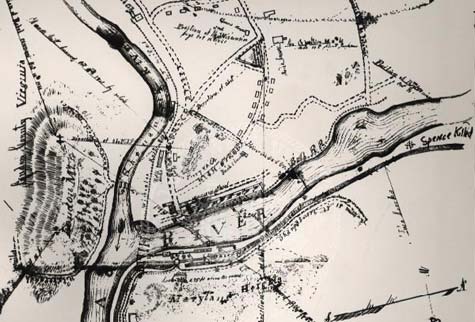
At left is a detail of
Russell's map of Bolivar
Heights. The digital image is twice the length. Resolution of this scan
is poor but it gives some idea of the detail Russell put into his map.
The
Shenandoah and Potomac Rivers are easily identifiable. The
spot
where Spencer fell is marked on the right. Peacher's or
Pritchard's Mill was just across the river on the Virginia side. Part
of Old Furnace road can be seen sweeping up towards Bolivar Heights.
The position of the Wisconsin troops during the
Battle of Bolivar Heights, is at the top center.
Loudon Mountain is depicted on
the left. Maryland Heights at the bottom center. An
extensive key has been cropped out of the image.
A third Russell map depicts
Company I's
position at Four Locks of the C
& O canal, a few miles up the Potomac, where Company I
skirmished with rebels on December 20th. I have only seen
a very poor photocopy of it.
Today,
(in part due to this website)
these maps are a valuable resource in the public
interpretation of historic events at Harper's Ferry during the fall of
1861.
Lauriman Russell was detailed,
February, 1863,
for 'side
service,' as
Assistant Engineer at the Convalescent Camp in Alexandria,
Va., while
he waited for a discharge from service
due to disability, which came on December 23, 1863. His two
brothers were killed in the war. John died from wounds
received at
Antietam, October, 1863, two months prior to Lauriman's discharge, and
Benjamin was killed July 1st at Gettysburg.
After the war Lauriman
settled in Winthrop, Mass,. and continued to work as an engineer.
*NOTE: There is an
editorial by
Obediah Albee on
the June, 1862 page of this website. His son, Eugene was in
Company
I.
Biographical information on
Russell, courtesy of Mr. Paul Brodeur, Trustee of the Marlboro
Historical Society.
Return
to
Top of Page
Virginia
Raids; A Confederate Citizen Complains

The Union expeditions across the Potomac
irked prominent Confederate
sympathizers who lived in Virginia along the border with
Maryland.
James L.
Ranson, Andrew Hunter, and Alexander Boteler lobbied
Confederate Secretary of War, J. P. Benjamin, to
appoint a high ranking officer to direct all military
operations along
the border. The Confederate Army soon appointed a very
capable officer to take command of Shenandoah Valley troops; Thomas
"Stonewall" Jackson, who arrived in Winchester the evening of November
4th. The following letter is from the
Official Records of the Union and Confederate Armies, Series I, Vol. 5.
Charlestown, October 5,
1861.
Hon.
J. P.
Benjamin,
Secretary
of War ad interim, &c,:
Dear
Sir : At the instance of a number of the good
citizens in this quarter of the State (my own judgment fully
concurring) I am induced to call your attention to the condition of
things here connected with the operations of the military, and I beg
leave to protest that I do so under a full sense of the diffidence and
delicacy which should govern a mere civilian in dealing with such
subjects. I know of no one connected with the military at
Winchester or on this border who is not my personal friend, and as to
whom certainly I have none other than the most kindly feelings, and yet
I deem it my duty to say broadly that the management of military
affairs in this quarter is in utterly incompetent hands.
Ever since General Johnston
marched his army from Winchester in July, most absurdly as it seems to
me and to hundreds of others here, large bodies of militia have been
assembled there and kept there, 30 miles from the border, where the
enemy are constantly not only committing depredations, but doing
everything in their power to debauch the minds of our people off from
their allegiance and loyalty to the South, and recently, at the very
time when the enemy are making their boldest inroads upon us,
plundering, insulting females, and keeping the whole border for miles
into the interior in a state of uneasiness and alarm, the militia from
this (Jefferson) county have been marched away to Winchester, and are
now held there under the miserable pretext of drilling them.
The feeling is becoming very
general among our people that while we have plenty of men ready and
willing to protect the border against these incursions of the enemy,
yet that we are suffering needlessly for want of competent officers.
Without, therefore, entering further into particulars, or
perferring complaints of incompetency or inefficiency against any
particular officer or officers, I beg leave to submit whether it be not
practicable and expedient to send here (that is, on this border of the
valley) some competent regular or experienced officer of the army to
take charge of and direct the whole military operations in this
quarter, or if this can't be done, and we must have the peace
establishment militia officers still in command, then that some
experienced and intelligent officer be sent here to inquire into the
condition of things, and report was is proper to be done.
My friend and collegue Hon. A.
R. Boteler I presume is now in
Richmond, and he will give you full and minute information about the
matters and things referred to in the foregoing.
Very truly, your
obedient
servant,
Andrew
Hunter.
Next
Page: "The Battle of Bolivar Heights"
Return
to Top of Page | Continue
Reading
|